Loening XSL-1 / XSL-2

XSL-1

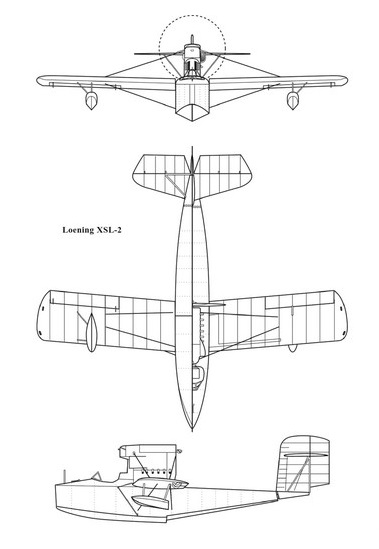
The Loening SL was the last type of airraft used in a series of Navy experiments, conducted intermittently from 1923 to 1933, to develop a small seaplane that could be deployed from a submarine. The aircraft had to be designed so that it could be easily dismantled and stowed in a watertight, eight foot diameter tube carried on the deck of the submarine. In 1930 BuAer decided to reinstate the idea with a small monoplane flying boat, and in June 1930, awarded Loening a contract to construct a single prototype as the XSL-1. The design emerged with a semi-cantilever monoplane wing which attached to the top of a single-step metal boat hull. The Warner engine, mounted on struts in a pusher configuration, featured a ring cowl and a small bullet-shaped nacelle. Stowage in the sub tube was accomplished by simply removing the wings and stabilising floats.

The prototype was delivered to NAS Anacostia for trials in February 1931. When testing revealed the XSL-1 to be underpowered with the Warner engine, it was returned to the factory for installation of a 160 hp Menasco B-6 and a more streamlined engine mount. The revised aircraft, re-designated XSL-2, resumed testing at Anacostia in early 1933 but these trials indicated only a nominal improvement in performance. Soon afterwards the Navy abandoned the entire program when the XSL-2 suffered serious damage during exercises with a submarine.

XSL-1
Engine: Warner Scarab, 110 hp
Prop: 2 blade fixed pitch metal
Wing span: 31 ft 0 in
Length: 27 ft 2 in
Wing area: 148 sq.ft
Empty weight: 1114 lb
Gross weight: 1512 lb
Max speed: 101 mh
Cruise: 88 mph
Ceiling: 13,000 ft
Loening OA-1A

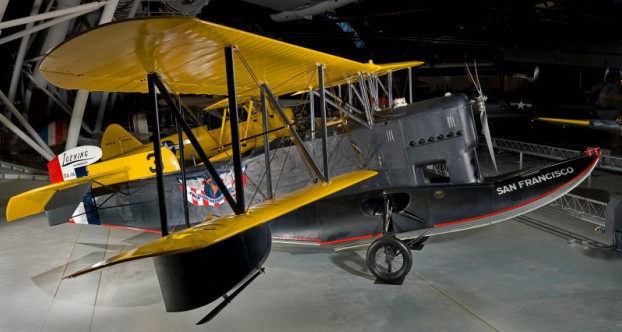
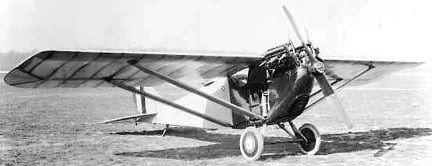
The hull is constructed of duralumin over a wooden frame, and the fuselage was built on top of the hull. The OA-lA is powered by a 420-horsepower, water-cooled Liberty V-12 engine that is mounted inverted.

The historic Pan-American Goodwill Flight of 1926 and 1927 through Mexico and Central and South America was intended to improve relations with Latin American countries, to encourage commercial aviation, and to provide valuable training for Air Corps personnel. The flight was made by ten pilots in five Loening OA-1A amphibian aircraft. To stimulate public interest, each airplane was named after a major U.S. city-the New York, the San Antonio, the San Francisco, the Detroit, and the St. Louis.

The 35,200 km (22,000 mi) flight began on December 21, 1926, from San Antonio, Texas. The journey took 59 flying days, interspersed with 74 days for scheduled maintenance and diplomatic meetings and ceremonies. The flight concluded at Bolling Field in Washington, D.C., on May 2, 1927. Within three weeks, however, the impressive achievement was eclipsed by Lindbergh’s solo trans-Atlantic flight in the Spirit of St. Louis.

Loening OA-1A San Francisco
Engine: Liberty V-12, 313 kw (420 horsepower)
Wingspan: 13.9 m (45 ft 7 in)
Length: 10.7 m (35 ft 1 in)
Height: 3.5 m (11 ft 6 in)

Loening Aeronautical Engineering Company

Grover C. Loening built a monoplane flying-boat in 1911. Formed company in 1918, and built his first Air Yacht (based on prewar design). A two-seat monoplane fighter with very advanced features was ordered by the Government, but contract for 2,000 canceled at war’s end. Produced very popular line of single-float, biplane flying-boats based on Air Yacht for civil and naval use.
In 1920, Grumman joined the Loenings as test pilot for their famous Air Yacht amphibians, and over the next several years, he took over full responsibility for the company’s aircraft design.
The Loenings sold out their company in 1929 and backed Grumman in a venture of his own.
Merged with Keystone Aircraft Corporation in 1928. Built monoplane and biplane pursuits for the Army. After takeover by Keystone, Loening set up the Grover-Loening Aircraft Company at Garden City, New York, as consultant, and built small amphibian flying-boat XS2L for U.S. Navy in 1931. Delivered XSL-2 experimental submarine-borne version in 1933.

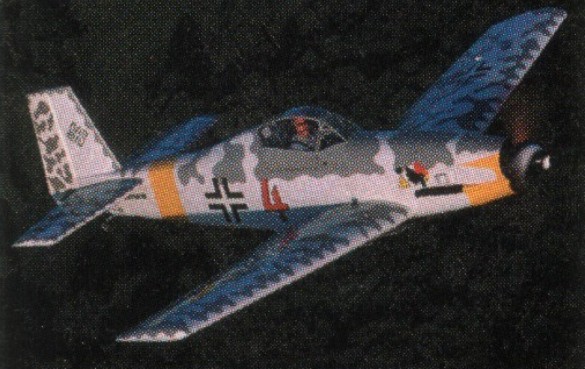
Loehle KW-909

A LSA aircraft, the KW-909 can be flown by a Sport Pilot.

Cruise: 85 mph
Stall: 30 mph
Range: 370 sm
Rate of climb: 1200 fpm
Takeoff dist: 150 ft
Landing dist: 250 ft
Engine: Rotax 582, 65 hp
Fuel capacity: 13 USG
Empty weight: 575 lb
Gross weight: 900 lb
Length: 22.9 ft
Wing span: 27.4 ft
Wing area: 130 sq.ft
Cockpit width: 22.5 in
Seats: 1
Landing gear: Retractable/tailwheel

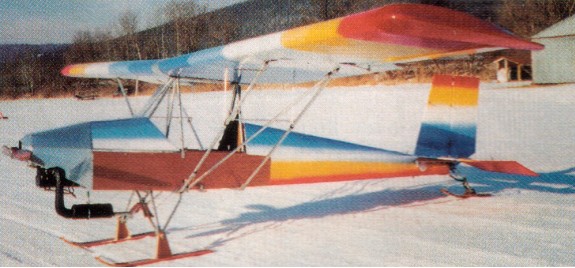
Loehle Sport Parasol

A wood and fabric, tailwheel monoplane that conforms with the FAA 51% rule and qualifies as an LSA.

Speed max: 85 mph.
Cruise: 65 mph.
Range: 200 sm.
Stall: 22 mph.
ROC: 750 fpm.
Take-off dist: 100 ft.
Landing dist: 150 ft.
Service ceiling: 12,500 ft.
Engine: Rotax 503, 50 hp.
HP range: 28-50.
Fuel cap: 5 USG.
Weight empty: 252 lbs.
Gross: 600 lbs.
Height: 6 ft.
Length: 18.4 ft.
Wing span: 25.5 ft.
Wing area: 114 sq.ft.
Cockpit width: 19.5 in
Seats: 1.
Landing gear: tail wheel.

Engine: Rotax 503, 40 hp
Wing span: 8.3 m
Wing area: 11.5 sq.m
MAUW: 300 kg
Empty weight: 180 kg
Fuel capacity: 25 lt
Max speed: 150 kph
Cruise speed: 120 kph
Minimum speed: 55 kph
Climb rate: 4.2 m/s
Certification: Vz
Seats: 1
Fuel consumption: 8 lt/hr
Kit price (1998): $3495