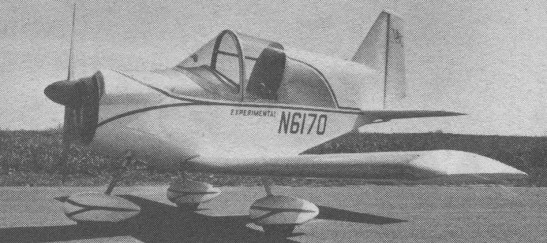
The Mini-Hawk combines the economy of the Volkwagen engine with that of detachable wings for towing or storage. Standard VW engines up to 67 hp can be used. The wings can be removed in under 10 minutes. Its all-metal construction is built around a configuration which includes low wings with trailing-edge flaps and seating for one under an enclosed canopy. The tricycle landing gear includes a steerable nosewheel, disc brakes and wheel fairings all around.
Gross Wt. 800 lb Empty Wt. 525 lb Fuel capacity 12 USG Wingspan 18 ft Length 13 ft 3 in Engine 72-hp Revmaster Volkswagen Top speed 175 mph Cruise 160 mph Stall 50 mph Climb rate 1000 fpm Ceiling 10,000 ft Takeoff run 400 ft Landing roIl 400 ft Range 700 nm
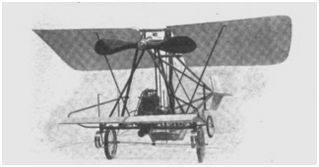
This little monoplane was exhibited at Stanley Cycle Show at the Agricultural Hall, Islington, UK, in November 1909. It was recognizable by the short wings, the high-mounted chain-driven propeller, the Demoiselle-like tail and the front-mounted elevator. “Flight” referred to it as a model, which looks likely when you see its diminutive size.
This Edward Mines curiosity was entered in the Doncaster (UK) Flying Meet, and made its debut there on the fifth day of the event (Wednesday, October 20, 1909). It attracted some media attention, unfortunately most of it negative. Promptly nicknamed the “coffee-stall”, its planes had a span of only fourteen feet and a chord of six feet. There was no tail, and the ruddering was by means of square ‘flaps’ fitted between the wings. This machine had an elevator in front of the top plane, and the bottom plane’s extremities were adjustable. Needless to say, it never flew. A photo exists of the Mines biplane in an earlier version, without the flaps between the wings.
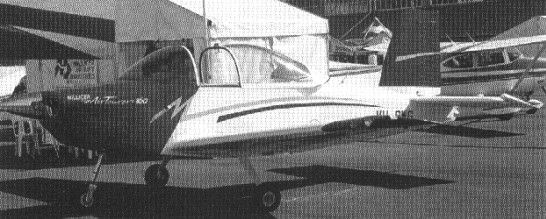
Originally introduced in the 1990s, Jim Millett’s Hornet returned in 2004 with a new team. One of the features is a large rubber donut shock-absorber that is centrally located in the fuselage to bear the load from the main gear.
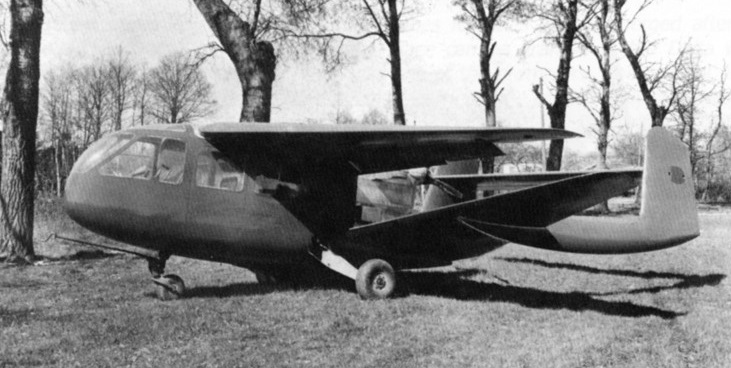
France Formed by Mm. Millet and Lagarde to exploit Lagarde ‘s ML-10 twin-boom, heavily-staggered biplane four-seater, powered by 180 hp Regnier engine and first flown 1949.
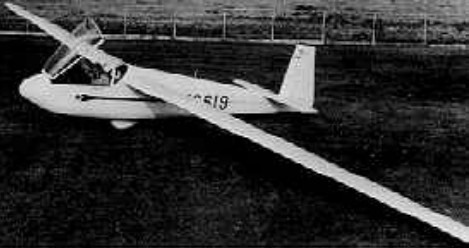
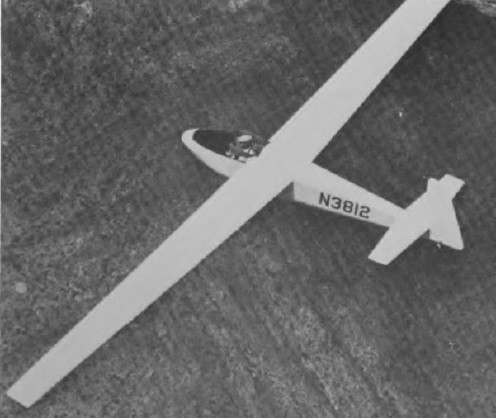
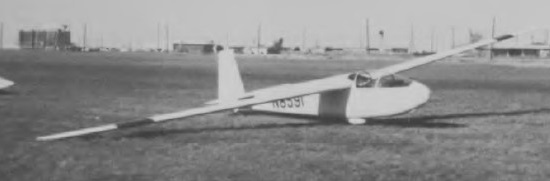
The Tern high perfomance single-seater was designed by Mr W. Terry Miller of Furlong, Pennsylvania, for amateur construction and the prototype, which was built in a total of 1,180 working hours, made its first flight in September 1965.
An improved version, known as the Tern II, made its first flight in August 1968; this featured a wing span increased by 4 ft 6 in to 55 ft 6 in, increasing the aspect ratio from 20 to 22, and giving an improved best glide ratio and minimum sinking speed. During 1968 brake parachutes were fitted to the prototype Tern, and two types of these were later made available for installation in both versions of the Tern in the base of the rudder, namely a 6 ft diameter cross parachute or a 5 ft diameter guide surface parachute.
By May 1970 nearly 100 Terns and 12 Tern IIs were under construction not only in the USA, but by amateurs in Africa, Australia, South America and Canada.
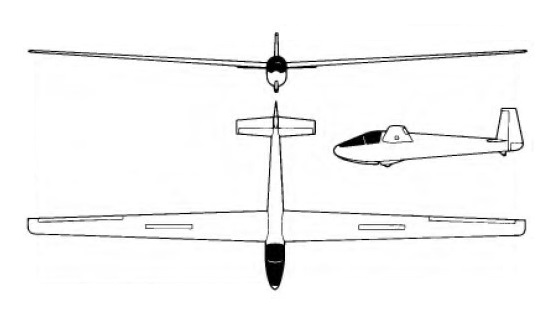
Of conventional all-wood construction, the Tern has unswept cantilever shoulder wings which are two piece two-spar spruce structures, entirely plywood covered. There are no flaps and the plain ailerons are also all wood; there are wooden spoilers in the wing lower surface used for approach and glide slope control. The semi-monocoque wooden fuselage has a plastic-reinforced glassfibre nose and plywood skinning aft of the cockpit. The cantilever all-wood tail unit has modified NACA laminar flow sections and special hinge-line contours to reduce drag and increase control effectiveness at large angles of deflection; there are no elevator or rudder tabs. Landing gear consists of a non-retractable monowheel forward of the eg housed in a streamlined pod, and skids under the nose and tail; there is a brake lever for applying pressure directly to the tyre. The pilot sits in a semi-reclining seat under a three piece canopy, the centre portion of which hinges sideways for entrance and exit, and radio can be fitted.
One Tern belongs to the National Soaring Museum.
Miller Tern 2
Tern Wing span: 15.54 m / 51 ft Wing area: 12.08 sq.m / 130 sq.ft Empty Weight: 215 kg / 475 lb Payload: 102 kg / 225 lb Gross Weight: 317 kg / 700 lb Wing Load: 26.24 kg/sq.m / 5.4 lb/sq.ft L/DMax: 34 93 kph / 50 kt / 58 mph MinSink: 0.64 m/s / 2.1 fps / 1.24 kt Aspect ratio: 20 Airfoil: Wortmann 61 Series Seats: 1
Tern II Span: 15.56 m / 55 ft 6 in Length: 6.49 m / 21 ft 3.5 in Height: 1.52 m / 5 ft 0 in Wing area 13.01 sq.m / 140 sq ft Aspect ratio: 22.0 Wing section: Wortmann 61 Series Empty weight: 249 kg / 550 lb Max weight: 363 kg / 800 1b Water ballast: None Max speed: 120 mph / 104 kt / 193 km/h (smooth air) Stalling speed: 34.5 kt / 64 km/h Max aero-tow speed: 88 mph Max rough air speed: 76.5 kt / 142 km/h Min sinking speed: 1.95 ft/sec / 0.59 m/sec at 48 mph / 41.5 kt / 77 km/h Best glide ratio: 38:1 at 60 mph / 52 kt / 97 km/h
The “Lil’ Rascal” by Merle B. Miller began flight testing in early 1978. This biplane makes use of a steel-tube fuselage and tail section covered with Stits Poly-Fibre Dacron. The wings are constructed of spruce and plywood and are covered with same fabric. The landing gear is the nonretractable tailwheel type, and seating is for two persons in a side-by-side open cockpit. The standard 85-hp engine turns a fixed-pitch prop.
Gross Wt. 1100 lb Empty Wt. 600 lb Fuel capacity 12 USG Wingspan 20 ft 8 in Length 15 ft 3 in Engine 85-hp Continental Top speed est: 110 mph Cruise est: 90 mph Stall est: 58 mph