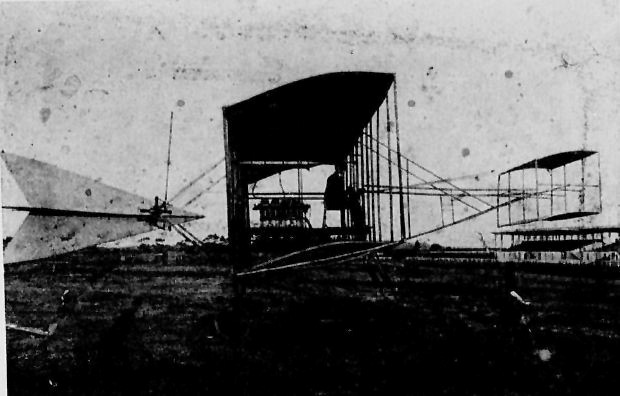
The Moy Aerial Steamer was an experimental 15-foot span tandem-wing monoplane, powered by a 3 hp steam engine driving two, 6-foot diameter pusher- propelling paddle wheels. Built by Englishman Thomas Moy, the unmanned flying machine was tested in the Spring of 1875, tethered to a pole, running on a circular track, at the gardens of the Hotel DeLuxe in south London. Spuriously reported to have left the ground and “flown” at a height of six inches, the Aerial Steamer may sometimes be claimed to be the first unmanned airplane to fly from level ground.
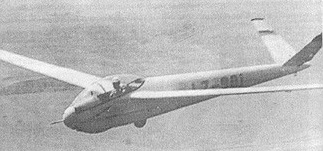
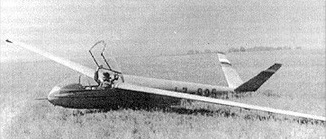
The second postwar Bulgarian sailplane designed by Eng L. Panov and D. Panchovsky, the Kometa-Standard (or Comet Standard) fully aerobatic Standard Class single-seater flew for the first time in prototype form on 5 August 1960; the type later went into small-scale production for the Bulgarian gliding clubs.
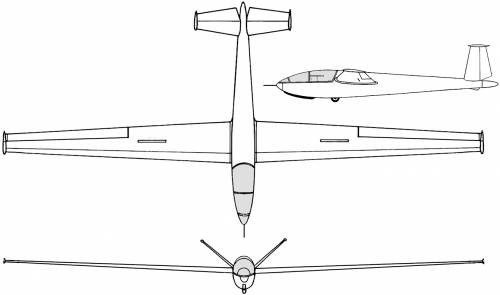
The Kometa-Standard is a cantilever midwing monoplane of conventional wooden construction with a butterfly-type V-tail with an included angle between the tailplanes of 110°. The wings, straight tapered in plan and set at mid-wing position, are single-spar wooden structures with a leading edge plywood torsion box and wing tip ‘salmon’-type fairings; the slotted ailerons are fabric-covered and there are spoilers on the wing upper and lower surfaces. They had 4° of dihedral. The Kometa-Standard had mass-balanced, slotted ailerons and spoilers at 60% chord which opened above and below the wing.
The plywood monocoque fuselage has a metal nose-cap and the landing gear consists of a non-retractable wheel with brake and a rubber mounted skid under the forward fuselage. The tail unit is of wooden construction with plywood and fabric covering, and the pilot is seated under a hinged Perspex canopy, proud of the rear fuselage line, but this was lowered and reshaped on the production Kometa-Standard II, merging into the rear fuselage from which it was hinged.
Kometa – Standard II
The cockpit was changed again in the Kometa-Standard III which had a sliding canopy over a reclining seat, making this variant 30 km/h (19 mph) faster than the Kometa-Standard II. Overall, the fuselage tapered uniformly from the cockpit to the tail. The Kometa-Standard had a 110° butterfly tail, its plywood and fabric covered surfaces terminating, like the wings, in little salmon fairings. Its undercarriage was a fixed monowheel, fitted with a brake and assisted by a forward, rubber sprung skid.
The prototype was flown for the first time on 5 August 1960 and an initial batch of 10 Kometa-Standard IIs was built, followed by two batches, each of 10, of Kometa-Standard IIIs. Flown by Bulgarian clubs, they were fully aerobatic, though not cleared for cloud flying.
Kometa-Standard II Production variant with lowered, rear hinged canopy. 10 built.
Kometa-Standard III Further revision to nose/canopy lines with reclining seat and sliding canopy. 20 built.
Specifications:
Kometa-Standard Year: 1960 Span: 49 ft 0.5 in / 14.95 m Length: 22 ft 9.5 in / 6.95 m Wing area: 136.7 sq.ft / 12.90 sq. m Aspect ratio: 17.6 Empty weight: 573 lb / 240 kg Max weight: 750 lb / 340 kg Max speed: 130 mph (in smooth air) Max aero-tow speed: 93 mph Min sinking speed: 2.69 ft/sec at 48.5 mph Best glide ratio: 28:1 at 51 mph
Kometa-Standard II Length: 6.95 m (22 ft 10 in) Wingspan: 14.95 m (49 ft 1 in) Wing area: 12.70 m2 (136.7 sq ft) Aspect ratio: 17.6 Airfoil: NACA 43012A Empty weight: 240 kg (529 lb) Gross weight: 340 kg (750 lb) Never exceed speed: 210 km/h (130 mph; 113 kn) Rough air speed max: 150 km/h (93.2 mph; 81.0 kn) Aerotow speed: 150 km/h (93.2 mph; 81.0 kn) Winch launch speed: 100 km/h (62.1 mph; 54.0 kn) Terminal velocity: with full airbrakes 220 km/h (137 mph; 119 kn) g limits: +6.25 -3.3 at 220 km/h (136.7 mph; 118.8 kn) Maximum glide ratio: 28:1 at 82 km/h (51.0 mph; 44.3 kn) Rate of sink: 0.78 m/s (154 ft/min) at 78 km/h (48.5 mph; 42.1 kn) Wing loading: 26.70 kg/m2 (5.47 lb/sq ft) Crew: One
The Jastreb (or Hawk) two-seater fully aerobatic trainer was, with the Kometa-Standard single seater, one of the two indigenous Bulgarian designs that went into production in that country after the war.
The Jastreb was designed by Eng L.Panov and D. Panchovsky, the prototype making its first fight on 6 February 1948; the type was put into small-scale production for the Bulgarian clubs.
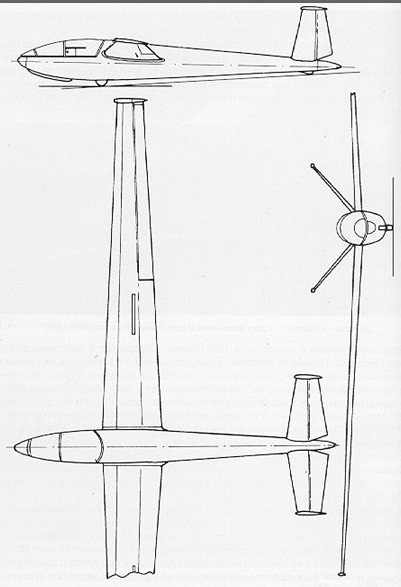
Of conventional wood and fabric construction, the Jastreb is a braced high wing monoplane with the centre section swept forward 5° at the quarter-chord line to improve the view from the rear seat, the absence of sweep on the outer panels enabling the spar to be uncranked. The wing is a single-spar wooden structure with leading edge plywood torsion box and is 30% fabric-covered; the wooden ailerons are plywood and fabric covered and there are spoilers in the wing upper and lower surfaces. The plywood-covered wooden fuselage has a metal nose-cap and the two pilots are seated in tandem under a sideways-opening Perspex canopy. The cantilever wooden tail unit is covered with plywood and fabric, and the landing gear consists of a fixed unsprung monowheel with no brake and a rubber mounted skid under the forward fuselage.
Span: 49 ft 2.5 in Length: 26 ft 3 in Wing area: 209.9 sq ft Aspect ratio: 11.55 Empty weight: 529 lb Max weight: 850 lb Max speed: 124 mph (in smooth air) Max aero-tow speed: 75 mph Min sinking speed: 2.95 ft/sec at 37 mph Best glide ratio: 20.5:1 mph
In October of 1910 at the Boufarik Racecourse, Algeria, Leon Mouraret flew his biplane for a distance of 200 meters on his first attempt. On his second attempted at flight the aircraft crashed and was damaged. Boufarik’s flying machine was distinguished by its unusual arrowhead-like tail and by the very high setting of the pilot and frame above the ground. The biplane was powered by a French 60 hp Mutel engine. Mouraret’s biplane was called a “Hydro-aeroplane” and could be fitted with two long floats.
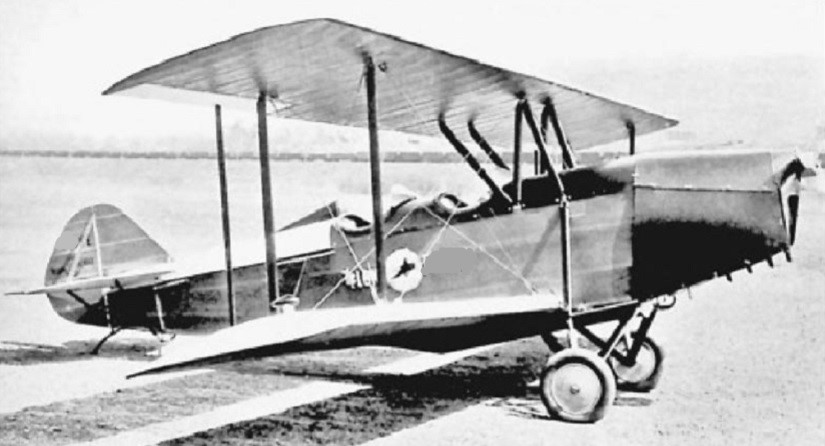
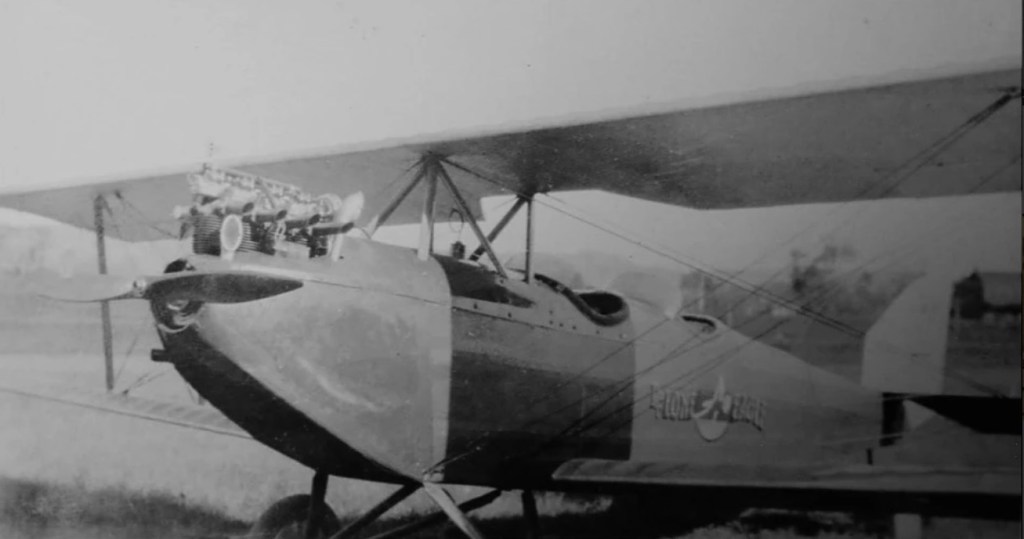
Part of Lindbergh’s 1927 visit to Moundsville included inspecting the Moundsville Airplaine Corporation’s first product– a single-seat bi-plane christened by Jimmy Doolittle as The Lone Eagle, in honor of Charles Lindbergh. Despite Lindbergh’s endorsement, there were not many “Lone Eagles” produced, and the factory went out of business in 1929.
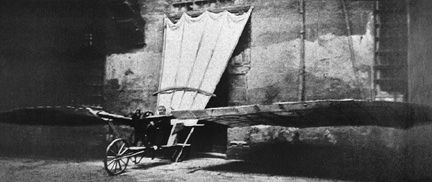
In 1881, Louis Mouillard wrote L’Empire de l’Air (Empire of the Air), in which he proposed fixed-wing gliders with cambered bird-like wings. He had been experimenting with gliders since 1856, and although his own gliders were unsuccessful, he realized the importance of gliding to the future of aviation – a perspective that was later shared by Otto Lilienthal. Photographed in Cairo, Egypt.
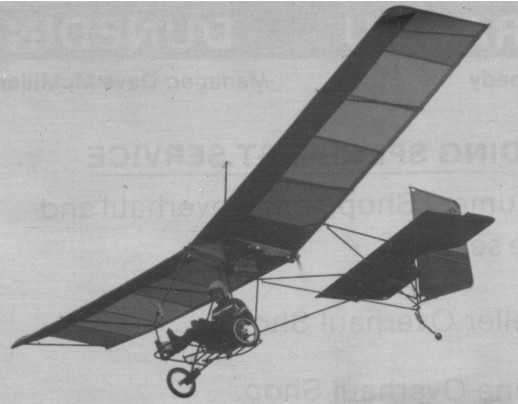
The Teratorn was a single seat single engined high wing monoplane with hybrid control. Wing has unswept leading and trailing edges, and constant chord; cruciform tail. Pitch control by weightshift; yaw control by fully flying rudder; roll control by one third span spollerons; control inputs through weight shift for pitch/yaw/roll. Wing braced from above by kingpost and cables, from below by cables; wing profile; 33% double surface. Undercarriage has three wheels in tail dragger formation; suspension on tailwheel and bungee suspension on main wheels. No ground steering. No brakes. Aluminium tube framework, without pod. Engine mounted above wing driving pusher propeller. Leading edges stiffened with Mylar.
The Teratorn which we are concerned with is itself a venerable design, having appeared at the birth of microlight aviation around the same time as the first powered version of the famous Quicksilver, with which it has a certain similarity. The Teratorn was powered, up till 1982, by the single cylinder Yamaha KT100S giving 15 hp through a reduction drive of 5/1, with initially the option and later the standard replacement by a twin cylinder Rotax of 28 hp with a 2.5/1 reduction drive.
On an original note, the company chose black anodising for the tubes on this hybrid control machine and the wires too were covered in black vinyl. The Teratorn is delivered as a kit requiring 20 to 25 h assembly according to the maker, and costs $3895 with the Rotax motor in 1983. Options include an instrument panel, skis, Kevlar floats and the choice of the Yamaha KT100S, which drops the price by $400. The machine is trailer transportable or on a roof rack and folds to around 16 x 5 x 1 ft (4.9 x 1.5 x 0.3 m). A kit allowing the Teratorn to be converted to the Teratorn TA with three axis control is also available.
The Teratorn TA was a single seat single engined high wing mono¬plane with conventional three axis control. Wing has unswept leading and trailing edges, and constant chord; cruciform tall. Pitch control by elevator on tail; yaw control by fully flying rudder; roll control by one third span spoilerons; control inputs through stick for pitch/roll and pedals for yaw. Wing braced from above by kingpost and cables, from below by cables; wing profile; 33% double surface. Undercarriage has three wheels in tail dragger formation; steel spring suspension on tailwheel and bungee suspension on main wheels. No ground steering. No brakes. Aluminium tube framework, without pod. Engine mounted below wing driving pusher propeller.
This is the three axis version of the hybrid control Teratorn. The TA appeared in 1982 with the Yamaha KT100S 15 hp engine, though today that has become just an option, the machine being fitted in standard form with the Rotax 300 of 28 hp or the Rotax 377 with 34 hp. Rigging time for the earlier model is 25 min, while this model requires 25 min to rig with two people. The Teratorn TA is sold so that it requires only 20h to complete, according to the maker, and for a price of $4295 with Rotax 300 or $4595 with Rotax 377. The options include the Yamaha engine for a reduction of $300, floats of Kevlar, skis and instrument panel. Production was phased out in favour of the more advanced Tierra.
Teratorn Engine: Rotax 300, 28hp at 6200rpm Propeller diameter and pitch 60 x 24 inch, 1.52 x 0.61 m Reduction ratio 2.5/1 Power per unit area 0.18 hp/sq.ft, 1.9 hp/sq.m Fuel capacity 3.3 US gal, 2.8 Imp gal, 12.5 litre Length overall 18.0 ft, 5.49 m Height overall 9.0 ft, 2.74m Wing span 32.0ft, 9.75m Constant chord 5.0 ft, 1.52 m Sweepback 0 deg Total wing area 160 sq.ft, 14.9 sq.m Wing aspect ratio 6.4/1 Tailwheel diameter overall 3 inch, 7 cm Main wheels diameter overall 16 inch, 41 cm Empty weight 212 lb, 96 kg Max take off weight 474 lb, 215kg Payload 262 lb, 119kg Max wing loading 2.96 lb/sq.ft, 14.4 kg/sq.m Max power loading 16.9 lb/hp, 7.7kg/hp Load factors; +3.0, 3.0 ultimate Max level speed 50 mph, 80 kph Never exceed speed 55 mph, 88 kph Economic cruising speed 35 mph, 56 kph Stalling speed 15 mph, 24 kph Max climb rate at sea level 600 ft/min, 3.1 m/s Min sink rate 250 ft/min at 25 mph, 1.3 m/s at 40 kph Best glide ratio with power off 8/1 at 25 mph, 40 kph Take off distance 50 ft, 15 m Landing distance 75 ft, 23 m Service ceiling 10,000 ft, 3050 m Range at average cruising speed 70 mile, 113 km
Teratorn TA Engine: Rotax 300, 28 hp at 6200 rpm Propeller diameter and pitch 60×24 inch, 1.52×0.61m Reduction ratio 2.5/1 Power per unit area 0.18hp/sq.ft, 1.9 hp/sq.m Fuel capacity 3.3 US gal, 2.8 Imp gal, 12.5 litre Length overall 18.0 ft, 5.49 m Height overall 9.0ft, 2.74m Wing span 32.0ft, 9.75m Constant chord 5.0 ft, 1.52 m Sweepback 0 deg Total wing area 160 sq.ft, 14.9 sq.m Wing aspect ratio 6.4/1 Tailwheel diameter overall 3 inch, 7 cm Main wheels diameter overall 16 inch, 41 cm Empty weight 227 lb, 103kg Max take-off weight 489 lb, 222kg Payload 262 lb, 119 kg Max wing loading 3.06 lb/sq.ft, 14.9kg/sq.m Max power loading 17.5 lb/hp, 7.9 kg/hp Load factors; +4.0, 3.0 ultimate Max level speed 50 mph, 80 kph Never exceed speed 55 mph, 88 kph Max cruising speed 45 mph, 72 kph Economic cruising speed 35 mph, 56 kph Stalling speed 17 mph, 27 kph Max climb rate at sea level 600 ft/min, 3.1 m/s Min sink rate 270 ft/min at 28 mph, 45 m/s at 45 kph Best glide ratio with power off 8/1 at 28mph, 45kph Take off distance 50ft, 15m Landing distance 75ft, 23m Service ceiling 10,000ft, 3050 m Range at average cruising speed 70 mile, 113km
Engine: Rotax 377, 34 hp at 6400 rpm Propeller diameter and pitch 60×36 inch, 1.52×0.91m Toothed belt reduction, ratio 2.6/1 Max static thrust 240 lb, 109kg Power per unit area 0.21hp/sq.ft, 2.3 hp/sq.m Fuel capacity 4.4 US gal, 3.7 Imp gal, 16.7 litre Length overall 18.0 ft, 5.49 m Height overall 9.0ft, 2.74m Wing span 32.0ft, 9.75m Constant chord 5.0 ft, 1.52 m Sweepback 0 deg Total wing area 160 sq.ft, 14.9 sq.m Wing aspect ratio 6.4/1 Tailwheel diameter overall 3 inch, 7 cm Main wheels diameter overall 16 inch, 41 cm Empty weight 237 lb, 108kg Max take-off weight 499 lb, 226kg Payload 262 lb, 119 kg Max wing loading 3.12 lb/sq.ft, 15.2kg/sq.m Max power loading 14.7 lb/hp, 6.6 kg/hp Load factors; +4.0, 3.0 ultimate Max level speed 55 mph, 88 kph Never exceed speed 63 mph, 101 kph Stalling speed 23 mph, 37 kph Max climb rate at sea level 900 ft/min, 4.6 m/s
The Motor Gliders Inc OHS-III was built in 1929. A two-place cabin high wing monoplane powered by a 55hp Velie M-5, also Warner Scarab, it is very likely this is the Cabin-Aire monoplane that the company exhibited in Chicago in 1928.
Registered NX7950, the “OHS” designation was for company treasurer O H Snyder.
Designed by Bud Snyder, the Buzzard Light Plane, or MG-1, of 1930 was a two-place, open, high-wing monoplane. Essentially a motorized glider with a pylon-mounted parasol wing and a pusher motor. It was fabric covered except for a dural-covered plywood fuselage bottom.
Purchased by Curtiss-Wright and is assumed to be the basis for, or at least a major influence on, the 1931 Curtiss-Wright CW-1 Junior.
The design was revived in 1983 as the kit-form, Zenoah-powered Ritz Standard A by Gerry Ritz, Wartrace TN.