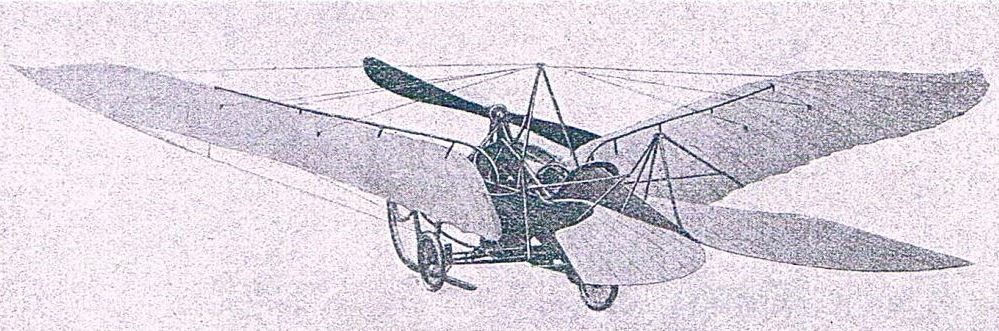
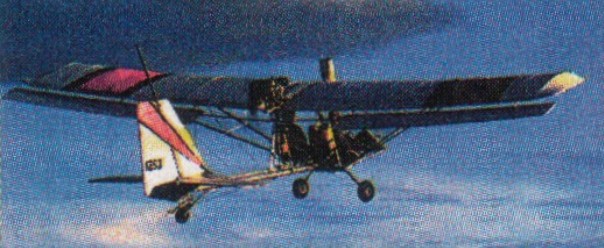
“Sport Eindecker ohne Seitensteuer” (sport monoplane without vertical tail plane), built by Bernard Mrozinski (of Polish birth), Berlin-Wilmersdorf. It flew in 1912.
Engine: 20 h.p. Anzani. Length 7 m Span 10 m Wing area 20 sq.m Weight 300 kg
Produced by the former J,Meaz works (Chocen plant) the M-3 Bonzo was designed by J. Mraz.
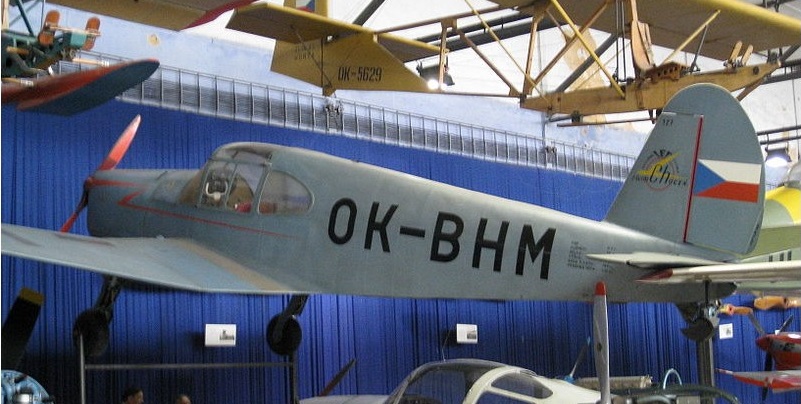
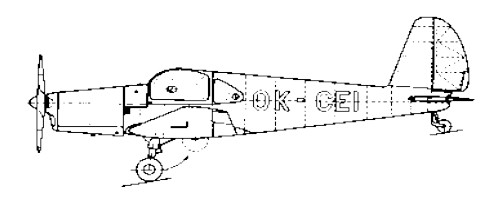
The M-3 Bonzo is a four-seat produced in prototype form only. Of all-wood construction, it is powered by a 160 hp Walter Minor 6-III engine. A retractable nosewheel undercarriage is fitted.
Engine: 160 hp Walter Minor 6-III Wingspan: 34 ft 9 in Wing area: 148.5 sq.ft Length: 25 ft 4 in Height: 7 ft 4.5 in Empty weight: 1278 lb Loaded weight: 2424 lb Max speed: 165 mph Cruise: 150 mph ROC: 708 fpm Ceiling: 16,400 ft Range: 620 mi
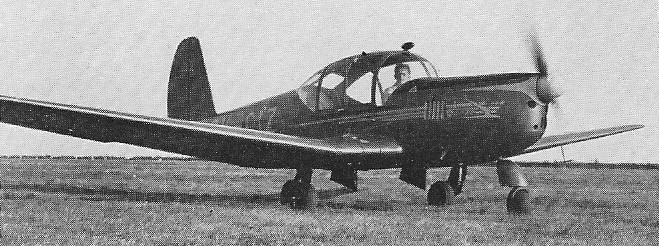
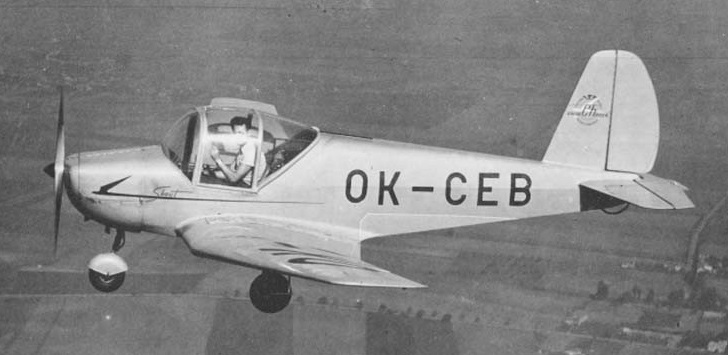
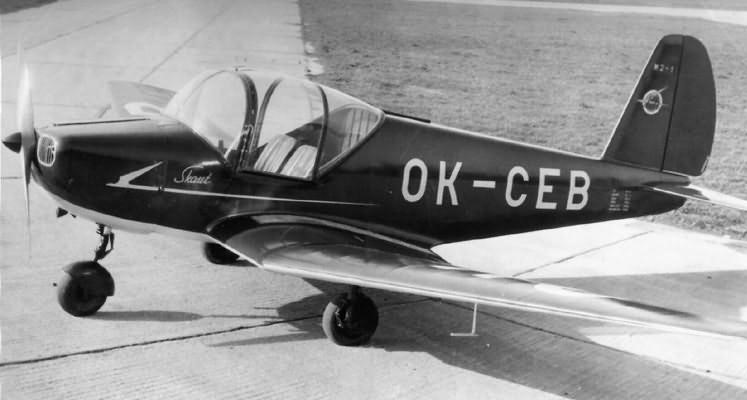
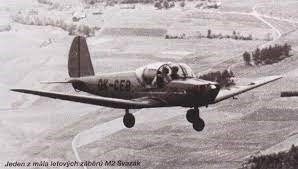
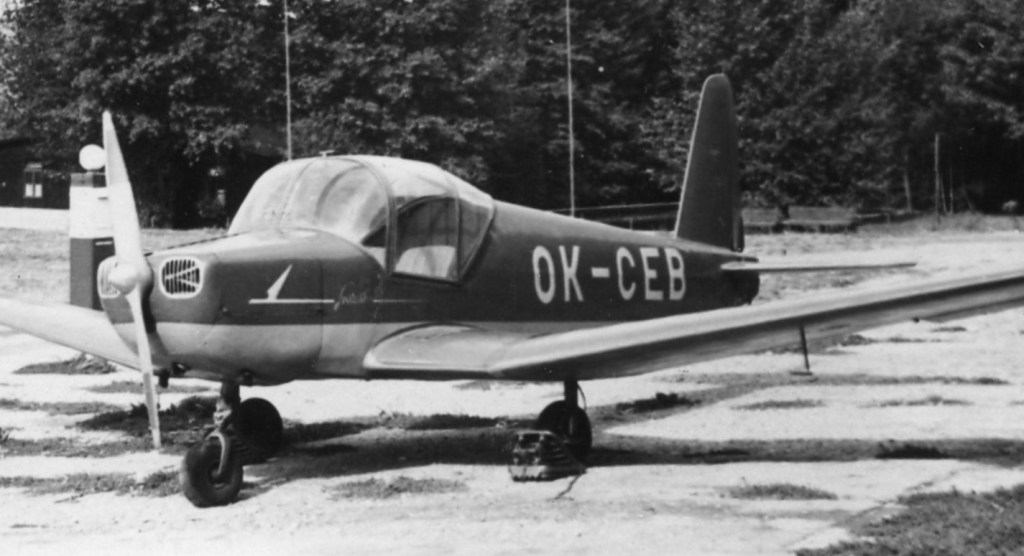
The Czechoslovak aircraft factory Mráz introduced several new sport aircraft after World War II. One of them was the M-2 Skaut, designed by Zdeněk Rublič. His aim was to design an easily flyable and reliable aircraft for basic club pilot training, with moderate operating costs and requiring little maintenance.
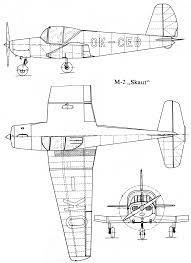
The Mráz M-2 Skaut was a wooden two-seat, single engine, low wing aircraft.
To simplify production, the wing and tail from his earlier, successful M-1C Sokol design was used. Like the Sokol, the Skaut was a wood framed, fabric covered aircraft. Their shared straight tapered wing had a swept leading edge but no sweep on the trailing edge They had marked dihedral beyond a very short centre section. The fin also had a swept leading edge and carried a rounded rudder. The tailplane was set well to the rear and near the top of the fuselage with a single piece elevator; the rudder moved above it. The Skaut had fixed tricycle landing gear.
The prototype, first flown in mid-1948, showed that the Skaut was a stable and safe aircraft, pleasantly controllable and with a good field of view. These characteristics together with a side-by-side cockpit and a tricycle landing gear made it a promising civil trainer aircraft. However, the new communist government nationalised the Mráz factory and directed it to produce military aircraft, so only the prototype Skaut was completed in the 20th century.
The only wooden prototype Skaut, OK-CEB Svazák, served at several flying clubs, mostly in Vrchlabí, and became very popular. There are rumours that it was flown solo by glider pilots without any previous experience of powered aircraft. In the early 1960s it was damaged during an emergency landing after an engine failure and was scrapped.
In 2005 the design was revisited, resulting in the metal framed, modernised Kubicek M-2 Scout which first flew in 2009 with plans for production and first deliveries in 2011.
Variation: Kubicek M-2 Scout
Powerplant: 1 × Praga D, 56 kW (75 hp) Propeller: 2-bladed fixed pitch Wingspan: 10 m (32 ft 10 in) Wing area: 13.8 m2 (149 sq ft) Length: 6.75 m (22 ft 2 in) Height: 1.9 m (6 ft 3 in) Empty weight: 370 kg (816 lb) Gross weight: 660 kg (1,455 lb) Fuel capacity: 70 L (18 US gal; 15 imp gal) Maximum speed: 185 km/h (115 mph, 100 kn) Cruise speed: 150 km/h (93 mph, 81 kn) Range: 700 km (430 mi, 380 nmi) Service ceiling: 4,200 m (13,800 ft) Rate of climb: 2.7 m/s (530 ft/min) Crew: 2
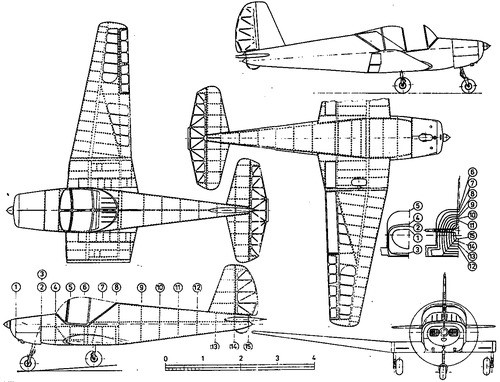
The Mráz M.1 Sokol (English: “Falcon”) was a light aircraft built in Czechoslovakia in the years following the end of the Second World War. Designed in secret by Zdeněk Rublič at the Beneš-Mráz factory during the German occupation.
The Sokol was a conventional, low-wing monoplane that took the pre-war Beneš-Mráz Bibi as its starting point. Two seats were provided side-by-side in an enclosed cabin, and the main units of the tailwheel undercarriage were retractable. Construction throughout was of wood.
M.1/1 prototype
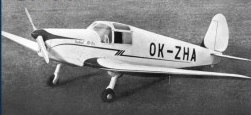
The prototype, then designated the M.1/1 and registered as OK-ZHA, first flew on 9 March 1946, following test flights the prototype was designated the M.1A as the two-seat-version. A re-engined two-seater was built designated the M.1B with a ZLAS Toma 4 engine, it first flew on 19 May 1946 but only one was built. The design was then modified as the M.1C with a third-seat in the rear and first flying on 16 February 1947. The M.1C became the main production variant and 183 aircraft were built.
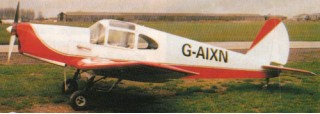
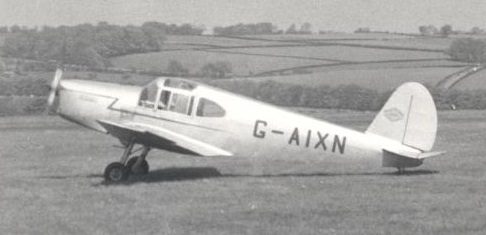
M1C Sokol G-AIXN at Leeds (Yeadon) in 1954, and was still airworthy in 2019
In 1948 the M.1C was further developed as the M.1D with an enlarged single-piece canopy and a revised rudder. The M.1D first flew on 4 October 1948 and 104 were built. One M.1D was fitted with locally produced floats and re-designated the M.1E, it first flew in September 1949. A minor variant was the Para-Sokol which was fitted with rearward sliding canopy to allow parachutists to leave the aircraft.
Some were operated by the Czechoslovakian National Security Guard and Egyptian Air Force.
Around 284 aircraft were built but the wooden-glued airframes were condemned in the early 1960s and withdrawn from use, under 20 were still in existence in the 2010s but only a few were flyable.
G-AIXN landing at its home base of Turweston Aerodrome in the United Kingdom in 2017
Some are on display at Museums in the Czech Republic, Hungary, Beijing, China, and Datangshan, China.
M-1A Original two-seat version Engine: Walter Minor
M-1B Similar to M-1A Engine: ZLAS Toma 1 built
M-1C Revised version, with longer fuselage and third seat, and swept leading edges on wing 183 built
M-1D Similar to M-1C with new, single-piece canopy and larger rear windows Engine: 1 × Walter Minor 4-III, 78 kW (105 hp) Wingspan: 10.0 m (32 ft 10 in) Length: 7.35 m (24 ft 1 in) Wing area: 13.8 m2 (149 sq ft) Height: 2.20 m (7 ft 3 in) (tail up) Empty weight: 425 kg (937 lb) Gross weight: 780 kg (1,720 lb) Maximum speed: 240 km/h (150 mph, 130 kn) Cruise speed: 212 km/h (132 mph, 114 kn) Range: 1,000 km (620 mi, 540 nmi) Service ceiling: 4,800 m (15,700 ft) Rate of climb: 3.0 m/s (590 ft/min) Crew: 1 Capacity: 2 passengers 104 built
M-1E Similar to M-1D but equipped with pontoons at least 1 built
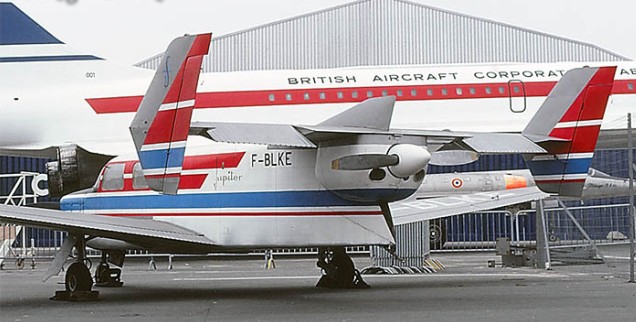
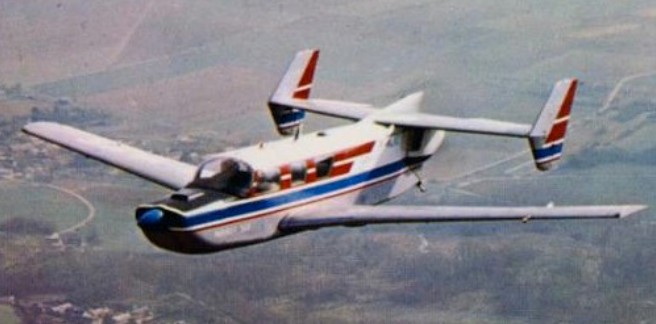
The Jupiter was an executive transport designed by André Moynet, a member of the National Assembly of France and a former government minister and built by S.S. Engins Matra (so it is sometimes referred to as the Matra Moynet Jupiter).
The Jupiter design began life in 1957 as a single-engine airplane, but evolved into its unusual “push-pull” arrangement during the design process. Moynet adopted the configuration to provide the power and safety of a twin, but without asymmetric handling characteristics.
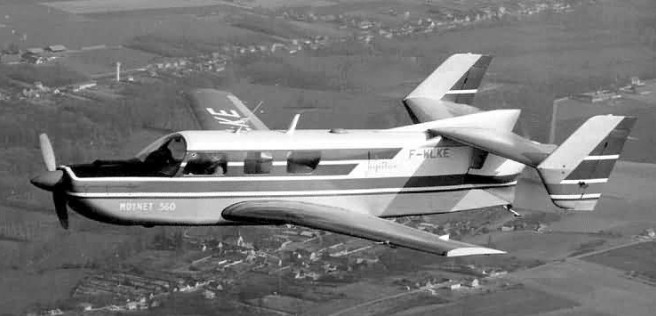
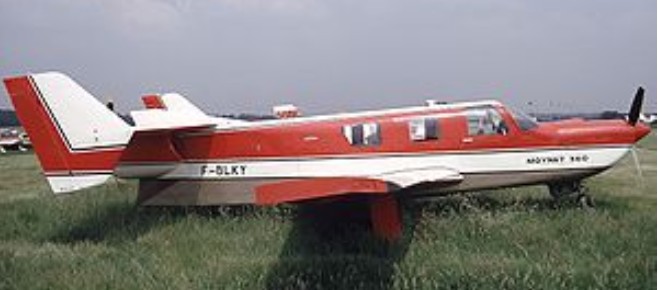
The Moynet 360 Jupiter was an example of a push-pull aircraft with a single conventional fuselage and an engine at either end. Its wing had a straight trailing edge, but the centre section had strong taper on the leading edge which continued more weakly outboard. It was of two spar, stressed skin construction, carrying mass balanced ailerons and slotted flaps. The main undercarriage legs, placed at the end of the centre section each carried a single wheel and retracted inwards electrically. A retractable nosewheel completed the landing gear.
One horizontally opposed Lycoming engine was conventionally placed in the nose. Behind it was a standard cabin, though the front seats were further ahead of the leading edge than usual because of the rearward shift of the centre of gravity caused by the rear engine. There were three large windows on each side. For the same reason the rear fuselage was quite short, and it lacked the normal taper, giving it a boxy look, so that the second, pusher Lycoming could be mounted in the extreme tail. This was cooled by air from rectangular intakes on the upper sides of the rear fuselage. The straight edged, tapered tailplane was mounted on the fuselage top above the engine, with small endplate fins carrying balanced rudders. These fins extended above and below the tailplane, with arrow shaped leading edges and straight, swept trailing edges. There was also a long, shallow strake over the rear fuselage. Seen from below, the long span of the tailplane was striking, about 44% of that of the wings; the elevators filled most of the outer part of its trailing edge, avoiding the propeller airstream.
Moynet had the support of Marcel Chassigny, then the head of the Matra company, and between them they hoped that the Jupiter 360 could provide real competition to U.S.-designed light aircraft. Matra’s Lucien Tieles partnered with Moynet on the final design. The first prototype flying on 17 December 1963 at Villacoublay with the designer and Lucien Tieles at the controls.
Only two Jupiters were built (plus a single static test airframe). The first, constructed by Matra, designated 360-4 and initially registered as F-WLKE had two 200 hp (150 kW) Lycoming IO-360-A1A engines driving two-bladed propellers and was configured as a 4-5 seater.
The second prototype, second constructed by Sud-Aviation, was of a more powerful and slightly larger variant designated the model 360-6; it first flew on 25 May 1965. This model had a choice of engines, either 290 hp (216 kW) Lycoming IO-540 six cylinder engines driving constant speed, three-bladed propellers, or 310 hp (231 kW) Lycoming TIO-541 engines. The span was increased by 0.37 m (15 in) and length by 0.64 m (25 in). The increased length allowed seats for 6-7, with two rows of two single seats and a bench seat at the rear that could accommodate 2 or 3. The cabin was sound-proofed and air conditioned and could be pressurised. Access was via a forward starboard side door. There was baggage space behind the cabin with its own external door. The sole 360-6 was registered as F-WLKY.
The intention was for Sud-Aviation to produce the 360-6 Jupiter as the Sud-Aviation M 360-6 Jupiter, but no sales resulted. An order was obtained from the French government for some 360-6 pre-production aircraft, but this seems to have been cancelled. Despite sales campaigns in Europe and the U.S.A. no further orders resulted.
The first prototype is now in the reserve collection of the Musée de l’Air et de l’Espace, Le Bourget Airport, Paris museum. Parts of its fuselage were to be used as the gondola of an abortive airship project, before it was recovered by Ailes Anciennes Le Bourget and presented to the museum. At le Bourget, the 360-4 bears the normal French registration F-BLKE rather than the French prototype style F-WLKE.
Moynet 360-4 “Jupiter” n°01
Moynet himself retained the second aircraft, the six-seater 360-6 F-BLKY. It passed into the hands of the Musée Régional de l’Air Angers – Loire Airport, France, after Moynet’s death in 1993. Limited restoration work was carried out in 1994 and from 1998, before the major current restore-to-flight effort began in 2009, undertaken by six volunteers. In March 2012 the museum signed a partnership agreement with the Association Aérospatiale Matra to aid with the restoration.
M 360-4 Jupiter First prototype, 4–5 seats, two 149 kW (200 hp) Lycoming IO-360 engines.
M 360-6 Second prototype, with stretched fuselage with seven seats and two 216 kW (290 hp) Lycoming IO-540 engines.
M 360-6P Proposed pressurised seven-seat version, with Lycoming O-480 engines. Unbuilt.
Sud-Aviation Présidence Further enlarged, pressurised version planned by Sud-Aviation.
Specifications:
M 360-4 Jupiter Engines: two 149 kW (200 hp) Lycoming IO-360 Wingspan: 35.42 ft Length: 25.81 ft Seats: 4–5
360-6 Engines: 2 x Lycoming IO-540, 216 kW (290 hp) Propellers: 3-bladed Hartzell constant speed Length: 8.77 m (28 ft 9 in) Wingspan: 11.49 m (37 ft 8 in) Height: 2.46 m (8 ft 1 in) Wing area: 16.81 sq.m (180.9 sq ft) Empty weight: 1,338 kg (2,950 lb) Gross weight: 2,390 kg (5,269 lb) Fuel capacity: 566 lt Maximum speed: 363 km/h (226 mph; 196 kn) at sea level Cruising speed: 338 km/h (210 mph; 183 kn) at 1,830 m (6,000 ft) on 75% power Range: 2,060 km (1,280 mi; 1,112 nmi) at 4,500 m(15,000 ft) and 45% power. Rate of climb: 7.3 m/s (1,440 ft/min) at sea level Capacity: 6 or 7
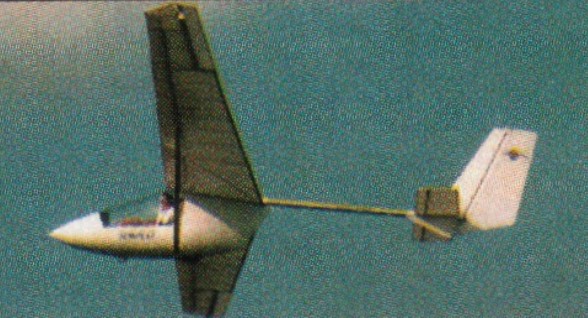
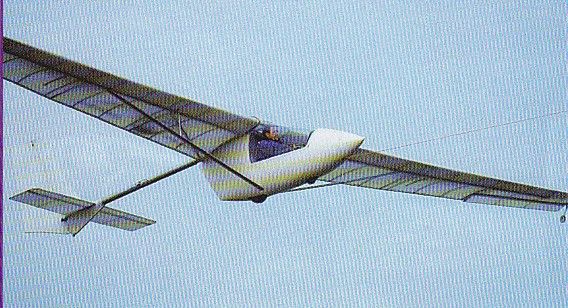
Designed by Bobby Bailey, the Tempest is an FAI Class 4 light sailplane circa 1998, using tube and fabric construction, and composite cockpit. It can be dismantled into three parts for transport. The semi-enclosed fiberglass cockpit has a canopy that hinges to one side.
Launchable by towing from an UL, it was availablein the US as a kit for $10,000 or as a completed sailplane for $12,500, through Quest Air Soaring Canter, 6548 Groveland Airport Road, Groveland, Florida 34736.
Tempest Wing span: 13 m / 42 feet Wing area: 14 sq.m / 150 square feet Height: 5 ft Length: 21 ft Aspect ratio: 12:1 MTOW: 400 lb Empty weight: 100 kg / 220 lb Vzmin: 0.8 ẚ 40 m/sec Stalls: 29 km/h Speed max: 80 mph Glide Ratio: 25 @ 60 kph L/D: 24 @ 68 km/h L/D ratio: 5:1 Min sink: 170 fpm Seats: 1 Landing gear: single wheel Price (1998) $ 10500 (kit)
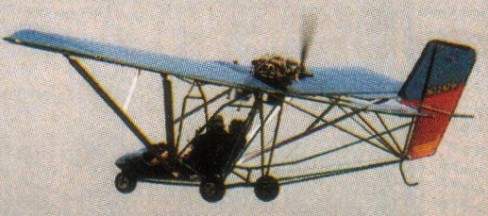
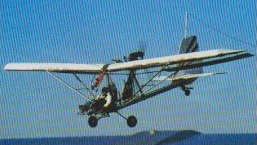
The main product from the LiteFlite stable is the Dragonfly. The Dragonfly is a three axis ultra light aircraft which takes off in a reasonably small area and lands in a reasonably small area. It has dual seating and dual controls.
Due to the slow flying speed, the Dragonfly is a favoured hang gliding towing aircraft and has been sold to 12 different countries. The Dragonfly provides a low cost form of aviation which can be flown almost anywhere and is really easy to learn.
The Dragonfly has been in production since 1990 and during this period, in excess of 100 aircraft have been manufactured.
The Dragonfly is constructed from 6061 grade aluminium tubing, is structurally supported by stainless steel wire and has fabric covered wings. It is powered by either a two stroke or four stroke engine. It has a range of options available depending upon your requirements and financial constraints.
Engine: Rotax 582, 65 hp Overall Length: 5.974 m / 19 ft 6 in Maximum Height: 2.316 m / 7 ft 6 in Wing Span: 10.363 m / 34 ft Wing Area: 15.8 sq.m / 170 sq.ft MTOW: 385 kg Gross Weight: 800 lb Empty Weight: 150 kg / 330 lb Fuel cap: 6 USG / 20 lt VNE: 57 knots / 100 kph VC at 5200rpm: 40 knots / 60 kph Stall: 14-17 kt Normal Landing Approach Speed: 26 kt ROC: 1400 fpm /16 m/s Take-off dist: 50 ft Take-Off Distance (To 50ft): 195 feet Landing dist: 100 ft Landing Distance (From 50ft): 363 feet Range: 100 sm Fuel consumption: 16 lt/hr Service ceiling: 16,000 ft Seats: 2 Kit price (1998): US$15,700 Landing gear: tail wheel