MVP.Aero Model 3

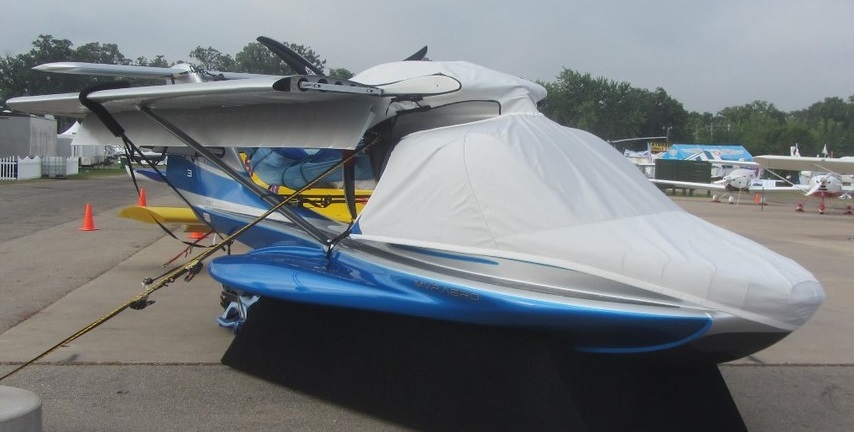
Designed by Mike Van Staagen, the MVP Model 3 is a prototype American “triphibian” light-sport aircraft, displayed in mockup form in 2014. The aircraft is under development by MVP.Aero Inc. of Delaware.

The MVP Model 3 is designed to operate on land, water, snow and ice. The floor panels can be rearranged to accommodate fishing or camping. The design will be marketed in several versions, including the E-AB, E-LSA, and S-LSA. The aircraft is a two-seats in side-by-side configuration with a pusher propeller and folding wings, which are constructed with carbon-fiber composite spars and covered with fabric. The balance of the airframe is constructed from a combination of carbon fiber and fiberglass. Electric thrusters help the aircraft manoeuvre in the water.

The design allows the canopy to be raised on a four bar system to sit above the engine cowling. This leaves the cockpit area open for fishing from and can also allow mounting of a tent for camping, with the floor panels inserted. With the canopy fully open the engine can still be run for water maneuvering.

The unit cost was US $169,000 as an Experimental and $189,000 as S-LSA.

Variants:
Model 3 E-AB
Model 3 E-LSA
Model 3 S-LSA

MVP Model 3
Engine: 1 × Rotax 914, 115 hp (86 kW)
Wingspan: 36 ft 0 in (10.97 m)
Length: 23 ft 9 in (7.24 m)
Length wings folded: 8.1 m (26 ft 7 in)
Width: 8 ft 0 in (2.44 m) wings folded
Fuel capacity: 26 US gal (22 imp gal; 98 l)
Cruise speed: 104 kn (120 mph, 193 km/h) at sea level
Stall speed: 41 kn (47 mph, 76 km/h) with full flaps
Rate of climb: 1,000 ft/min (5.1 m/s) at sea level
Wing loading: 11 lb/sq ft (54 kg/sq.m)
Crew: one
Capacity: one passenger

MVP.Aero Inc

MVP.Aero Inc has its design and engineering team in Duluth, Minnesota, with management and administration based in Minneapolis. In January 2016 it was announced that the Model 3 will be built in Brunswick, Maine.

The Model 3’s lead designer, Mike Van Staagen, is a former Cirrus Aircraft engineer who played a key role in the design and development of the Cirrus Vision SF50 personal jet, as well as the Cirrus SR20 and SR22 composite light aircraft.

Mustang Aeronautics

1997-2009: 1470 Temple City Troy, MI 48084, USA.

The president of Mustang Aeronautics is Chris Tieman. Chris earned a degree in aerospace engineering from the University of Michigan and has a background in metal fabrication. He acquired his pilots license in 1986 and soon began looking for something to build that was faster and more economical than the average factory airplane. The Mustang II was the best choice for the desired requirements so plans were purchased and construction started.

When Robert Bushby decided to retire in 1992 Chris’ hobby of home kitplane builder became his profession. Mustang Aeronautics, Inc. acquired the design rights from Robert Bushby in March 1992 for both the Midget Mustang and Mustang II aircraft. Located just north of Detroit in Troy, Michigan. His background in aeronautical engineering and architectural aluminum are evident in today’s complete kits that have reduced build times dramatically. New manufacturing processes have simplified the kits yet still maintained the economy of the Mustang through improved manufacturing efficiency.

Murrell Ornithopter

An ornithopter, circa 1910, that was built by Melville M. Murrell of Morrinsville, Tennessee. He’d previously patented a human-powered ornithopter in 1877, then was bitten by the aviation bug again when powered flying machines were being developed. For reasons of his own, 35 years after applying for his flying-machine patent, Murrell pulled his old drawings out, made some alterations, and built a new flyer. Though Murrell’s new model bore some resemblance to his original ornithopter, he’d apparently been doing some reading. This time, he gave his plane a fixed wing; his louvered flapping wings were still a part of the design, but now supplied forward thrust. Murrell rigged the machine to a cable along a hillside and harnessed it to a mule to launch it into the air. The cable having some sort of a trip such that, when the plane had gotten to a certain speed, it was hurled into the air.

Murrayair MA-1

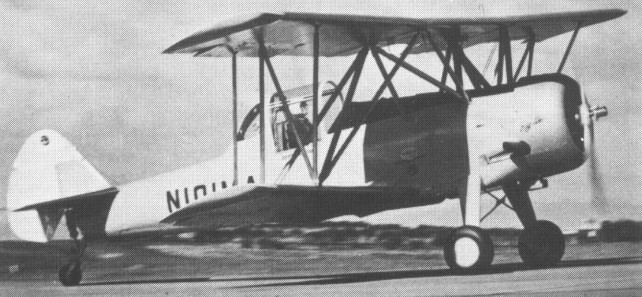
The Murrayair MA-1, a conversion of the Stearman Kaydet, was designed by the technical services section of Air New Zealand at Mangere during 1968 and 1969. The conversion of the Stearman involved the fitting of a 600 hp P & W R-l340 Wasp engine from a Harvard to double the aircraft’s payload to 30 cwt, and the redesigning of the entire centre fuselage using a New Zealand-made integral fibreglass hopper. With a capacity of 62 cu ft it is the largest in the ag aviation industry. Fuselage panels are also of moulded fibreglass and are quickly removable for maintenance. An enclosed cockpit was also fitted. The rear fuselage, tail unit and strengthened undercarriage were from the Stearman. The wooden and fabric wings were increased in area by 35 per cent, and the entire strut system was redesigned to eliminate the flying and landing wires, using steel lift struts to accommodate the increased gross weight (3,495 lbs to 6,250 lbs).

Work on the conversion of the Stearman began towards the end of 1968, and the first aircraft, N101MA, first flew from Mangere on July 27, 1969. The job was carried out for the Honolulu-based aviation service firm, Murrayair Ltd, which operated a fleet of modified Stearmans for spraying pineapple and sugar plantations in the Hawaiian Islands. By mid-1972 N101MA had flown 1,100 hours and production of five more pre-production aircraft, the MA-1, was begun. In 1974 the MA-1 was being produced at Harlingen in Texas by a subsidiary of Murrayair, Emair Ltd, at the rate of one aircraft per month, with completion of 2-3 air¬craft per month planned by the middle of that year.

The Emair MA-1, was offered with a 1,200 hp Wright R-1820 engine derated to 900 hp. The MA-1B, which began its flight tests from Harlingen, Texas, in August, also has a new slower turning propellor with larger diameter and broader blades.

MA-1
Engine: P&W R-1340, 600 hp
Seats: 1-2
Wing loading: 15.7 lb/sq.ft
Pwr loading: 11.7 lb/hp
Max TO wt: 7000 lb
Empty wt: 3550 lb
Equipped useful load: 3398 lb
Payload max fuel: 2750 lb
Hopper cap: 450 USG / 30 cwt / 62 cu.ft
75% cruise: 95 kt
Working speed: 90 kt
Working endurance: 2.9 hr
Stall: 56 kt
Fuel cap: 648 lb

MA-1B
Engine: Wright R-1820, 900 hp
Seats: 1-2
Wing loading: 15.7 lb/sq.ft
Pwr loading: 8.9 lb/hp
Max TO wt: 8000 lb
Empty wt: 4300 lb
Equipped useful load: 3648 lb
Payload max fuel: 3000 lb
Hopper cap: 450 USG
75% cruise: 115 kt
Working speed: 105 kt
Working endurance: 2.3 hr
Stall: 63 kt
ROC: 1750 fpm
Min field length: 1600 ft
Fuel cap: 648 lb

Murphy VM-7 Competitor

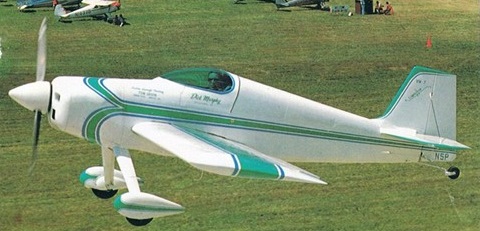
Murphy VM-7 Competitor N5P c/n 01

“Richard L. “Dick” Murphy of Doylestown, Pennsylvania, USA, was a Captain with American Airlines and had 23 years of military and civil flying and engineering experience when he designed and built this single-seat Unlimited class aerobatic aircraft. Murphy had previously constructed a Van’s RV-3, which was flown competitively during 1976, also registered N5P. The VM-7 Competitor owed much to this aircraft and to ideas and suggestions from other designers and pilots, including Bud Judy, Leo Loudenslager, Ed Mahler and Nick d’Apuzzo.

Cantilever mid-wing monoplane. Wing section NACA 23015. Constant chord. Light alloy structure, comprising a laminated main spar, passing through fuselage under pilot’s knees, and twenty hydroformed ribs, covered with light alloy skin panels, bonded and pop-riveted in place. Symmetrical, balanced and sealed ailerons.

Light-alloy semi-monocoque fuselage structure, mostly bonded but with some pop rivets.

The tail unit is a cantilever light alloy structure. Fin integral with rear fuselage. Trim tab in port elevator. Non-retractable tailwheel type landing gear. Wittman type cantilever spring steel main legs. Main-wheel tires size 5.00-5. Cleveland brakes. Streamline fairings over main wheels. Steerable tailwheel.

A 200 hp Avco Lycoming O-360 flat-four engine, driving a Hartzell two-blade constant-speed propeller, with spinner. Engine fitted with IO-360 sump, manifold and fuel injector. Main and auxiliary fuel tanks in forward fuselage; total capacity 17 gal (64.4 l). Second auxiliary tank optional. Oil capacity 2 gal (7.6 l).

Single seat, inclined at about 15°, under forward-sliding canopy.

Design objectives for the VM-7 were that it should be easy to construct, should cost under $10,000, and should have good performance. Without the engine and propeller, it cost $6,000 and took 2,000 working hours to build. Plans would be made available to amateur builders when the aircraft had proved its capability in competitive aerobatics.

The prototype flew for the first time in March 1978 and according the FAA received a CofA a year later, March 28, 1979. Reportedly the aircraft was destroyed by fire during December 1979, however, on December 4, 1979 the aircraft was reregistered to Bishop Aviation, Inc of N. Richland Hills, Texas. Reportedly Murphy began construction of a second example, with the intention of having it completed it time to compete in the 1980 World aerobatic contest, however, there is no information a second example was ever completed. The registration N5P expired and was cancelled on October 14, 2014.”

Engine: Avco Lycoming O-360, 200 hp
Propeller: Hartzell two-blade constant-speed
Span: 19 ft 6 in (5.94 m)
Length: 19 ft 9 in (6.02 m)
Wing chord, constant: 4 ft 6 in (1.37 m)
Propeller diameter: 6 ft 4 in (1.93 m)
Empty weight: 797 lb (361.5 kg)
Max takeoff weight: 1,250 lb (567 kg)
g limits: + 14/-14 Never exceed speed: 215 mph (346 kmh)
Max level speed: 200 mph (322 kmh) at sea level
Max cruise speed: 175 mph (282 kmh)
Econ cruise speed: 150 mph (241 kmh)
Stall speed: 50 mph (80 kmh)
Climb: 3,000 ft (915 m)/min
Takeoff run: 150 ft (46 m)
Takeoff to 50 ft (15 m): 250 ft (76 m)
Landing run from 50 ft (15 m): 1,200 ft (366 m)
Service ceiling, estimated: 18,000 ft (5,485 m)
Range: 250 mls (402 km)

Murphy, Richard L.

Richard L. “Dick” Murphy of Doylestown, Pennsylvania, USA, was a Captain with American Airlines and had 23 years of military and civil flying and engineering experience when he designed and built the VM-7 single-seat Unlimited class aerobatic aircraft. Murphy had previously constructed a Van’s RV-3, which was flown competitively during 1976, also registered N5P.

Murphy SR 3500 Moose

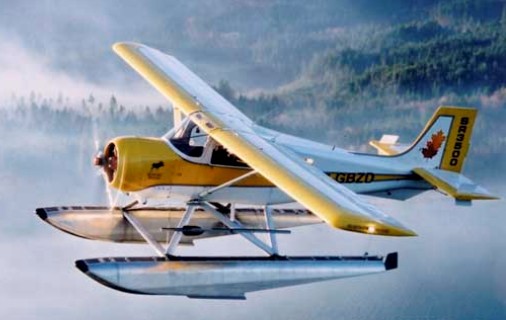
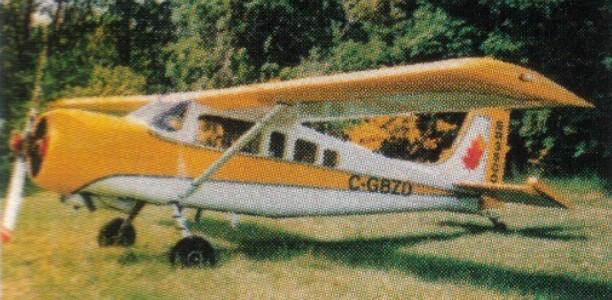
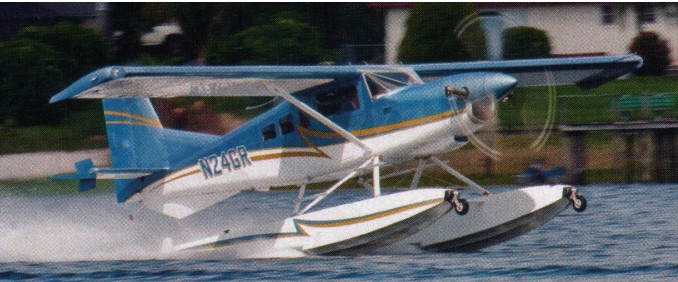
The Murphy SR3500 Moose is a STOL aircraft capable of operating from wheels, floats or skis. Featuring all metal construction, the pre-formed and pre-punched parts suit the first time builder.

The empty weight of the SR 3500 was increased 2% over the SR 2500 Super Rebel to prepare it structurally for more powerful engines, speed increase, and a 17% payload increase. Most of the changes are to the outside of the structure, including doublers added to the wing and horizontal stabiliser roots. A stronger set of rudder and elevator horns and the undercarriage has been strengthened. The structure was stactically loaded to 8400 lb on each wing (5.3G) and the torsional load tests were equivalent to a 220 mph dive with a 4 G pull-up with full aileron deflection.

Turbine Moose

When powered by a 360 hp Russian radial, a gearbox allows the engine to run at 2950 rpm while the propeller turns at 1940 rpm. Typically producing 390 hp, the prop diameter is 98 in.

Murphy Moose
Engine: Lycoming O-540, 250 hp
Power Loading: 14.0 lb./hp
Gross weight: 3500 lb
Empty weight: 1650 – 1800 lb
G-loading (normal): +5.7 -3.8
Power range: 250 – 360 hp
Wing span: 36′
Length: 23′
Fuselage width: 44″
Wing chord: 60″
Tail span: 130″
Tail chord: 33.5″
Airfoil: 4415 (Modified)
Flap area: 22.5 sq. ft
Flap reflex: 5
Flap droop: 40
Aileron area: 25.5 sq. ft
Aileron reflex: 5
Aileron up deflection: 20
Aileron down deflection: 12
Useful Load: 1750-1850 lb
Wing Area: 182 sq.ft
Wing Loading: 19.2 lb./sqft
Rate of Climb: 950 ft/min
Take Off Run: 800 ft
Landing Roll: 600 ft
Stall (no flap) Power off: 64 mph
Stall (full flap) Power off: 58 mph
Cruise (70% Power): 143 mph
Vne: 189 mph
Top Speed: 155 mph
Fuel Burn: 14.1 USG/hr
Fuel Capacity: 60 USG
Endurance: 4.3 hr
Range: 610 statute miles

Murphy Moose
Engine: M-14P, 360 hp
TBO: 1500 hr
Gross weight: 3500 lb
Empty weight: 1650 – 1800 lb
G-loading (normal): +5.7 -3.8
Power range: 250 – 360 hp
Wing span: 36′
Length: 23′
Fuselage width: 44″
Wing chord: 60″
Tail span: 130″
Tail chord: 33.5″
Airfoil: 4415 (Modified)
Flap area: 22.5 sq. ft
Flap reflex: 5
Flap droop: 40
Aileron area: 25.5 sq. ft
Aileron reflex: 5
Aileron up deflection: 20
Aileron down deflection: 12
Power Loading: 9.7 lb./hp
Useful Load: 1800-1600 lb
Wing Area: 182 sq.ft
Wing Loading: 19.2 lb./sqft
Rate of Climb: 1500 ft/min
Take Off Run: 600 ft
Landing Roll: 600 ft
Stall (no flap) Power off: 64 mph
Stall (full flap) Power off: 58 mph
Cruise (70% Power): 150 mph
Vne: 189 mph
Top Speed: 175 mph
Fuel Burn: 15 USG/hr
Fuel Capacity: 80 USG
Endurance: 5.3 hr
Range: 795 statute miles

Turbine Moose
Engine: Pratt & Whitney PT6A-20
Wingspan: 37 ft 6 in
Wing loading: 22.2 lb/sq.ft
Fuel cap: 160 USG
Max Gross Wt: 4000 lb
Empty wt: 2795 lb
Useful load: 1205 lb
Seats: 4
Cabin width: 46 in
Baggage cap: 250 lb
Max ROC: 2000+ fpm
Stall clean: 65 mph / 56 kt IAS
Stall ldg config: 62 mph / 54 kt IAS
Cruise: 180 mph / 157 kt @ 8000 ft @ 60% pwr
Fuel burn at cruise: 34 USG/hr