Chicago IL and Galveston TX.
USA
Circa 1912 airplane builder
Chicago IL and Galveston TX.
USA
Circa 1912 airplane builder
1997-8: 5611 Kendall Ct., No. 4 Arvada, CO 80002, USA
Produces kits and plans to allow amateur construction of the Cassutt IIIM single-seat monoplane racer, originally designed/built by Captain Tom Cassutt in 1954.
A three place monoplane built in 1928.
Nash wrote to CAA on 9 March 1930, “Dismantled, motor went to the bad. I am holding ship for sale without motor.”
Only the one was built, registration N6811. The registration was cancelled on 28 March 1930.
Engine: Gnôme rotary, 165hp
Wing span: 32’8″
Length: 23’10”
Seats: 3
Chapin IL.
USA
Circa 1927 built the Nash Aircraft N

Robert T. Jones of Ames calculated that an aircraft’s wing made to pivot 4 degrees to the fuselage might halve the fuel consumption. Specifications bases, in particular geometric configuration were established by NASA based on one made by Boeing. In consultation with the Rutan Aircraft Factory, Ames and Dryden built the AD-1 oblique wing aircraft in 1977, a twin jet composite aircraft with direct controls and a top speed of 175kts (324kph). Set perpendicular to the fuselage for takeoff and landing, the oblique wing could be made to rotate up to 60 degrees for higher speed flight and between 1979 and 1982, demonstrated the feasibility of such a concept, performing three landings with the wings pivoted at 45 degrees.
The test aircraft’s 32 foot wing can be pivoted 60 degrees during cruise, to reduce drag while still allowing high airspeeds. In the conventional position, the wing should provide ample lift and stability for takeoffs, landings and low speed manoeuvres. Designated the AD 1, the test aircraft is 40 feet long, has a gross weight of 2,000 pounds and is powered by two 220 pound thrust turbojets. The structure was made entirely of fiberglass.
The aircraft was delivered by Aimes at Dryden Flight Research Center at Edwards Air Force Base in March 1979. The first flight was performed by test pilot NASA Thomas C. McMurtry December 21, 1979. Thomas flew only the 79 flights until 7 August 1982.
Although the oblique wing is still considered by some as a viable concept for large transport, unpleasant flight characteristics of the AD-1 at certain angles discouraged designers to adopt this configuration.


Engines: 2 x Microturbo TRS-18, 220 lb / 100 kg
Wing span: 9.85 m / 34 ft 2 in
Length: 11.82 m
Wing area: 8.60 m²
Aspect ratio: 11.2
Thickness/chord: 12%
Loaded weight: 809 kg
Empty weight: 535 kg
Max speed: 220 knts
Min speed: 74 knts
Seats: 1


QSRA – A Quiet Short-Haul Research Aircraft built under contract to the U.S. National Aeronautics and Space Administration by Boeing. Following a short flight-test period at Boeing, the plane was delivered to NASA Ames in California to continue the design flight test programme. The advanced research vehicle is actually a remanufactured twin-engined C-8A Buffalo built originally by de Havilland Canada and owned for several years by NASA, Boeing created an all-new wing incorporating boundary layer control, four Lycoming turbofans which exhaust over the upper surfaces of the wings and new engine nacelles and cross-ducting, Coanda flaps, a new but similar tail and installed new instrumentation.
Objective of the QSRA is to build an experimental flight research aircraft aimed at developing the technology for quiet short-haul commercial airliners of the future with short takeoff and landing capabilities. Another purpose is to explore the operating procedures of such an airplane in the airport terminal environment.
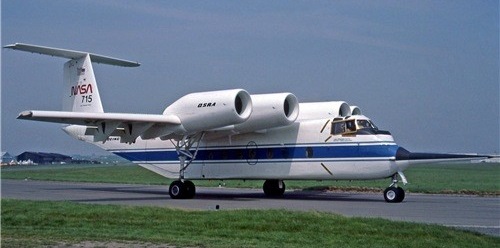
The QSRA has four engines of 7500 pounds thrust each mounted above the wing and exhausting over the wing. This arrangement provides “upper surface blowing” much like the Boeing YC-14 military prototypes. In union with the specially designed wing and flap system, extremely high lift is generated with very low noise.
Engines: 4 x Lycoming turbofan

There had long been the desire to have a reusable vehicle that could be launched into Earth orbit, have the ability to manoeuvre in space, re enter Earth’s atmosphere and land conventionally on an airfield. The first step in this direction was made with lifting body research aircraft which, in turn, led to design of the Space Shuttle Orbiter, for which Rockwell International became prime contractor in July 1972.
A large vehicle with a thick section wing of double delta planform, the SSO has a fuselage which conforms to lifting body outlines. Mounted in the rear fuselage are three Rocketdyne SSME rocket engines, each developing 417,300 lb (189287 kg) thrust for launch, at which time the SSO has mounted beneath it a large external fuel tank for the SSME rocket engines, and at each side of the tank a solid propellant rocket booster. The whole assembly is launched with the main engines and the boosters firing; after burn¬out the boosters are jettisoned and recovered by parachute, the main engines then being fed from the external fuel tank, which is jettisoned just before entry into orbit. Having completed its orbital mission, during which the SSO is controlled by orbit manoeuvring and reaction control engines, a de orbiting manoeuvre is initiated and, at a high angle of attack, the SSO re enters Earth’s atmosphere to make an unpowered but otherwise conventional aircraft type landing.
It was not until 13 August 1977 that the Enterprise and its crew were launched in free flight from the SCA at a height of 22,800 ft (6950 m), to make a gliding and unpowered flight to a conventional landing at Edwards AFB, California.
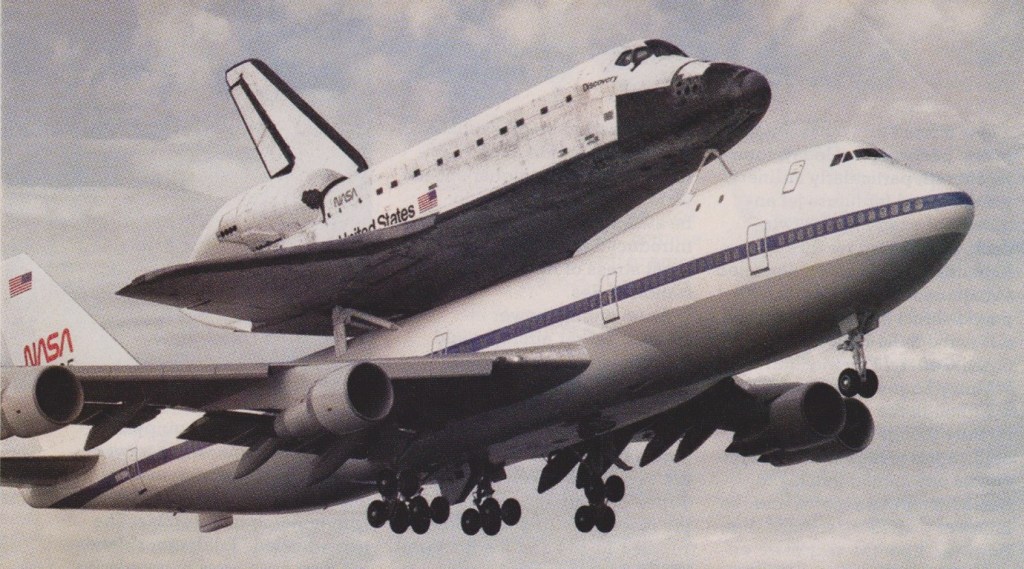
Almost four years later, on 12 April 1981, the spacecraft OV 102 Columbia, crewed by astronauts John Young and Robert Crippen, lifted off from Cape Canaveral on the first orbital mission. It then completed 37 orbits of the earth in 54 hours and on 14 April made a near perfect unpowered 200 mph (322 km/h) landing on Runway 23 at Rogers Dry Lake, Edwards AFB, California. The first ever “soft” return from space in a re-usable craft that is part spaceship and part aeroplane.
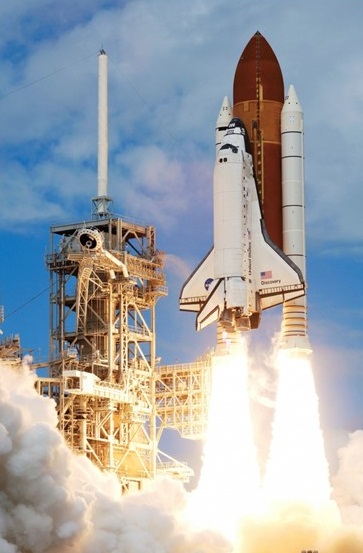
The Columbia was subsequently flown back to Cape Canaveral on the back of its Boeing 747 mother-plane for full examination and preparation for the next mission.
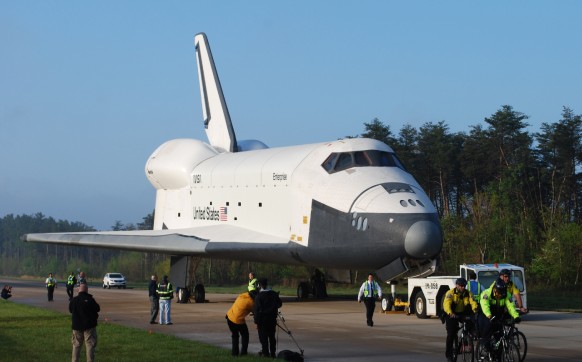
Boosters: 2 x Solid rocket, 1,315,430 kg (2,900,000 lb) thrust each
A batch of 50 HL-6 tandem two-seat low-wing monoplane trainers was begun 1943.
In 1947, improved Series B versions of the HL-1 and HL-6 appeared .
A two-seat primary trainer, designated HL-1, with strong resemblance to Piper Cub.
In 1947, improved Series B versions of the HL-1 and HL-6 appeared.
Brazil
Companhia Nacional de Navegagao Aerea, took over manufacture of Muniz-designed aircraft from Companhia Nacional de Navegagao Costiera (CNNC) around 1941. Produced Muniz M-11 two-seat primary trainer, designated HL-1, with strong resemblance to Piper Cub; batch of 50 HL-6 tandem two-seat low-wing monoplane trainers was begun 1943. Other designs included HL-2 and HL-4. In 1947, improved Series B versions of the HL-1 and HL-6 appeared; the company’s activities had ceased by about 1950.

