New Standard D-25

New Standard D-25 as crop-duster N928V

The 1925 D-25 received ATC 108 and was priced at $9,795. About 45 were built. ATC 2-542 was issued in 1937.
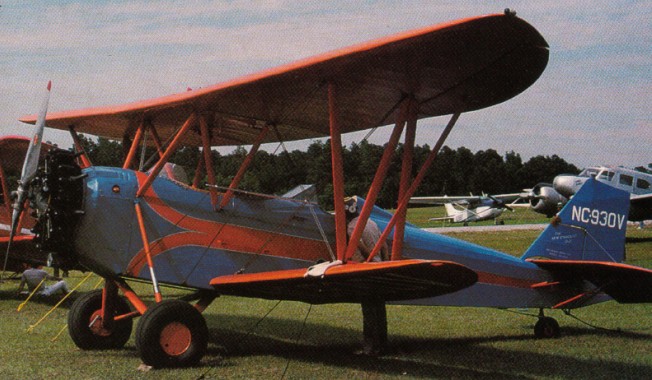
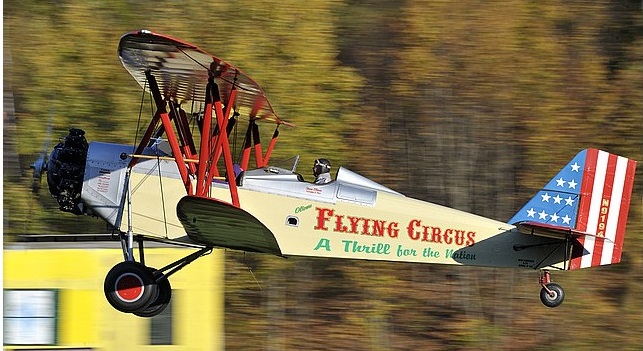
In 1928 the Gates-Day Aircraft Corporation became New Standard Aircraft Corporation, and the following year produced the White New Standard D-25 tandem, open-cockpit four-seat biplane, developed from the Gates-Day GD-24.

With the pilot seated behind and four passengers in front, all in open cockpits, it is a large biplane by any standards.

Designed by Charles H Day, production of D¬25s began at the Gates Day plant at Peterson, New Jersey in 1928 and when production ceased two years later about 65 of the type had been delivered a few were built during the 1930s as crop dusters.

Jones Aircraft Corp was formed in 1935 by Ben Jones after acquiring rights in D-25 biplane previously built by the New Standard Aircraft Company. Jones built 10 of these in 1938, in factory at Schenectady, New York.
New Standard D-25

The 1929 D-25A (ATC 224) was powered by a 225hp J-6 for an increase in load. Priced at $7,990, five were built, NC33K, NC38K, NC150M, NC930V, NC9190, the next-to-last of which was modified with 300hp J-6 as D-25B (see White D-25B).

The D-25X was a modification of D-25A, registered N37K c/n 203.

D-25
Engine: 220hp Wright J-5
Wingspan: (upper) 45’0″ (lower) 32’6″
Length: 26’10”
Useful load: 810 lb
Max speed: 110 mph
Cruise: 98 mph
Stall: 37 mph
Range: 490 mi
Ceiling: 18,000′
Seats: 5

D-25A
Engine: 225hp Wright J-6
New Standard D-24

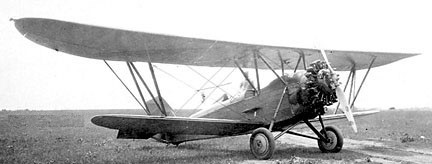
The 1929 New Standard D-24 (ATC 107) was designed by Charles H Day as a five-place open biplane. Selling for $4,600 with a 180hp Wright-Hisso E or $4,250 with a 150hp Hisso A, four were built, NC442, NC9102, NC9756, and NC9794, and two were converted from Standard GD-24, NC193 and NX7286.

D-24
Engine: 180hp Wright-Hisso E
Wingspan: 45’0″
Length: 26’6″
Useful load: 1334 lb
Max speed: 100 mph
Cruise speed: 95 mph
Stall: 37
Range: 550 mi
Seats: 5

Newson Kelvin 40

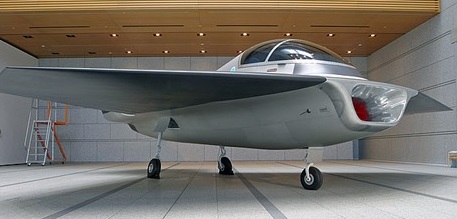
The Kelvin 40 “concept plane” by designer Marc Newson, who was developing the interiors for Qantas’ A380s. The Kelvin is fitted with a real Snecma jet engine, and Newson says the aircraft has been proven to be aerodynamically viable. But will never fly. On display at a design exhibition in Tokyo.

New Piper Aircraft Inc.

USA
Established July 1997 as subsidiary of Newco Pac Inc., taking over assets of Piper Aircraft Corporation. Production of PA18-150 Super Cub ended 1995, and production ended of PA28-236 Dakota. Marketed were 160 hp PA28-161 Warrior III four-seat lightplane (first flown 1976, as development of original 1972 Warrior), 180 hp PA28-181 Archer III four-seat lightplane, 200 hp PA28-201 Arrow four-seat lightplane (first flown 1975), 300 hp PA32R-301 Saratoga five/six-seat lightplane, PA34-220T Seneca V five/six-seat twin 220hp-engined lightplane (unveiled 1997), PA44-180 Seminole four-seat twin 180 hp-engined lightplane (first flown 1976), and 350 hp PA46-350P Malibu Mirage (first flown 1983) and turboprop-powered Malibu Meridian (first flown 1998) six seat and single-engined business aircraft.

New Pacer Aircraft New Pacer

Designed by Frank R Seesock circa 1925, the New Pace had two side-by-side cockpits. An open cockpit high wing monoplane. It s known one carried 1491 lb in one test with a 1000-fpm rate of climb.

Known examples:
1929
Engine: 150hp Hisso A
Wingspan: 36’6″
Length: 22’9″
Useful load: 1200 lb
Max speed: 138 mph
Cruise speed: 110 mph
Stall speed: 42 mph
Range: 750 mi
Incl: NX1928

1930
Engine: 200hp Wright J-5
Max speed: 147 mph
Cruise speed: 120 mph
Stall speed: 42 mph
one NR786Y c/n 2

1932
Engine: 300hp Wright
one NX749Y c/n 101