Parker, William D “Billy”
Ft Collins CO and San Diecgo CA
USA
Circa 1912-13
(W D “Billy”) Parker-(A B) Riggs Airplane Co
Bartlesville OK.
USA
Circa 1928
Parker, William D “Billy”
Ft Collins CO and San Diecgo CA
USA
Circa 1912-13
(W D “Billy”) Parker-(A B) Riggs Airplane Co
Bartlesville OK.
USA
Circa 1928
Built from what materials were on hand or found locally, it sported a landing gear of four motorcycle wheels, plain galvanized wire helping to brace its structure, and some gas pipe for parts of its frame. Parker incorporated a smoke chamber, with hand-operated bellows, built to study airflow across model wings.
After incorporation with a couple dozen townsfolks, completion of the airplane mid-year, and a maiden flight to 20′ high and 1,500′ in length (during which Parker also learned to fly) followed by a crash-landing, an exhibition tour was planned. Those plans were cut short when a second flight also ended in a crash with more severe damage.
With funds running low and no signs of any income on the horizon, and the reluctance of the plane to leave the ground in further modifications and attempts over three more years, the company was dissolved in 1914. Yet Parker is credited by many as the first to fly in Utah, which is contested by supporters of Lagar Culver for the honors.
Engine: Emerson, 60hp
Wing span: 14’0″
Seats: 1
Utah Aviation Co
Utah Aviation Assn
Grantsville UT.
USA
Circa 1911 airplane
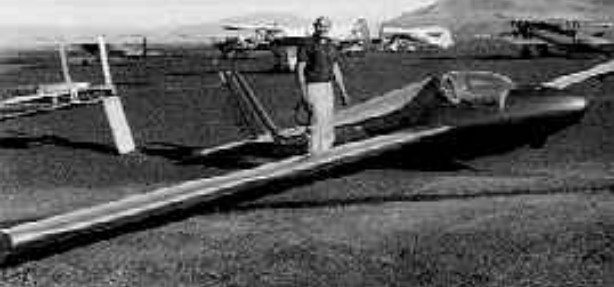
Designed by W.L.Parker, the Ranger originally had a retractable 11 kW/ 15 bhp engine and a 78 cm/ 31 in propeller. The Ranger was unable to take off on its own, so the Righter engine was fitted instead to give self- launch capability. It has a fixed main wheel plus a wheel in the nose, and no glidepath control devices.
Construction is all aluminum, with a laminated aluminum spar.
Engine: 26 kW/ 35 bhp Righter
Wing span: 11.43 m / 37.5 ft
Aspect ratio: 12
Wing area: 11.33 sq.m / 122 sq.ft
Gross Weight: 91 kg / 200 lb
Payload: 263 kg / 580 lb
Empty weight: 354 kg lb / 780 lb
Wing Load: 31.24 kg/sq.m / 6.5 lb/sq.ft
L/DMax: 18
Airfoil: NACA 4418
Seats: 1

The sole wood and fibreglass T-Bird built first flew in 1962 and placed 8th in the Nationals that year flown by its designer/ builder Ray Parker. It was acquired by the Santa Maria (CA) Museum of Flight
Wing span: 15.45 m / 50.7 ft
Wing area: 11.15 sq.m / 120 sq.ft
Gross Weight: 329 kg / 725 lb
Empty Weight: 247 kg / 545 lb
Payload: 82 kg / 180 lb
Wing Load: 29.51 kg/sq.m / 6.04 lb/sq.ft
L/DMax: 34
MinSink: 0.61 m/s / 2.0 fps / 1.18 kt
Airfoil: Wortmann FX 05-191
Seats: 1
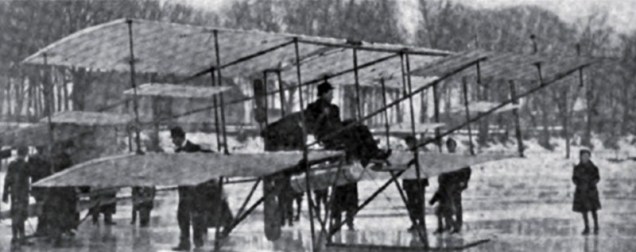
James J. Parker, of Fulton, NY, made the first trial and successful flight with this machine completely of his own construction starting on skids from the ice of Lake Neahtawanta 1910-1911. A flight of a mile and return was reportedly made. The generally Farman-like plane was equipped with a four-cylinder, two-cycle motor of his own make and had a unique tandem-mounted ailerons arranged between the wings.
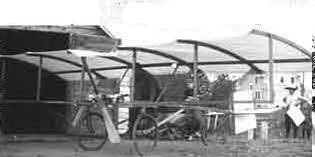
The Spokane (Washington) Spokesman-Review of August 28, 1910 reported Fred Parker’s monoplane’s first flight in Minnesota occurring a day earlier. Fred was 22-years old at the time. The monoplane was built in a workshop in Hamline, a St. Paul suburb, and weighed 130 pounds. It is stated in Popular Mechanics (1909) that Fred Parker had previously made several dirigible flights for Roy Knabenshue and Captain Baldwin.
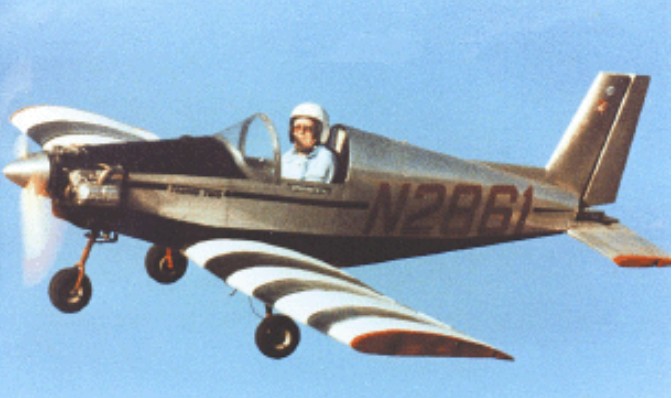
An improved version of the Jeanie’s Teenie, the Teenie Two is an all-metal, single-place monoplane built entirely from aluminum except for the landing gear and controls. Building needs no bending brake, nor is any metal or riveting experience required. Most of the sheet metal bending involved in building the Teenie Two is done by hand and the design is close to optimum simplicity. Power is provided by a Volkswagen conversion. Stressed for aerobatics. The wingspan is optionally 19 feet 10 inches w/wingtips.
Cruise at 3/4 throttle is 110 mph, using 2 1/2 Usgph. The top speed level is 120 mph, and up to 140 mph with full canopy & cowl.
Plans and component kits were available.
The Double Teenie was a two place version.
Engine 1600-cc Volkswagen
HP range: 60-80
Wingspan 18 ft – 19 ft 10 in
Length 12 ft 11 in
Height: 6 ft
Wing area: 59 sq.ft
Gross Wt. 550-590 lbs
Empty Wt. 310 lbs
Fuel capacity 9 USG
Usefull load: 240 lb utility to 280 lbs. standard category
Top speed 120-140 mph
Cruise 110 mph
Stall 48 mph
Takeoff run 600 ft
Landing roll 800 ft
Range 400 sm
ROC: 800 fpm
Service ceiling: 14,000 ft
Seats: 1
Tricycle gear 350 x 4 tires & wheels
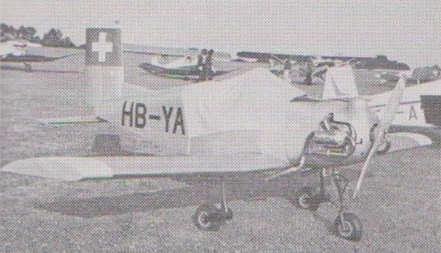
In the 1960s Calvin Parker built one prototype Jeanie’s Teenie, single place, open cockpit low wing monoplane.
Several thousand sets of plans were reportedly sold to home-builders.
HB-YAO c/n SF.01 was built by S.Freudiger, appearing at Sywell, UK, in 1974 and 1975. Destroyed at Ecuvillens, Switzerland, in an overshoot on 23 August 1975.
Engine: Volkswagen, 36hp
Wingspan: 18’4″
Length: 12’8″
Useful load: 250 lb
Max speed: 110 mph
Cruise speed: 90 mph
Built in 1962, the two place cabin, mid-wing monoplane Tin Wind had all components made from flat alumninum stock. Cost for prototype, N348L, was about $500, less motor.
Plans were marketed for home-builders.
Engine: Lycoming O-290G, 125hp
Wing span: 21’0″
Length: 18’0″
Useful load: 600 lb
Max speed: 180 mph
Cruise speed: 160 mph
Stall: 55 mph
Seats: 2

