Paulhan Triplane

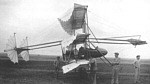
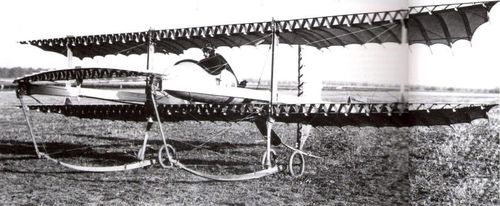
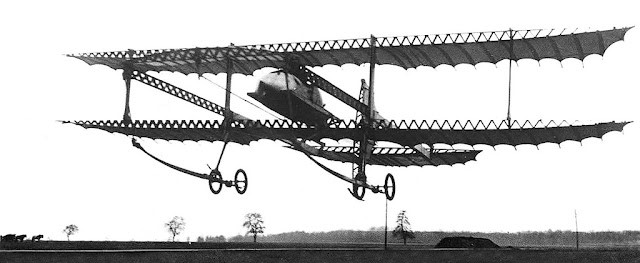
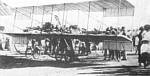
The Paulhan triplane was entered by Louis Paulhan for the 1911 military aircraft competition [Concours Militaire d’Aviation]. This Concours was the chance to get orders from the French Army. As a result the competitors entered in great numbers. 41 Aeroplane constructors entered, with a total of 138 (!) aeroplanes which were powered by 24 different engine constructors.

The Paulhan design was a mix of aluminium used for the nacelle and wood for the wings. The wing construction was elaborate as a form of wing warping was used which resembled somewhat the Taube way of wing warping. All wing tips on the three wings could be bent down almost 90 degrees. Almost always wing warping weakened the wing structure because of the regular bending of the wood in flight, making extra inspections and replacements necessary.

The engine fitted is a Renault of 80 hp driving a four-bladed propeller of 3,5 meter diameter.

The Paulhan triplane did not win any orders.

Span: 45’3″
Length: 33’5″
Weight: 2300 lb

Paulhan 1910 Machine à voler

The first biplane built by Louis Paulhan in September/October 1910 [not February 1911 as given by Opdycke] in association with Henri Fabre. This explains the Fabre like wing construction. It was a big pusher with elevator in front and huge skids, powered by a 50 hp Gnome rotary engine. A later version of the biplane, featuring ‘conventional’ wooden spars, was notable for it being able to be re-configured, so that it could be towed on a road behind a car, and also to be demountable so that all its parts could be fitted into packing crates.

Paton Monoswift

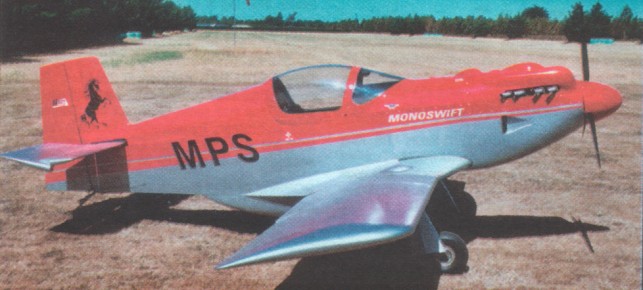
For Maurice Paton of Canterbury, New Zealand, his re¬quirements were to design an aircraft that was bigger than a Corby Starlet and about the same size as a Thorp T18, but to be a single seater and meet the micro¬light rules.

With all of these ideas in mind Maurice sat down at his computer and with the help of the C.A.D system he designed his Monoswift over a period of six months. The next step was to build a 3D surface model to prove the concept. Then followed the printing of detailed drawings of all the components at full size. This made the building easier and very accurate because each piece was built directly on top of the drawing.

Western Hemlock is the main type of ma¬terial used in the construction, with fibre¬glass being used for the wing tips and the belly fairings.

The engine option was the water-cooled 3.9-litre Rover V8 using a single, two-inch SU carburettor (instead of fuel injection) and a radiator belly scoop, which direct drives a ground adjustable, 68-inch, three-blade Warp drive propeller via a custom made adapter to the flywheel end of the crankshaft. Fuselage construction is basically a wood and ply box section, with formers for the shape and fibreglass for the non-structural cowlings, wing tips, etc.

The undercarriage is a tailwheel configuration with the main wheels attached to the main spar and folding into the lower fuselage. Engine cooling is via a radiator housed beneath the fuselage. The starting point for the drawings was a Thorp three-view, with a radiator belly scoop and a larger rudder, the undercarriage moved to the wings, a raised rear turtle deck and a reshaped engine cowl. The wing is a single piece and based on the Sirocco (that is, a box spar with no dihedral but given one degree of washout at the tips).

From start to finish the Monoswift took Maurice three years and two months to build.

The aircraft, sn MPS001, was first registered, to M J Paton, Rangiora, New Zealand, on 24 September 2003.

The aircraft was flown by Maurice from his home strip “Barraca” to the Rangiora airfield on 26-10-2003.
Maurice reports it just flies like any other plane with no real surprises. After eight hours he found it to cruise at 130 kts, stalls at 38 kts and uses 25 litres/hr. The manually operated system for the retractable undercarriage works well al¬though there is noticeable drag on the air¬craft when the wheels are going down. He approaches at 55 60 kts over the fence with good forward visibility and finds the air¬craft easy to control on the ground.
The empty weight has come out at 9001bs which allows for 300 Ibs. for fuel and pilot etc. Maurice is using a 3 blade, direct drive, ground adjustable propeller but has found that he is running out of pitch adjustment in flight. So he has purchased a new warp drive in flight adjustable propel¬ler which should see the cruise speed in¬crease to 145 150 kts. The only other mod he is considering is to add a trim tab on the elevator to unload the stick forces when the flaps are fully extended for approach and landing.

Engine: 1 x 3.9-litre Rover V8
Paterson-Francis 1913 Twin-Tractor

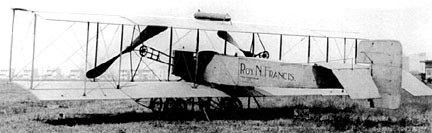
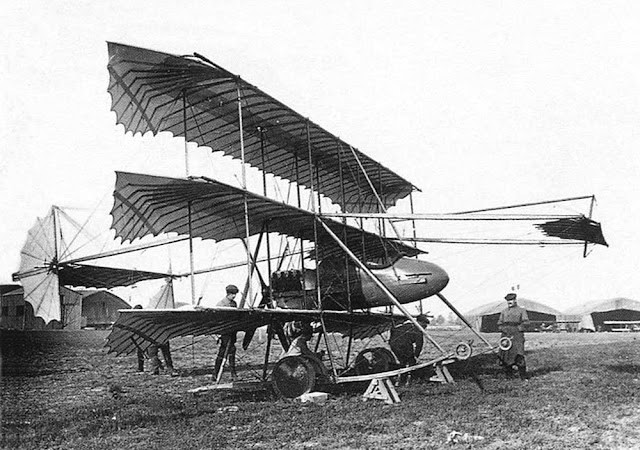
The Paterson-Francis Twin-Tractor of 1913 was a two-place open cockpit biplane. It was powered by Hall-Scott V-8 with two chain-driven props. A developed version of the 1912 Fowler-Gage, the plane’s components were designed and built in San Francisco by Francis, then shipped to Cicero IL for assembly. It crashed on its test flight and disappeared soon afterwards, either stolen or vandalized.

Paterson-Francis 1913 flying boat

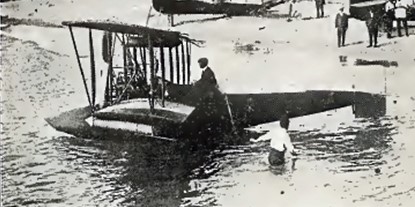
A flying boat with the engine mounted in the front of the (boat) fuselage, driving two tractor propellers via chains. Roy Noel Francis was a designer and aviator who in 1913 founded the Paterson-Francis Aviation Company. Charles Paterson was probably the financier. The machine was built in 1913 for the Great Lakes Reliability Tour. It apparently did survive the Great Lakes event and is reported to have been packed up by Francis and sent home, but nothing seems to be mentioned afterward. Around the same time, Paterson was reportedly building a monoplane flying boat.

Paterson No. 2 biplane

Paterson No. 2 biplane

The 1911 Paterson No. 2 biplane was designed by C. C. Paterson and built by Liverpool Motor House Ltd in the UK.

The 1913 Paterson No. 2bis sea-biplane was designed by C. C. Paterson and built by Liverpool Motor House Ltd in the UK.

1913 Paterson No. 2bis sea-biplane

Paterson No. 2 biplane
Span: 32′
Length: 32’9″
Weight: 750 lb

1913 Paterson No. 2bis sea-biplane
Span: 32′
Length: 32’9″