
A plans built single-seat aerobatic monoplane.

The Peña Dahu, named for the legendary French mountain animal, is a French amateur-built aircraft that was designed by Louis Peña of Dax, Landes and made available in the form of plans for amateur construction.
First flown on 9 May 1996, the Dahu is intended for mountain flying, aero-towing gliders and touring. It features a cantilever low-wing, a four-seat enclosed cockpit, fixed conventional landing gear and a single engine in tractor configuration.
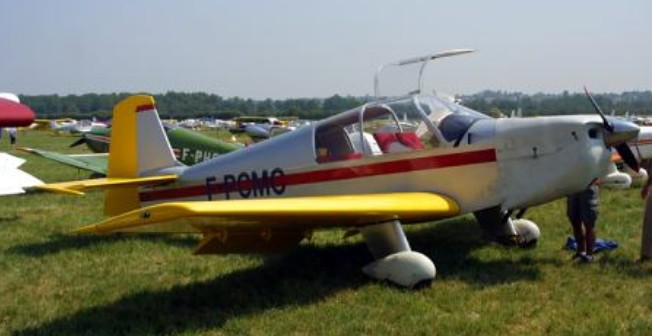
The Dahu is made from wood. Its 9 m (29.5 ft) span wing has an area of 15 sq.m (160 sq ft) and mounts flaps. The recommended engines range in power from 120 to 200 hp (89 to 149 kW) and include the 160 hp (119 kW) Lycoming O-320, 180 hp (134 kW) Lycoming O-360 and the fuel-injected 200 hp (149 kW) Lycoming IO-360 four-stroke powerplants. When equipped with a 120 hp (89 kW) engine the gross weight is limited to 900 kg (1,984 lb) instead of 1,200 kg (2,646 lb).

Plans were available in 2012, the 2011 price was €600.
Engine: 1 × Lycoming O-360, 130 kW (180 hp)
Propeller: 2-bladed metal constant speed propeller
Wingspan: 9 m (29 ft 6 in)
Wing area: 15 sq.m (160 sq ft)
Empty weight: 600 kg (1,323 lb)
Fuel capacity: 200 litres (44 imp gal; 53 US gal)
Maximum speed: 310 km/h (193 mph; 167 kn)
Cruising speed: 230 km/h (143 mph; 124 kn)
Stall speed: 80 km/h (50 mph; 43 kn)
Rate of climb: 6 m/s (1,200 ft/min)
Wing loading: 80.0 kg/m2 (16.4 lb/sq ft)
Crew: one
Capacity: three passengers
Engine: 120 hp (89 kW)
Wingspan: 9 m (29 ft 6 in)
Wing area: 15 sq.m (160 sq ft)
Gross weight: 1,200 kg (2,646 lb) 900 kg (1,984 lb)
Fuel capacity: 200 litres (44 imp gal; 53 US gal)
Crew: one
Capacity: three passengers
Engine: Lycoming O-360, 180 hp
Wing span: 8.6 m
Wing area: 16.1 sq.m
MAUW: 1200 kg
Empty weight: 560 kg
Cruise speed: 200 kph
Seats: 4
Plan price (1998): 4000 F

A plans built tandem two-seat aerobatic monoplane of wooden construction.
Engine: Lycoming O-360, 200 hp
Wing span: 8.4 m
Empty weight: 575 kg
Fuel capacity: 130 lt
Max speed: 310 kph
Cruise speed: 280 kph
Minimum speed: 95 kph
Climb rate: 12 m/s
Seats: 2
Plan price (1998): 5000 F
France
Louis Pena offers plans to construct Bilouis 01 tandem two-seat aerobatic monoplane, Bilouis Dahu four-seat tourer and Capena 01 single-seat aerobatic monoplane.
1998:
6, impasse du grand Piton
F-40100 Dax
France
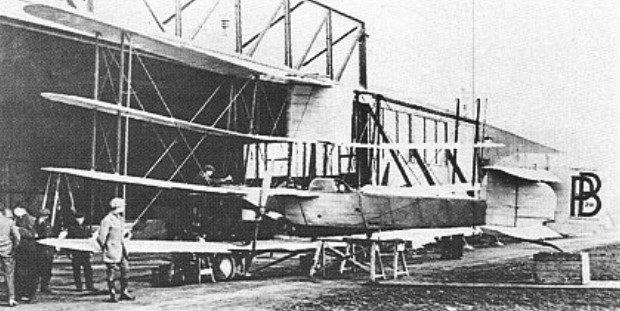
The 1915 P.B.29E twin-engined quadruplane interceptor fighter was conceived as an anti-airship aircraft. Intended to be capable of prolonged cruise at low speeds during the nocturnal hours, and built in seven weeks from beginning of design, the P.B.29E featured high aspect ratio wings with a pair of 90hp Austro-Daimler six-cylinder water-cooled engines underslung from the second mainplane and driving pusher propellers. The entire wing cellule was braced as a two-bay structure, the fuselage being attached to the second wing and accommodating two crew members, and a gunner with a single 7.7mm machine gun occupying a nacelle that filled the gap between the centre sections of the upper mainplanes. The P.B.29E was flown in the winter of 1915-16, and was destroyed comparatively early in its flight test programme, but aroused sufficient interest to warrant development of the P.B.31E of similar concept. No data relating to the P.B.29E are available.

Known officially as the Scout, the P.B.25 was a development of the P.B.23. The most obvious differences were in the design of the nacelle, which was fabric covered, and in the wing cellule, the mainplanes featuring 11 degrees of sweepback and inversely-tapered ailerons. Twenty P.B.25s were ordered by the Admiralty, all but one of these being powered by the 100hp Gnome Monosoupape, the exception having a 110hp Clerget rotary. Armament comprised a single 7.7mm machine gun mounted on the nacelle. The last P.B.25 was delivered to the RNAS in February 1917, by which time this type had acquired an unenviable reputation, the take-off and landing characteristics being particularly hazardous. Apart from poor flying qualities, its performance was inadequate and, being viewed as something of an anachronism, the Scout was quickly discarded.
Max take-off weight: 699 kg / 1541 lb
Empty weight: 490 kg / 1080 lb
Wingspan: 10.04 m / 33 ft 11 in
Length: 7.34 m / 24 ft 1 in
Height: 3.17 m / 10 ft 5 in
Wing area: 25.73 sq.m / 276.96 sq ft
Max. speed: 143 km/h / 89 mph

Designed in 1915 by Noel Pemberton-Billing, and built by the company bearing his name, the P.B.23E single-seat pusher fighting scout biplane was of wooden construction, but the nacelle mounted between the wings and accommodating the pilot was unusual for its time in being covered with light alloy sheet metal. Armament consisted of a single 7.7mm machine gun mounted in the nose of the nacelle and power was provided by an 80hp Le Rhone rotary. The P.B.23E was first flown in September 1915, but was not adopted in its original form, being further developed as the P.B.25.
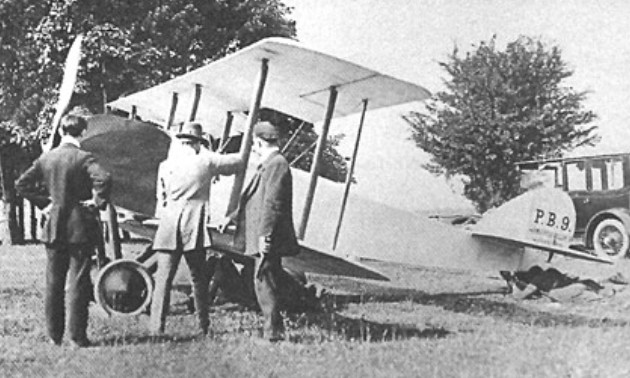
A single-seat open-cockpit equal span biplane scout aircraft, built by Pemberton-Billing Limited, which later became the Supermarine Aviation Works. Only one P.B.9 was built. The wings had full span spars with the upper and lower wings connected by four pairs of interplane struts. The fuselage had a fixed landing gear with a tail skid. While designed to allow the use of Grome 80 hp engine the prototype P.B.9 was powered by a 50 hp (36 kW) Gnome rotary engine taken from the company’s prototype P.B.1. Using a set of wings that had been obtained from Radley-England it was designed, built and made its first flight within nine days, though for publicity reasons its designer Noel Pemberton Billing claimed it had taken a week (giving rise to the nickname “Seven Day Bus”). It was first flown August 1914. Although the aircraft performed well only the prototype was built. it was later used by the Royal Naval Air Service as a trainer.
Exhibited at the 1914 Olympia Show.
The 1911 Pelliat monoplane was designed and built by Pelliat in France.
Span: 28’7″
Length: 28’3″
Weight empty: 507 lbs

