Percival P.6 Mew Gull

The Percival Mew Gull G-AEXF was designed by Captain Edgar W. Percival and produced in 1936. This clean, low-winged monoplane, with a finely streamlined cockpit cover and a spatted undercarriage, was designed for racing and six were built.

Percival P.6 Mew Gull Article

Alex Henshaw exchanged his de Havilland Leopard Moth for a Mew Gull in 1937, and achieved the fastest times in many air races and won the Folkestone Aero Trophy in the same year.

During this period Alex met Jack Cross of Essex Aero Ltd who made mechanical and structural alterations to XF in order to win the 1938 King’s Cup. The effect was a dramatic increase in performance and resulted in winning success in the King’s Cup at a speed of 380.2km/h (236.25mph).
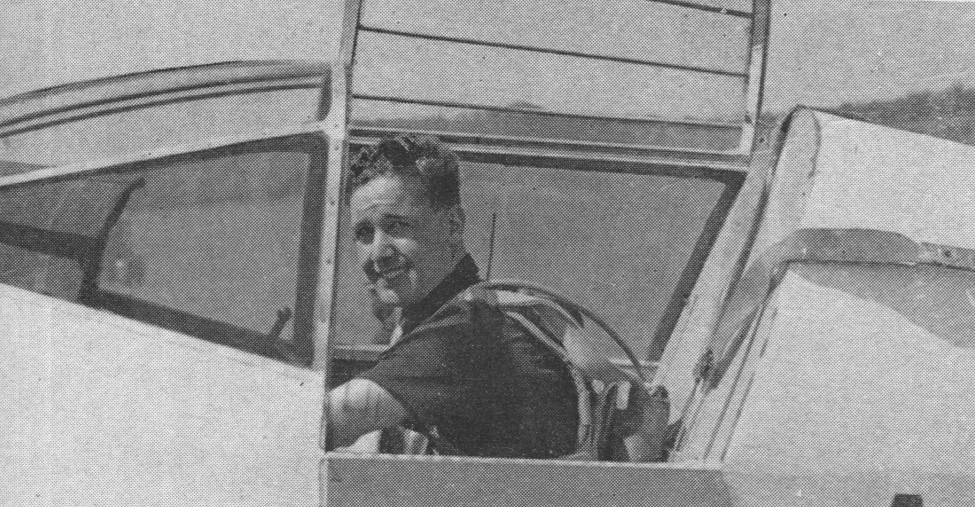
Alex Henshaw in Mew Gull

Alex then decided to attempt the solo records on the England to Cape Town route. He set off from Gravesend on 5 February 1939 and after four days returned having broken all records on this route. They remain unbroken to this day for an aircraft in this class. Each leg took 39 hours 23 minutes at an average speed of approximately 334.7km/h (208mph).

The Mew Gull was sold in the late summer of 1939 to a Frenchman. XF remained hidden from the Germans throughout the Second World War occupation of France. It then passed through a number of different owners before eventually being bought by Robert Fleming in 2002.
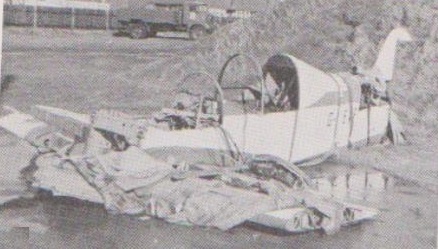
Mew Gull G-AEXF ‘displayed’ at Reflectaire Museum at Squires Gate on 20 February 1971, prior to restoration by Tom Storey

In 2008 XF was still operated by The Real Aeroplane Company at Breighton in Yorkshire.
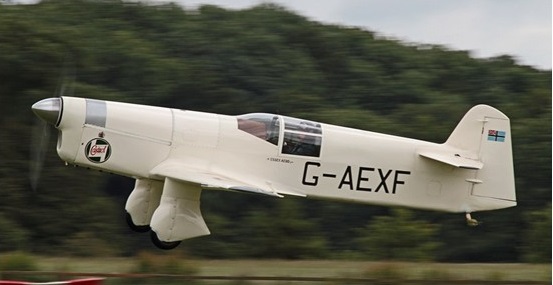
Gallery

Engine: 165 hp Napier Javelin
Length: 18.23 ft (5.56m)
Wing span: 24 ft (7.32m)
Weight empty: 1,000 lb (450 kg)
Max speed: 195 mph (314 kph)
Range: 550 miles (885 km)
Seats: 1
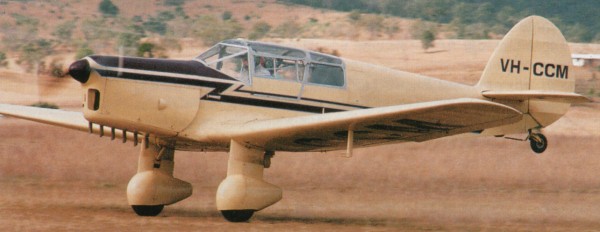
Percival P.3 Gull Six

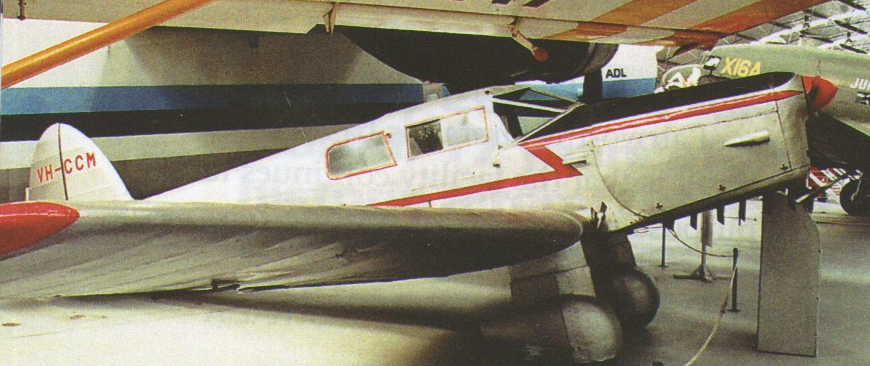
The prototype Gull G-ABUR flew in 1932 as a 3 seat touring aircraft, all wooden construction, powered by a 130hp Cirrus Hermes IV. The aircraft was designed by Australian Edgar Percival and constructed by Lowe-Wylde British Aircraft Company at a small glider factory Maidstone, Kent. The following year the prototype was re-engined with a Napier Javelin II, and its speed and performance was further improved. Edgar Percival flew it in races in England and it was later written off in Rhodesia during a speed record attempt to the Cape.

Percival P.3 Gull Six Article

The first production model was the Percival “D” Series Gull, 29 built by George Parnall and Company at their works at Yate, Gloucestershire under contract to Percival Aircraft Co Ltd. They were designated D.1 or D.2 depending on engine installed, top/side hatch cockpit entry and tripod undercarriage legs, but were all called Percival Gull IV. In 1934 Percival Aircraft Co Ltd established its own works at Gravesend Airport, Kent. Here 19 type D.3 Gulls named the Percival Gull VI were built, featuring side opening cockpit doors and single leg undercarriage with spats, powered by a 200hp Gipsy Six.

Gull Six VH-CCM

Gull Six
Engine: de Havilland Gypsy Six I, 184 hp at 2,100 rpm / 205 hp at 2,350 rpm. for takeoff.
Propeller: two-bladed fixed-pitch
Wingspan: 36 feet, 2 inches (11.024 meters)
Length: 24 feet, 9 inches (7.544 meters)
Height: 7 feet, 4½ inches (2.248 meters)
Empty weight: 1,170 pounds (530.7 kilograms)
Gross weight: 2,050 pounds (929.9 kilograms).
Max speed: 178 miles per hour (286.5 kilometers per hour)
Service ceiling: 16,000 feet (4,876.8 meters)
Range: 700 miles (1,126.5 kilometers).
Crew: 1
Passengers: 2

Percival P.1 Gull Four

A liaison aircraft of 1932, twenty-nine of this type were built circa 1934.

Mk.III
Engine: de Havilland Gipsy Major, 130 hp
Max speed: 153 mph

Mk. 4
Length: 24.738 ft / 7.54 m
Height: 7.021 ft / 2.14 m
Wingspan : 36.089 ft / 11.0 m
Max take off weight : 2249.1 lb / 1020.0 kg
Max. speed : 124 kts / 230 km/h
Service ceiling : 16076 ft / 4900 m
Range : 486 nm / 900 km
Crew : 2+2

Percival Aircraft Ltd

Percival Aircraft Ltd formed in 1932 by Australian born aircraft designer Edgar. W. Percival and E. W. B. Leake at Gravesend, Kent, moving to Luton, Bedfordshire, in 1937. Built series of successful light aircraft beginning with the single-engine Gull and later twin-engine Q-6 six/seven seat cabin monoplane. Percival Gulls were used for a number of record-breaking flights, and the type was developed into the Proctor light communications aircraft. Several Mew Gull racers were built in the late 1930s. After Second World War, production of the Proctor continued for civilian customers, while a new three-seat trainer, the Prentice, appeared in 1946 and was built in quantity for the RAF and several overseas air forces. It was followed by the Provost trainer, ordered for the RAF in 1951. Following the experimental Merganser light transport of 1946, a larger version, the Prince, flew in 1948 and was produced in civil and military versions.
During 1944 the Percival Company was absorbed by the Hunting Group in the UK.

A change of name is announced in April 1954, by Percival Aircraft, Ltd. who will be known as Hunting Percival Aircraft, Ltd. The change of name was to provide more complete identification with the parent Hunting Group, and then Hunting Aircraft in 1957.

Percevant, Emile

Emile Percevant was a policeman from Rétiers in eastern Brittany. His “Metalloplan” pusher canard monoplane bicycle was built in 1913.

Although the Metalloplan company did not have much luck with aircraft, it seems they made successful business manufacturing bikes and motorbikes, and were active at least into the 1950s.

Pepper 1911 biplane

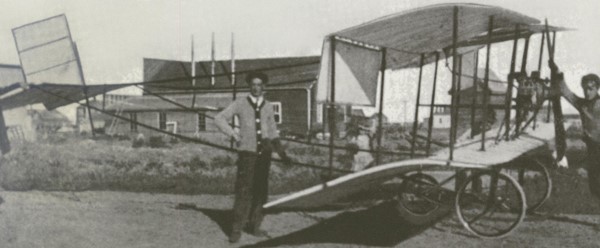
George and Ackley ‘Ace’ Pepper did their flying in Davidson, Saskatchewan, Canada. The machine was built with community support during 1910-11, mainly of wood and bamboo, powered by a 20-30 hp Detroit aero engine. A first flight attempt in July 1911 resulted in a damaged undercarriage and propeller, but another attempt on Aug. 1 was successful, but resulted in a crash.

Penkala 1910 Biplane / Leptir / Cvjetkovic CA-10 Penkala

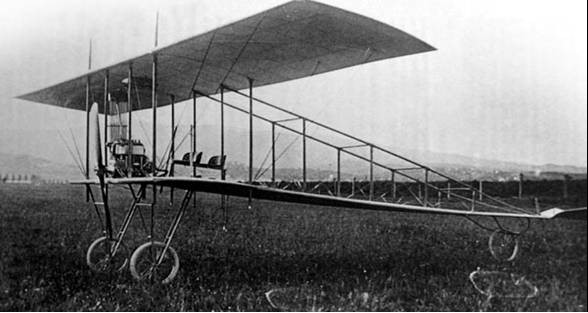
Slavoljub Penkala was interested in flight and decided to buld his own airplane, pretty much making it up as he went along. He patented it in late 1909 and the plane was ready for its first flight by June 1910. The funding came from Penkala’s own income from his pen and pencil factory, and a lot of the work and ideas also came from Dragutin Novak, who joined Penkala earlier the same year.

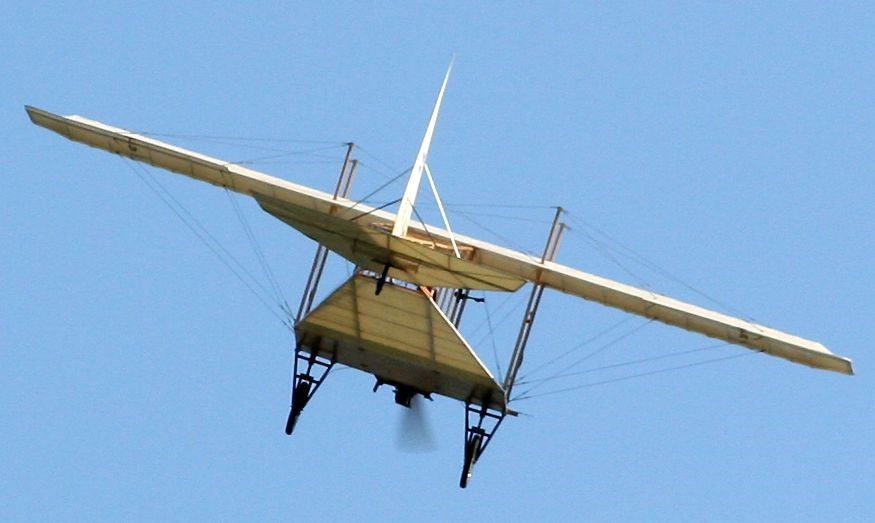
The Leptir (English: Butterfly)was a single engine, sesquiplane aircraft with conventional landing gear. The open girder fuselage provides an unusually long distance to the tail surfaces, compared to modern aircraft. The flat bottom surface of the fuselage was covered, forming a long thin triangular surface intended to provide lift, which was not functional in level flight. The aircraft was tail heavy with a center of gravity at 70 percent of wing chord.

The first flight occurred on 22 June 1910 with pilot Dragutin Novak. The 1910 Leptir II featured modifications to include skids. The aircraft was crashed several months later.

The CA-10 replica was built in 2010 and known as the Cvjetkovic CA-10 Penkala, bearing the registration of 9A-XCA. It was powered by an 80 hp (60 kW) Rotax 912 with the center of gravity moved forward for safety.

Cvjetkovic CA-10 Penkala

Penkala Biplane
Propeller: 2-blade
Wingspan: 11 m (36 ft 1 in)
Length: 11 m (36 ft 1 in)
Empty weight: 330 kg (728 lb)
Crew: 1

Penkala, Slavoljub Eduard

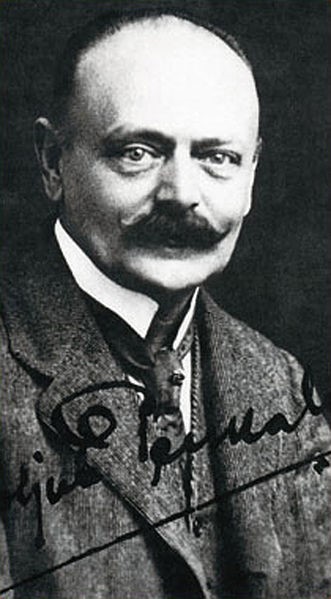
Slavoljub Penkala in 1920

Eduard Penkala (Croatian pronunciation: [slâʋɔʎuːb ɛ̂duard pɛŋkǎːla]) was born in Liptószentmiklós (now Liptovský Mikuláš), then part of Austria-Hungary, to Franciszek Pękała, who was of Polish heritage, and Maria Pękała (née Hannel), who was of Dutch descent. He attended the University of Vienna and Royal Saxon Polytechnic Institute, graduating from the latter on March 25, 1898, and going on to earn a doctorate in organic chemistry. During his studies, he attended violin lessons where he met his future wife, pianist Emily Stoffregen. He then moved with his wife to Zagreb (which was then in the Kingdom of Croatia-Slavonia). To mark his loyalty to his new homeland, he took on the Croatian name Slavoljub (Croatian for “slavophile”), becoming a naturalized Croat.

He became renowned for further development of the mechanical pencil (1906) – then called an “automatic pencil” – and the first solid-ink fountain pen (1907). Collaborating with an entrepreneur by the name of Edmund Moster, he started the Penkala-Moster Company and built a pen-and-pencil factory that was one of the biggest in the world at the time. The company, now called TOZ Penkala, still exists today.

He also constructed the first Croatian aircraft to fly in the country, the Penkala 1910 Biplane, flown by Dragutin Novak, who was also the first Croatian pilot. He constructed and invented many other products and devices, and held a total of 80 patents.

He had four children with his wife, Emily.

Penkala died in Zagreb at the age of 50, after catching pneumonia on a business trip. He was buried at the Mirogoj Cemetery.