Two subsequent Pigeon aircraft were the I and much larger II, a three bladed prop biplane of which only three were made. They were used by N.A.T. in the early 1930’s.
Aircraft
Pigeon Hollow Spar Co Model I
Two subsequent Pigeon aircraft were the I and much larger II, a three bladed prop biplane of which only three were made. They were used by N.A.T. in the early 1930’s.
Pigeon Hollow Spar Co Thomas-Pigeon

The Pigeon Hollow Spar Company also produced a flying boat called the Thomas-Pigeon about 1920. This hydroplane was built for Reginald deNoyes Thomas, a WWI naval aviator and director of the Thomas-Pigeon Aeroplane Corporation of Boston, Massachusetts.
The fuselage is spruce and ash ribboned all-wood construction with mahogany planking. This type of construction was said to insure safety, long life and reliability in all weather conditions.
The engine is mounted over the fuselage and below the upper wing. The only control is a joystick, and it may never have been completed.
The fuselage of which was located and purchased by Cole Palen, and reported in 1994 at “Yanks Air Museum in Chino.”
Pigeon-Fraser Albree Scout / Model 9 / Timson-Albree / SG
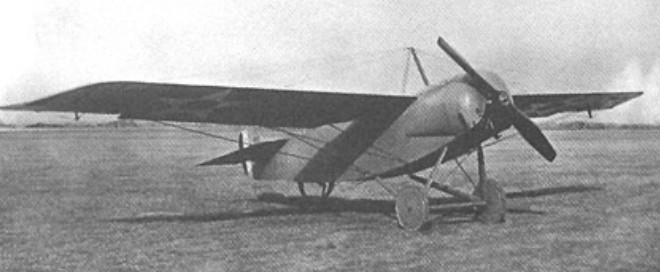
At a time when the biplane configuration had become the norm for single-seat fighting aircraft, George N Albree designed a single-seat shoulder-wing monoplane intended for use as a fighting scout. Ordered by U.S. Army April 17, 1917, two prototypes were delivered to the US Army Signal Corps by the Pigeon Hollow Spar Company in September 1917.
The aircraft was of wooden construction and powered by a 100 hp Gnome rotary engine. A unique design concept of the aircraft was that the “rudder” was not used for flight control, but only to compensate for engine torque. Also the Scout quite possibly was the very first aircraft design to invoke the use of an all ‘flying tail’ as the entire tail assembly was hinged behind the cockpit moving up and down for elevator control. It is believed to be the first aircraft to utilize a flat-bottomed airfoil, and uniquely designed spring-type wheels were used to provide shock absorption.
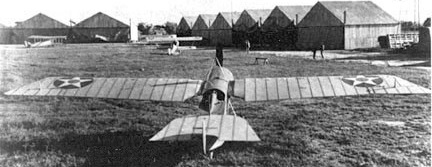
First aircraft Model SG- SC-#116 delivered in September 1917 and SG- SC #117 followed in November 1917. First flight: both were flown and successfully tested by contract pilots including Eddie Stinson, at Langley Field, VA. There were no official flights authorized to be made for the U.S. Army acceptance process.
The third Model SG order under the same contract was for a fuselage only, no engine to be provided and with instructions for it to be shipped to the Colt Arms Company, Hartford, CT. The SG fuselage was completed and shipped in the fall of 1917.
The two Model SGs for the Army had their SC Serial #s: high on the vertical stabilizer for #117, and lower for #116). U.S. Army standard aircraft wing star markings for 1917. The first pursuit aircraft contracted for by the United States.
The aircraft was intended to be fitted with a single machine gun, but no armament was ever provided and the Signal Corps considered the aircraft both unreliable and too slow. The fisrt aircraft was tested to destruction, while reportedly the second aircraft was test flown on behalf of the USASC, crashing on its first flight, killing the pilot. The USASC considered the aircraft both unreliable and too slow, consequently, no series production was undertaken.
A third unfinished aircraft was stored in the rafters of the Pigeon Company. It was bought by Cole Palen on November 15, 1961, and restored for display at the Old Rhinebeck Aerodrome Museum.
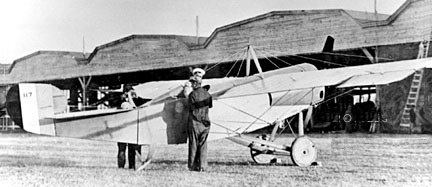
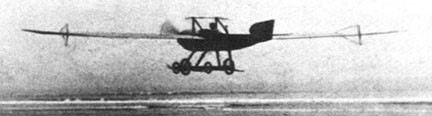
A Pigeon with 50hp Gnôme engine constructed by Roscoe P Timson and flown at Nahant Beach twice in 1916 by Clifford Webster of Lowell, a test pilot for Burgess Airplane Co.
Of the 4 built, of which 3 for US Army, but were not accepted after testing at McCook Field—one reportedly was a static test model, one crashed and burned in a test flight, one was put in storage by Pigeon Co, and info on the fourth is imprecise, but it could be Albree’s plane. Photos verify the existence of four aircraft, with two of them identified as c/n 9 and s/n 117.
Engine: 100 hp General Vehicle-Gnome rotary
Span: 37ft 11in (11.56 m)
Length: 24 ft (7.32 m)
Height: 8 ft 8.5 in (7.32 m)
Weight T/O: 1250 lb (557 kg)
Speed max: 103 mph (166 kmh)
Seats: 1
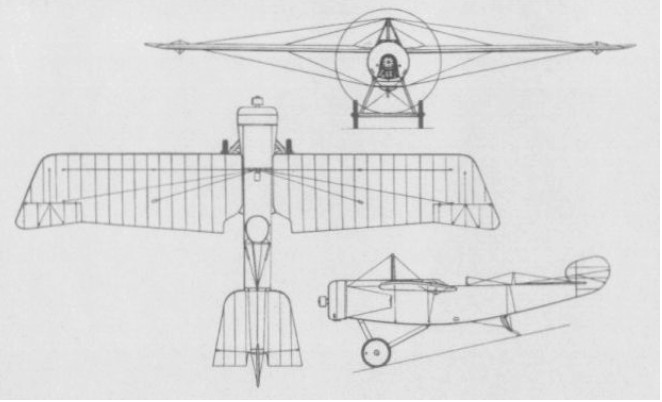
Pigeon-Fraser / Pigeon Hollow Spar Co
1830:
Henry Pigeon Mast & Spar Co,
Boston MA.
USA
1900:
Pigeon Hollow Spar Co,
131 Coleridge St,
Boston
USA
The company also built automobiles and gondolas for airships prior to their foray into the airplane field. It was still active in watercraft to about 1979.
Piffard No. 2 biplane
The 1911 Piffard No. 2 biplane was designed and built by H. H. Piffard in the UK.
Span: 34′
Length: 31′
Weight all up: 850 lbs
Pietsuj PAI-6
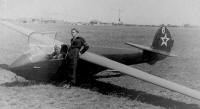
Between 1947 and 1948, the test pilot and aeronautical constructor Alexei Ivanovich Pietsuj developed two new projects at the MAI that were called PAI-5 and PAI-6 (Russian: Пьецух ПАИ-6).
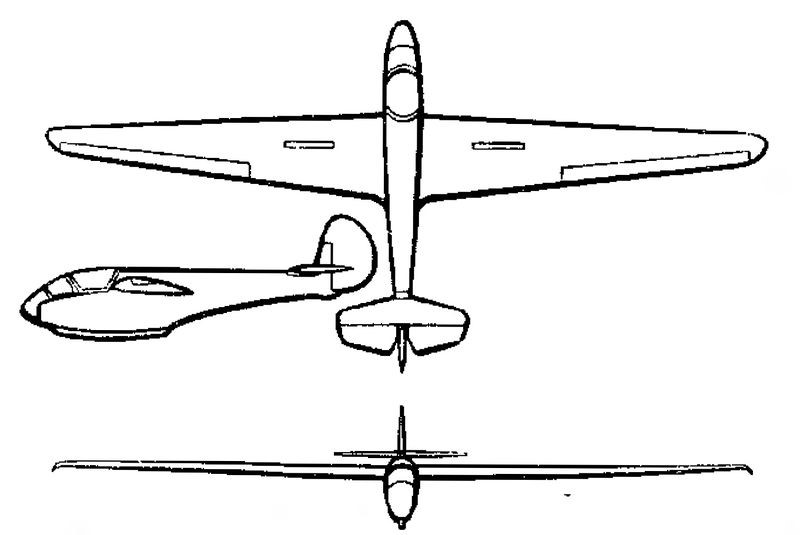
The PAI-6 was designed as a single-seater training glider to take advantage of thermal flight and had full aerobatic capabilities. It was generally similar to the previous PAI-5, but was notable for its increased wingspan.
The PAI-6 was a high-cantilever glider with a large trapezoidal high-wing.
The glider was built entirely of wood. The fuselage had a simple construction made up of 24 frames joined by three stringers and a set of stringers. The exterior coating was made with plywood between 1.5 and 2 mm thick. The cross section was oval, with downward elongation. In the upper part of the fuselage, a slit was made, crossed by the force elements of the wing. An aluminium cover was placed over this slit.
The wing composition comprised two trapezoidal-shaped consoles in plane joined at their bases on the longitudinal axis of the apparatus. The consoles had a TsAGI R-Sh profile of constant relative thickness (15.5%) and were fixed to the fuselage by means of four points of two reinforced frames located in the upper part. The two consoles were joined together by screws and conical fixings. The fixing points to the frames were located on the spar and on the last wing spar.
The wing featured a single spar structure with ends working by twisting. The stringer was made up of two faces with plywood partitions. The wingtips and the frontal region of the wing were covered with plywood and the rest with fabric covered with paint.
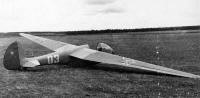
The ailerons were attached to an auxiliary spar at three points and featured a single spar structure with diagonal ribs. The front part was covered with plywood and the rest with fabric. The wing-end interceptors were conceived as smooth pine frames with fabric covering on both sides. Each interceptor was attached to the wing spar by three points.
The horizontal tail plane was raised to the top line of the fuselage and positioned in front of the vertical tail. The stabilizer featured a single spar construction with plywood overlay. The elevators also used a single spar and coating similar to that of the ailerons.
The keel was an integral part of the fuselage construction and ended in a rudder with aerodynamic compensation. This rudder featured a two-stringer structure. From the leading edge to the second spar the covering was plywood and from there on fabric. All rudders featured three-point fixation. The landing was made on a wooden ski, with a trunk structure, located in the lower part of the fuselage.

The cockpit, located in front of the wing, was closed by a cover that protruded from the upper line of the aircraft. The flight control was mixed with control of the ailerons by means of ropes and bars for the control of the tail planes.
The control of the interceptors and the tow hook was also carried out by cables, with actuators located on the sides of the cockpit.
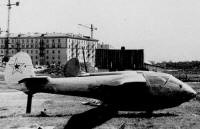
Once the tests were completed from the GK NII VVS Experimental Factory, improvements were made to the original design and the entire set of plans and technical diagrams was created to launch production. In Ryazan, Moscow, a small series was built in 1949. Its main destination was the flying clubs of the country. PAI-6 participated in several air parades for Aviation Day in Túshino.
An improved version of this glider known as PAI-6M was built in the early 1950s at the MAI. This aircraft was never flown and was destroyed as a result of the cooling towards the gliders that occurred in the USSR in those years.
PAI-6
Wingspan: 12.4 m
Wing area: 11.8 m²
Aspect ratio: 13
Length: 5.41 m
Height. 1.35 m
Glider weight: 193 kg
Wing loading: 24 kg / m²
Stabilizer surface: 0.9 m²
Elevator area: 0.75 m²
Keel surface: 0.17 m²
Rudder surface area: 0.85 m²
Spoiler area: 1.58 m²
Minimum descent speed: 0.82 m / s
Cruising speed: 85 km / h
Landing speed: 60 km / h
Max glide ratio: 24
Accommodation: 1
Pietsuj PAI-5
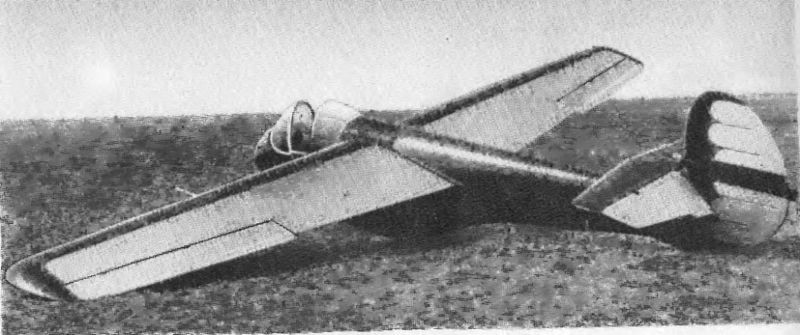
Between 1947 and 1948, the test pilot and aeronautical constructor Alexei Ivanovich Pietsuj developed two new projects at the MAI that were called PAI-5 and PAI-6. The Pietsuj PAI-5 (Russian: Пьецух ПАИ-5) was designed as a single-seater competition glider and was built at the GK NII VVS experimental factory in 1947.
The PAI-5 was designed as a high cantilever glider with a small trapezoidal wing.
The glider was built entirely of wood. The fuselage had a simple construction made up of a series of frames joined by four stringers. The outer covering was made with plywood. The wings had an R-Sh profile. The wingtips were covered with plywood and the rest with paint coated fabric.
The horizontal tail plane was raised to the top line of the fuselage and positioned in front of the vertical empennage.
The landing was made on a wooden ski, with a trunk structure, located in the lower part of the fuselage.
The cockpit, located in front of the wing, was closed by a cover that protruded from the upper line of the aircraft.
The PAI-5 glider was tested in February 1948. Pietsuj himself flew the model in front of a group of renowned test pilots, most notably Air Marshal Ye. During the test flight the complete set of high school aerobatics was executed and an overload of 8g was achieved at speeds of 220 km / h.
During the celebration of Air Fleet Day in 1948 Pietsuj made a demonstration of high school piloting. For the design and construction of this glider AI Pietsuj received the Order of the Red Star.
Pietsuj PAI-3
The Pietsuj PAI-3 (Russian: Пьецух ПАИ-3) was a glider designed and built by Alexei Ivanovich Pietsuj as a single-seater training apparatus for the preparation of Class B sport pilots and was built in 1937.
It was designed with the aim of replacing the Gribovski G-9 and Antonov BS-5 gliders, already outdated for the time. It was necessary to have a training glider capable of being towed from another plane and performing all kinds of high school stunts in all weather conditions.
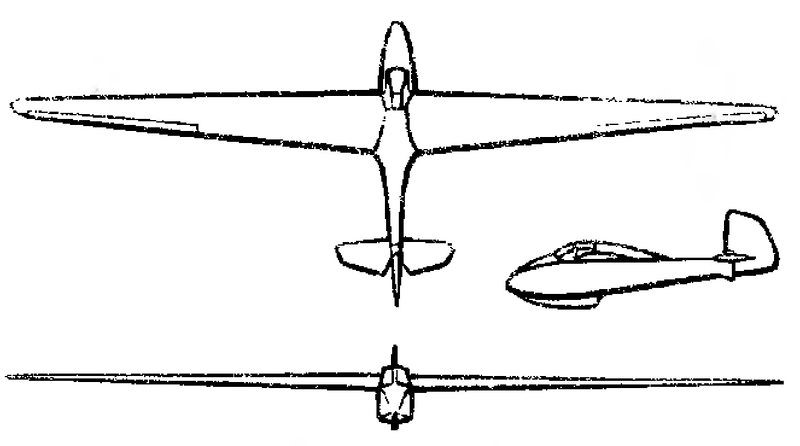
The PAI-3 was designed as a high-wing cantilever monoplane with a trapezoidal wing and high aspect ratio.
The fuselage had a simple construction made up of a series of frames joined by four stringers. The outer covering was made of 2 mm thick plywood covered with fabric.
The wing construction incorporated a single main spar, a secondary spar, and a set of ribs. To fix the ailerons another small auxiliary spar was used. The wing tip was covered with plywood, but the rest of the coating was made of fabric covered with several layers of paint.
The empennage featured a large rudder attached to the shallow keel at three points. The horizontal empennage featured two non-stabilized elevator rudders.
At the bottom of the fuselage there was a ski with a trunk structure, without amortization.
The spacious cabin featured an angular deck constructed of duralumin and celluloid.
From a production point of view the Pietsuj PA-3 glider was easier and cheaper to produce than the Gribovski G-9 and Antonov BS-5.
The flight tests of the PA-3 glider were developed by pilot PI Shelest. Despite showing good performance, series production was not approved. Only the one prototype was built.
Pietsuj, Alexei Ivanovich
Alexei Ivanovich Pietsuj (Russian: Алексей Иванович Пьецух) was born in 1918 in Vínnitsa, Ukraine. At age 16, he built a small glider, called PAI-1, in which he learned to fly and demonstrated at Aviation Day parties in Kiev. For this device he would receive the award for the youngest constructor in the national competition for light aircraft.
Later, working in the Osoaviajim Glider Factory and under the direction of Oleg Konstantínovich Antonov and BN Sheremetiev he would build his second model, called PAI-2 “Pavel Golovin” in 1937, followed by PAI-3in 1937 itself. Pietsuj worked as a teacher at the glider school, developing the PAI-4 tailless glider in that period.
From 1939 on he was called up to serve in the ranks of the Red Army.
During the Great Patriotic War he served as a tug pilot in the glider section of the air landing troops. He was tasked with piloting an Ilyushin Il-4 to tow gliders towards the front line, but Pietsuj requested a fight. After his request was denied three times, in reply he made a dead link between Nesterov and the Il-4. His performance was branded as “dangerous vandalism”, for which he was handed over to a court, demoted to the ranks and sent to a punishment battalion. On his first night he made seven combat sorties in a Polikarpov Po-2 bomber. After two months the accusation was withdrawn in court.
As a pilot of the 44th Guards Bombardment Aviation Regiment and the Don Red Flag belonging to the 9th Guards Bombardment Division, he carried out 91 combat sorties. He participated in the fighting for Warsaw.
In the spring of 1945 in Germany and with the help of several soldiers, he managed to assemble a flight-capable Messerschmitt Me-410 using components from three aircraft. At the controls of the Me-410 he airlifted it to Moscow. In June this aircraft was tested on the NII VVS.
After the victory he began working as a test pilot in the GK NII VVS, serving in the V. Ye squad. Golofastov. At this stage he built the PAI-5 (1947) and PAI-6 (1949) gliders with aerobatic capacity, which participated in several aerial demonstrations for the Air Fleet Day in Túshino. He was the test pilot PAI-5 (02- 1948) towed gliders Antonov A-7 from Ilyushin Il-4. As a test pilot he flew in more than 60 types of aircraft and gliders.
In the early 1950s Pietsuj organized a student construction bureau among the students of the Moscow Aviation Institute. In this institution he developed the glider models PAI-6M (1952), MAI-56 (1956), MAI-63 (1964), MAI-68 “Pushinka” (1970) and the MAI-58 (1958) and MAI- 62 (1962), as well as the MAI-63M motor glider. He personally tested the MAI-53 models in 1954, MAI-56 in 1958, MAI-62 in 1965, MAI-63 in 1964 and MAI-63M in 1965.
He lived in the village “Liotchik Ispitatiel” (Test Pilot) of the city Iksha, in the Moscow suburbs. He built a house made of bottles there. He died in 1994.
Military grade
Captain
Awards and distinctions
Order of the Great Patriotic War Second Class (5-02- 1988)
Twice Order of the Red Banner (04- 1945, 1948)
Medals
Pietsuj was the author of several articles published in the pre-war period in the magazine “Samoliot”.
He wrote the book “Krylya Molodiozhi” (Youth Wings), published by the Moscow publishing house “Oborongiz” in 1954.

