Markets plans and some components to construct a wide range of light aircraft, including P.50 Bouvreuil single-seat monoplane (first flown 1979), P.60 Minacro single-seat aerobatic biplane, P.70S single-seat monoplane, P.80S single-seat monoplane, P.100TS two/three-seat monoplane (first flown 1980), P.110TS three-seat monoplane, P.170S tandem two-seat monoplane, P.180S side-by-side two-seat monoplane, P.190S Castor side-by-side two-seat monoplane as wooden version of metal P.180S, P.210S Coati single-seat monoplane, P.220S Koala side-by-side two-seat version of Coati, P.230S Panda three-seat monoplane, P.240S Saiga four-seat version of Panda, and P.300 Ara three-seat monoplane (kits anticipated).
A new Heinkel company (mid of fifties) began by forming the Flugzeug Union-Süd Group, in collaboration with Messerchmitt AG., to produce 210 Fouga Magister for the new German air force. In cooperation with Potez, it developped from the Magister a new four seat executive, training and liaison aircraft known as the Potez-Heinkel CM-191. Heinkel was entirely responsible of the production.
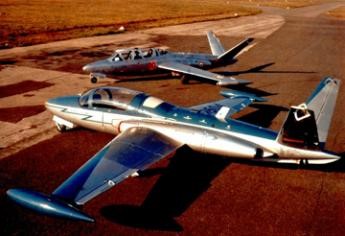
The prototype of the four-seat Potez-Heinkel CM191 was flown for the first time at Toulouse on 19 March 1962. Jacques Grangette, Potez’s chief pilot was at the controls, with P.Caneill. The CM 191 first flight lasted forty minutes and a second flight of one hour and ten minutes duration was made on the same day.
Two prototypes were built. They were for many years as experimental aircraft to test various equipment or as liaison aircraft
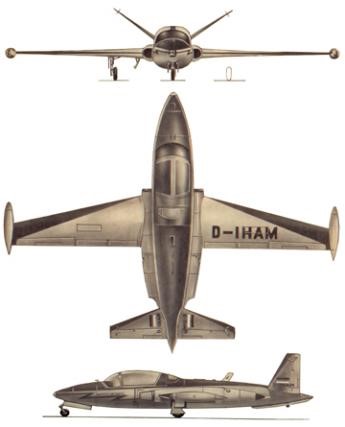
Potez – Heinkel CM191 # 1 received a double registration from the beginning as D- 9504 and D- IHAM. It made its first flight in Toulouse March 19, 1962 and after 109 hr of manufacturer flight testing it was issued to the CEV Istres for testing .
It was subsequently delivered to Germany where it finished its career with 61 Erprobungsstelle Manching. This aircraft was registered in the United States, where it has changed ownership in 2008, to be based in Elk Grove, Illinois.
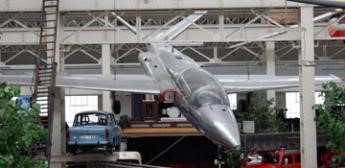
Potez – Heinkel CM191 # 2 received the registration D- 9532 and completed its career with 61 Erprobungsstelle Manching. This aircraft is now preserved and exhibited at the Am Technik Museum, Speyer, Germany.
Potez – Heinkel CM- 191 # 2 D- 9532
Variants:
CM.191 – 1956 4-seat corporate jet deriv. of CM.170, 2 x Marboré IV, 2 built CM.191: aka Potez-Heinkel C.M.191, aka Heinkel P.191, first flown 1962
CM.192 – Messier project nos. 48046/48007 and 27457/48008 CM.192: Flight 1 June 1961 ident. Potez-Heinkel C.M.192 as per C.M.191
Engines: 2 x Marboré IV Span, without tip-tanks: 12,02 m (39 ft. 5 in) Span, with tip-tanks: 12,70 m (41 ft. 8 in) Length: 9,93 m (32 ft. 7 in.) Height: 3,20 m (10 ft. 6 in.) Weigth empty: 2 391 Kg (5,271 lb.) Max Payload: 380 kg (838 lb.) Max TO weight: 4 350 Kg (9,590 lb.) Max 0 fuel weight: 3 005 Kg (6,625 lb.) Max wing loading: 231 Kg/m² (47.3 lb/sq ft) Max. Speed: 710 kmh (441 mph) Max. Permissible speed: 740 kmh (460 mph) Max. Crusing speed: 605 kmh (376 mph) Stalling speed: 148 kmh (92 mph) Max rate of climb: 906 m/mn (2970 ft/mn) Service ceiling: 12 000 m (39,370 ft) TO. Run: 900 m (3,250 ft) TO. Run dist. to 15m: 1 180 m (3,870 ft) Range with max fuel: 1860 km (1,150 miles)
The first prototype of the Potez 840 executive transport made its initial flight on 29 April 1961. An all-metal low-wing cantilever monoplane, it was powered by four 328kW Turbomeca Astazou II turboprops, had fully retractable tricycle landing gear, and carried a crew of three with cabin accommodation for up to 18 passengers. A second prototype, F-WJSU, was flown in June 1962, had Astazou XII engines of 447kW each.
F-WJSU was ferried to the USA as N840HP for use by the Ameriican distributors Turbo-Flight. In 1964 N840HP returned to Frane and became F-BMCY.
After a sales tour in North America by the P-840.02, plans were made for a production batch of 25 Potez 840s, but in fact only two more prototypes were built, one of these being reserved for static testing. Two Potez 841 aircraft followed, powered by 417kW Pratt & Whitney Aircraft of Canada PT6A-6 turboprops. Finally, the modified Potez 842 appeared in 1965, a second aircraft, also powerd by Astazou XIIs following two years later.
These eight light transports were the last aircraft of the Potez marque to be built; one is now exhibited at the Musee de I’Air, Paris, and a second has been restored and is flown under the auspices of the French Association Aeromedicale.
Engines: 4 x Turbomeca Astazou turboprop Max take-off weight: 7800 kg / 17196 lb Wingspan: 19.33 m / 63 ft 5 in Max. speed: 540 km/h / 336 mph Pax cap: 16
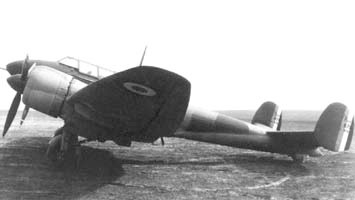
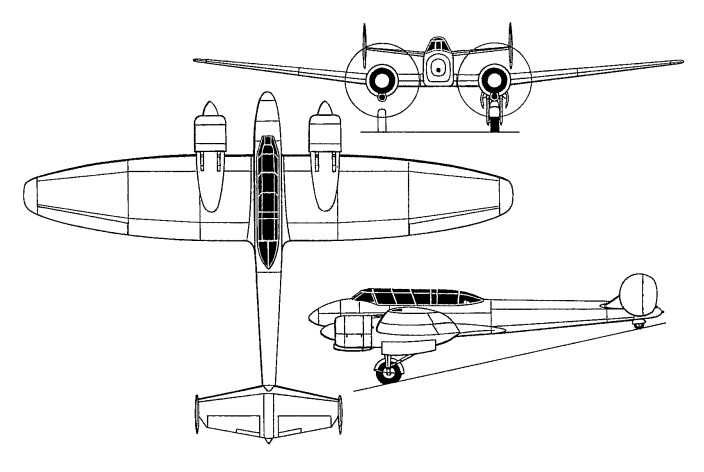
Designed to meet a requirement for a three-seat fighter with an endurance of three hours at 90% max speed, the Potez 670 was configurationally similar to the Potez 630 and 631. Flown for the first time on 30 March 1939, the Potez 670 had meanwhile been modified as a two-seat long-range escort fighter and bomber destroyer.
Potez 670
Initially powered by two 700hp Gnome- Rhone 14M radials, it was re-engined after initial flight trials with two 800hp Hispano-Suiza 14AB 12/13 radials, with which it resumed flight tests in July 1939 as the Potez 671.
Potez 671
Several production variants were proposed, but flight trials were incomplete at the time of the French collapse and the sole prototype was destroyed during the German onslaught. At the time, work had begun on an initial batch of 40 Potez 671 C2 fighters.
Potez 670 Engines: 2 x Gnome & Rhone 14M-3, 700 hp Wingspan: 15.10 m Wing area: 32.50 sq.m Length: 10.80 m Height: 3.27 m Empty weight: 3120 kg Maximum take-off weight: 4680 kg Maximum speed: 460 km / h Cruising speed: 412 km / h Practical range: 1800 km Service ceiling: 10,000 m Crew: 2 Armament: 2 x 20-mm cannon Hispano-Suiza HS-404 front, 2 x 7.5-mm machine guns MAC 1934, 1 x 20-mm cannon Hispano-Suiza HS-404 rear-firing turret
Potez 671 Engines: 2 x Hispano-Suiza 14AC, 800 hp Wingspan: 15.10 m / 50 ft 6 in Wing area: 32.50 sq.m / 349.83 sq ft Length: 10.80 m / 35 ft 5 in Height: 3.27 m / 11 ft 9 in Max take-off weight: 4726 kg / 10419 lb Empty weight: 3186 kg / 7024 lb Max. speed: 500 km/h / 311 mph Cruising speed: 445 km / h Maximum rate of climb: 876 m / min Service ceiling: 10,500 m Range: 2000 km / 1243 miles Crew: 2 Armament: 2 x 20-mm cannon Hispano-Suiza HS-404 front, 2 x 7.5-mm machine guns MAC 1934, 1 x 20-mm cannon Hispano-Suiza HS-404 rear-firing turret
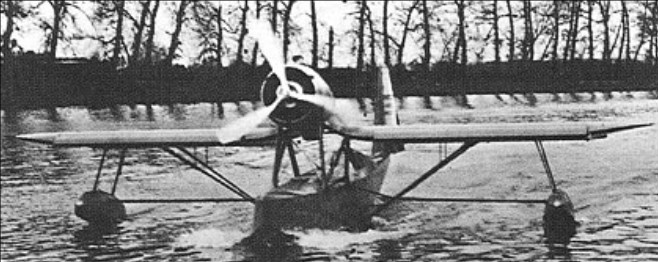
A contender to fulfil the 1933 Marine Nationale requirement for a single-seat float fighter suitable for catapult operation from 10,000-ton cruisers, the Potez 453 was based broadly on the design of the two-seat Potez 452 light observation flying boat. Competing with floatplanes tendered by Bernard (H.52), Loire (210) and Romano (R-90), the Potez 453 flying boat first flew on 24 September 1935. Of mixed construction, it was powered by an 800hp Hispano-Suiza 14Hbs radial engine and was intended to carry an armament of two 7.5mm machine guns. The engine was carried on bracing struts ahead of the wing, the thrust axis passing high above the CG of the flying boat with the result that, in view of the small dimensions of the aircraft, a considerable diving moment was induced at full throttle which could not be easily counteracted. Take-off was, in consequence, difficult and could be effected only by reducing engine power. Further development of the Potez 453 was therefore abandoned.
Max take-off weight: 1937 kg / 4270 lb Empty weight: 1534 kg / 3382 lb Wingspan: 11.20 m / 37 ft 9 in Length: 10.20 m / 33 ft 6 in Height: 3.45 m / 11 ft 4 in Wing area: 19.00 sq.m / 204.51 sq ft Max. speed: 318 km/h / 198 mph Range: 540 km / 336 miles
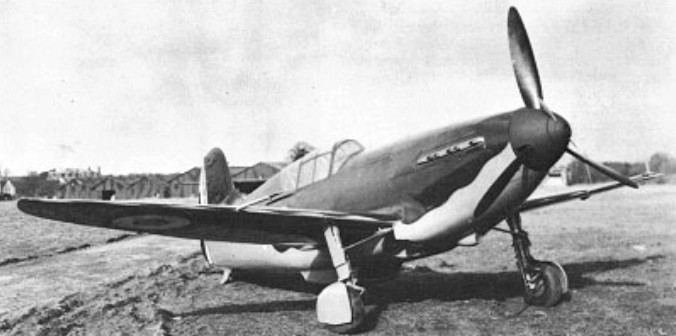
With the absorption of ANF-Mureaux in 1937 as a component of the SNCA du Nord (which also included Potez and retained the appellation for its products), Andre Brunet and his co-designers Lemaitre and Hubert continued the line of lightweight fighter development commenced with the ANF-Mureaux 190. In the autumn of 1938, work on a progressive development, the Potez 230, was begun. While possessing a number of features in common with the earlier fighter (eg, elliptical wings), the new aircraft was of more advanced design. Powered by a 670hp Hispano-Suiza 12Xcrs 12-cylinder liquid-cooled engine and having a proposed armament of one engine-mounted 20mm cannon and four wing-mounted 7.5mm machine guns, the Potez 230 was flown on 30 March 1940. When German forces occupied Villacoublay, the sole prototype of the Potez 230 was seized and transported to Germany for examination of the wing torsion box, which, of integral construction, was the first of its type to have been flown.
Max take-off weight: 1800 kg / 3968 lb Wingspan: 8.74 m / 29 ft 8 in Length: 7.57 m / 25 ft 10 in Height: 2.18 m / 7 ft 2 in Wing area: 10.97 sq.m / 118.08 sq ft Max. speed: 560 km/h / 348 mph
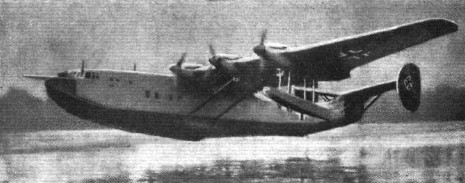
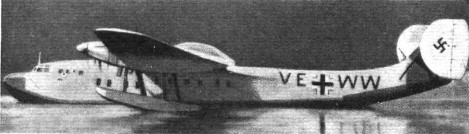
The Potez-CAMS 161 was one of three French large, six-engined flying boats intended as airliners on the North Atlantic route. The others were the Latécoère 631 and the SNCASE SE.200. In the summer of 1938, the 161’s aerodynamics had been investigated and refined with the Potez-CAMS 160, a 5/13 scale flight model.
Potez-CAMS 161 in foreground with the type 160 scale flight model behind. Floats retracted.
The 161 was an all-metal monoplane with a high, semi-cantilever wing, braced on each side by a pair of parallel struts between the lower fuselage and the wing near the first outboard engine. The engines were mounted on a constant chord central section but the outer panels were tapered, with ailerons interconnected to Handley Page slots near the wing tips. The trailing edges carried split flaps. The flying boat’s wing stabilizing floats retracted vertically to the outer engine cowlings. The tail unit was of the twin endplate fin type with the tailplane, mounted with marked dihedral, on a fuselage pedestal and externally braced from below. The D-shaped fins were fixed to the tailplane a little below their horizontal mid-lines and were also lightly braced, with struts between them and the upper tailplane surfaces.
The CAMS 161 was powered by six 664 kW (890 hp) Hispano-Suiza 12Ydrs liquid cooled V-12 engines driving three blade propellers. These were cooled via both wing surface and frontal radiators, the latter retracted after take-off. Its two step hull was flat sided forward of the wing but more rounded aft; there were long wing root fillets. Ten square windows on each side lit the passenger cabin, where twenty were provided with seating and sleeping compartments and flown and looked after by six crew.
Very different dates for the first fight appear in the literature: a contemporary report in Flight gives it as within few weeks before 7 December 1939, with “further flying tests” in the first half of 1942, whereas Hartmann has 20 March 1942 as the first flight date. In either case the CAMS machine was the first of the three to fly.
In Hartmann’s account, the March flight was from the Seine, with the aircraft in German markings. Earlier it had been painted in Air France Atlantique trim and at some point it received a French civil registration.
Full flight trials and performance measurements were never done, so the figures remain estimates, but there is clear evidence that the empty weight had increased by about 33% from the 1938 estimates by the time the 161 was flying, with a corresponding 16% increase in gross weight.
It seems to have been destroyed by enemy fire toward the end of World War II, but there is disagreement on exactly when and where: Hartmann locates the event to the Baltic, others to Lake Constance. Cuny states that the SE.200 and the Laté 631 were destroyed on the lake early in 1944, but that the Potez escaped.
Engines: 6 × Hispano-Suiza 12Ydrs, 660 kW (890 hp) each Propellers: 3-bladed Wingspan: 46 m (150 ft 11 in) Wing area: 261 m2 (2,810 sq ft) Length: 32.11 m (105 ft 4 in) Height: 8.87 m (29 ft 1 in) Empty weight: 17,220 kg (37,964 lb) ; Flight (1942) has 22,979 kg (50,660 lb) Gross weight: 37,000 kg (81,571 lb) ; Flight (1942) has 43,001 kg (94,800 lb) Fuel capacity: 15,500 kg (34,172 lb) including oil Maximum speed: 335 km/h (208 mph; 181 kn) at 1,000 m (3,281 ft) Cruise speed: 300 km/h (186 mph; 162 kn) at 4,000 m (13,123 ft) Range: 6,000 km (3,728 mi; 3,240 nmi) in a 60 km/h (37 mph) wind, full load, std fuel Crew: Six Capacity: Twenty passengers
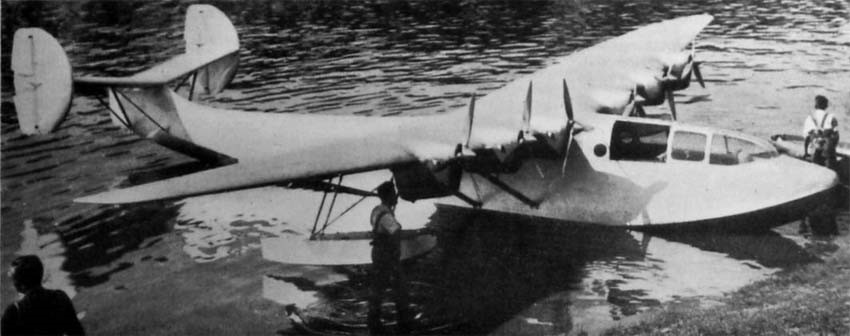
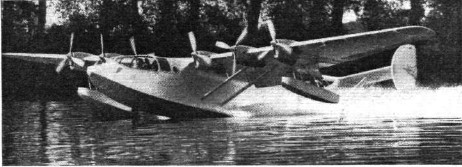
In 1936 the design bureau of Potez-CAMS was beginning the development of the Potez-CAMS 161 six engine, trans-Atlantic passenger flying boat, intended to be a key component of Air France’s Transatlantique fleet. To test the design they built a 5/13 scale flying scale model of it, careful not just to scale dimensions of the flying surfaces and hull, but also to copy the form the nose around the cabin, engine cowlings and retractable float housings. Control surface detail and the flaps of the 161, together with its variable-pitch propellers, were included on the resulting Potez-CAMS 160. It was intended to prove both the aerodynamic and hydrodynamic behaviour of the airliner.
The 160 was a high-wing monoplane. The wing was a semi-cantilever structure, with two parallel bracing struts on each side from the lower fuselage to the wing just inside the central engines, straight-edged in plan with taper on the trailing edge only and rounded tips. It was fitted with interconnected Handley Page slots and ailerons as well as split flaps. It was powered by six four-cylinder inverted inline air-cooled Train 4T engines, each producing 30 kW (40 hp) driving three blade, variable-pitch propellers. The engines were mounted on the wing underside, housed in long, narrow cowlings intended to mimic those around the 664 kW (890 hp) Hispano-Suiza 12Ydrs water-cooled V-12 engines of the full scale aircraft.
The little flying boat had a conventional stepped hull and was stabilized on the water by a pair of floats, attached under the outboard engines and retracting into their cowlings. Its enclosed, tandem seat cockpit was shaped to reproduce the form of the 161’s nose, though the full sized aircraft had proportionally shorter glazing. The 161 had a twin fin empennage with a N-strut braced, parallel chord tailplane mounted on top of the fuselage on a short pillar with marked dihedral. The fins were of the endplate type, with curved leading edges and roughly symmetric above and below the tailplane; on each, the rudder was split into an upper and lower part. All of these features appeared on the final, full size airliner.
It flew for the first time on 20 June 1938.
The Potez-CAMS 160 appeared, after its first flight, at the 1938 Paris Aero Show.
Engines: 6 × Train 4T, 30 kW (40 hp) each Propellers: 3-bladed variable pitch Wingspan: 17.69 m (58 ft 0 in) Wing area: 38.7 sq.m (417 sq ft) Length: 12.37 m (40 ft 7 in) Height: 3.41 m (11 ft 2 in) Gross weight: 2,275 kg (5,016 lb) Maximum speed: 222 km/h (138 mph; 120 kn) at 950 m (3,116 ft) Power/mloadng: 75 W/kg (0.047 hp/lb) Wing loading: 58.5 kg/sq.m (12.0 lb/sq ft) Crew: Two, pilot plus observer