c.1950
Paul Price
Pontiac IL.
USA
19??
Warren OH.
USA
Built two aircraft. In 1950 and 1962.
c.1950
Paul Price
Pontiac IL.
USA
19??
Warren OH.
USA
Built two aircraft. In 1950 and 1962.
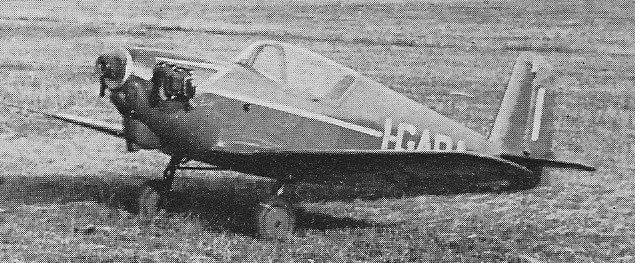
The PM-280 artuca (Tortoise) was produced in 1949 by the Instituto di Aeronautica of the Politecnico di Milano in Italy to the designs of Ermenegildo Preti.
A single-seat low-wing monoplane of all-wood construction, the Tartuca is fitted with flaps and a retractable undercarriage. Power is from a 60 hp C.N.A. D4 engine.
From the time that the design was started to the test flight was only ten weeks.
Engine: 60 hp C.N.A. D4
Wingspan: 16 ft 5 in
Wing area: 53.8 sq.ft
Length: 16 ft 6 in
Empty weight: 550 lb
Loaded weight: 770 lb
Max speed: 161 mph
Time to 3280 ft: 5 min 50 sec
Range: 342 mi
Ceiling: 10,827 ft
In 1974 the Prestwick Man Powered Aircraft Group, made up of some Scottish Aviation Employees, announced the Dragonfly man-powered aircraft.
Its span was about 80 ft and it was nearing first flight in August 1975. It has been reported to be an ornithopter, and the Dragonfly was allocated G-BDFU.
In 1974 the Prestwick Man Powered Aircraft Group, made up of some Scottish Aviation Employees, announced the Dragonfly man-powered aircraft.

The Prest Baby Pursuit of 1929 was a single-place monoplane with a diamond-shaped fuselage cross-section, designed by Clarence Prest. Priced at $2,100, optional engines were the 40hp Szekely SR-3 and 60hp Lawrance.
Seven were built including prototype NX876K, NX955Y, NX2304, NX13741, and NX17308/17309.
One set a world’s lightplane speed record of 101mph on 28 May 1930, using a 40hp Szekely, piloted by Prest.
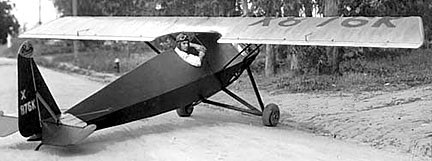
Engine: 45hp Anzani
Wingspan: 24’0″
Length: 17’11”
Useful load: 225 lb
Max speed: 100 mph
Cruise: 80 mph
Stall: 40 mph
Range: 250 mi
c.1925
(Clarence O) Prest Airplane Supply
Arlington CA
USA
1929:
Prest Airplane & Motor Co.

A development of the Preiss RHJ-8 (itself a T-tailed, larger span, improved version of the RHJ- 7), the RHJ-9 is similar to its predecessors, but with a larger span wing. The wing has foam ribs bonded to the aluminum spar and skins with PVC ribs. It first flew in 1978.
Wing span: 18.29 m / 60 ft
Wing area: 14.38 sq.m / 154.8 sq.ft
Empty Weight: 304 kg / 668 lb
Payload: 196 kg / 432 lb
Gross Weight: 500 kg / 1100 lb
Wing Load: 34.77 kg/sq.m / 6.94 lb/sq.ft
L/DMax: 38
MinSink: 0.70 m/s / 2.3 fps / 1.36 kt
Aspect ratio: 26.6
Airfoil: Wortmann 63-3-318
Seats: 2
The Preiss RHJ-8 was a T-tailed, larger span, improved version of the RHJ-7.
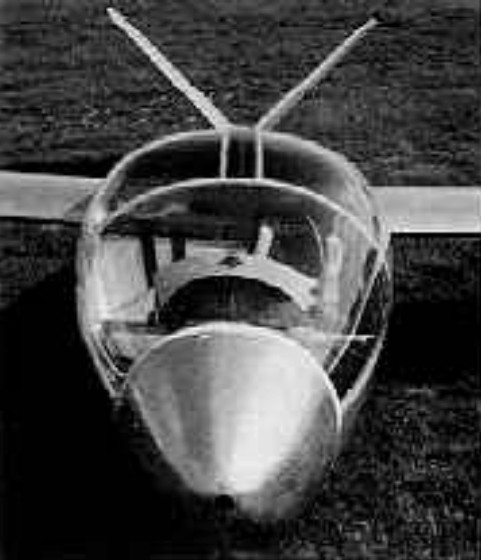
In 1966 Henry Preiss converted an all metal Schreder HP-14 into a 2-place ship with side-by-side seating (two sets of rudder pedals and a center control stick with a bar that swings from one side to the other) and a fixed landing wheel. The design used standard HP-14 wings with a 2-ft center section added in the fuselage.
Wing span: 17.22 m / 56.5 ft
Wing area: 13 sq.m / 140 sq.ft
Empty Weight: 233 kg / 492 lb
Payload: 181 kg / 400 lb
Gross Weight: 404 kg / 892 lb
Wing Load: 31.08 kg/sq.m / 6.4 lb/sq.ft
L/DMax: 38 105 kph / 56 kt / 65 mph
MinSink: 0.61 m/s / 2.0 fps / 1.18 kt
Airfoil: Wortmann FX 61-163 mod.
Aspect ratio: 21.6
Seats: 2
No. Built: 1
Predappio sa, a division of the Caproni Group, produced two trainers in the late 1930s, the Ca.602 two-seat biplane and a single-seat aerobatic version, the Ca.603, both powered by Alfa-Romeo in-line engines.

