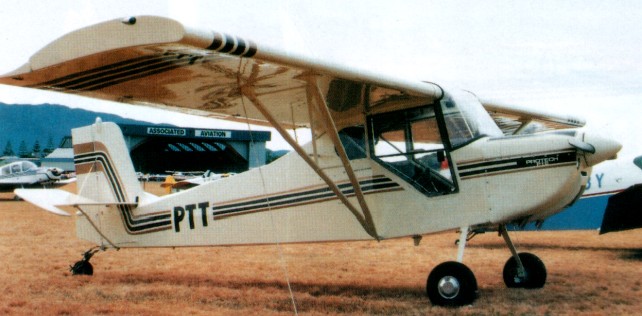
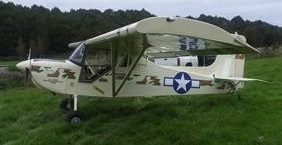
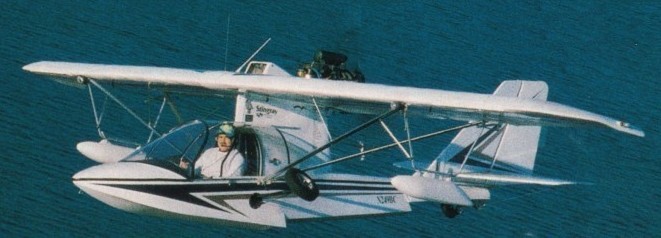
A high wing aircraft with all aluminium wings that can be easily and quickly folded rearwards, parallel with the steel tube, ceconite-covered fuselage. It has transparent doors which hinge upwards under the wings and can be opened in flight. The undercarriage is one-piece spring steel and either two or four 20 lt fuel tanks in the wing roots. Standard tires are 600×6, with optional 700×6.
The Protech PT2 Sassy origi¬nates from Houston, Texas circa 1988. Being a high wing side by side two seater of taildragger design, power comes from a 75hp Revmaster, providing a maximum speed of 140 mph. An interesting feature is the aircraft’s fold back wings to facilitate storage. The first was N211PT.
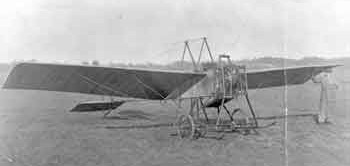
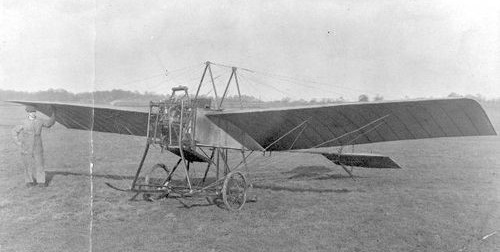
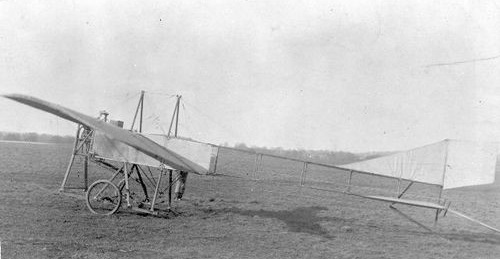
Possibly of Montreal, Canada, circa 1909, almost nothing is known of Prosper, although he was reported to have assisted in the assembly of the infamous “Scarabée” – a Channel-crossing 50 hp Blériot XI flown by Comte Jacques De Lesseps – at the Montreal aviation meet, Canada’s first airshow, which ran from June 25 until July 5, 1910.
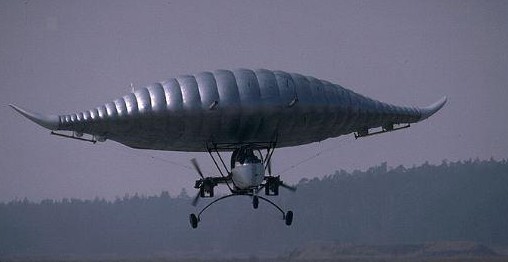
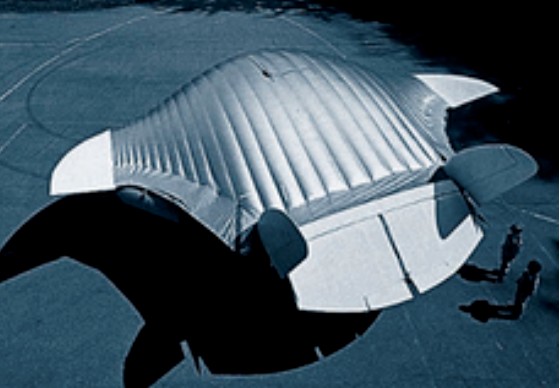
The media talked about a “flying stingray” when Prospective Concepts AG finally unveiled its secretive technology demonstrator in May 1998. Stingray is designed by this Swiss company, with a wing that derives its rigidity from compressed air. Later versions will be filled with helium. The second radical concept developed especially for the Stingray is a pneumatic catapult to be placed in the aicraft’s tail. The concept has been tested on the “Kangarou,” a light airplane with slow flight characteristics similar to the Stingray’s: a cylinder that extends to 5 meters catapults the craft right into the air and accelerates it from standstill to flying speed at 1.5 g.
According to the company, a significantly larger successor to the Stingray is also planned. It will derive 25 percent of its lift from helium in its wing and integrate propulsion and the gondola into the wing. Development of the Stingray was supported by the German pneumatic conglomerate Festo.
Stingray Wingspan: 13 m Length overall: 9.4 m Wing surface: 70 sq.m Volume: 68 cu.m Max. speed: 130 km/h (85 mph)
A Belgian enterprise, the Jet Squalus was designed and built around the Garrett TFE109 engine by General Avia in Italy. Designed by Stelio Frati, the prototype Jet Squalus made a successful first flight on April 30, 1987. Three prototypes of the “all through” side by side seat trainer were built and flown to Belgium. The Squalus was promoted as “the first and only third generation global trainer”, offering ab initio and advanced training from one cockpit.
Two proto¬types of the Jet Squalus are being built by General Avia in Italy, the first powered by a Garrett TFE-109 turbofan, and the second by a more powerful Williams International FJ-44. Following completion of initial flight trials the aircraft will be flown to Belgium, where production, marketing, and support of the “all-¬through” jet trainer will be administered by Promavia.
The initial 1,330 lb st (5.92 kN) -1 unit was replaced by the Garrett TFE 109-3 turbofan of 1,600 lb st (7,12 kN). Light weapons and/or drop tanks can be carried on underwing hardpoints.
No orders had been placed for the aircraft by 1988.
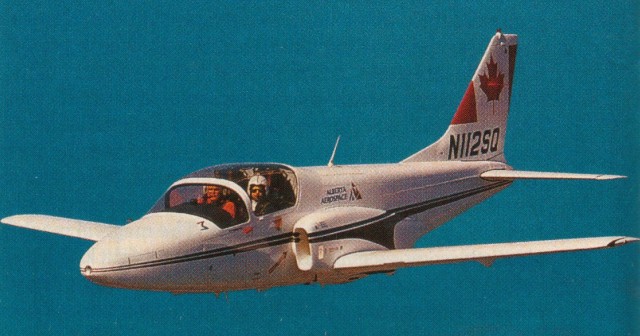
In 1995 the Belgian company Promavia licensed Alberta Aerospace to begin development of an ab initio trainer version of its Jet Squalus, under the name Phoenix FanJet. Eventually Promavia sold Alberta Aerospace the flying Jet Squalus prototype for conversion (to include new Williams- Rolls FJ44 turbofan engine in a revised airframe, new “glass” cockpit, larger flying control surfaces and more), allowing certification in about the year 1999. After Promavia ceased trading, Alberta Aerospace purchased other Promavia assets, allowing eventual production in Canada.
Based in Calgary, Canada, Alberta Aerospace obtained the two prototypes built with plans to install Williams-Rolls FJ44-1a engines. Almost 80% of the structural and stress testing for certification was completed by Frati, who tested the airframe to +7 and –3.5G. With a 140 kt gear extension speed, the aircraft did not meet the 61 kt stall speed required for civilian certification for single engine, so the wing span was to be extended by four feet.
A flight demonstrator was fitted with the Williams FJ44 engine.
Jet Squalus Engine: 1 x Garrett F109-1, 1,330 lb st (5.92 kN) Span: 9 m Length: 9.4 m Wing area: 13.6 sq.m Empty wt: 1200 kg MTOW: 2000 kg Max speed: 584 kph Initial ROC: 975 m / min. Ceiling: 11,280 m T/O run: 366 m Ldg run: 336 m Fuel internal: 720 lt Range: 1850 km Combat radius: 460 km Hardpoints: 4
Jet Squalus Engine: 1 x Garrett TFE 109-3 turbofan, 1,600 lb st (7,12 kN).
Jet Squalus Engine: 1 x Williams-Rolls FJ44-1A, 1600 lb ROC SL: 2360 fpm Max cruise: 315 kt at 20,000 ft Max range; 715 nm at 261 kt MTOW: 5100 lb Equipped weight; 3408 lb Useful load: 1692 lb Fuel capacity: 185 USG
The Danish Dolphin tandem two-seater motor glider was designed and built by the Projekt 8 I/S company of Roskilde, and 10 construction of the prototype was taking place at three separate sites near Copenhagen, and it was expected that the first flight was to be made late in 1978.
The Dolphin is a cantilever mid-wing monoplane of mixed constrution with a T-tail, powered by a 54hp Volkswagen VW1600 engine driving a two-blade pusher propeller, mounted on a pylon and retracting rearwards behind closed doors into the top of the fuselage aft of the wings. The wings, which have 4° dihedral, have an aluminium centre section and wood and glassfibre outer panels, flaps and ailerons; there are aluminium air brakes in the upper surfaces just ahead of the flaps. The forward fuselage is a welded steel tube framework covered with a light glassfibre shell, and the rear fuselage is a wooden structure reinforced by glassfibre. The tail unit is likewise of wood, with a fixed incidence tailplane, a central trim tab in the elevator and an inset tab at the base of the rudder. There is a semiretractable rubber-sprung mainwheel plus a nosewheel and a steerable tailwheel, as well as retractable wing tip balancer wheels. The one-piece cockpit canopy opens sideways.
Span: 61 ft 5 in Length: 27 ft 10.75 in Height: 4 ft 3.25 in Wing area: 223.9 sq ft Aspect ratio: 16.8 Empty weight: 1,058 lb Max weight: 1,653 lb Max speed: 163 mph Max aero-tow speed: 77.5 mph Min sinking speed: 2.30 ft/sec at 50 mph Best glide ratio: 32:1 at 62 mph