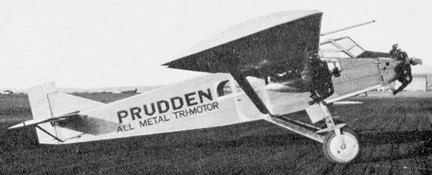
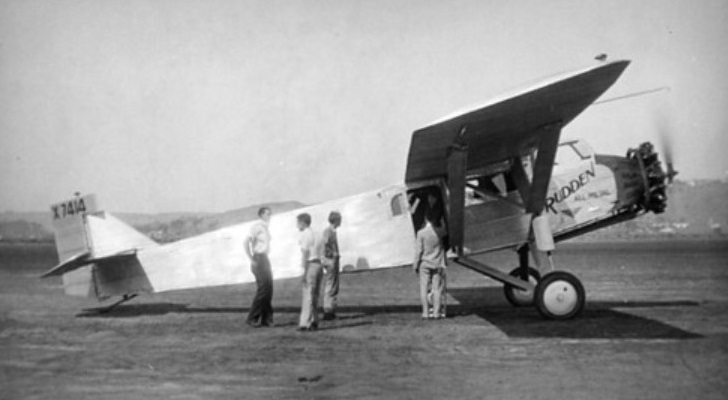
The Prudden-San Diego Airplane Company was founded in 1927 by George Prudden and seven San Diego area businessmen. Due to differences in management philosophy between Prudden and his investors, Prudden left the company in November 1928.
1929:
1212 Juniper Ave,
San Diego CA,.
USA
Became the Solar Aircraft Company in March 1929.
Later, Prudden developed the Prudden-Whitehead monoplane with the Atlanta Aircraft Corporation. While in Atlanta, Prudden helped develop Candler Field, Atlanta.
The Solar MS-1 was a prototype all-metal sesquiplane airliner built in 1930 at Lindbergh Field, San Diego, California. Due to the Great Depression in 1929, the company was unable to market the aircraft and made only three airplanes. Solar would never build another aircraft after the MS-1, turning to saucepans to survive the depression, and later stainless-steel exhaust shrouds.
During this period, they won a number of contracts to produce jet engine components. Convinced that the gas turbine was the prime mover of the future, the company invested heavily in the development of small turbines.
The company was reincorporated in 1937 as the Solar Aircraft Company, dropping the “Ltd” from its name. By 1939, Solar Aircraft Company had a work force of 229. Military orders during World War II led to rapid expansion and by the end of the war the company had a workforce of 5,000, largely part of a massive effort to build more than 300,000 exhaust manifolds for U.S. airplanes.
Business dropped considerably after World War II and the management developed a plan to diversify into producing other stainless steel products including caskets, frying pans, bulk milk containers and even redwood furniture; immediately after World War II, the company also produced the Solar Midget race car. Solar’s expertise in hard-to-manufacture parts able to withstand high-temperatures led to contracts to produce jet engine components. Solar Aircraft began to design and manufacture completed turbine engines for the United States military for applications such as auxiliary power units, fuselages, and rocket engine components of guided missiles.
Solar Aircraft Company’s expertise in high-temperature metallurgy led to work producing components for some of the first US jet engines, including the General Electric I-40 and a contract from the US Navy to build an afterburner for the Westinghouse J34. Solar Aircraft Company also won contracts for the Allison J33, Allison J35, Avro Canada Orenda, and Bristol Olympus. It was during this time that one of its engineers, Wendell Reed, developed the pneumatic engine microjet controller, for which he won the Wright Brothers Medal in 1955 and which became widely used for gas turbines, afterburners, and ramjets.
Solar Aircraft Company’s work in the jet engine field convinced the company’s president, Edmund Price, that the turbine would be the main prime mover in the future. Solar Aircraft Company assembled a team under the direction of Paul Pitt in 1946 and started developing a small 80 horsepower (60 kW) axial-flow turbine as an auxiliary power unit for the US Army Air Force’s Convair B-36 strategic bomber. The Army eventually cancelled this contract, but Solar Aircraft Company soon won a contract from the US Navy in 1947 for a 250 kW system to provide emergency power on ships. First running in 1949, the T-400 would go on to provide power on minesweepers and landing craft.
In 1947, Leon Wosika and Eric Balje set up a second design line and developed a centrifugal-flow system that was much more compact than Solar’s previous designs. Originally known as the MPM-45, the unit was delivered as the 45 horsepower (34 kW) “Mars”. The Navy purchased the Mars to power portable fire-fighting pumps on ships and gave it the designation T41. In 1956, the Navy turned to Solar to provide a slightly larger design to power a small helicopter, the Gyrodyne XRON-1. Solar Aircraft Company responded by developing a slightly larger version of the Mars, the 55 horsepower (41 kW) “Titan”, which the Navy designated the T62. When the Navy abandoned development of Gyrodyne’s XRON helicopter, Solar Aircraft Company adapted the Titan for service as an auxiliary power unit. Deliveries of this auxiliary power unit started in 1962.
Solar did win the contract to provide the APU for the first 632 KC-135A tankers for the Strategic Air Command.
In the late 1950s, the Navy once again turned to Solar, this time for a larger 750-kilowatt (1,010 hp) unit that would be used as an engine in a high-speed boat. The result was the axial-flow “Saturn” engine, which entered production in 1960. Solar started marketing the Saturn to industrial users needing a 1,000-horsepower (750 kW) unit for any role, and it went on to become the world’s most widely used industrial gas turbine with some 4800 units in 80 countries.
During the next decade, the Solar Division introduced a number of new designs, both larger and smaller than the Saturn. The Centaur, which first entered service in 1968, supplied 2,700 horsepower (2,000 kW), while the modern versions supply 4,700 horsepower (3,500 kW). In 1973, Solar exited the aviation industry to concentrate its resources on industrial gas turbines.
The turbine never came to be the main prime mover, but Solar’s expertise in small turbines found a number of niche roles. The company was purchased by International Harvester Company in early 1960, becoming the Solar Division of International Harvester in 1963. In 1973, the Solar Division exited the aerospace industry to focus solely on industrial turbines. In 1975, the development and manufacture of the Solar Division’s radial engines was moved into a newly formed Radial Engines Group, renamed the Turbomach Division in 1980.
In 1977, the Solar Division introduced a larger version of the Centaur, the 10,600 horsepower (7,900 kW) Mars, re-using the name from the earlier smaller engine.
Solar Turbines Incorporated became a wholly owned subsidiary of Caterpillar Tractor Co. after Caterpillar purchased the assets of the Solar Division and the Turbomach division from International Harvester on 31 May 1981. The newly acquired assets were organized as a wholly owned subsidiary of Caterpillar Tractor Co. named Solar Turbines Incorporated.
After the purchase, Caterpillar assigned development and manufacturing of the Caterpillar Model 5600 to Solar Turbines. The 5600 was originally developed by The Boeing Company as the Boeing 551/553 series, which Caterpillar had purchased when Boeing decided to exit the gas turbine business in 1966.
In 1985, Caterpillar sold the Turbomach Division to Sundstrand Corporation (now Collins Aerospace), exiting the Centrifugal gas turbine engine business.
Solar Turbines Incorporated continued to introduce new versions of their axial-flow industrial engines throughout the 1980s and 90s, often re-using older names instead of introducing new names.
In 2004 Caterpillar acquired Swiss company Turbomach S.A. which had long been a packager of industrial turbines from Solar, Rolls-Royce, and Trent.
Solar has sold more than 15,000 gas turbine systems, with a combined operating history of over 2 billion hours of use, equivalent to over 100,000 years.