Louis E Salina & Earl Hoffman
Carnegie
PA.
USA
Circa 1967 built the Susie Bee
Louis E Salina & Earl Hoffman
Carnegie
PA.
USA
Circa 1967 built the Susie Bee
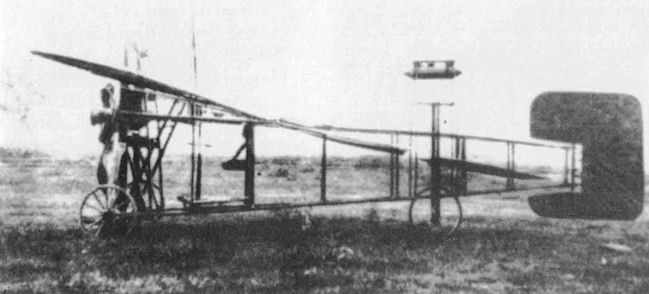
Sotoichi Saito of Tsuruoka City, Yamagata Prefecture, had been involved in the development of balloon flight since 1889. In 1910 he bought a 50hp Gnome engine from France so that he could study aero-engines. He later acquired a patent for a ‘Flying Machine’ and manufactured an aircraft resembling a Bleriot monoplane. Helping with this project was Shotaro Ueda. Single-engine monoplane. Wooden structure with fabric-covered wing and uncovered fuselage structure.
The aeroplane contained some rather innovative features. For protection against inflight fire, the fuel tank was installed on struts high above the rear fuselage at a considerable distance from the engine. Another feature was that in the event of an inflight emergency, a cable could be pulled, causing the fuselage and engine to separate from the wings leaving the pilot still seated on the wing section which was to act as a parachute.
Saito named his aeroplane the Saigai, an acronym derived from his own name. In june 1912 he tested the aeroplane on the dry bed of the Akagawa River in Tsuruoka City. The aeroplane, piloted by Suketaro Koya, was put on a special railway track for take off. Koya was probably selected because of his engine experience in operating the Mogami Maru river boat. Soon after becoming airborne, Koya felt that further flight would be risky and pulled the emergency cord, thus destroying the aeroplane. The Gnome engine was salvaged and installed in the Tamai 3 Aeroplane in 1917, in which the pilot, Seitaro Tamai, was killed. The engine then passed to Shigesaburo Torigai, and still later was installed in the Tsurubane No.2 Aeroplane of Otojiro Itoh, which made the first loop by a Japanese civil aeroplane when piloted by Toyotaro Yamagata in 1918.
Engine: 50hp Gnome
Propeller: two-blade wood
Span: 10.30m (33ft 9 1/2in)
Length: 9.10m (29ft 10 1/4in)
Loaded weight: 560kg (1,234Ib)
The LB.4 made by the company in 1938 was a very different twin-boom airframe with tricycle landing gear.
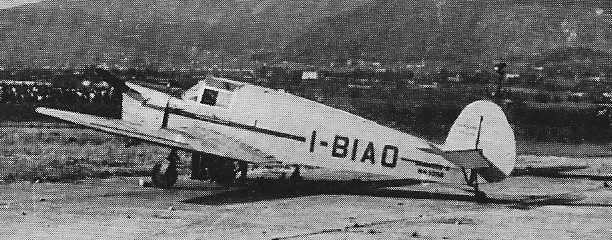
The Italian Saiman 202-M was first introduced in 1936 and participated in a number of international competitions in pre-war years. During the war the type was employed as a liaison and communications two-seat cabin monoplane by the Regia Aeronautica.
Construction is all-wood with fabric and plywood covering. The Saiman 202-M is powered by a 130 hp Alfa Romeo 110 engine.
The Saiman 204 is generally similar but is arranged as a four-seater and has a 180 hp Alfa Romeo 115 engine.
Saiman 202-M
Engine: 130 hp Alfa Romeo 110
Wing span: 35 ft 7 in
Wing area: 190 sq.ft
Length: 25 ft 3 in
Height: 6 ft 7 in
Empty weight: 1364 lb
Loaded weight: 2068 lb
Max speed: 143 mph
Cruise: 124 mph
Absolute ceiling: 16,400 ft
Range: 683 mi
Seats: 2
Saiman 204
Engine: 180 hp Alfa Romeo 115
Seats: 4
During 1934-1938 made SAIMAN 200 two-seat trainer biplane and 201 and 202 two-seat touring monoplanes.
During 1934-1938 made SAIMAN 200 two-seat trainer biplane and 201 and 202 two-seat touring monoplanes.
In 1932 SAIMAN built experimental C.10 monoplane with variable-incidence wing.
Italy
Founded 1929, SAIMAN specialized in repair and maintenance of marine aircraft and boats. In 1932 built experimental C.10 monoplane with variable-incidence wing. During 1934-1938 made SAIMAN 200 two-seat trainer biplane and 201 and 202 two-seat touring monoplanes. SAIMAN 204 of 1939 was an experimental derivative, but LB.4 made by the company in 1938 was a very different twin-boom airframe with tricycle landing gear.
In 1935 Clarence & Raymond Sagstetter built two single place open cockpit monoplanes. The were registered N14813 c/n 15207 to Raymond Sagstetter and N14814 c/n 12570 to Clarence Sagstetter. U
Ultralights with identical specifications, the engines were Sagstetter home-built (or modified) 30hp Sagstetter engines.
Wausau
WI.
USA
Circa 1935 built monoplanes

