Queensland, Australia.
Seabird Aviation offered the Seeker SB7L two-seat monoplane (first flown October 1989), featuring a pod-and-boom fuselage with heavily glazed cabin, braced high-mounted wings with two hardpoints for attaching 264 lb (120 kg) of stores, and a piston engine with pusher propeller. Uses include agriculture, surveillance, patrol, photographic, search and rescue, training, media.
Aircraft
Scroggs The Last Laugh
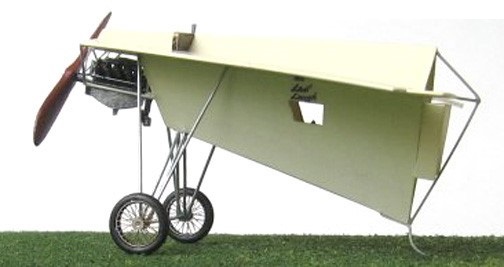
Built by Roy B Scroggs in 1930, The Last Laugh was similar to a dartlike paper airplane, with a narrow delta-wing with about a 75-degree sweepback/ Powered by a 90hp Curtiss OX-5, it had elevons and twin rudders. Registered N10648, the pilot sat in a closed cabin under the “wing”.
Scroggs prophesized that his airplane would one day revolutionize the entire air industry. The creation was test-flown successfully at an altitude of 10′, and Scroggs predicted an eventual top speed of 300mph, but he, and his airplane, eventually faded away.
Scroggs, Roy B
Eugene OR.
USA
Scroggs was a tailor and built ‘The Last Laugh’ airplane in 1930.
Scrappy UAC-200
The Scrappy is a single-place sport biplane constructed of steel tubing, wood and fabric. A 200-hp Lycoming engine provides the power.
Gross Wt. 1428 lb
Empty Wt. 981 lb
Fuel capacity, 28 USG
Wingspan 20 ft 8 in
Length 16 ft 8 in
Top speed 188 mph
Cruise 151 mph
Stall 55 mph
Climb rate 3700 fpm
Takeoff run 950 ft
Landing roll 1250 ft
Range 500 sm
Scrappy
1980: W.A. Skipper, 1907 14th Avenue, Greeley, CO 80631, USA.
Aircraft builder
Scoville Stardust II
The Stardust is a single-seat, homebuilt Formula 1 racer designed by John Scoville. It accommodates engines rated from 65 to 100 hp. Its fuselage is built from molybdenum steel tube with light alloy and fabric covering. Its wings feature composite structure of steel and wood, with wood and fabric covering.
Gross Wt. 790 lb
Empty Wt. 520 lb
Fuel capacity 15 USG
Wingspan 16 ft
Length 18 ft
Top speed 258 mph
Cruise 178 mph
Stall mph 58
Takeoff run 900 ft
Landing roll: 1800 ft
Range 500 sm
Scoville JS-2 Stardust
The 1954 Stardust is a single-place Formula One sport/racer constructed from the conventional wood, fabric and tubular steel combination. It is propelled by the regulation 85-hp or the 100-hp Continental.
Registered N85N, it was involved in a nonfatal crash during races at Niagara Falls NY on 4 July 1956.
Gross Wt. 790 lb
Empty Wt. 520 lb
Fuel capacity 15 USG
Wingspan 16 ft
Length 17 ft 6 in
Vne 250 mph
Top speed 158.17 mph
Stall 58 mph
Takeoff run 1500 ft
Landing roll 1800 ft
Range 500 sm
Scoville
1980: 172 Cedarwood Terrace, Rochester, NY 14609, USA.
Airplane builder
Scout Airplane Co / Pacific Air Industries
Scout Airplane Co (Pacific Air Industries)
Los Angeles CA
USA
On acquisition of Tunison assets.
Aviation Preservation Society of Scotland Sopwith 1½ Strutter
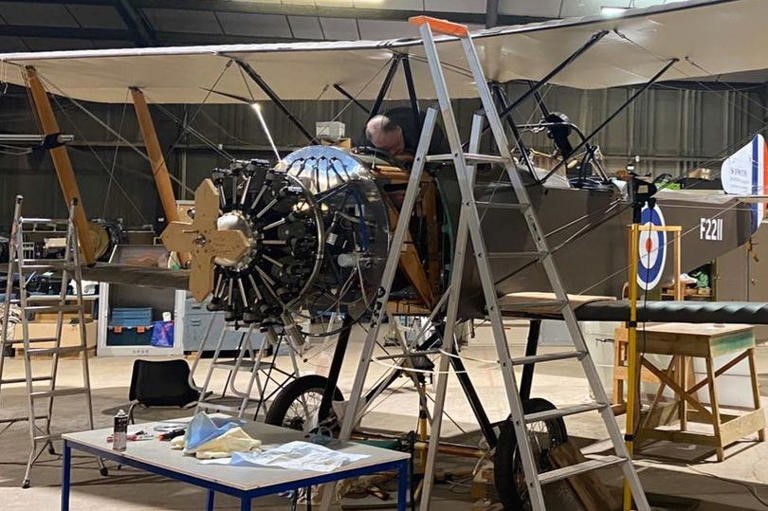
Adam Smith, former director of the National Museum of Flight, started to recruit volunteers in 2000. The group has included retired medics, teachers, civil engineers, film-makers and sign-writers – no one who knew how to build a plane.
The exact working replica has been built by a team of dedicated experts and enthusiasts. The building of the plane took place over the 23 years. The Strutter was built from scratch in a big shed in East Lothian. A group of pensioners aged between 65 and 100 built the historic biplane with nine of them not living to see it finished as their names have been recorded on a plaque in the cockpit.
The plane was built by pensioners in a barn in East Lothian is set to be flown by a young female pilot, Ellie Carter, 20, for the first time.
But they have now completed a Strutter, with a working engine. The Strutter was seen leaving East Lothian on the back of a lorry to undergo testing in West Lothian.
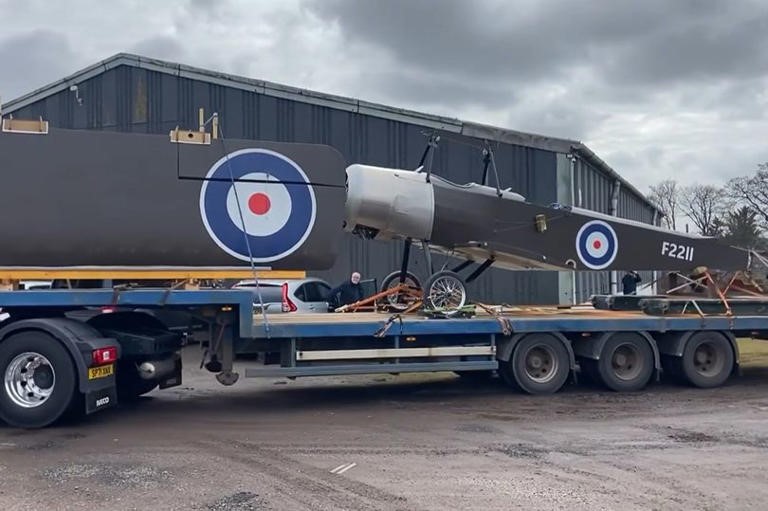
Funding was needed to keep the Strutter in Scotland. It stands in an outsize converted fruit shed in Congalton, near Edinburgh, soon to be sold.
If the shed cannot be purchased, the plane was likely to move to England.
Mike Harper, chair of the Aviation Preservation Society of Scotland, said: “The Strutter is probably worth twice what the shed is worth, but we don’t want to see it leave Scotland, where it was designed and built.

