Siebert Sie 3

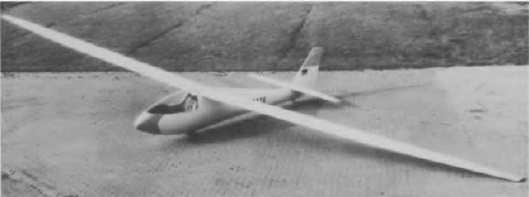
This wooden Standard Class single-seater was designed by Paul Siebert and first flew in prototype form in 1971; by January 1975 a total of 27 had been built by the Paul Siebert Sportund Segelflugzeugbau and sold to Belgium, Holland, Denmark and Portugal as well as to customers in Germany. Permission was being sought from the Luftfahrtbundesamt, the Federal German civil aviation authority, to offer the Sie 3 in a form suitable for amateur construction. Of conventional wooden construction, the Sie 3 is a cantilever high wing monoplane with a constant chord centre section and tapered outer panels; Schempp-Hirth aluminium air brakes are featured. The fin and rudder are swept back and the low-set tailplane is an all-moving surface. Landing gear consists of a monowheel with brake and a tailskid, and the pilot sits under a one-piece flush-fitting cockpit canopy.

Span: 49 ft 2.5 in
Length: 22 ft 0 in
Height: 3 ft 11 in
Wing area: 127.44 sqft
Empty weight: 467 lb
Max weight: 750 lb
Max speed: 124 mph (in smooth air)
Min sinking speed: 2.23 ft/sec at 48.5 mph
Best glide ratio: 34.3:1 at 56 mph

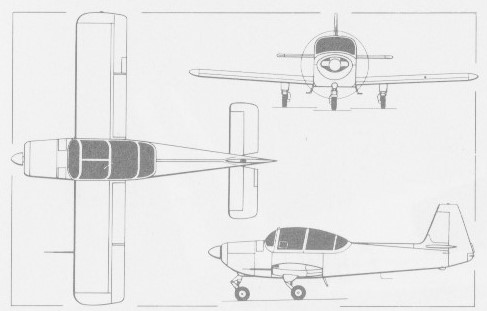
Siebel MBB-SIAT 223 Flamingo

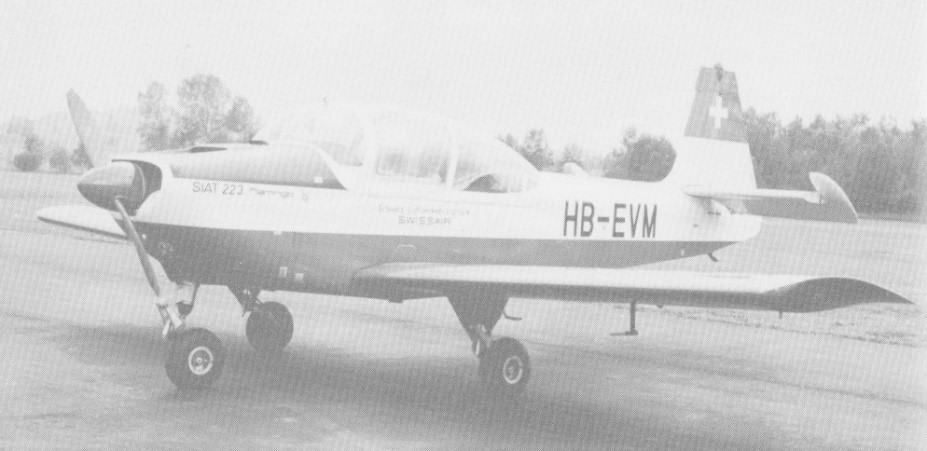
Designed by the Siebelwerke and first flying in 1967 the Flamingo was turned into an aerobatics trainer.

There are two seats side-by-side at the front of the cabin with provision for fitting a folding seat for one adult or two children in the baggage area. Removable dual controls are fitted.

Originally produced in Germany by SIAT, CASA produced the 223A1 basic version in the Normal Category as a there/four-seater or agricultural aircraft, or in Utility Category as a two-seater intended primarily for training airline pilots.

The 223K1 single-seat fully-aerobatic version with a specially modified IO-360-C1B engine and stressed to +6 / -4g was also originally produced in Germany by SIAT, then CASA in Spain.

Later, in 1986 the Flamingo was used as a testbed for the new developed Porsche aviation engine.

CASA 223A1
Engine: Lycoming IO-360-C1B, 200 hp
Wingspan: 27 ft 2 in / 8.28 m
Length: 24 ft 4.5 in / 7.43 m
Empty weight equipped: 1610 lb / 685 kg
MTOW Norm: 2315 lb / 1050 kg
Max cruise 76%: 116 kt / 134 mph / 216 kph
ROC SL: 846 fpm / 258 m/min
Service ceiling: 12,300 ft / 3750 m
Range 30min res: 620 nm / 715 mi / 1150 km
Seats: 3-4
Baggage capacity: 200 lb / 90 kg
Cabin length: 7 ft 2.5 in / 2.20 m
Cabin width: 3 ft 8 in / 1.12 m
Cabin height: 3 ft 11 in / 1.20 m

MBB 223 PFM Flamingo
Engine: Porsche PFM 3200, 207 hp
Wingspan: 27.231 ft / 8.3 m
Max take off weight: 2425.5 lb / 1100.0 kg
Max. speed: 124 kts / 230 km/h
Range: 756 nm / 1400 km
Crew: 3

Siebel Si 202 Hummel

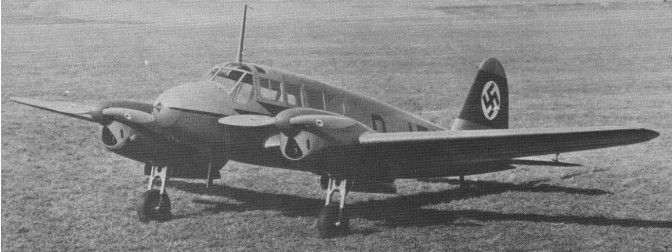
The Si 202 Hummel of 1938 was a side by side 2-seater of simple all-wooden construction.

The Fh 104 and a liaison machine, the Si 202 Hummel (which had lost out to Fiesler’s Fi 156 STORCH) shared production line space with license built Do 17s, all examples of the Siebels going to the Luftwaffe.

Siebel Si 202 P 4 Hummel
Engine: Zündapp 29-92, 49 hp
Length: 20.997 ft / 6.4 m
Height: 6.234 ft / 1.9 m
Wing span: 34.449 ft / 10.5 m
Max take off weight: 1212.8 lb / 550.0 kg
Max. speed: 86 kts / 160 kph
Service ceiling: 14108 ft / 4300 m
Range: 270 nm / 500 km
Crew: 1+1

Siebel Si 201

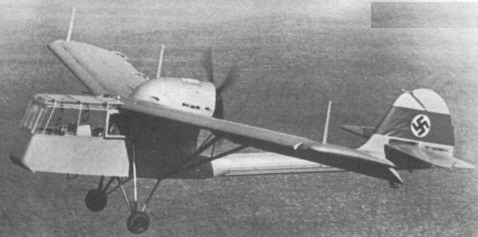
The Siebel Si-201 was designed and built by Siebel in response to the German Air Ministry specification issued in February 1937 for an air observation / army co-op aircraft that had superlative Short Take-off/Landing (STOL) capabilities, excellent slow-flight performance and all-round visibility. Three aircraft were designed and built to meet this particular specification – the Fiesler Fi-156 (already being tested before the specifications were released), the Bayerische Flugzeugwerke designed and built Bf-163 and the Siebel Si-201, these latter two flying in 1938.

The Si-201 was an unorthodox design with its Argus As10 V-8 air-cooled engine mounted above the wing as a pusher, driving a four-bladed fixed-pitch airscrew which rotated above a slim, circular-section tailboom. It had a boxy, fully glazed forward fuselage with room for a pilot and observer in tandem and was a high-wing braced monoplane with a tail-wheel landing gear.

This design allowed superlative vision from the forward cockpit and so the pilot was seated towards the rear of the cockpit. The aircraft had high lift devices such as full span automatic leading edge slots and four section Fowler-type flaps with the outermost flaps also acting as ailerons and which occupied almost the entire trailing edges, the outboard sections serving as ailerons. The fuselage was of welded steel-tube construction with metal skinning and the plywood-covered wing was of wood. The pilot and observer were seated in tandem in the extensively-glazed forward fuselage, the observer being positioned ahead of the pilot with his seat offset to starboard.

The first of two prototypes of the Si-201 flew during the early summer of 1938, revealed excellent short take-off and landing characteristics, and was found to possess acceptable slow-flying characteristics closely comparable with those of the Storch, but at the upper end of the speed scale tail flutter proved troublesome. Considerable effort was expended in damping out oscillation in the tailboom which developed under certain flight conditions, and the second prototype, which featured some simplification of the high-lift devices, was flown with a somewhat sturdier tailboom. The most serious shortcoming of the Si-201 proved to be the extremely limited cg travel permitted by its configuration, and when Siebel was ordered to abandon further development of the aircraft the problem of tail flutter remained largely unsolved.

The Si-201 was evaluated against the Fieseler Fi 156 and Messerschmitt Bf 163 but did not compare well to these aircraft. The Si-201 was also flown by General Ernst Udet, then head of the Reich Air Ministry’s technical department. He was unimpressed with its ground handling and landing characteristics, essential elements in the success of the Storch. The Si 201 would also have been more costly to construct than the Fi 156 Storch. The Si-201 had a higher top speed than the Storch, but speed wasn’t an important consideration for its expected roles, and work on the Si 201 stopped after two prototypes had been built.

The Ilmavoimat evaluation team test-flew the aircraft and experienced the same issues at the upper end of the speed scale with tail flutter. While this was a concern, the aircraft remained under consideration until the decision by the Reich’s Air Ministry not to order the aircraft into production put a halt to further consideration.

Siebel Si 201
Crew: two (Pilot and Observer)
Engine: 1 x Argus As 10C, 179 kW (240 hp)
Maximum speed: 115mph
Range: 280 miles
Service ceiling: 18,000 ft
Siebel / Flugzeugwerke Halle GmbH

Siebelwerke-ATG GmbH

Siebelwerke-ATG GmbH name was that of F. W. Siebel (1891-1954), associated with early sport-flying in Germany and who helped form the Klemm company, for which he took charge of new works at Halle (Saale). In 1937 Siebel established own company as Flugzeugwerke Halle GmbH, later renamed Siebelwerke-ATG GmbH. First aircraft was Fh 104 5-passenger monoplane of 1937. Si 201 was experimental military reconnaissance aircraft; Si 202 Hummel of 1938 a sideby- side 2-seater. In Second World War Siebel contributed to production of standard German military types; also built own Si 204 communications aircraft, though this was mainly built by SNCAC in France.

Klemm joined Siebel in 1940.

ATG joined Siebel in 1945 to become Siebel ATG (SIAT).

After war produced Si 222 Super-Hummel and 3-seat Si 308. As member of Nordflug group helped with Noratlas.

Siebel ATG (SIAT) joined MBB in 1973.

Sidou Joao Grande

Designed by Eng Antonio Menezes Sidou of Porto Alegre in the state of Rio Grande do Sul, this Brazilian tandem two-seater is intended for primary and advanced training and Open Class contest flying, and Eng Sidou hoped to begin construction of the Joao Grande (or Stork) at Paso Funde in Rio Grande do Sul early in 1978. It is a cantilever midwing monoplane similar to the IPD Urupema in appearance but with a T-tail and cambered wing tips, of all-wooden construction with plywood covering and abrasion-resistant plastics finish; it is designed for aerobatics and cloud flying. There are Schempp-Hirth air brakes on the upper and lower surfaces of the wing, which has long span ailerons and a dihedral of 3° 36′. The ailerons, elevators and rudder are both statically and dynamically balanced, a narrow-chord tailptene being mounted on top of the swept back fin. There is a retractable rubber-sprung monowheel with rubber shock absorbers and a brake, and a tail bumper. The two pilots sit in tandem under a long flush-fitting one-piece jettisonable Plexiglas cockpit canopy.

Span: 59 ft 0.75 in
Length: 29 ft 6.25 in
Height: 8 ft 3.25 in
Wing area: 139.5 sqft
Aspect ratio: 25.0
Empty weight: 595 lb
Max weight: 992 lb
Max speed: 112 mph (in rough air)
Min sinking speed: 1.87 ft/sec at 50.5 mph
Best glide ratio: 43.9:1 at 59 mph

Siddeley S.R.2 Siskin

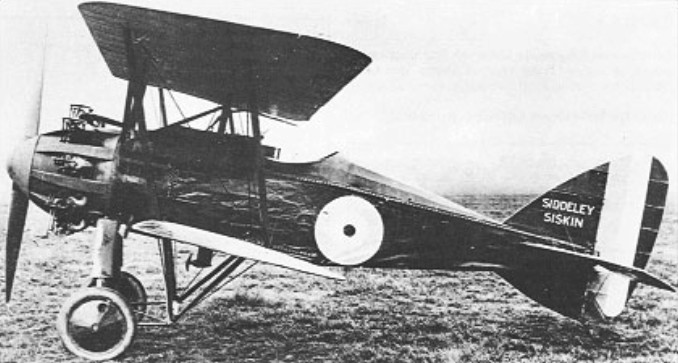
When, in January 1917, Capt F M Green became chief aeronautical engineer of the Siddeley-Deasy Motor Car Company, he began the design of a single-seat fighter, the S.R.2. A compact single-bay sesquiplane predominantly of wooden construction with fabric skinning, the S.R.2 was powered by a 320hp A.B.C. Dragonfly nine-cylinder radial engine. Armament comprised two synchronised 7.7mm machine guns.

A contract for six prototypes was reduced to three in mid 1918, the first of these flying in April 1919, by which time the fighter had been officially named Siskin. The first prototype Siskin was subsequently re-engined with an Armstrong Siddeley Jaguar, development in this form continuing after Siddeley Deasy acquired in 1921 the name and goodwill of Sir W G Armstrong Whitworth & Co Ltd, and the Armstrong Whitworth Siskin II emerging in 1922.

Max take-off weight: 989 kg / 2180 lb
Empty weight: 664 kg / 1464 lb
Wingspan: 8.38 m / 27 ft 6 in
Length: 6.48 m / 21 ft 3 in
Height: 2.97 m / 9 ft 9 in
Wing area: 22.95 sq.m / 247.03 sq ft
Max. speed: 233 km/h / 145 mph
Ceiling: 7255 m / 23800 ft