A monoplane single-seat fighter.
Aircraft
Siemen Schkukert D-IV
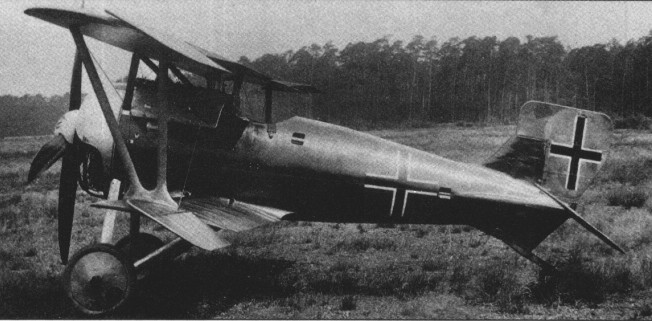
The D III was followed by the D IV, which introduced much aerodynamic refinement for slightly higher speed and still better climb rate. A total of 280 were ordered, but less than 140 D IVs were completed, most entering service after August 1918.
D IV
Engine: l x Siemens-Halske Sh.IIIa, 119kW (l60hp)
Span: 8.35m (27ft 4.75in)
Length: 5.7m (18ft 8.5 in)
Max TO weight: 735 kg (1,620 lb)
Max speed: 119 mph
Operational endurance: 2 hr
Armament: 2 x 7.92-mm (0.312-in) LMG 08/15 mg
Siemen Schkukert D-II / D-III
Via the D II prototype Siemens-Schuckert then moved to a completely German design, ordered late in 1917 as the D III equal-span biplane with the 119-kW (160-hp) Siemens-Halske Sh.III rotary engine whose diameter dictated the circular section of the compact fuselage that tapered sharply into the empennage with its large tailplane and angular vertical surfaces. After the teething problems of this engine had been cured, the 50 D IIIs matured as extremely fast-climbing interceptors whose other performance figures were low.
Siemen Schkukert D-1
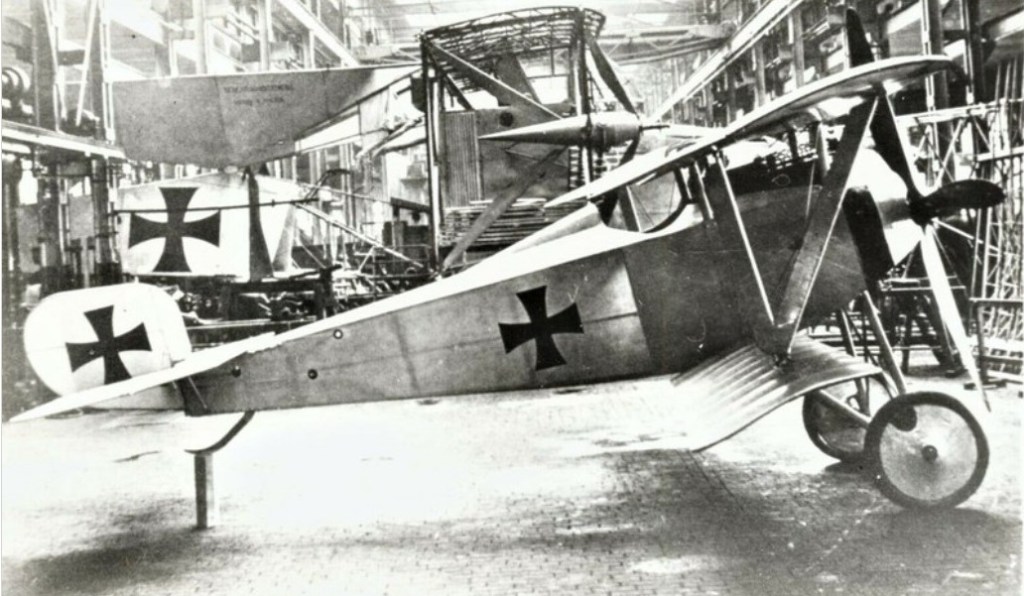
A German copy of the Nieuport 11. Some 150 were ordered into production of which only 94 became operational due to improved aircraft coming into service by mid-1917.
Replica Ultralight:
Circa Reproductions Siemens Schukert
Engine: Siemens-Halske, 110 hp
Siemen Schkukert
Siemens-Schuckert Werke GmbH
Began airship construction in 1907. In 1909 manufactured airplanes, but poor results stopped work in 1911. Airplane department reopened 1914. In October started design of four-engined aircraft similar to that of Sikorsky in Russia. As entirely new venture company sponsored designs by two Steffen brothers leading to giants R.I-VII of 1915-1917. R.VIII, which did not fly, was then world’s largest airplane with span of 158 ft (48.16 m), and had experimental rotating gun-turret. Other advanced projects included steam-turbine monoplane and wire-guided flying bombs. Company also made E-l monoplane single-seat fighter and D-l copy of Nieuport. D-III and D-IV also built in quantity. Fighters were technically very advanced.
Siegrist RS1 Ilse
The 1971 Siegrist RS1 Ilse was a four-place cabin high-wing monoplane, built by Rudolf Siegrist. Registered N3087, it first flew in June 1971.
Engine: 180hp Lycoming O-360
Wingspan: 28’0″
Length: 21’6″
Useful load: 907 lb
Max speed: 170 mph
Cruise: 150 mph
Stall: 73 mp h
Seats: 4
Siegrist, Rudolf
Parma OH.
USA
Built the Siegrist RS1 Ilse in 1971.
Siegel MS-5 / MS-6

Mieczysław Siegel, a village schoolteacher from Skrzynice near Lublin, had already some experience with designing and building fairly amateur gliders when he decided to turn to somewhat more ambitious endeavour of building an aircraft. In 1927 he built a small MS-5 plane with parasol configuration, which was then deliberately destroyed during static tests. A year later Siegel built an improved MS-6 airplane but failed to acquire an engine, which made the designer decide to stick to gliders.
Siegel, Mieczysław
Mieczysław Siegel, a village schoolteacher from Skrzynice near Lublin, had some experience with designing and building fairly amateur gliders when he decided to build an aircraft and in 1927 he built a small MS-5. A year later Siegel built an improved MS-6 airplane but failed to acquire an engine, which made the designer decide to stick to gliders.
Siedek KS 3

The Siedek KS 3 was built by Diplom-Ingenieur Richard Siedek in Vienna, Austria. The powerplant was an 80 hp two-stroke aircraft engine, developed by Ingenieur Kraus and Siedek.”
Span: 22 ft 11.6 in (7.00 m)
Length: 16 ft 8.8 in (5.10 m)
Height: 6 ft 6.7 in (2.00 m)
Wing area: 172 sq.ft (16.00 sq.m)
Takeoff weight: 882 lb (400 kg)
Cruise speed: 75 mph (120 kmh)

