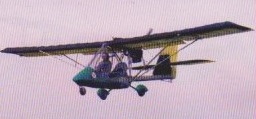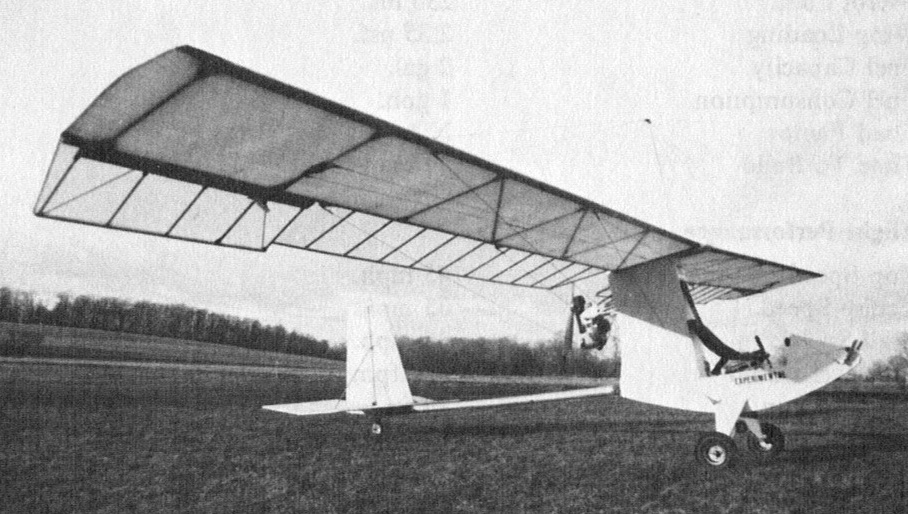
Skyhigh Sky Baby

Single seat single engined high wing monoplane with conventional three axis control. Wing has unswept leading and trailing edges, and constant chord; conventional tail. Pitch control by elevator on tail; yaw control by fin mounted rudder; roll control by half span ailerons; control inputs through stick for pitch/roll and pedals for yaw. Wing braced from above by kingpost and cables, from below by cables; wing profile; double-surface. Undercarriage has three wheels in tail dragger formation; suspension on tailwheel and bungee suspension on main wheels. Push right go right tailwheel steering connected to yaw control. No brakes. Aluminium tube/wood/steel tube fuselage partially enclosed. Engine mounted below wing driving pusher propeller.

Skyhigh Sky Baby Article

The single seat Skybaby is aimed at homebuilders and is therefore only sold as sets of plans. It is intended to have a McCulloch Mc101 engine developing 12.5 hp at 9000rpm or, for heavier pilots, the Yamaha KT100S of 15 hp at 10,000 rpm. Certain parts are available from Skyhigh Ultralights, for example the landing gear, controls, reduction drive, seat etc.

The price of the plans was $55 in 1982. According to Skyhigh, the construction time for the Skybaby should not exceed 200h.

Engine: McCulloch Mc 101, 12.5hp at 9000rpm
Power per unit area 0.09hp/sq.ft, 1.1 hp/sq.m
Fuel capacity 3.0 US gal, 2.5 Imp gal, 11.4 litre
Length overall 17.0 ft, 5.18 m
Height overall 5.0ft, 1.52m
Wing span 32.0ft, 9.75m
Constant chord 4.0 ft, 1.22 m
Sweepback 0 deg
Total wing area 128 sq.ft, 11.9sq.m
Wing aspect ratio 8.0/1
Empty weight 155 lb, 70kg
Max take off weight 360 lb, 163kg
Payload 205 lb, 93kg
Max wing loading 2.81 lb/sq.ft, 13.7 kg/sq.m
Max power loading 28.8 lb/hp, 13.0kg/hp
Load factors; +5.0, 3.0 ultimate
Max level speed 40 mph, 64 kph
Never exceed speed 50 mph, 80kph
Max cruising speed 35mph, 56kph
Stalling speed 24 mph, 39 kph
Max climb rate at sea level 225 ft/min, 1.1 m/s
Best glide ratio with power off 9/1
Take off distance 200 ft, 60 m
Landing distance 100 ft, 30 m
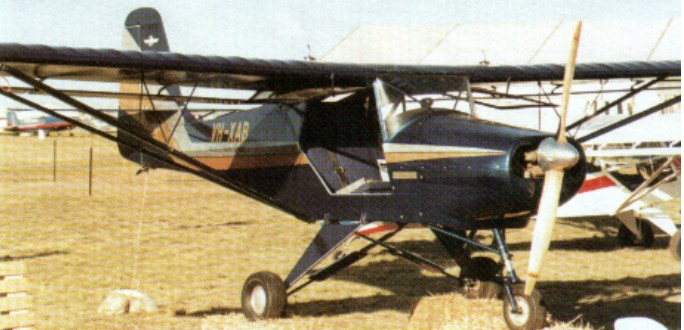
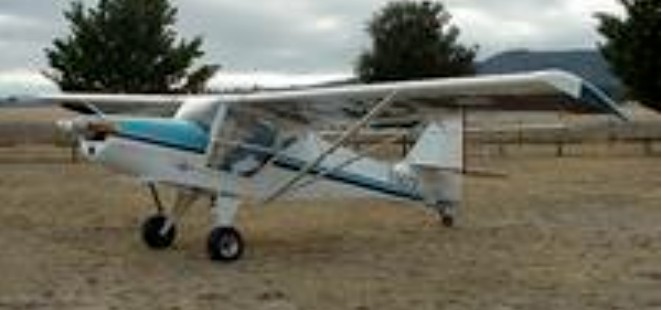
Skyfox CA-25 Gazelle

CA-25N Gazelle

To meet market demand CA-22 were again reworked and a new type certificate was gained for the CA-25N (nose-wheel) Gazelle. This name stems from the fact that the redevelopment finance for this aircraft was obtained from the Swiss agents Gisela. Production of the CA-22 Elan and the CA-25 Impala (both with tail-wheels) continued but sales of the CA-25N (nose-wheel) went at about l0 to 1.

The CA-25N nose wheel development, first flew 1995.

The airframe is built from 4130 chrome molyb¬denum steel, with the wings built up on tubular spars with an internal web, along with metal drag and anti drag braces. Plywood ribs are epoxy bonded to the spars. They are then covered with Stits polyfibre and Dulux paint. Power is from a Rotax 912, which gives the aircraft the flatter engine cowl¬ing — the easiest way to differentiate this machine from the radial type cowl of the US Kitfox.

Production ceased in late 1999 after about 106 tail-draggers and 83 nose-wheeled machines had been constructed.

CA-25
Tail wheel undercarriage

CA-25N
Extended wingspan: 9.52m (folded: 2.4m)

Skyfox CA-22

About 100 CA-22 tail-wheel machines were built and registered either as CA-22s in the ultralight (AUF) class, or as CA-22As under full VH registration marks. To meet market demand these models were again reworked and a new type certificate was gained for the CA-25N (nose-wheel) Gazelle. Production of the CA-22 Elan and the CA-25 Impala (both with tail-wheels) continued but sales of the CA-25N (nose-wheel) went at about l0 to 1.

Skyfox Aviation Skyfox
Stall: 43 kt / 49 mph / 80 kmh
Cruise: 70 kt / 81 mph / 130 kmh
VNE: 93 kt / 107 mph / 172 kmh
Empty Weight: 315 kg / 694 lbs
MTOW Weight: 520 kg / 1146 lbs
Glide Ratio: 10:1
Take-off distance (50ft obstacle): 330 ft / 100 m
Landing distance (50ft obstacle): 390 ft / 120 m

Skyfox Aviation

Skyfox Aviation came on the scene in 1991 at Caloundra, north of Brisbane, after acquiring the rights to manufacture the US Kitfox ultralight. The aircraft was significantly modified to meet the CAQ 101-55 standards for a commercially-built two-seat ultralight able to be used for flight training. The aircraft was also re-worked to meet the international JAR/VLA certification standards for sale in Europe and this was completed by about mid-1993, as the CA-22.

Founded as a public company in 1996 but originating in 1991. Offers the Skyfox STOL two-seat braced high-wing cabin monoplane (first flown September 1989) for pleasure, training, surveillance and other roles, in CA22 ultralight, CA25 tailwheel general aviation and CA25N nosewheel general-aviation versions.

A fi¬nancial crisis in 1997 saw the company again re¬financed.

Skye Treck Skyseeker Mk.III

A single seat single engined high-¬wing monoplane with conventional three axis control. Wing has unswept leading and trail¬ing edges, and constant chord; cruciform tail. Pitch control by fully flying tail; yaw control by fully flying rudder; roll control by half¬span ailerons; control inputs through stick for pitch/roll and pedals for yaw. Wing braced from above by kingpost and cables, from below by cables; wing profile single¬surface. Undercarriage has three wheels in tail dragger formation; bungee suspension on all wheels. Push right go right tailwheel steer¬ing connected to yaw control. No brakes. Aluminium tube framework, with optional pod. Engine mounted below wing driving pusher propeller. Aluminium tubing is 6061T6 grade. Rigging is stainless steel cable. Wing covering is Dacron.

It is similar in layout to the Mk.I, but the control system has been changed to conventional three axis, with stick and rudder pedals.

The Skyseeker Mk.III is in effect a single seat version of the Mk.II, using the same control system and having very similar dimensions and only slightly lower empty weight. Apart from the seating arrangements, the most obvious difference is the use of 16 inch (41 cm) main wheels, as on the Mk.I, rather than the 20 inch (51 cm) type fitted to the Mk.II

This machine is supplied in kit form and the manufacturer says it takes 30h to build. Rigging time is listed as 30 min.

Floats, skis and instruments are available as on the Mk.I, while the Rotax engine can be replaced at customer’s request by a 215 cc single cylinder Cuyuna of 20hp.

Engine: Rotax 277, 28 hp at 6200 rpm
Length overall 12.0 ft, 3.66 m
Height overall 9.0ft, 2.74m
Wing span 32.0ft, 9.75m
Constant chord 5.0ft, 1.52m
Dihedral 5 deg
Sweepback 0 deg
Elevator span 9.2ft, 2.80m
Total aileron area 9.0 sq.ft, 0.84 sq.m
Rudder height 5.0 ft, 1.52 m
Total wing area 160sq.ft, 14.9sq.m
Wing aspect ratio 6.4/1
Wheel track 4.2ft, 1.27m
Main wheels diameter overall 16 inch, 41cm
Tailwheel diameter overall 3 inch, 8 cm
Optional floats, dimensions: 10.0ft long x 2.0ft wide, 3.05 x 0.61 m
Optional skis, dimensions: 4.0 ft long x 10 inch wide, 1.22 x 0.25 m
Empty weight 245 lb, 111 kg
Max take off weight 496 lb, 225 kg
Payload 251 lb, 114 kg
Max wing loading 3.101b/sq.ft, 15.1 kg/sq.m
Max power loading 17.71b/hp, 8.0kg/hp
Load factors +4.0, 2.0 design
Max level speed 55mph, 88kph
Never exceed speed 65mph, 105 kph
Max cruising speed 45 mph, 72 kph
Economic cruising speed 42 mph, 68 kph
Stalling speed 20 mph, 32 kph
Max climb rate at sea level 700 ft/min, 3.6 m/s
Min sink rate 250 ft/min at 30 mph, 1.3 m/s at 48 kph
Best glide ratio with power off 6/1
Take off distance 50ft, 15m
Landing dis¬tance 25ft, 8m
Service ceiling 10,000ft, 3050m
Range at average cruising speed 180 mile, 290 km

Skye Treck Skyseeker Mk.II

Side by side two seat single engined high-¬wing monoplane with conventional three axis control. Wing has unswept leading and trail¬ing edges, and constant chord; cruciform tail. Pitch control by fully flying tail; yaw control by fully flying rudder; roll control by half¬span ailerons; control inputs through stick for pitch/roll and pedals for yaw. Wing braced from above by kingpost and cables, from below by cables; wing profile single¬surface. Undercarriage has three wheels in tail dragger formation; bungee suspension on all wheels. Push right go right tailwheel steer¬ing connected to yaw control. No brakes. Aluminium tube framework, with optional pod. Engine mounted below wing driving pusher propeller. Aluminium tubing is 6061T6 grade. Rigging is stainless steel cable. Wing covering is Dacron.

The Skyseeker Mk.II is the two seater in the Skye Treck range. It is similar in layout to the Mk.I, but to fit it for its two seat role, the control system has been changed to conventional three axis, with stick and rudder pedals. A notable point is that whereas most three axis aircraft with single-¬surface wings use spoilers for roll control, the Skyseeker Mk.II uses ailerons.

Unusually for a two seater, the principal dimensions and engine specifications are virtually identical to the solo machine, the differences being largely confined to the undercarriage, where larger main wheels are used. As on the single seater, floats, skis and instruments are available as extras.

Engine: Rotax 277, 28 hp at 6200 rpm
Length overall 12.5ft, 3.81m
Height overall 9.0ft, 2.74m
Wing span 32.0ft, 9.75m
Constant chord 5.0ft, 1.52m
Dihedral 5 deg
Sweepback 0 deg
Elevator span 9.2ft, 2.80m
Total aileron area 9.0 sq.ft, 0.84 sq.m
Tailwheel diameter overall 3 inch, 8cm
Main wheels diameter overall 20 inch, 51 cm
Rudder height 5.0 ft, 1.52 m
Total wing area 160sq.ft, 14.9sq.m
Wing aspect ratio 6.4/1
Wheel track 4.2ft, 1.27m
Optional floats, dimensions: 10.0ft long x 2.0ft wide, 3.05 x 0.61 m
Optional skis, dimensions: 4.0 ft long x 10 inch wide, 1.22 x 0.25 m

Skye Treck Skyseeker Mk.I

Single seat single engined high wing mono¬plane with hybrid control. Wing has unswept leading and trailing edges, and constant chord; cruciform tail. Pitch control by fully flying tall; yaw control by fully flying rudder; no separate roll control; control inputs through weight shift for pitch/yaw/roll. Wing braced from above by kingpost and cables, from below by cables; wing profile single surface. Undercarriage has two wheels with tailskid; bungee suspension on main wheels. Push right go right tail steering con¬nected to yaw control. No brakes. Aluminium tube framework, without pod. Engine mounted below wing driving pusher propeller. Aluminium tubing is 6061T6 grade, anodized. Rigging is stainless steel vinyl coated cable. AN hardware.
The Skyseeker uses a taildragger undercarriage with skid.

The Skyseeker Mk.1 is a hybrid machine, with weight shift assisted by a rudder and elevator. Various engines have been fitted to the aircraft, but the usual one is a Rotax 277. However, there were also Skyseeker Mk.1s around with Cuyuna 215R engines, developing 20hp, or with single cylinder Kornet K 55 engines mated to a 48×20 inch (1.21×0.51m) propeller through a 2/1 reduction. Construction time is listed as 25 h and rigging time as 15 min. Options include floats, skis, and various instruments such as ASI, CHTG, EGTG, and compass. In addition, the factory will convert a Mk.I to Mk.III specification on request.

Engine: Rotax 277, 28 hp at 6200 rpm
Propeller diameter and pitch 48 x 34 inch, 1.22 x 0.86 m
Reduction ratio 2.1/1
Max static thrust 1801b, 82kg
Power per unit area 0.18h p/sq.ft, 1.9 hp/sq.m
Fuel capacity 4.8 US gal, 4.0 Imp gal, 18.2 litre
Empty weight 225 lb, 102 kg
Max take off weight 496 lb, 225 kg
Payload 271 lb, 123 kg
Max wing loading 3.101b/sq.ft, 15.1kg/sq.m
Max power loading 17.71b/hp, 8.0kg/hp
Load factors +4.0, 2.0 design
Length overall 12.0 ft, 3.66 m
Height overall 9.0ft, 2.74m
Wing span 32.0ft, 9.75m
Constant chord 5.0ft, 1.52m
Dihedral 5 deg
Sweepback 0 deg
Elevator span 9.2ft, 2.80m
Rudder height 5.0 ft, 1.52 m
Total wing area 160sq.ft, 14.9sq.m
Wing aspect ratio 6.4/1
Wheel track 4.2ft, 1.27m
Main wheels diameter overall 16 inch, 41cm
Optional floats, dimensions: 10.0ft long x 2.0ft wide, 3.05 x 0.61 m
Optional skis, dimensions: 4.0 ft long x 10 inch wide, 1.22 x 0.25 m
Max level speed 55 mph, 88 kph
Never exceed speed 65 mph, 105 kph
Max cruising speed 45 mph, 72 kph
Economic cruising speed 42mph, 68kph
Stalling speed 19 mph, 31 kph
Max climb rate at sea level 800 ft/min, 4.1 m/s
Min sink rate 220 ft/min at 32 mph, 1.1 m/s at 51 kph
Best glide ratio with power off: 6/1
Take off distance 50ft, 15m
Landing dis¬tance 25ft, 8m
Service ceiling 11,000ft, 3350m
Range at average cruising speed 180 mile, 290 km