In 1938, at Kirbymoorside, Yorkshire, Slingsby Sailplanes Ltd built the Kirby Kitten single-seat monoplane, designed by F. N. Slingsby.
Aircraft
Slingsby T.9 King Kite
The initial layout of the Buxton Hjordis 2 were commenced by Mungo Buxton but it was built as the Slingsby T.9 King Kite. Many of the King Kite drawings were entitled Hjodris 2 (King Kite).
Slingsby had had a bad experience with the Type 9 King Kite entering incipient spins at low airspeed which was ascribed to the use of a NACA 4312 aerofoil section at the wing-tips, so he designed the Gull with a modified RAF 34 profile at the tips. The cause of the wing drop problem on the King Kite was later found to be inaccurate manufacture, but the Gull retained the modified RAF 34 section.
Slingsby T-8 Kirby Tutor
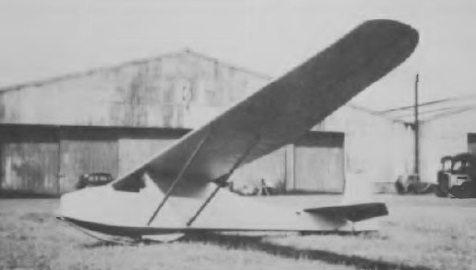
The T8 Tutor single-seater introduced in 1937 was an improved version of the Kirby Kadet with a new two-spar wing of increased span (43ft 3.75in) and tapered outer wing panels married to the same wooden fuselage and wooden tail unit with braced tailplane as the Kadet’s. At the same time a differential mechanism was introduced into the aileron control circuit. This wing was capable of being fitted to the Cadet TX Mk 1, most of which, by the early 1950s, had been converted to Tutor standard as the T8 Cadet TX Mk 2 by the fitting of this wing.
The Tutor prototype first flew in July 1937 and seven examples had been built by the outbreak of war; it re-entered production after the Cadet to meet the demands for an ATC trainer, and 62 more were built in the war as the Cadet TX Mk 2.
Total Tutor production was 106, and the price had risen from £99 10s (£99.50) in 1939 to £360 ex-works in 1948. A two-seater version for teaching the initial stages of flying, and suitable for the circuits and bumps of training, was the T31 Tandem Tutor.
Variation:
Osbourn Twin Cadet
Slingsby T-7 Kirby Cadet
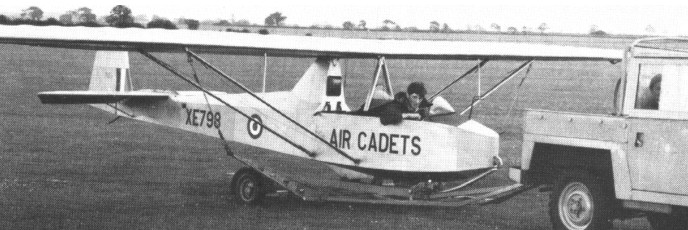
This single-seat intermediate trainer was originally designed by John S. Sproule in 1935 as a soarable version of the Slingsby T3 or Nacelled Primary glider, and was at first known as the T7 Kirby Kadet.
It first flew in prototype form at Sutton Bank on 11 January 1936.
It was of conventional wood and fabric construction, with a high-set, braced, two-spar constant chord wing that was, in fact, interchangeable with that of the later T8 Tutor; no flaps or air brakes were fitted, and the ailerons were fabric-covered. The plywood-skinned wing was mounted on a built-up centre portion of the fuselage, in front of which the pilot sat in an open cockpit. Early examples had a rubber shock absorbed skid for takeoff and landing, but later versions had a modified nose, a less tall rudder and a fixed main wheel and a tailskid. The Cadet’s Gottingen 426 wing section gave it gentle stalling characteristics and good lift at low speeds and this, allied to a simple design making for ease of repair as well as manufacture, made it an excellent trainer.
Only 22 Kadets had been built when the war put a stop to production, the price of a new one being £93 in 1939, which had risen to £325 by 1948, but the type was put back into production with an Air Ministry order for 200 for use by the ATC, the first aircraft from this order, later to be known as Cadet TX Mk 1s, being built in 1943; the ATC variant differed slightly from the prewar civil Kadet in having reduced rudder height and a monowheel in the fuselage as well as the nose skid. The ATC’s predecessor, the Air Defence Cadet Corps, had given its cadets some instruction at British gliding clubs before the war, but this stopped when war broke out, and it was not until 1942 that the first ATC gliding school was opened at Kirbymoorside, Yorkshire, where the Slingsby works were located, and an instructors’ course was started.
By December 1945 the ATC had 84 gliding schools with over 600 Service and civilian instructors, and about 4,500 cadets had received some gliding instruction, as well as instruction in winch-launching, and an equal number had reached the top proficiency stage of their training. The Royal Air Force air cadet training program eventually acquired 376, known as the Kirby Cadet T.X. Mk. 1.
During World War II, Total production by Slingsby and subcontractors (including Ottley Motors Ltd., a batch of 30) amounted to around 430, with some kits being supplied in addition. Plans were made available for license building.
Altogether 226 Cadets were built during the war by Slingsby and three other subcontractors, of which Martin Hearn Ltd of Hooton Park, Cheshire, was the most important; this firm also built 27 of the postwar production for gliding clubs, which brought the total built since 1936 to 431.
By the early 1950s most Cadet TX Mk 1s had been converted to Tutor standard (the RAF Kirby T8 Cadet TX Mk 2) by fitting the Tutor’s longer span (13.24 m / 43.4 ft) tapered wings. This in turn evolved into the T.31 Tandem Tutor (RAF Kirby Cadet T.X. Mk. 3) two-place trainer. Spare T. 7 Kirby Cadet TX Mk 1 wings were used to produce the Slingsby T38 Grasshopper TX Mk 1 post war, which was a version of the SG 38 primary glider with a simplified open-framework fuselage, modified tail unit and the surplus Cadet wings; production began in 1952 and 115 Grasshoppers were built.
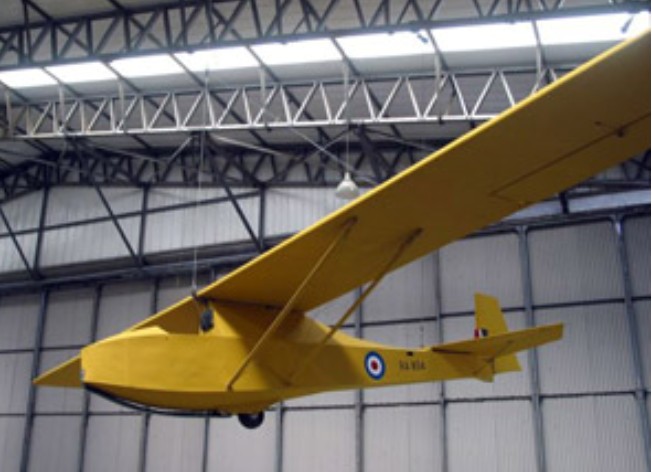
Variation: Cadet Aeronautics Cadet UT-1
Cadet TX Mkl
Wing span: 11.73 m / 38 ft 6 in
Wing area: 15.8 sq.m / 170 sq.ft
Length: 20 ft 10.5 in
Empty Weight: 134 kg / 295 lb
Payload: 218 lb / 99 kg
Gross Weight: 513 lb / 233 kg
Wing Load: 3.02 lb/sq.ft / 14.75 kg/sq.m
Aspect ratio: 8.67
L/DMax: 14 @ 48 kph / 26 kt / 30 mph
Best glide ratio: 16:1
Airfoil: Go 426
MinSink: 1.07 m/s / 3.5 fps / 2.07 kt at 32 mph
No. of Seats: 1
Slingsby T-6 Kirby Kite
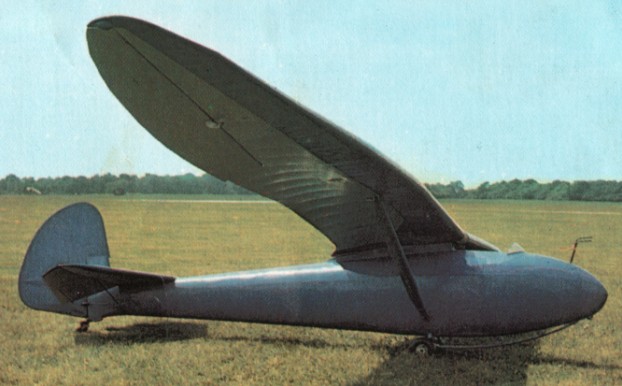
The Kirby Kite was a development of the Schneider Grunau Baby 2 with a gull wing and a streamlined fuselage first flown in 1935. Slingsby had already built a number of Grunau Babies under license and in the construction of the Kite used some of the same components and metal fittings. During World War II most were impressed into military service in 1940, and several kites were used to work out and establish safe towing procedures and instructing techniques for British Military glider pilots. After trials with standard kites, one was fitted with wooden control rods instead of cables to investigate the ability of radar to detect all-wooden aircraft.
Only 25 were built.
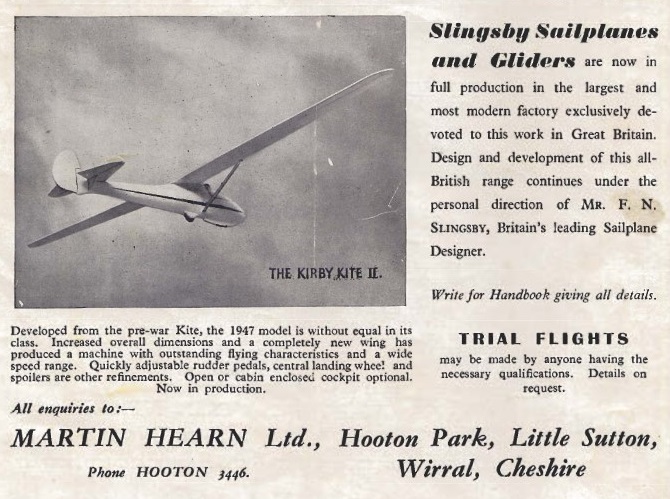
Wing span: 14.2m / 26.6ft
Wing area: 14.49sq.m / 156sq.ft
Empty Weight: 138kg / 304lb
Payload: 93kg / 205lb
Gross Weight: 231kg / 509lb
Wing Load: 15.94kg/sq.m / 3.17 lb/sq.ft
Aspect ratio: 13.8
Airfoil: Go 535
Structure: strut-braced wood/ fabric wings, wood/ fabric tail, wood fuselage
Slingsby
Slingsby Sailplanes Ltd
Slingsby Aircraft Company Ltd
Having served in the Royal Flying Corps in the First World War Frederick N. Slingsby helped to found the Scarborough Gliding Club in 1930 and, from repairing the first Primary the club owned, in his furniture works, soon became a designer and builder of gliders. His first glider, the Falcon I, was a version of the Schleicher Falke, built from plans bought from the German Aero Club.
Mr. C.E. Hardwick requested Slingsby build another Falke for himself and this was the beginning of the Slingsby glider works. He also began to manufacture primary gliders and the first advertisement appeared in “Sailplane and gliders” in November 1933 offering primary gliders for £45 complete.
For several months the empty tramsheds of Scarborough Corporation were used but, in September 1934, a move was made to part of an engineering factory in Kirkbymoorside. The move was at the invitation of Major J.E.D. Shaw, a local landowner, who owned several aircraft and had a small aerodrome on his estate at Welburn Hall. His objective was to bring employment to the region and he offered Slingsby complete financial backing. The engineering firm then operated as Slingsby, Russell & Brown Ltd.
During a slack period, light aircraft were also considered and the construction of two different types began in 1938 but both types were abandoned.
In 1938, at Kirbymoorside, Yorkshire, Slingsby Sailplanes Ltd built Kirby Kitten single-seat monoplane, designed by F. N. Slingsby.
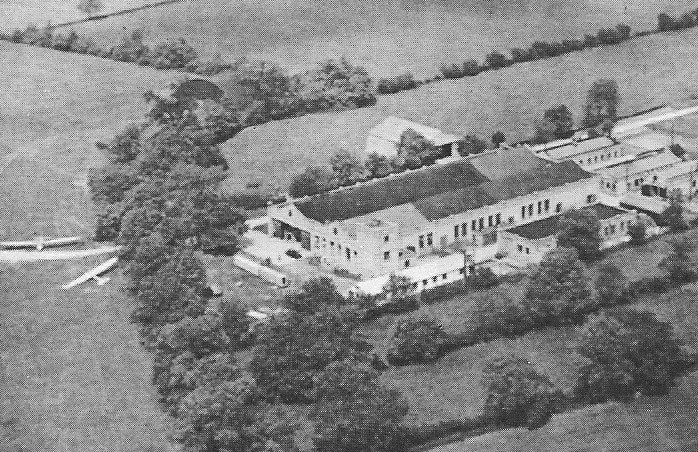
Demand called for larger premises and a new factory was built at the side of Major Shaw’s airfield at Welburn just outside Kirkbymoorside was built. In July 1939, when the new factory was ready for occupation, a separate company, Slingsby Sailplanes Ltd, was formed with Major J.E.D. Shaw as Chairman and F.N. Slingsby as Managing Director and Chief Designer. It was planned to officially declare the new factory open on Monday September 4th but the outbreak of the war on the previous day put a stop to all private flying in the UK.
Chiefly famous for gliders, Motor Tutor of 1948 was Slingsby Tutor glider with engine and landing gear.
On 21 April 1955 Major Shaw died. His share in Slingsby Sailplanes had to be sold to settle death duties on his estate. To avoid a take-over bid the shares were acquired by a trust formed by the leading members of the British gliding movement. The company was then owned by the Shaw-Slingsby Trust, and Phillip Wills was appointed Chairman.
In 1962 Slingsby was affect by heart trouble and in 1964, aged seventy, decided to retire. P.R. Street joined the company as Managing Director.
In 1965 J.W. Bradley was appointed Chairman of the Board, with W.N. Slater as Managing Director. In 1967 the company was split into Slingsby Aircraft Ltd and Slingsby Joinery Ltd, with a holding parent company Slingsby Aircraft Holdings Ltd.
The whole of the main aircraft factory area was burnt to the ground on 18 November 1967. No Slingsby drawings were lost in the fire but all records and drawings of Operation Sigma Ltd were destroyed.
After the fire many employees were made redundant. The total number before the fire was 120. Further redundancies were declared in February 1969 but on 11 July it was announced Slingsby Aircraft Holdings Ltd was in the hands of a Receiver.
On 3 November 1969 Vicker Ltd acquired the entire assets of the company for a reported figure of £179,150. A new company using the old title of Slingsby Sailplanes Ltd was established.
The fibreglass work which was by then a speciality was continued, but aimed more at the military and marine environment, such as bathyspheres and small submarines.
Slingsby Aviation Ltd. is member of ML Holdings Plc group and offers professional pilot training and subcontract component building, in addition to sales of the T67 Firefly side-by-side two-seat civil/military piston-engined trainer and private aerobatic-capable lightplane (first flown May 1981, as license-built Fournier RF6B).
Jim Tucker came along later and bought the company, being a major shareholder of Slingsby Aviation which continued to produce for military GRP contracts and underwater craft, as well as hovercraft and gondolas for airships.
Sling Aircraft Sling
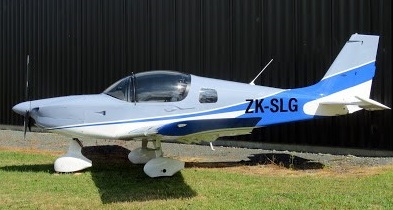
The two-seater Sling was designed by Mike Blyth bigger than some of the comparable sport aircraft and can be certified as an LSA.
The prototype first flew on 18 November 2009. It is produced by Sling Aircraft (Pty) Ltd of Johannesburg in South Africa as a kit or a fully built up aircraft. After a full testing programme the second prototype was flown around the world from East to West in 40 days in 2009, which proved the credentials of the design. The Sling is of all metal construction with composite cowling and fairings. The design has been extended to a 4 seater aircraft which is called the Sling 4 while the 2 seater has been renamed the Sling 2.
Sling
Engine: Rotax 912, 100 hp
Wingspan: 30 ft 1 in / 9.17 m
Wing area: 127.5 sq.ft
Length: 22 ft 10 in / 6.98 m
empty weight: 806 lb / 370 kg
MAUW LSA: 1,320 lb / 598 kg
Cruise: 140 mph / 120 kt
Stall: 46 mph / 40 kt
Sling Aircraft (Pty) Ltd
Johannesburg
South Africa
Produced the Sling Aircraft Sling kit or a fully built up aircraft from 2009.
Slesarev Sviatogor
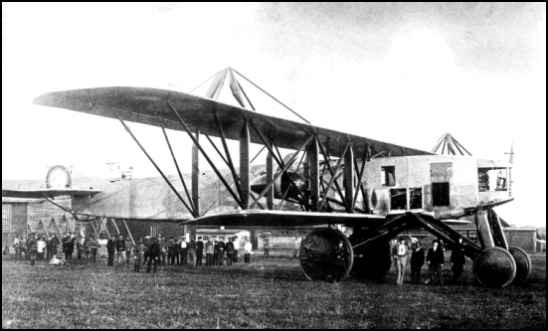
A “Sviatogor” built by Slesarev around 1913-1918. It seems to have been powered with two 300 hp Mercedes engines.
Engines: two 300 hp Mercedes
Wingspan: 36 m
Wing area: 180 sq.m
Length: 21 m
Est max speed: 100 km/h
Ceiling: 2500 m
Weight: 6500 kg
Slepcev Storch
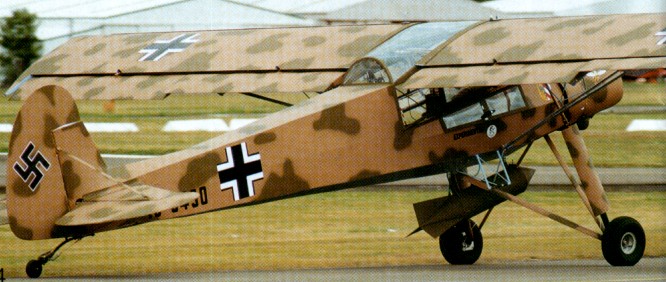
The Slepcev Storch is a kit plane designed by Nestor Slepcev and is produced at the factory in Beechwood, Port MacQuarie, Australia. The Slepcev Storch is a dual control 75% scale replica of the Feisler Fi-156 Storch modified for simplicity. Initially designed in 1992 as a single seater, the Slepcev Storch is produced as a two seat tandem Ultralight STOL aircraft.
The Slepcev Storch is JAR-VLA certified, Type Certificate No.VA505 issued by the Australian CASA on 14 October 1991. It also meets Australian Noise Certification to standard 66.8dBA.
The plane was designed around a light fuselage rated at +6/-3G. Reportedly it will fly as slow as 20 mph with full flaps and 30% power. The construction is 4130 chromemoly steel tubing for the fuselage, rudder and elevator. The wings are all-aluminium and the main landing gear is made of 4130 tubing with 10 inches of travel. Standard wheels are 8.00 x 6 mains, and a Maule tailwheel. Brakes are hydraulic disc, and the fuel is contained in the wings.
The kit consists of JAR-VLA certified components and is fully welded with the fuselage and empennage primed for protection against corrosion. Also supplied are upholstered seats, the main landing gear, wheels, hydraulic disc brakes and the Maule tailwheel. The aluminium wingspars and ribs are pre-drilled and the lightening holes are flanged. All the hardware is included, as are the wingskins. Much of the control system is installed, including the stick and all of the fuselage pushrods. The Lexan windows are supplied, and all hardware. No special tools are required.
The interior measures 2.6 ft wide, 3.3 ft high, and 4.9 ft long. The fuel tank holds three hours and an optional 26.4 gallon belly tank can add another four hours.
The controls are aluminium pushrods, through the rudder and the elevator trim trim are controlled by cables. The brakes are toe-operated.
Avaliable ready to fly or as an advanced kit 2009 Price: A$44,000.
Slepcev Microlight Storch
Stall: 22 kt / 25 mph / 41 kmh
Cruise: 72 kt / 83 mph / 133 kmh
VNE: 80 kt / 92 mph / 148 kmh
Empty Weight: 289 kg / 637 lbs
MTOW Weight: 450 kg / 992 lbs
Climb Ratio: 800 ft/min / 4 m/s
Take-off distance (50ft obstacle): 30 ft / 9 m
Landing distance (50ft obstacle): 30 ft / 9 m
Engine: Rotax 618, 75 hp
HP range: 65-100
Height: 7.5 ft
Length: 21.33 ft
Wing span: 33.5 ft
Wing area: 160 sq.ft
Weight empty: 618 lb
Gross: 1056 lb
Fuel cap: 14 USG
Speed max: 78 mph
Cruise: 65 mph
Range: 300 sm
Stall: 16 mph
ROC: 1200 fpm
Take-off dist: 30 ft
Landing dist: 50 ft
Service ceiling: 16,500 ft
Seats: 2
Landing gear: tail wheel
Engine: Rotax 912, 80 hp
HP range: 80-120
Height: 7.5 ft
Length: 24 ft
Wing span: 33.7 ft
Wing area: 180 sq.ft
Empty weight: 650 lb
Gross weight: 1200 lb
Fuel capacity: 18 USG
Top speed: 95 mph
Cruise: 75 mph
Stall: 16 mph
Range: 250 sm
Rate of climb: 1200 fpm
Takeoff dist: 30 ft
Landing dist: 50 ft
Service ceiling: 15,000 ft
Seats: 2 tandem
Landing gear: tailwheel
Engine: Rotax 912S, 100 hp
Length: 22.3 ft
Wing span: 32.8 ft
Wing area: 172.2 sq.ft
Empty weight: 771.6 lb
Gross weight: 1212.5 lb
Fuel capacity: 19.8 Gal
Top speed: 78 kt
Cruise: 70 kt
Stall: 25 kt
Rate of climb: 700 fpm
Takeoff dist: 50-100 ft
Landing dist: 50-100 ft
Service ceiling: 15,000 ft
Seats: 2
2009 price (JAR-VLA) fly away: A$63,000
2009 price (JAR-VLA) Advanced kit: A$44,000
2009 price (JAR-VLA) kit: A$35,000
Slepcev Storch Mk.4
Engine: Rotax 912, 80 hp
Wing span: 10 m
Wing area: 16 sq.m
MAUW: 450 kg
Empty weight: 289 kg
Fuel capacity: 75 lt
Max speed: 150 kph
Cruise speed: 125 kph
Minimum speed: 27 kph
Climb rate: 6 m/s
Seats: 2
Fuel consumption: 11 lt/hr
Price (1998): 77,000 DM
Kit price (1998): 29,650 DM

