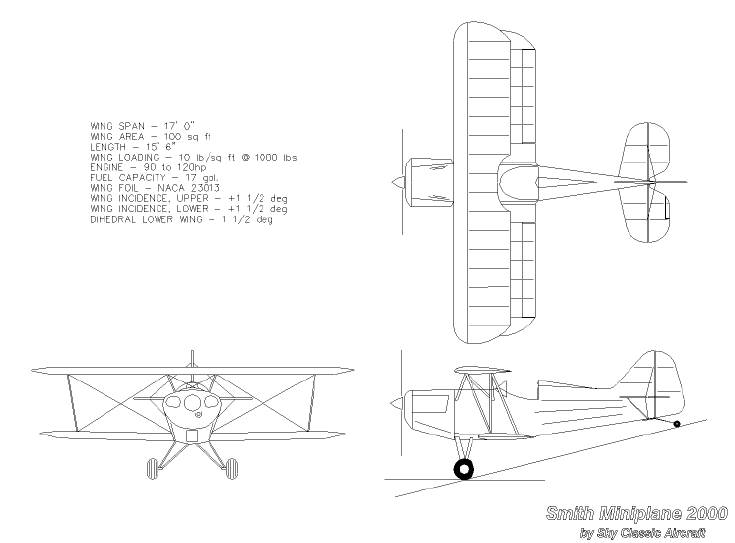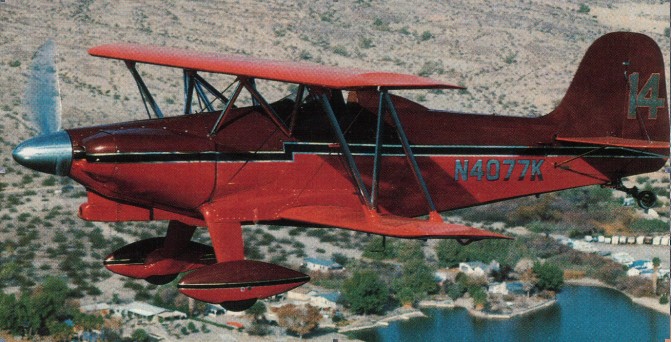
The primary appeal of the Smith Miniplane is its small-size construction simplicity and open-cockpit. The fuselage framework is a conventional truss structure of welded steel tubing, faired to shape with wood stringers. As on most similar designs, the vertical stabilizer is welded up as part of the rear fuselage structure. The wings are made from spruce spars and ribs. Several engines can provide the power, the Continental from 65 to 85 hp or the Lycoming from 100 to 125 hp.
The 1956 DSA-1 Miniplane model designation was for “Damn Small Aeroplane”. The prototype first flew on 29 October 1956.

There have been hundreds of the original Smith Miniplane Biplanes built and flying today. In 1996 plans cost US$140.
Sky Classic Aircraft introduced the 2000 version of the Smith Miniplane Biplane. Many of the parts and pieces on the aircraft were simplified to make it easier to build.
Changes include:
1) New wing fittings to simplify building.
2) Stretched the length of the fuselage by 5 inches to accommodate a larger person.
3) Stretched the width of the fuselage by 2 inches to accommodate a larger person.
4) Added a trim tab to the elevator.
5) Reshaped the rudder assembly to look more racy.
6) Added struts to the horizontal stabilizer to stop any cracking like the Pitts did.
7) Changed the wing foil to a NASA 23013. Good for aerobatics yet very stable with less drag.
8) Changed the wing angles of attack to fix an old problem on the old aircraft.
9) Reduced the rudder control speed to make it just a little easier to fly.
10) Aircraft plans on computer CAD so that they are easy to read.
11) Adding springs to the original type landing gear.

Engine: 65- 85-hp Continental, 100-125-hp Lycoming.
Gross Wt: 1000 lb
Empty Wt: 616 lb.
Fuel capacity: 17 USG
Wingspan: 17’.
Length: 15’3”
Wing area: 100 sq.ft.
Top speed: 130 mph
Cruise: 122 mph.
Stall: 56 mph
Climb rate: 1600 fpm.
Ceil¬ing: 13,000 ft
Takeoff run: 450 ft
Landing roll: 500 ft
Range: 275 sm
Seats: 1
Sky Classic Aircraft Smith Miniplane 2000
Engine: Lycoming O-235, 100 hp
HP range: 90-120
Length: 15.5 ft
Wing span: 17 ft
Wing area: 100 sq.ft
Empty weight: 650 lb
Gross weight: 1000 lb
Fuel capacity: 15 USG
Cruise: 125 mph
Stall: 60 mph
Range: 90 sm
Rate of climb: 1000 fpm
Takeoff dist: 400 ft
Landing dist: 400 ft
Seats: 1
Cockpit width: 23 in
Landing gear: tailwheel
Sky Classic Aircraft Smith Sport Miniplane
Engine: Continental O-200, 100 hp
HP range: 90-120
Height: 5.5 ft
Length: 15.5 ft
Wing span: 100 ft
Wing area: 100 sq.ft
Empty weight: 650 lb
Gross weight: 1000 lb
Fuel capacity: 17 USG
Top speed: 135 mph
Cruise: 125 mph
Takeoff dist: 400 ft
Landing dist: 400 ft
Seats: 1
Landing gear: tailwheel