Russia
Founded 1955 at Samara State Aerospace University. Aircraft are A-16 single-seat composites lightplane, Che-15 two-seat open ultralight floatplane (optional wheels or skis), and S-202 two-seat amphibious flying-boat (first flown 1994). Re-winged S-302 and four-seat S-400 projected.
Aircraft
Stroukoff YC-134 Pantobase
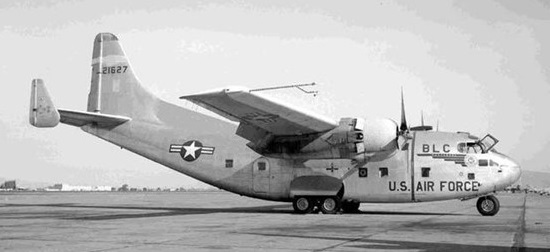
The Stroukoff YC-134, designed in 1956, was based heavily on the Fairchild C-123 Provider. The United States military contracted with Stroukoff Aircraft Corporation to develop an improved version of the aircraft, combining features that the company had developed for the YC-123D and YC-123E.
The product of a US Air Force contract in 1956, a single C-123B from the -CN production block (serial 52-1627) was modified by Stroukoff Aircraft to become the YC-134. This aircraft was heavily modified with the following new features:
New Engines: The YC-134 was equipped with two 3,500 hp (2,600 kW) Wright Turbo Compound R3350-89A radial engines, turning four-blade, thirteen foot Aeroproducts constant-speed fully feathering propellers.
A new thickened wing. In the root of the wing they installed two turbocompressors with 400 hp each
Improved Control Surfaces: The YC-134’s horizontal stabilizers were given endplates to improve directional stability.
Improved landing gear: While the nosewheel from the C-123B was retained, both main gears were given a third wheel to improve weight distribution.
Fuel was no longer housed in the rear of the engine nacelles, but in an expanded center-wing fuel tank. In addition, two plumbed hardpoints for 550-gallon drop tanks were also added to each wing.

Stroukoff’s BLC and Pantobase: the YC-134 was fitted with Stroukoff’s own BLC and all three aircraft had they been delivered were to have been fitted with the Pantobase equipment designed for the YC-123E.
The features gave an empty weight increase over the C-123B from 31,058 lb (14,088 kg) to 37,965 lb (17,221 kg), and a maximum loaded weight increase from 60,000 lb (27,000 kg) to 74,700 lb (33,900 kg). The aircraft’s cruising speed was 219 mph (352 km/h), compared to the C-123B’s 190 mph (310 km/h), and the YC-134 had a 1,600-mile (2,600 km) range with a 24,000 lb (11,000 kg) payload. The BLC allowed the YC-134’s take-off distance to decrease from 1,850 feet (560 m) to 750 feet (230 m), very similar to that of the YC-123D.
The aircraft for the first time rose into air on 19 December, 1956, on the tests were obtained good results, and servicemen ordered two additional machines. On them they installed the modernized boundary-layer control system with one more powerful compressor and “pantobase”. The YC-134 gained the designation “Pantobase” after hydro-skis were added. The YC-134 demonstrated following: takeoff on the earth – 244 m, on the snow and the water – 458 m; path on the earth – 320 m, on the snow – 305 m, on the water – 228 m. In the beginning of 1958 all three YC-134 were transferred to the Air Force.
One conversion to a YC-134 (YC-123D) was made in 1956 (53-8068), powered by two 3500hp Wright R-3350, with similar dimensions to the Fairchild C-123B. Fitted with a boundary layer control system, tailplane endplates, and tandem mainwheels.
The 1958 YC-134A had a sealed and strengthened fuselage and “Pantobase” multi-purpose landing gear fitted with land/water skis and wingtip floats. Began as Chase C-123B 52-1627 rebuild then was modified by Fairchild as YC-123B with wingtip J44 jets, and later reputedly converted by Stroukoff as YC-134A “Pantobase” with R-3350-89A engines and boundary layer control.
The U.S. Air Force, however, deemed that the YC-134 did not offer substantial improvement over the C-123, nor did it have a requirement for a piston-engined amphibious assault transport, and decided to purchase the Lockheed C-130 Hercules.
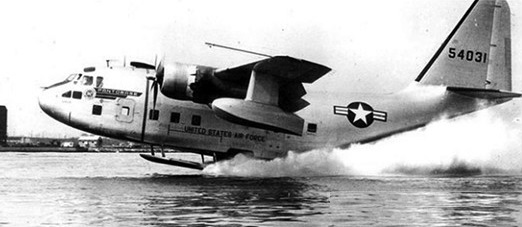
YC-134-SA
Engine: 2 × Wright R-3350-89A, 3,500 hp
Payload: 24,000 lb
Empty weight: 37,965 lb (17,221 kg)
Max. takeoff weight: 74,700 (33,900 kg)
Cruise speed: 219 mph (352 km/h)
Range: 1,600 miles (2,600 km) with 24,000 lb (11,000 kg) payload
Take-off distance: 750 feet (230 m)
Stroukoff Aircraft Corp
USA
Formed at West Trenton, New Jersey, by Michael Stroukoff, responsible for design of Chase C-123 military transport, after controlling interest in the Chase Aircraft Company Inc, of which Stroukoff was vice-president, had been acquired by the Kaiser-Frazer Corporation. New Stroukoff corporation developed design of C-123. Experimental model with boundary-layer control flown December 1954. Stroukoff also developed for amphibious aircraft of this class “pantobase” landing gear (retractable land/water skis and wingtip floats).
1953: (Michael) Stroukoff Aircraft Corp, Trenton NJ.
Stroop SP-4
Built by Robert C Stroop at Rome GA circa 1927, Stroop SP-4 was a convertible biplane-to-triplane arrangement.
A single-place powered by a 90hp Curtiss OX-5 it was registered N4197.
It is likely not completed or did not exist long enough to be recorded.
Stroop Scout
Built by Robert C Stroop at Jacksonville in 1932, the Scout was a major conversion of a Thomas-Morse Scout into a parasol monoplane to test Stroop’s arcuate aileron system. A single-place powered by an 80hp LeRhône rotary engine, only one was built.
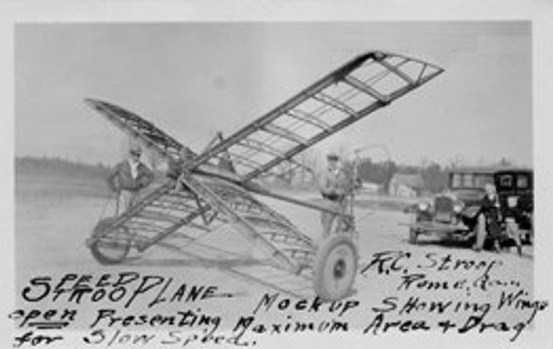
Stroop SP-7 X-wing
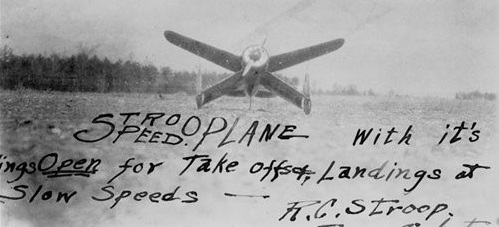
The Robert C. Stroop SP-7, created in 1940, was to combine the biplane’s landing characteristics and the monoplane’s speed characteristics.
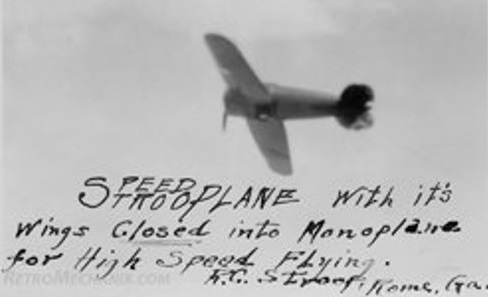
On the runway the wing is in the X-wing position, and when in the air the wings are retracted to the monoplane position, the wheels automatically retracted.
Stroop AT-6

An AT-6 biplane conversion built in Selma, Alabama, by Robert C. Stroop, for use as a sprayer.
This aircraft, N6435D, c/n 88-17079, was an AT-6D originally ordered by the Army as 42-85295, but later assigned to the Navy as SNJ-5, B/N 84995. It was retired from the Navy, stored at NAF Litchfield Park, and then sold as surplus in the late fifties.
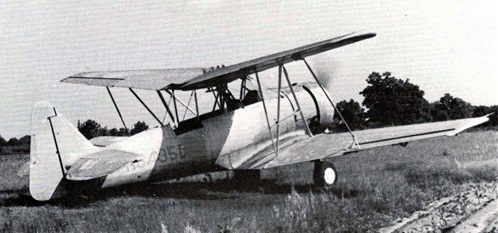
Requiring a low and slow sprayer in Alabama, Robert C. Stroop purchased the AT-6D and two more wings from AT-6, plus some additional fittings, and probably about 1964 converted the basic AT-6D into a biplane sprayer.
The airplane retained the basic configuration of the AT-6D, with only the cockpit and addition of the upper wing changing its appearance. The additional wing consisted of two outer wing panels from another airplane, and enough struts to stabilize the structure. The wing produced a negative stagger, probably to move the CG back so that the spray tank could be made larger, and a heavier load could be carried. Cabane struts braced the center section, and large “N” struts were installed outboard. Ailerons were interconnected by a smaller strut, and some bracing wires were installed between the cabane struts. There were no landing gear doors, and the cockpit was completely open except for the standard windshield. Only the front seat remained. The entire airplane was silver or unpainted.
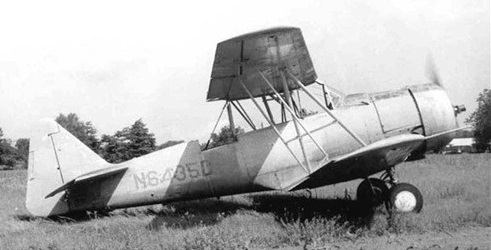
With quite satisfactory takeoff and landing characteristics and a low stalling speed, it received a restricted certificate “only agricultural work”.
The aircraft was operated from 1965 to 1970 (the last known owner – farmer J.F. Carter, of Monroeville, AL,), after which his fate is unknown.
Stroop, Robert C.
Robert C Stroop
Rome GA & Jacksonville AL.
USA
Built and modified aircraft during 1932-40.
Strom 1911 monoplane

Designed by Carl Strom, a Dane, this was an all-steel passenger-carrying monoplane. Dimensions were 49 feet span, 24 feet height and the wings had a chord of 11 feet. Construction started late in 1911, with Strom building his machine with Oscar Olesen in Mineola, New York, USA.
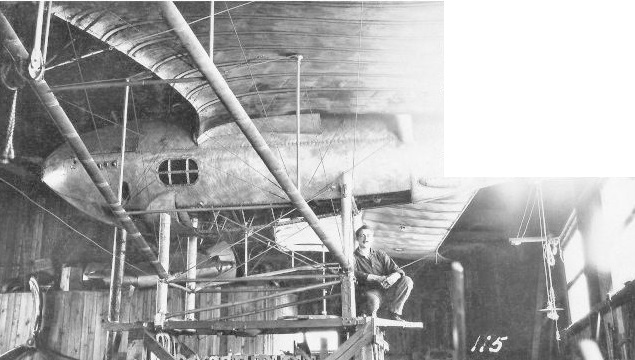
Appears to have never been completed.
Strojnik S-2
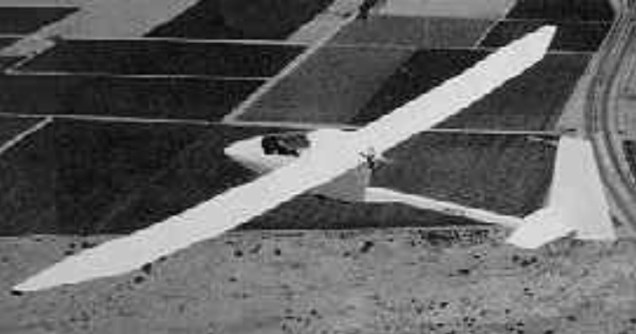
Designed by Alex Strojnik, the S-2 uses carbon fiber and aluminum wing spars with fiberglass skins. The fuselage pod is wood skinned with fiberglass, the boom is aluminum and the tail group is carbon-reinforced and skinned with fiberglass. The fixed gear consist of two small wheels in tandem. The Kohler engine drives a foldable propeller. Glidepath control is by flaps.
Designed by Alex Strojnik, the S-2a is a pod and boom pusher with folding propeller. The span is 15 meters and the best L/D is about 34:1. Alex made many excellent soaring flights with his motorglider, including diamond goal distance. A number of these have been built. Plans are no longer available for sale.
S-2
Wing span: 15 m / 49.2 ft
Wing area: 11.8 sq.m / 127 sq.ft
Aspect ratio: 19
Airfoil: Modified Wortmann
Empty Weight: 280 kg / 617 lb
Payload: 165 kg / 363 lb
Gross Weight: 445 kg / 980 lb
Wing Load: 37.11 kg/sq.m / 7.7 lb/sq.ft
L/DMax: 34 88 kph / 48 kt / 55 mph
MinSink: 0.67 m/s / 2.2 fps / 1.30 kt
Seats: 1
Structure: aluminum, wood and fiberglass

