Sud-Est

Societe Nationale de Constructions Aeronautiques du Sud-Est
SNCASE

In France, the Socialist Government of the so called Popular Front brought all the companies building military aircraft, aero engines and ar¬mament under its control in 1936. The im¬mediate result was the socialized oblivion of such established companies as Marcel Bloch, Bleriot, Nieuport, Potex, Dewoitine, Hanriot and Farman within half a dozen nationalized groups or Societies Nationales, named ac¬cording to their geographical location (Nord, Ouest, Centre, Midi and so on). Liore-et-Olivier, Potez, Romano, and SPCA formed SNCASE in 1936. Sud-Est was a nationalised company that had taken over manufacture from Bloch.

Company thus became responsible for development and production of LeO.45 twin-engined bomber, first flown January 1937, outstanding in many points of design and much used and adapted during and after Second World War. Built also Romano trainers and LeO.43 catapult floatplane, of type first flown December 1934.

In 1941 the company absorbed SNCAM. Early post-Second World War products included Languedoc four-engined airliner, developed from Bloch 161 of 1939, which entered service between Paris and Algiers in 1946, and was ordered additionally for military use.

Dewoitine joined SNCASE in 1942.

After World War II, although four of the nationalized groups continued operating un¬der state control, private companies were al¬lowed to resume the design and manufacture of both civil and military aircraft. Some of the pioneering names of French aviation, such as Breguet and Morane Saulnier, returned to prominence, and by 1950 a new one had been added Avions Marcel Dassault.

Military types in development included Grognard twin-jet attack aircraft of 1950; the unique trolley-launched skid-landing Baroudeur strike aircraft of 1953; and Mistral and Aquilon developments of the British de Havilland Vampire and Sea Venom. Especially notable original developments were the Alouette helicopter series first flown in 1951, and the rear-engined twin-jet Caravelle in 1955.

Until 1 September 1956 known as Societe Nationale de Constructions Aeronautiques du Sud-Est (SNCASE). On the 1st September 1956 the S.N.C.A. du Sud-Est was merged with the S.N.C.A. du Sud-Oest into Sud-Aviation.
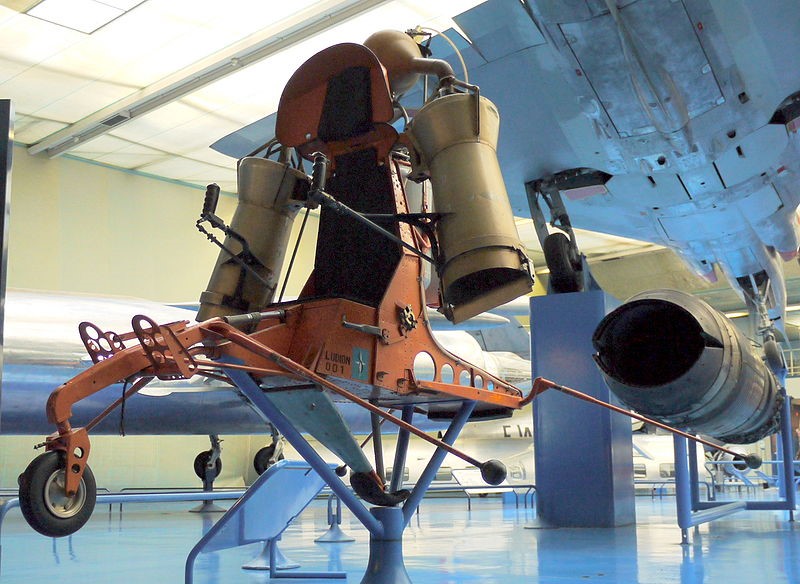
Sud-Aviation SA-610 Ludion

The Sud Aviation/Aérospatiale SA-610 Ludion (Ludion – Cadet) was a tiny, unorthodox VTOL aircraft demonstrated at the 1967 Paris Air Show. It consisted of little more than a chair, behind which were mounted two downward-pointing augmented rocket engines with control provided by thrust vectoring. The Ludion was intended to carry its pilot and 30 kg (66 lb) of equipment up to 700 m (2,300 ft) at an altitude of up to 200 m (600 ft).

The unusual powerplant consisted of a monofuel de-composition chamber fed with pressurised isopropyl nitrate (AVPIN), ignited by a catalyst. The high pressure gasses produced in the de-composition chamber were fed to two augmentor tubes, built by Bertin, either side of the pilots seat, angled slightly outwards. As the gasses entered the augmentor tubes through rocket nozzles, thrust was augmented by inducing airflow through the ducts which acted as aero-thermo-dynamic ducts, due to the heat and kinetic energy added to the flow through the ducts, and the carefully shaped exhaust nozzles.

SA-610 Ludion
Powerplant: 1 × SEPR S178 isopropyl nitrate (AVPIN) decomposition gas generator with augmentor tubes
Length: 1.95 m (6 ft 5 in)
Width: 1.485 m (4 ft 10 in)
Height: 1.6 m (5 ft 3 in)
Empty weight: 90 kg (198 lb)
Gross weight: 170 kg (375 lb) approx
Capacity: payload 30 kg (66 lb)
Crew: 1
Ceiling: 700 m (2,297 ft)

Sud-Aviation

Formed 1 March 1957 by amalgamation of Ouest-Aviation (SNCASO) and Sud-Est Aviation (SNCASE). Main responsibility was further development and marketing of highly successful S.E.210 Caravelle twin-jet airliner, first flown in 1955, and Alouette series of helicopters. Continued also development of S.E.5000 Baroudeur, S.O.9050 mixed-power interceptor and widely used S.O.4050 Vautour twin-jet multipurpose aircraft. Frelon series of large turbine-powered helicopters developed after first flight in February 1959, and Super Frelon flew December 1962, setting new world records. In 1965, Morane-Saulnier became a subsidiary of Sud-Aviation. Design leadership in A300 European Airbus assumed and diversification into non-aeronautical fields undertaken. Jointly with Nord Aviation made Corvette light rear-engined jet transport.

On January 1st, 1970 became major component of Aerospatiale, with Nord-Aviation and SOCATA, and the missile manufacturing company, SEREB.

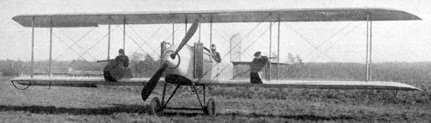
Sturtevant S-4 Tractor / Battleplane

The 1916 Sturtevant S-4 Tractor was an Army scout-bomber designed by George Armitage and Grover Loening.

Steel frame, steel sheeting skin; experimental 8’0″ x 2’6″ twin-gun gondolas were mounted on each lower wing of one of the ships as a “Battleplane.”

Sturtevant Battleplane

Four went to the Air Service as AS126-127, and AS214-215.

A contract for 26 was pared after complaints from pilots about crowded cockpit, overheating problems, and general workmanship.

Engine: 150hp Sturtevant 5A
Wingspan: 48’7″
Length: 25’1″
Useful load: 525 lb
Cruise speed: 73 mph
Stall: 40 mph
Seats: 2

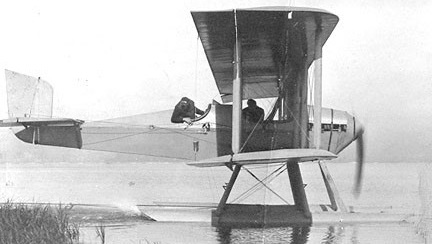
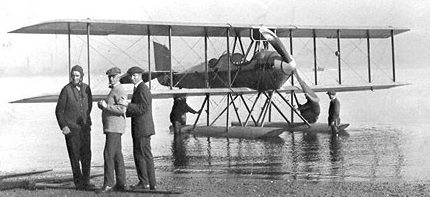
Sturtevant S-2 Trainer

The 1916 Sturtevant S-2 Trainer was an advanced trainer.

Two went to the USAS as AS110 and AS111 (four more were cancelled but issued s/ns AS64 to AS67).

Twelve went to the USN as A76 to AS81, and A128 to AS133. Most were built as two place floatplanes.

Engine: 130hp Sturtevant 5
Wingspan: 49’6″
Length: 25’1″
Speed: 50 mph
Seats: 2