Towards the end of the first World War, the marauding German Brandenburg fighter seaplanes had become a nuisance to Allied patrol airships and flying boats which were guarding coastal convoys and Naval flotillas from U boats. These were beyond the effective range from shore bases of fighters, and the need for a small fighter flying boat to counter this menace was recognised by Supermarine which built the Baby in 1918 for just this purpose. It had the strength in its hull which twin float seaplanes lacked and it seemed full of promise, particularly in the open waters of the North Sea in times when engines lacked reliability. It was too late to see war service, but the design led to the successful Sea Lion series and, eventually, to the Walrus.
Aircraft
Supermarine Aviation Works / Pemberton-Billing Ltd
Noel Pemberton-Billing, a wealthy yacht-broker, gun-runner and aircraft manufacturer (he established the Supermarine company, described as ‘tall, slick, monocled and iron-jawed’ by contemporary society columnists, learned to fly in 24 hours to win a £500 wager with Frederick Handley Page and subsequently served with the Royal Naval Air Service, from which his ‘tem¬pestuous temperament’ earned him an early retirement, though not before he had helped to organize the first aerial attack on the Zeppelin sheds on Lake Constance.
Noel Pemberton Billing began aeronautical experiments in 1908 with a primitive monoplane. Acquiring a factory at Woolston, Southampton, in 1913, he began to design and build marine aircraft, his P.B.1 biplane flying-boat being exhibited at the 1914 Olympia Show, but not flown.
Pemberton-Billing Ltd registered June 1914.
At outbreak of First World War in 1914 designed, built and flew P.B.9 single-seat scout biplane in nine days. The P.B.29E night patrol quadruplane of 1915, built in seven weeks from beginning of design, paved the way for the improved version, the 1915 P.B.31E Nighthawk anti-airship fighter with many ingenious features, including searchlight and recoilless gun. By the time this had flown the company had been renamed Supermarine Aviation Works.
Other designs were a twin-float seaplane and Baby single-seat fighter flying-boat, the latter flying in February 1918. Company’s postwar Schneider Trophy Sea Lion racing flying-boats were developed from Baby, but advanced S.4 racer of 1925 was a twin-float seaplane, though still of wooden construction. The S.5 and S.6 seaplanes, which followed, were renowned for racewinning and record-breaking, but especially as forerunners of Second World War Spitfire, designed by Reginald Mitchell (1895-1937), who had joined company in 1916. Well-known maritime aircraft included the Admiralty (AD) type built by Supermarine (and Pemberton-Billing) in First World War, and Seal/Seagull/Scarab/Sheldrake series developed during 1920s and 1930s.
When the company was absorbed by Vickers in 1928 it was already famous for large multi-engined flying-boats, particularly Southampton, distinguished in RAF service from 1925, especially for long cruises.
Supermarine became Vicker-Supermarine in 1929.
Successors were much-refined Scapa of 1932 and Stranraer of 1935, and the Walrus and Sea Otter earned their place in FAA history during Second World War. The Supermarine Spitfire first flew March5, 1936. Well over 20,000 were built by various makers. Basic change came when the Rolls-Royce was replaced by the Griffon engine. Seafire was naval development (over 2,500 built). Spiteful and Seafang were late piston-engined types with new wing, from which the jet-propelled Attacker was developed to enter service in 1951. Swept-wing Swift was unsuccessful as fighter, and twin-jet Scimitar of 1958 concluded fighter line.
Supermarine Aircraft Spitfire Mk.26
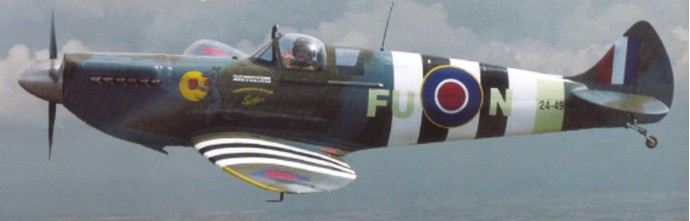
With the success of the MK25 single seat the demand for a two seat spitfire that looked like a single drove Mike O’Sullivan to build the MK26 80% Spitfire in the early 90s.
A two-seat Spitfire built as a kit by Australian Mike O’Sullivan, retaining the single seat canopy and the passenger seat is placed where the radio rack would be in the original WW II aircraft. The passenger’s legs will be on either side of the pilot’s seat when inside. In lieu of a passenger, the space can be occupied by up to 90 kg of baggage. The overall scale is 80 per cent. Features such as the sliding bubble canopy, drop down doors and vertically oriented oval control stick are all there. The kit is of all aluminium construction other than a couple of fibreglass fairings. All major structural components have been finished by Supermarine Aircraft. The factory completes about 700 hours of work and the owner is estimated to have about 1200 hours of work remaining to complete the aircraft. Powered by the eight cylinder Jabiru of 200 horsepower
It’s a two-seater, complete with elliptical Spitfire wings, removable and are of aluminium with stressed skin construction.
This aircraft has been superseded by the MK26B 90% Spitfire.
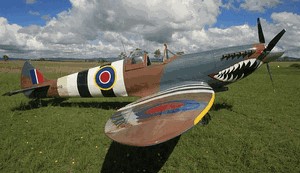
With the success of the MK25 and the MK26, the idea was hatched in mid 2004 to produce 90% spitfire due to the demand from customers.
The design of the MK26B Spitfire is to keep the kits simple and the build time down so that the builders can get the aircraft flying in less that a year. The prototype took just over 8 months to complete with all the tooling, cad drawings and setting up for production.
The MK26B is designed to house our V6 and V8 engine with out any modifications. It also has under wing radiators as an option which gives it that final touch.
The Mk26 and Mk26b are now well proven designs with all aluminium components pre-drilled and precision cut using a computer cotrolled CNC router cutter. This keeps parts standards consistent and accurate, a far cry from the original Spitfires construction methods. The main structural sections of the aircraft are pre-built in factory jigs thus ensuring the highest possible accuracy of these critical components. The method of construction is aimed at the average person who is good with their hands.
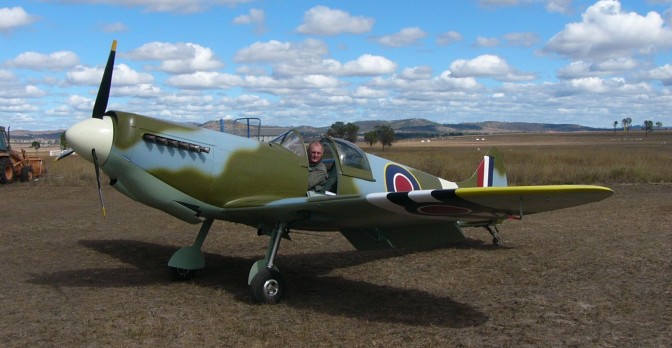
The Mk.26B fuselage is two seat and features a stainless steel firewall, monoque construction of aircraft grade aluminium, aircraft grade rivets, paints dimpled and riveted ready for fix out of internals, and has a rear luggage compartment. The instrument panel and cockpit is layed out much the same as the original Spitfire, with dual electric fuel pumps, switch operated, and dual electric flap motors.
The landing gear is retractable (electro-mechanical) and gas-strut assisted. An emergency release for landing gear can be initiated by the pilot. The wheels can be individually activated and use a similar locking system to the original Spitfire physical “tell tail” pins which rise up on the wings to indicate leg position and are standard in the kit. Undercarriage warning lights can also be added.
The six-inch wheel rims are custom made to match the original Spitfire looks and dual caliper disc brakes are used in combination with fully adjustable pedal controls.
The fuel tank is forward of the pilot and behind the engine as original. Volume is 150 litres. A fuel level sight gauge is mounted on the instrument panel. The Spitfire also has a wing tank option available This increases fuel volume by approx 140Ltrs. A trim is cable operated with adjustable stops.
The pilot seat & pedals fully adjustable to suit the pilot. There are fresh air outlets for both pilot and passenger via outside air scoops.
The 90% scale two seat Mk.26B fast build kit were available and suit a V-6 260-340 hp or V8 420 hp. Load limit is +6 and –4G.
Engine: Jabiru 8cyl 200hp
Seats: 2
Wingspan: 8.43m
Length: 7.0m
Height: 1 .85m
Wing area: 11.42 sqm
Design limits: +6 -3g
Empty weight: 380kg
MTOW: 650kg
Fuel capacity: 115 litres (91 litres useable)
Fuel burn: 30 Lt/hr
Max cruise: 150-160 kts
Vne: l80kts
Va: 120 kts
Stall: 44 kts
Initial climb: 3000 fpm
T/O roll: 330m
Ldg roll: 450m
Max endurance: 3hours
Engine: 240 hp
Cruise: 150 kts
Vne: 190 kt
TO dist: 150m
Ldg dist: 400m
Spitfire Mk26b
Stall: 42 kt / 48 mph / 78 kmh
Cruise: 160 kt / 184 mph / 296 kmh
VNE: 230 kt / 265 mph / 426 kmh
Empty Weight: 450 kg / 992 lbs
MTOW Weight: 560 kg / 1235 lbs
Climb Ratio: 2500 ft/min / 13 m/s
Take-off distance (50ft obstacle): 680 ft / 207 m
Landing distance (50ft obstacle): 1460 ft / 445 m
Supermarine Aircraft Spitfire Mk.25
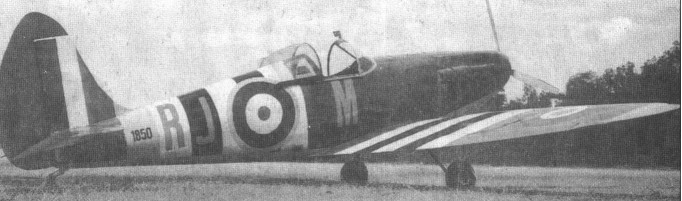
It all started when Mike O’Sullivan in the very early 90s built the first all metal 75% Spitfire reproduction. Mike built the first one and word soon got around about the quality and likeness to the original spitfire that people where asking him to build them a spitfire. This got Supermarine off the ground and running.
Supermarine Aircraft Spitfire Mk.25 Article
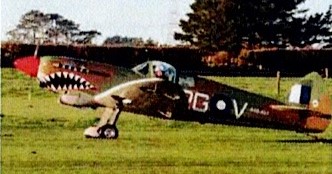
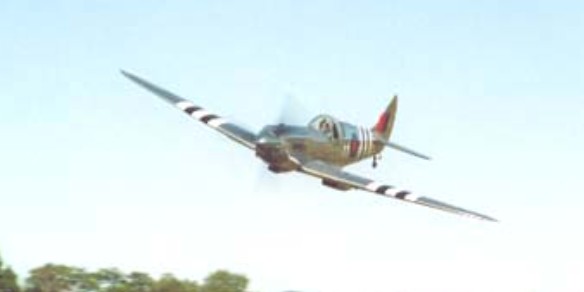
A 75 per cent scale single seat Spitfire based on the original MkV. The wing area was increased and pilot seat moved forward to retain a correct centre of gravity position. Powered by a Jabiru 3300 six cylinder.
Engine: Jabiru 3300
Seats: 1
Supermarine Aircraft
Michael (Mike) O’Sullivan’s Supermarine Aircraft Factory officially began its life in the kit aircraft manufacturing business in 1995, although the original idea is much older. The Mk26 and Mk26b are now well proven designs with all aluminum components pre-drilled and precision cut using a computer controlled CNC router cutter. This keeps parts standards consistent and accurate, a far cry from the original Spitfires construction methods. The main structural sections of the aircraft are pre-built in factory jigs thus ensuring the highest possible accuracy of these critical components. The method of construction is aimed at the average person who is good with their hands.
Super-Marine Systems Inc
Super-Marine Systems Inc of Graybar Bldg NY (sales office), USA, built in 1930 high-wing flying boat N11035. Two two Super-Marine Special motors were buried in the wing and it was equipped with “sponsons.”
Superior Aircraft 1929 Racer
Designed by Leo Mohme (designer that year for US Aircraft, builder of the Air-istocrat SR-4), two race aircraft were built.
Single-place, open cockpit low-wing monoplanes, one was registered NR215N.
Engine: 110hp Warner Scarab
Wingspan: 24’6″
Seats: 1
Superior Aircraft Co [1929]
(pres: Leo C Mohme),
2525 Pennway,
Kansas City MO.
USA
Information from Kansas City as a list of racing aircraft and race pilots from that area shows no Superior.
An article in the 5/28/29 Kansas Citizen tells of personnel from Kansas City’s National Aircraft Welding School setting up National Aircraft Co and acquiring the services of Mohme, their intention being to build two planes. Possibly they changed name to Superior as there was a National Aircraft in NJ at the time.
Superior Aircraft Co [1926]
In 1926 Superior Aircraft Co of Dearborn MI., USA, built a three-place, open cockpit biplane, registered N1636 c/n 1. It first flew on 15 August 1926.
It was sold in 1927 to Henry J Limbright (Dearborn), but the registration was cancelled on 16 October 1928 when he failed to reply to CAA inquiry for information.
Engine: 120hp Super LeRhône
Wingspan: 31’6″
Length: 23’6″
Seats: 3
Superior Satellite
A two-seat low-wing cabin monoplane, derived from the Culver Model V, and rebuild of Culver PQ-8 target drone. They featured retractable undercarriage.
First flying on 20 December 1957, they were certified under ATC 2-559 and 2-584 and, priced at $6,720 about 40 were sold.
Engine: 80hp Franklin 4AC
Wingspan: 29’0″
Length: 21’0″
Useful load: 570 lb
Speed: 130 mph
Range: 700 mi
Seats: 2

