The 1928 United Aircraft Corp / UAC Special was designed by F R McConigal as a two or foup place biplane. The one built had a four place cabin which modified to a two place open cockpit, or vice-versa. It was registered NX5613 and powered by a 225hp Wright J-5.
Aircraft
United Aircraft Corp / UAC
1928: United Aircraft Corp
pres: Curtis C Baldwin, on acquisition of Lark Aircraft Co, 471 W 1st St, Wichita KS.
c.1929: Company or its assets possibly went to Commercial Aircraft Corp at Van Nuys CA.
In 1928, Boeing Airplane and Transportation Corporation went pub¬lic and the stock sold quickly. Encour¬aged, Boeing formed the United Air¬craft and Transport Corporation, which included Boeing Airplane Com¬pany, Pratt & Whitney, Chance Vought, Sikorsky, Hamilton Propeller, Pacific Air Transport and Boeing Air Transport.
March 1930:
Boeing Air Transport Inc
Boeing Airplane Co Inc
Boeing Schools of Aeronautics
Canadian Pratt & Whitney Aircraft Co Ltd
Chance Vought Corp
Hamilton Standard Steel Propeller Co
Hoffar-Beeching Shipyards Ltd
Northrop Aviation Corp
Pacific Air Transport Inc
Pratt & Whitney Aircraft Corp
Sikorsky Aviation Mfg Corp
Stearman Aircraft Corp
Hamilton Metalplane Co
Stout Air Lines Inc
United Aircraft Exports Inc
United Airports Inc
In 1934, Boeing was informed by the U.S. Gov¬ernment that he was violating the new antitrust laws. He resigned as chair¬man, sold out his stock and the corporation was divided into three new companies United Air Lines to han¬dle air transport, United Aircraft Cor¬poration to take over the eastern man¬ufacturing firms and Boeing Airplane Company to manage Western opera¬tions.
Jack Northrop was employed by United Aircraft and Transport Corporation. All went well until United decided Northrop should leave Burbank and join another United division. He re¬mained in California to form a new company.
Uni¬ted Aircraft Corporation with which Vought Sikorsky merged.
This conglomerate was founded in 1934 to group together the activities of Pratt & Whitney Aircraft and Engines, Hamilton- Standard (formerly Hamilton Metalplane), United Airports and Vought-Sikorsky, each company retaining its separate identity.
Continued as United Technologies.
United Aerospace Technologies Ltd
UK
Put under development the two-seat composites-built Ranger lightplane, the four-seat Super Ranger, and six seat and twin-engined Twin Ranger, all with rear-mounted wings, canards and pusher propellers, and all former Luscombe designs.
UNI Stuutgart E-Genius
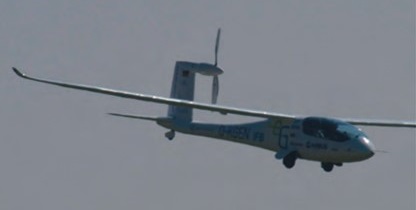
The E-Genius two seat electric motorglider from UNI Stuttgart has an over 400 km range on full battery power.
Union Works Pfeil / Arrow

The Union Pfeil-Doppeldecker was designed by Josef Sablatnig and/or Walter Höhndorf, and/or Karl Bomhard, characterized by the swept-back wings with unusual upturned lower wing tips, and built in Berlin-Teltow. It won four prizes at the Wiener International Flag-Meeting 1913, fitted with a 120 hp Austro-Daimler engine. Previous and later versions with other engines were successful in several meetings and set altitude records.

Union Aircraft Co Rotorplane

The 1931 Union Aircraft Co Rotorplane was designed by Isaac C Popper with four conical rotors in an open frame replaced the wings and were driven by two additional 28hp Indian (motorcycle) engines. An experiment based on the Magnus Effect to create lift.
Power was by a 90hp ACE (Cirrus).

The two-place aircraft was registered NX772N c/n M-1 and although the designer claimed it had double the lifting power of conventional wings and could land a half the speed, there is no record of actual flight.
Union Aircraft Co
Long Island NY
USA
Built the Union Rotorplane NX772N in 1931.
Underwood Flying Wing
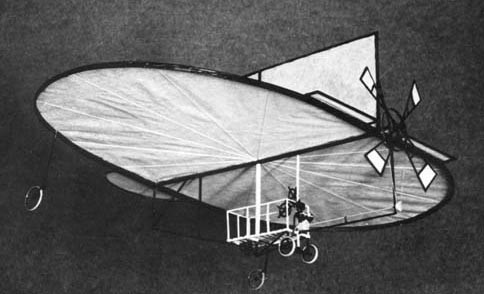
Elmer, George and John Underwood of Stettler, Alberta set to work inventing a flying of their own. The result was a craft with elliptically shaped wings. The Flying Wing was composed of long strips of fir and wire that were covered with cloth. Above the wing was a large fin, with a rudder at the back and an elevator attached to the tail. Under the large wing was a platform where the pilot sat. Motorcycle wheels were placed under the platform and bicycle wheels placed on each wing to hold it steady for take-offs and landings.
The platform also contained a place to house the motorcycle motor once they were able to afford one. In the meantime, the Underwoods displayed their creation at Stettler’s exhibition in July 1907, and tested the machine on their farm.
Tying the aircraft to a fencepost, the brothers placed sacks of wheat on the platform to replicate the weight of a pilot, and launched the plane like a kite. The test went well, and for the next trial, John took the place of the wheat to “fly” the machine for 15 minutes. Their enterprise was then put away until the next year, when the Underwoods finally obtained their motorcycle engine.
Attached to the front of the wing was a large bamboo and canvas propeller, powered by the motorcycle motor. Unfortunately, the brothers found that the engine was too small to get the craft airborne, so they hitched the plane to the fence post once again, using it like a kite, until the Flying Wing was destroyed one day by high winds. Their effort was eventually abandoned, since they lacked the resources to continue.
Ultravia Super Pelican

The Super Pelican is a Canadian design built by Ultravia Aero, Repentigny, Quebec. Being similar in appearance to the Piper Cub it is a high wing taildragger monoplane with a semi-enclosed cabin/fuselage powered by 35hp, Global engine. A conventional 3 axis control microlight of aircraft tube and dacron cover.
Engines suitable for the Super Pelican include the Global flat twin four-stroke, 35 hp at 3200 rpm, the three cylinder Konig radial, 25 hp at 4200 rpm, the four cylinder Konig radial, 28 bp at 4200 rpm, or Rotax 277 or 377.
Engine: Global 2 cyl 4 stroke (1039cc), 35 hp
Empty wt: 250 lb (113 kg)
Max wt: 525 lb (238 kg)
Wing span: 35 ft (10.67m)
Max cruise: 65 mph (101kph)
Stall: 27.5 mph
ROC: 950 fpm
TO dist 50 ft: 250 ft
Seats: 1
Range: 422 km
Ultravia Le Pelican
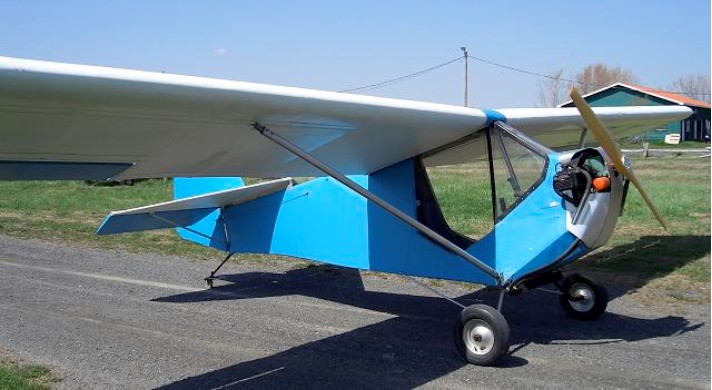
Single seat single engined high wing mono¬plane with conventional three axis control. Wing has unswept leading and trailing edges, and constant chord; cruciform tail. Pitch control by elevator on tail; yaw control by fully flying rudder; roll control by 40% span ailerons; control inputs through stick for pitch/roll and pedals for yaw. Wing braced from below by struts; wing profile double surface. Undercarriage has three wheels in tail dragger formation; axle Flex suspension on main wheels. Push right go right tailwheel steering connected to yaw control. Optional brakes on main wheels. Aluminium tube framework with glass fibre nose and fabric covering, partially enclosed (total enclosure optional). Engine mounted below wing driving tractor propeller. Covering of framework and wing is Dacron. Ribs made from foam-¬aluminium composite. Aircraft grade aluminium used for structural components. AN hardware.
Ultravia’s publicity material describes Le Pelican as ‘a new ultralight respectful of aircraft tradition’ and is powered by a four stroke twin¬-cylinder Briggs & Stratton engine. Designer Jean Rene Lepage, the Canadian engineer who developed the aircraft over a period of three years, realised that the four stroke was fairly heavy for its rated horsepower and therefore designed the aircraft with long wings and a relatively short nose. Le Pelican is basically a tube and Dacron machine, with D cell wings braced by a single strut and using composite¬ construction ribs made from foam and alumi¬nium alloy. The entire structure was designed in accordance with FAR Part 23, the first aircraft taking to the air on 31 May 1982.
The prototype used spoilers for roll control, though ailerons are now standard, as is a steerable tailwheel (also absent from the prototype). Doors have now been developed to make the cockpit fully enclosed if desired. For those wanting more power, Onan engines of 20 or 22 hp are offered In this form the aircraft was introduced at C$5800 in kit form, the first machines being delivered in February 1983, though this price rose to C$6500. 2009 Price: 5500 US$. Claimed construction and rigging times respectively are 150h and 30 min.
The Pelican was sold in kit form by Ultravia in 1984. It is an aircraft of traditional configuration with a taildragger landing gear and steerable tailwheel. The aircraft was originally fitted with a Global engine and aluminum cowling. The fuselage and tail unit are built with aluminum tubes covered with doped fabric. The wing structure consists of an aluminum D-cell spar on which the styrofoam ribs are mounted. The wings are also covered with doped fabric. Wings are hung to the fuselage with a single strut. All these characteristics combine to give an aerodynamically clean wing with a 12-to-1 glide ratio.
Le Pelican has been compared with the Aeronca C-2, with earlier models being po¬wered by horizontally opposed 4-stroke en¬gines. The strut braced high-wing monoplane is built of aluminium tube gussett rivetted and dacron covered. The engine cowling is one piece fibreglass and the cockpit has remov¬able doors for summer flying.
The Pelican is powered by a Gobal engine. This is the original engine that came with this airframe kit in 1984. The Global is a 4-stroke, 2-cylinder engine based on the Volkswagen flat four, air-cooled engine, except that this one has 2 cylinders instead of four. For this reason, it is often referred to as a half-VW engine. However, the castings are especially designed for aircraft use. This engine is very fuel efficient and burns only 1 gallon of autogas per hour. It is also more reliable than 2-strokes. It is free-air cooled and the oil circulates through an oil cooler located below the fuselage. This engine is devoid of all the troublesome components such as a cooling fan, radiator, hoses, thermostat and other hardware associated with liquid-cooling systems; making it more reliable and less hassle to maintain. The 58 X 24 inch wood propeller is bolted directly to the solid forged crankshaft. This eliminates the potential problems of reduction drives with their added mechanical complexity and heavier weight. The Global develops 35 hp @ 3250 RPM and has plenty of torque for a direct-drive prop. Ignition is by a magneto. This eliminates the need for a battery and alternator and allows for a very simple and reliable electrical system. The Global is started by hand propping; another simple and reliable system that never breaks down. This engine is surprisingly light for a 4-stroke; it weighs only 76 lbs ready-to-run.
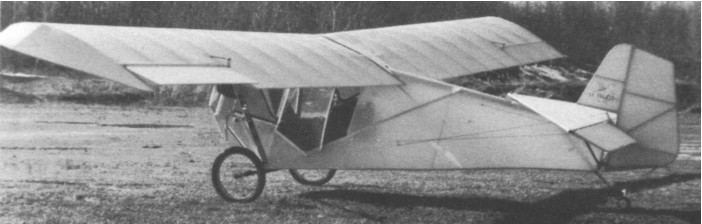
Engine: Global, 35 hp @ 3250 RPM
Span: 35 ft
Length: 15 ft
Height: 6.5 ft
Wing area: 136 ft.sq
Max wing loading: 3.86 lbs.sq.ft
Empty weight: 113 kg / 250 lbs
MTOW Weight: 238 kg / 525 lbs
Useful load: 275 lbs
Cruise speed: 60-70 mph
Max speed: 80 mph
Stall speed: 23 kt / 27 mph / 43 kmh
Vne: 78 kt / 90 mph / 145 kmh
Max climb rate: 900 ft/min / 5 m/s
Fuel capacity: 5 USG
Fuel burn: 1 to 1.2 gal.hr
Max range: 300 miles
Glide Ratio: 12:1
Takeoff distance: 50 ft
Landing roll: 100 ft
Load factors at 525 lbs: +4 -2 G’s Limit, +6 -3 G’s Ultimate
Engine: Briggs & Stratton, 18 hp at 3600 rpm
Prop¬eller diameter 43 inch, 1.09m
No reduction
Power per unit area 0.13hp/sq.ft, 1.4hp/ sq.m
Fuel capacity 2.5 US gal, 2.1 Imp gal, 9.5 litre
Empty weight 210lb, 95kg
Max take off weight 450lb, 204kg
Payload 240lb, 109 kg
Max wing loading 3.21 lb/sq.ft, 15.7 kg/sq.m
Max power loading 25.0lb/hp, 11.3kg/hp
Load factors +4.4, 2.2 design; +6.6, 3.3 ulti¬mate
Max level speed 60 mph, 97 kph
Never exceed speed 85 mph, 137 kph
Max cruising speed 55 mph, 88 kph
Economic cruising speed 50 mph, 80 kph
Length overall 14.0 ft, 4.27 m
Height overall 6.0ft, 1.83m
Wing span 37.0ft, 11.28m
Constant chord 3.8ft, 1.17m
Dihedral 3 deg
Sweepback 0 deg
Tailplane span 8.0ft, 2.44m
Fin height 3.8ft, 1.14m
Total wing area 140 sq.ft, 13.0 sq.m
Wing aspect ratio 9.8/1
Wheel track 6.0 ft, 1.83 m
Wheelbase 11.0 ft, 3.35m
Tailwheel diameter overall 4 inch, 10 cm
Main wheels diameter overall 20 inch, 51 cm
Stalling speed 26 mph, 42 kph
Max climb rate at sea level 500 ft/min, 2.5 m/s
Min sink rate 250 ft/min at 30 mph, 1.3 in/s at 48 kph
Best glide ratio with power off 13/1 at 35 mph, 56kph
Take off distance 150ft, 45m
Service ceiling 12,500 ft, 3810 m
Range at average cruising speed 104 mile, 167 km
Engine: Rotax 277
Prop: 147cm
Wing span: 10.67 m
Length: 4.57m
Weight: 115kg
Fuel capacity: 19 ltr
Econ cruise speed: 55 kts
Stall: 25 kts

