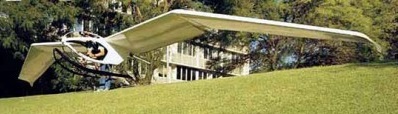
University Of Pretoria Exulans

Designed by three engineers from the University of Pretoria, Exulan I is inspired by the shape of albatrosses and pteranodons.

The 1989 Exulans (named after the scientific name for albatros) used some wingtip pivot shift for pitch control, in combination with elevons to overcome the inherent inefficiency of elevons for pitch alone. It was tested successfuly but no commercial version was released.

Designer Joachim Huyssens and his team were working on a second prototype since 2004.

Wing area: 12 m²
Wing span: 12 m
Length: 3 m
Minimum pilot weight: 65 kg
Maximum pilot weight: 150 kg
Minimum speed: 150 km/h
Maximum speed: 40 km/h

United States Army Engineering Division

USA
Established at McCook Field, Ohio, the US Army Engineering Division was concerned with the design, development and manufacture of aircraft for the US Army. These included the FVL-8 and BVL-12, biplane fighter and bomber respectively, designed by Italian Ottorino Pomilio; USD-9 version of the British Airco D.H.9; XB-1 version of the Bristol F.2B Fighter; M-1 and MAT communications aircraft designed by Alfred Verville and built by the Sperry Aircraft Company; three R-3 low-wing monoplane racing aircraft by the same Verville/Sperry combination; VCP-1 (Verville-Clark Pursuit) of 1918; NBL-1 ‘Barling’ bomber designed by Briton Walter Barling and built by Witteman- Lewis Aircraft Corporation; and GA-1, or G.A.X. (Ground Attack Experimental), built by the Boeing Company. With establishment of the USAAC in 1926, the Engineering Division was replaced at McCook Field by the Materiel Division.

United States Aircraft Corp

In 1917-18 the company had built about 50 Curtiss JN-4s under a wartime contract.

1918: United States Aircraft Corp Ltd, Redwood City & San Francisco CA on acquisition of Christofferson Bros factory.

In 1930 acquired the assets and plant of Marchetti Motors, but apparently never did anything with it.

Undertook aircraft conversions, including Turbo Express lengthened and turboprop conversion of DC-3.