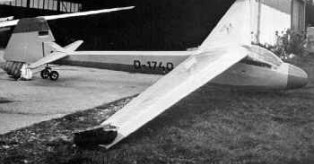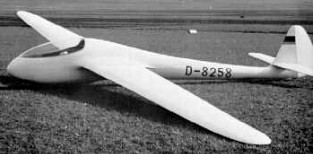
Akaflieg Stuttgart Phönix-T fs-24

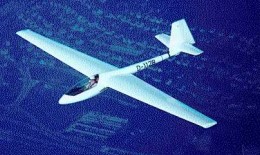
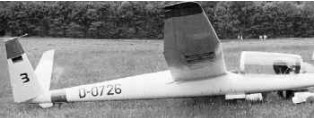
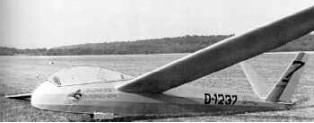
Notable as being the first sailplane to be built of glassfibre, design of the Phonix was started at the Stuttgart Akademische Fliegergruppe under R.Eppler and H. Na’gele in 1951. Originally balsa wood construction with a strengthened outer skin of paper-and-glue layers was decided upon with the idea of reducing weight, but the Phonix project had to be abandoned for a time. Work was continued when the Stuttgart Fliegergruppe was given a grant for further research, and by now the new glassfibre strengthened polyester resins were available as a constructional material. The Phonix was redesigned to a basically balsa wood/glassfibre sandwich form of construction. At first a conventional tail unit with low-set tailplane was featured, but this was later replaced by a T-tail; the landing gear is retractable.
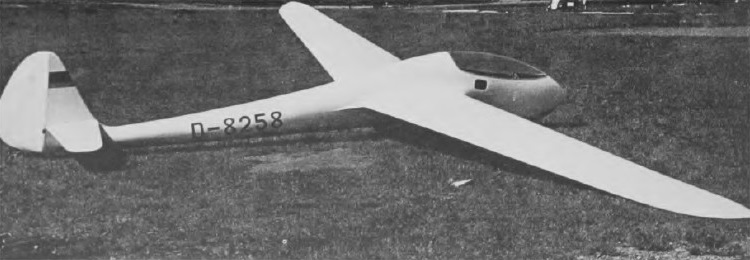
The monocoque fuselage is built in two pieces with a sandwich skin with balsa wood filling and an outer skin of glassfibre. The wing attachment, controls and fittings are installed before the two pieces are glued together with the glassfibre skin overlapping; weight carrying points and the edge of the cockpit canopy are strengthened with plywood. The wings and tail unit are of similar balsa wood/glassfibre sandwich construction, the ailerons, flaps and rudder being cut out after the glueing process is completed.

The first made its first flight on 27 November 1957. Altogether eight Phonixes were built and all of them were still flying 21 years after the prototype first took to the air.
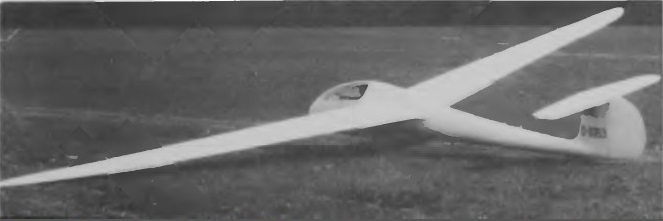
Akaflieg Stuttgart FS-24 Phonix

FS-24 Phonix
Wing span: 16m / 52 ft 6 in
Length: 22 ft 5.25 in
Wing area: 14.36 sq.m / 154.6 sq.ft
Empty Weight: 180kg / 362 lb
Gross Weight: 330kg / 584 lb
Wing Load: 22.9kg/sq.m
Aspect ratio: 17.83
Airfoil: Eppler 91
Max speed: 107 mph
L/DMax: 40 @ 79kph / 48 mph
MinSink: 0.59 m/s @ 68 kph / 1.7 ft/sec at 43 mph
No. of Seats: 1

FS-24 Phonix-T
Wing span: 16.0 m / 52 ft 6 in
Length: 6.84 m / 22 ft 5 in
Wing area: 14.36 sq.m / 154.6 sq ft
Wing section: EC86(-3)-914
Aspect ratio: 17.83
Empty weight: 164 kg / 362 lb
Max weight: 265 kg / 584 lb
Water ballast: None
Max wing loading: 18.5 kg/sq.m / 3.79 lb/sq ft
Max speed: 97 kt / 180 km/h
Stalling speed: 31 kt / 58 km/h
Min sinking speed: 0.51 m/sec / 1.7 ft/sec at 37 kt / 69 km/h
Max rough air speed: 54 kt / 100 km/h
Best glide ratio: 40 at 42 kt / 78 km/h)
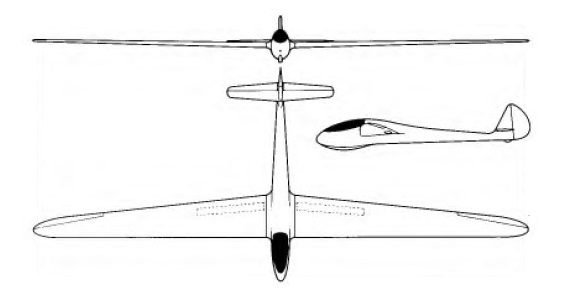
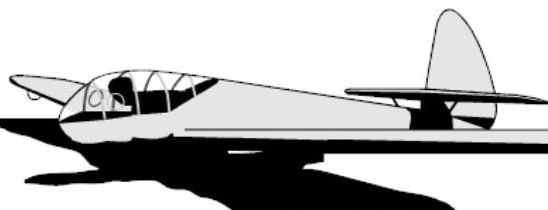
Akaflieg Munchen Mü-30 Schlacro

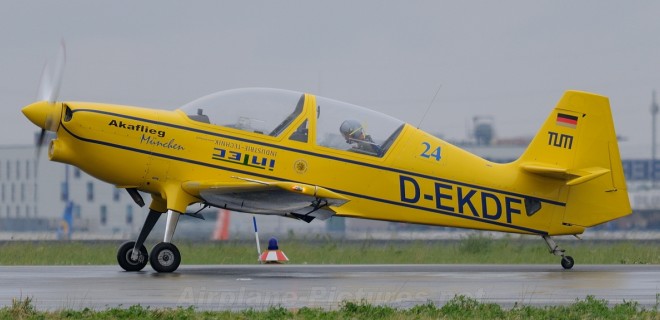
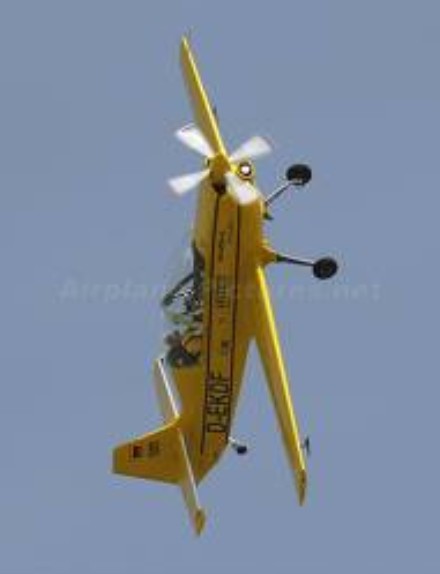
Students at Akaflieg München recognized that the requirements of an aerobatic aircraft and glider tug coincided, both needing a high power-to-weight ratio, high rate of climb at relatively low speed, and high control authority. To meet these requirements design and construction of the Mü30 Schlacro (SCHLepp-ACRObatic) began in 1985 led by Dieter Thomas. Initially it was intended to fit a Porsche PFM 3200, obtained from Porsche at no cost. Use of the PFM 3200 promised to cut operating costs and environmental impact dramatically, with the engine certified to use MOGAS in place of the very expensive AVGAS, but Porsche abandoned development of the PFM3200 in 1992, leaving the Mü30 without an engine.

During development the ailerons were optimized for maximum roll rate, the wings revised with carbonfibre structure and the center of gravity adjusted by moving the wings 150mm (6ins) forward, compensating for a heavier Lycoming engine and ensuring reserve for possible future re-design.

Work on the prototype continued and an alternative engine installation was designed for the 223 kW (300 hp) Lycoming AEIO-540 driving a four-bladed propeller. First flight with the Lycoming engine was carried out in 2000 with flight testing continuing till 2003. Problems with cooling the Lycoming engine necessitated the complete re-design of the cooling air intake, exhaust system and cowling.

Flying re-commenced on 16 February 2007, resuming flight tests which proved to be satisfactory and certification is well advanced. Initial problems with lateral stability have been overcome by altering the control geometry and flight tests by Uli Schell have revealed the aircraft to have adequate stability and be easy to control. Flight testing was completed by New Year’s Eve 2007, with the exception of Vd (Maximum Design Dive Speed – 1.2x Vne) which had earlier highlighted problems with the elevator trim. After thickening the trailing edge of the elevators the trim problems were alleviated and the Vd test was carried out successfully.

Mü30
Engine: Lycoming AEIO-540, 223 kW (300 hp)
Length: 7.5 m
Wingspan: 9 m
Empty weight: 748 kg
Maximum speed: 400 km/h (216 mph)

Akaflieg Munchen Mu-27

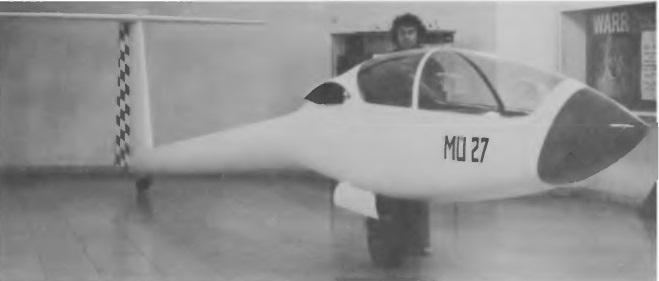
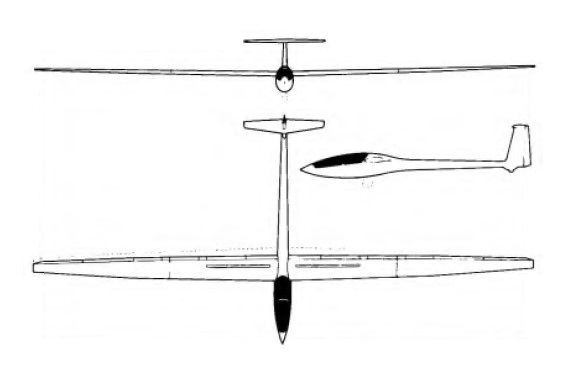
Some attention has been paid by designers to varying the wing geometry or area in flight to cater for different soaring conditions, and one approach to this problem is embodied in the Mu 27, which features slotted Fowler-type flaps enabling the wing area to be varied in flight. At high speeds a good gliding angle can be obtained by retracting the flaps while at low speeds or in a weakening thermal the flaps can be extened to give more lift, increasing the wing area by 36%.

The wings are a glassfibre/Conticell sandwich with aluminium spars and metal webs, and air brakes on the upper surface are at the 50% chord line. The ailerons are linked to the flaps. The semimonocoque fuselage is entirely of glassfibre with a large two-piece sideways-hingeing cockpit canopy, while the T-tail unit is of glassfibre/foam sandwich construction. The landing gear consists of a retractable monowheel and a fixed tailwheel.

The Mu 27 is a tandem two seater of largely glassfibre construction, and first flew on 24 February 1979 piloted by Thomas Fischer.

Mu 27
Span: 72 ft 2.25in / 22m
Length: 33 ft 9.5 in / 10.3 m
Height: 1.8m / 5 ft 11 in
Wing area: 189.5 sq.ft / 23.9 sq.m (flaps retracted)
Wing area 257.3 sq ft / 17.6 sq.m (flaps extended)
Aspect ratio: 20.2-27.5
Airfoil: FX 67-VC-170/136
Empty weight: 1,058 lb / 480 kg
Max weight: 1,543 1b / 700 kg
Water ballast: None
Wing Load: 8.19 lb/sq ft / 39.8 kg/sq.m
Max speed: 174 mph / 151 kt / 280 km/h
Min sinking speed: 1.8 ft/sec / 0.56 m/sec at 37 mph / 32.5 kt / 60 km/h
Best glide ratio: 47:1 at 63 mph / 54.5 kt / 101 km/h
L/DMax: 39 @ 88 kph
No. of Seats: 2
No. Built: 1

Akaflieg Munchen Mü-23 Saurier

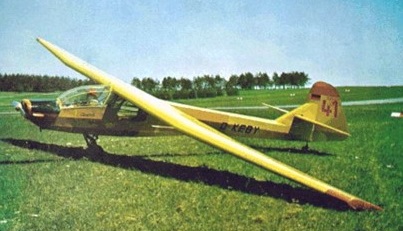
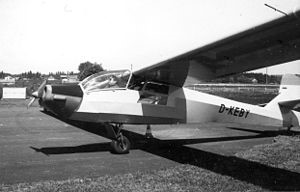
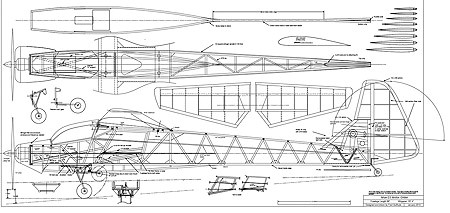
In 1957 the students at Akaflieg München began the design and construction of the Mü23 Saurier two-seat motor-glider. Using the classic ‘Munich School’ construction technique, the Mü23 was built using fabric covered welded steel tube for the fuselage and wooden wings and tail covered with plywood and fabric. The pilot sitting directly behind the engine under a built-up transparent canopy and the passenger sitting in a compartment under the centre section of the wing, similar to the seating arrangement of the Akaflieg München Mü10 Milan.

Using the Mü Scheibe aerofoil section imbued the Mü23 with excellent low speed characteristics and short landings and takeoffs, but development was slowed by problems with the chosen engines, initially a Volkswagen VW1200, later a Braendle ZB700 and finally a Volkswagen VW1500N which gave satisfactory performance.

Once the performance of the aircraft could be guaranteed with the VW1500N engine, the Mü23 took part in sailplane and motor glider competitions with some success. In 2010 the Mü23 is undergoing restoration.

Mü23 Saurier
Engine: 1 × Volkswagen VW1500N, 33.5 kW (45 hp)
Wingspan: 20 m (65 ft 7 in)
Wing area: 24 m2 (258 ft2)
Aspect ratio: 16.7
Wing profile: Mü Scheibe
Empty weight: 477 kg (1,052 lb)
Gross weight: 700 kg (1,543 lb)
Crew: 1
Capacity: 1