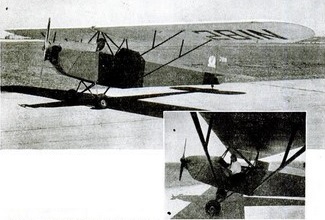
In 1930 American tested the American Eaglet at Kansas City. A home builders lightweight aircraft, it is a parasol type capable of carrying one person with a Cleone engine, or two with a Szekeley three cylinder 35 hp engine.
The conventional wings are built up in spruve and plywood. A feature of the fuselage is the way the lower longerons are brought together mid-way between the nose and tsil group as a single member. The fuselage is 23 inches wide and constructed of steel tubing as is the tail group.
Cables are used for control throughout. These run over pulleys and the aileron cables come down over two auxilliary pulleys at either side of the forward section of the cockpit. An aluminium seat is fitted with an instantaneous action safety belt.
The landing gear is a rigid inverted Vee type. It is equipped with 7×16 inch air wheels on four inch hubs. The landing gear is diagonally braced. A shoe tail skid is fitted, tied into the stern post and a rubber shock chord is used.
Wing tip ailerons are fitted. The horizontal stabiliser is ground adjustable and the fin is rigid. An unbalanced rudder is used.
Ordinary motor car gasoline and lubrication oil are mixed at 8:1 and carried in a single tank built into the cowling directly ahead of the pilot.
The gap where the wings are fasteed to the cabane section is covered with celluloid.
The Eaglet was sold for $995 with the Cleone engine and $1395 with the Szekeley in 1930.
Engine: Cleone Wingspan: 34 ft 4 in Length: 21 ft 6 in Height: 78 in Wing area: 164.4 sq. ft Max weight: 580 lb Engine weight: 46 lb Prop weight: 4 lb Battery weight: 15 lb Fuel capacity: 36 lb Speed: 60 mph Landing speed: 15 mph ROC: 350 fpm Glide ratio: 12-1 TO MAUW: 13 sec Fuel burn: less than 2 USG/hr
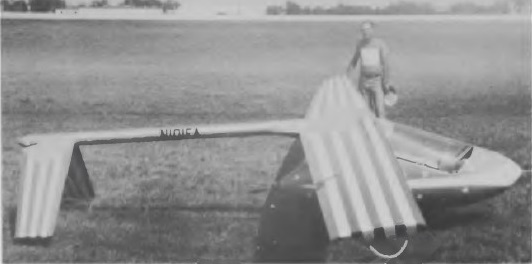
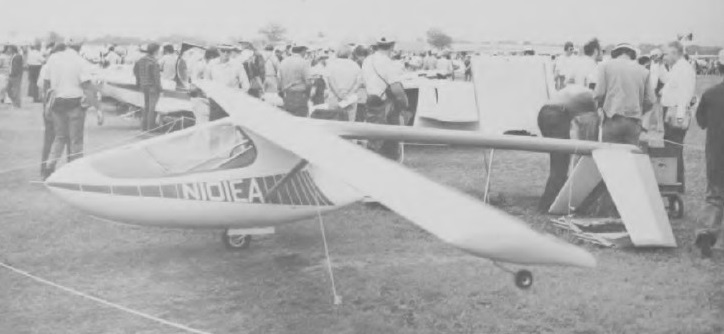
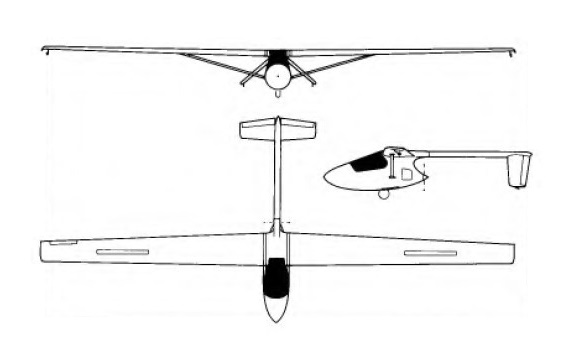
Designed by Larry Haig of Muskegon, Michigan, beginning in September 1974, the American Eaglet is a self-launching sailplane. The type is a high wing monoplane with a pod-and-boom type fuselage with the 12 hp(8.95kW) McCulloch 101B engine mounted aft of the cockpit and driving a 2 ft (60.96 cm)-diameter pusher propeller. The nylon propeller blades fold aft automatically when the engine stops. The cantilever inverted-Vee tailplane and elevators are carried on a tail boom that is a thin-walled 5 in (12.7 cm)-diameter aluminium tube with a moulded glassfibre tailcone. The compact cockpit includes a side-mounted control stick and aft-hinged, single-curved canopy. Construction is largely of glassfibre and urethane foam cores, with some components of aluminium.
The wings are stressed skin structures with spruce load-bearing spars and a single aluminium tube bracing strut on each side; the spars are surrounded by a urethane foam core, the leading edges and wing tips being of moulded glassfibre, and the urethane core portions are covered with epoxy-bonded precure glassfibre skin. There are no ailerons or flaps, but the functions of these two (ie roll and glide path control) are combined in two spoiler-like surfaces called ‘spoilerons’ at 30% chord on each upper surface towards the wing tip. The forward portion of the fuselage consists of two pre-formed glassfibre half shells pop-riveted to tubular aluminium longerons, the main load-bearing member in the fuselage being the bulkhead which carries the pilot’s seat on one side and the engine mounting on the other. This also carries the tail boom at the top rear, the monowheel at the bottom and the wing spar carry-through at the top, and this bulkhead is an aluminium-skinned urethane foam composite structure. There is a combined pitot tube/lifting handle in the fuselage nose. The inverted-Vee tailplane is very similar to the wings structurally, with an epoxy/glassfibre skin over urethane foam cores, and this V-tail greatly improves control in pitch and yaw, as the prop wash ‘blows’ directly over the tail surfaces; the V-tail also makes spins impossible. The manually-retractable monowheel has an external friction-pad brake, and is supplemented by a tailwheel under the tip of each tailplane.
The American Eaglet can be completed and flown as a pure sailplane, without the engine; the powerplant fitted is a McCulloch 101B single cylinder two-stroke engine developing 12.2hp at 8,000rpm, and drives a two-blade fixed-pitch pusher propeller with nylon plastic blades that fold backwards through 90° when the engine is stopped. The engine is intended only for take-off and self recovery, and is not designed for continuous cross country operation; it can be restarted in flight. A fuel tank of 2 litres (0.5 US gallons) capacity is provided. Fuel tank capacity is generally sufficient for one takeoff and climb to 2,000 feet AGL and three airborne restarts and climbs from 500 feet back up to 2,000 feet. The McCulloch 101B engine was available in only limited quantities, and the West Bend 820 engine will be fitted when availability of the 101B becomes a problem.
The Eaglet was designed for kit building and Larry Haig formed the AmEAGLE Corporation to market it.
Construction of the prototype, registered N101EA, started in June 1975 and this made its first flight on 19 November that year; a second prototype was later flown. A total of 400 kits had been ordered by early 1980, of which 20 had been completed.
Engine: McCulloch 10IB, 8.95 kW / 12 hp Wing span: 36 ft 0 in /10.97 m Length: 16 ft 0 in / 4.88 m Height: 0.91 m / 3 ft 0 in Wing area: 72 sq.ft / 6.69 sq.m Empty Weight: 160 lb / 72.5 kg Payload: 200 lb / 90.5 kg Gross Weight: 360 lb /163 kg Water ballast: None Fuel capacity 2 lt / 0.5 US gal Wing Load: 5 lb/sq.ft / 41.04 kg/sq.m Max speed: 115 mph / 100 kt / 185 km/h (in smooth air, power off) Aspect ratio: 18 Airfoil: Wortmann FX-61-184 Stall speed: 33 kt / 61 km/h MinSink: 0.76 m/s / 2.50 fps / 1.48 kt at 40 mph / 35 kt / 65 km/h L/DMax: 27 @ 84 kph/ 45 kt /52 mph Max rate of climb at sea level: 400 ft/min / 122 m/min Take-off run: 1,000 ft No. of Seats: 1
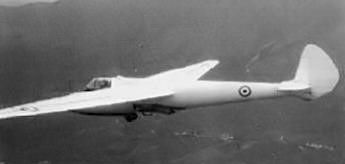
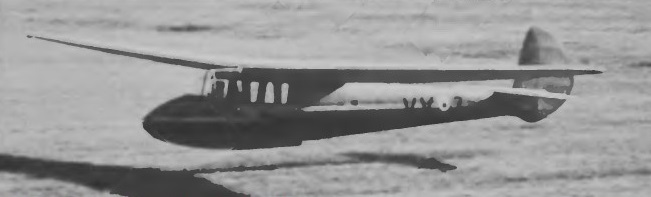
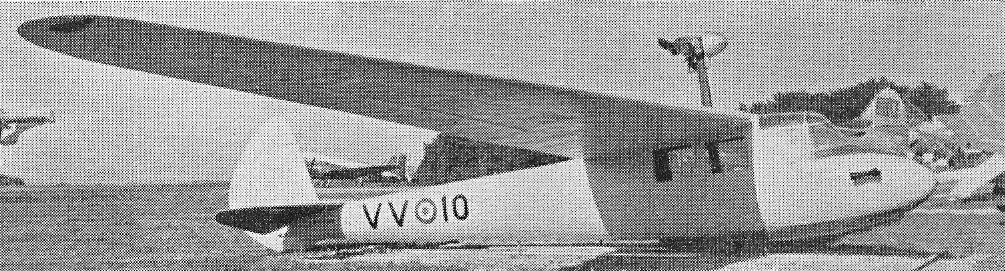
Originally, The Kangaroo is a wooden glider, two-seater, high-wing, and about 20m wingspan. It was designed in 1939 by the Gliding Institute Polytechnic of Milan (Centro Volo a Vela del Politecnico Di Milano) under the direction of the Engineer Ermenegildo Preti. In addition to the prototype, the Italian air force has ordered 32 copies. The first flew in 1940, only two copies will be built during the duration of the war. Others, built in 2 lots by two different companies were produced between 1953 and 1955. It was at this time, a significant number of aircraft.
The “Palas” version corresponds to a transformation seater glider with a Turbomeca Palas jet engine.
The jet version was created by Adrianno Mantelli, from one that had crashed. It was rebuilt with a shortened wing, and with the addition of a Turbomeca Palas engine of 150kg thrust. This came from the prototype Caproni Trento F-5 jet. The air inlet is a removable scoop on the top of the fuselage.
In this configuration, Adrianno broke the world record for altitude jet less than 800 kg, with a flight to 9366 m, 24 September 1964.
A high-wing cantilever monoplane built completely in wood, the CVV6 had a fixed, single wheel undercarriage.
Wingspan: 19.20 m (63 ft 3 in) Length: 8.00 m (26 ft 2 in) Wing area: 21.60 m² (235.5 sq.ft) Empty weight: 280 kg (616 lb) Payload: 180 kg (396 lb) MTOW: 460 kg (1012 lb)
The Canguru was designed in 1939 by the Gliding Institute Polytechnic of Milan (Centro Volo a Vela del Politecnico Di Milano) under the direction of the Engineer Ermenegildo Preti.
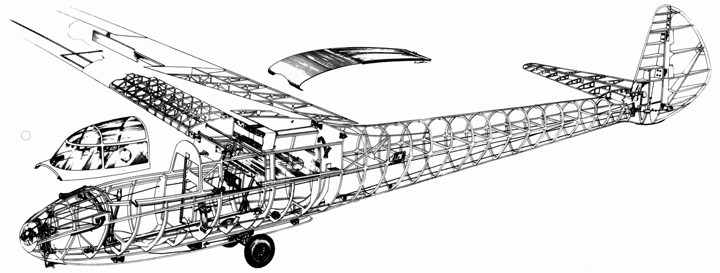
The Canguru two-seater is of conventional all-wood and fabric construction, with a high cantilever wing which has a single main spar with a torsionally stiff D-type leading edge; the wing is in two halves and can easily be detached for transport. CVV-type air brakes limit the maximum diving speed to 137mph. The oval-section fuselage is a monocoque structure and the two pilots are seated in tandem, an unusual feature being the location of the second pilot actually beneath the wing rather than ahead of it or in line with the leading edge. The cantilever tail unit has a low-set tailplane.
The CVV 6 Canguru two-seater was developed by the CVV (Centre Volo a Vela del Politecnico di Milano) and built in small numbers by Ambrosini – or Societa Aeronautica Italiana, Ing A. Ambrosini & C. It was also built under licence by Meteor SpA, Costruzioni Aeronautiche.
In addition to the prototype, the Italian air force has ordered 32 copies. The first flew in 1940, only two copies were built during the duration of the war. Others were produced between 1953 and 1955.
A powered prototype Ambrosini CVV6 Canguro, with Italian military number MM100028, was built with a 20 hp flat-twin engine.
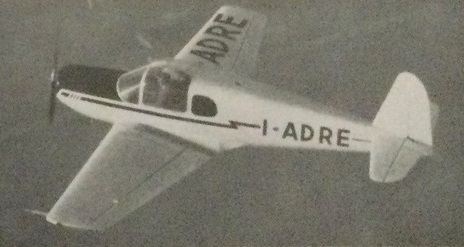
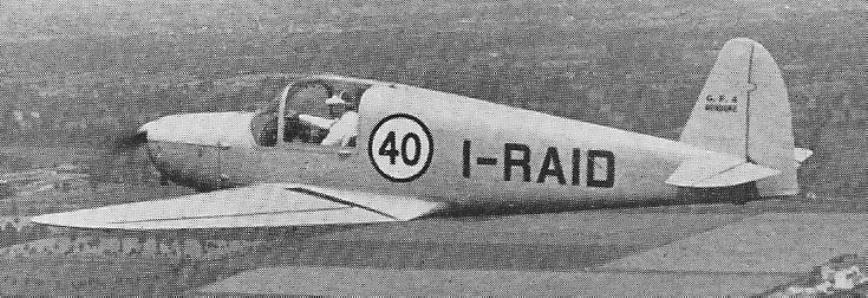
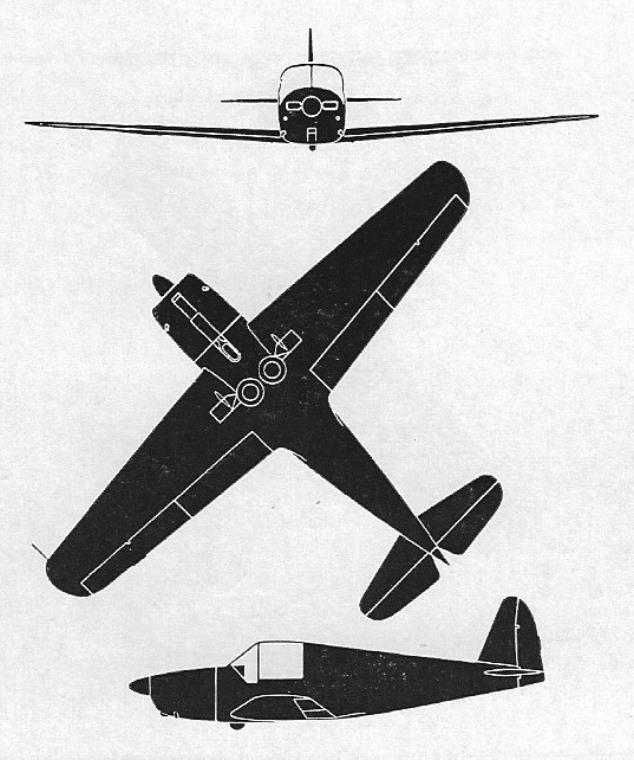
Designed by Stelio Frati, the Rondone was produced in two versions; the two-seat F.4 Rondone I and three-seat F.7 Rondone II (originally known as the Airone).
A batch of ten Rondone I two-seaters were built by S.A.I. Ambrosini, and additional aircraft were built by Legnami Pasotti & Co.
Rondone I
Both versions are generally similar externally.
The F 7 Rondone II with the 90 hp engine sold for 4.5 Mill.Lire.
Raab Flugzeugbau also acquired rights to license-produce the Ambrosini Rondone four-seat monoplane.
F.4 Rondone I Engine: Walter Mikron II, 65 hp Seats: 2 Empty weight: 749 lb Loaded weight: 1212 lb Max speed: 143 mph Cruise: 124 mph Range: 466 mi Wingspan: 28 ft 2.25 in Length: 20 ft 2 in Wing area: 114.097 sq.ft
F.7 Rondone II Engine: Continental C90, 90 hp Seats: 3 Empty weight: 1124 lb Loaded weight: 1742 lb Max speed: 149 mph Cruise: 130 mph Range: 385 mi Wingspan: 30 ft 6 in Length: 22 ft 3.5 in Wing area: 142.083 sq.ft
Derived from the S.A.I.2S, the S.1001 was produced in two versions; A four-seat tourer powered by a 130 hp Alfa 110, and A two-seat military trainer powered by a 145 hp DH Gipsy Major 10.
In 1948 the S1001 Grifo broke more records.
S.1001
The two seat S.1002 Trasimenus is essentially a variant of the S.1001 Grifo with a modified wing featuring increased span to 35 ft 9 in and area, and markedly increased dihedral. The fuselage of the Trasimenus is identical to that of the Grifo, and a 130 hp Alfa 110ter engine.
S.1001 Tourer Engine: 130 hp Alfa 110 Wingspan: 32 ft 5.5 in Length: 25 ft 7 in Empty weight: 1543 lb Loaded weight: 2340 lb Max speed: 149 mph Cruise: 130.5 mph Seats: 4
S.1001 Military Engine: 145 hp DH Gipsy Major 10 Seats: 2
S.1002 Trasimenus Engine: 130 hp Alfa 110ter Wingspan: 35 ft 9 in Seats: 2
Basically similar to the Sagittario II, the Aerfer Ariete (Battering Ram) was built by Industrie Aeronautiche Meridionali (Aerfer), and represented the next step towards the development of the Leone (Lion) mixed-power light interceptor fighter, which was being worked upon with the financial support of the US government. The Ariete had a deeper rear fuselage and, in addition to the Derwent 9, had an 821kg thrust Rolls-Royce Soar R.Sr 2 auxiliary turbojet, which improved overall performance. The Ariete prototype (MM 568) flew for the first time on 27 March 1958, but the entire project was later abandoned.
Engine: 1 x Rolls-Royce Derwent 9 turbojet, 1633kg and 1 x Rolls-Royce Soar R.Sr 2 auxiliary turbojet, 821 kg Wingspan: 7.50 m / 24 ft 7 in Length: 9.60 m / 31 ft 6 in Wing area: 14.50 sq.m / 156.08 sq ft Loaded weight: 3535 kg / 7793 lb Empty weight: 2400 kg / 5291 lb Max. speed: 1080 km/h / 671 mph
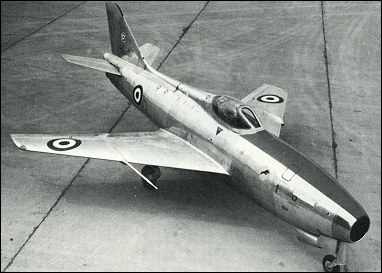
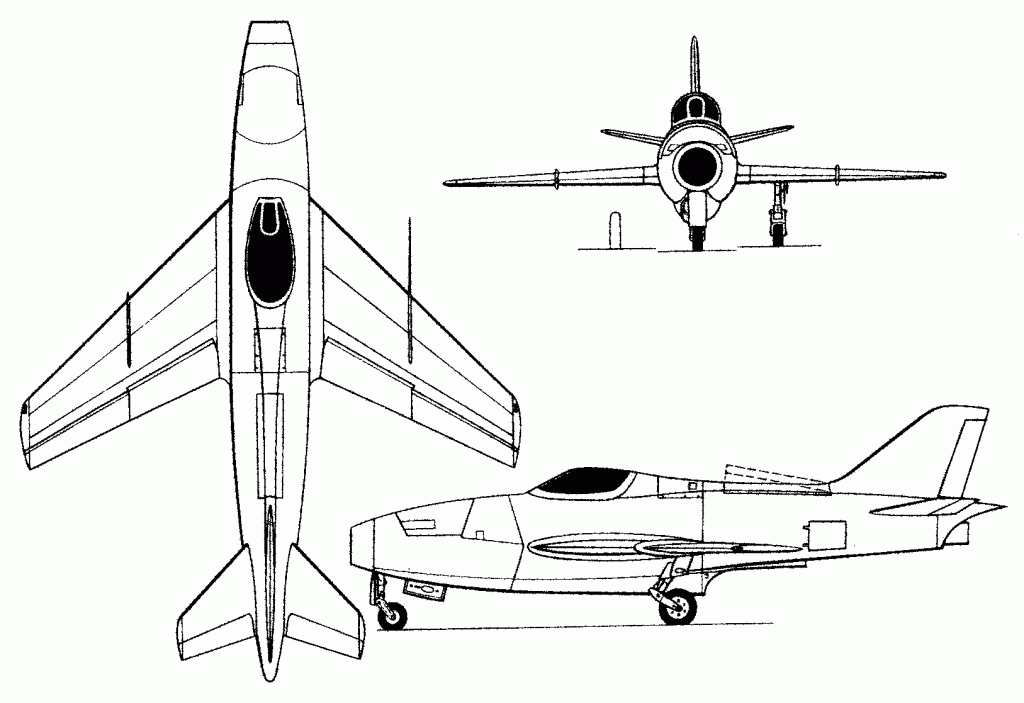
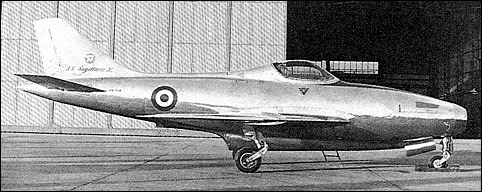
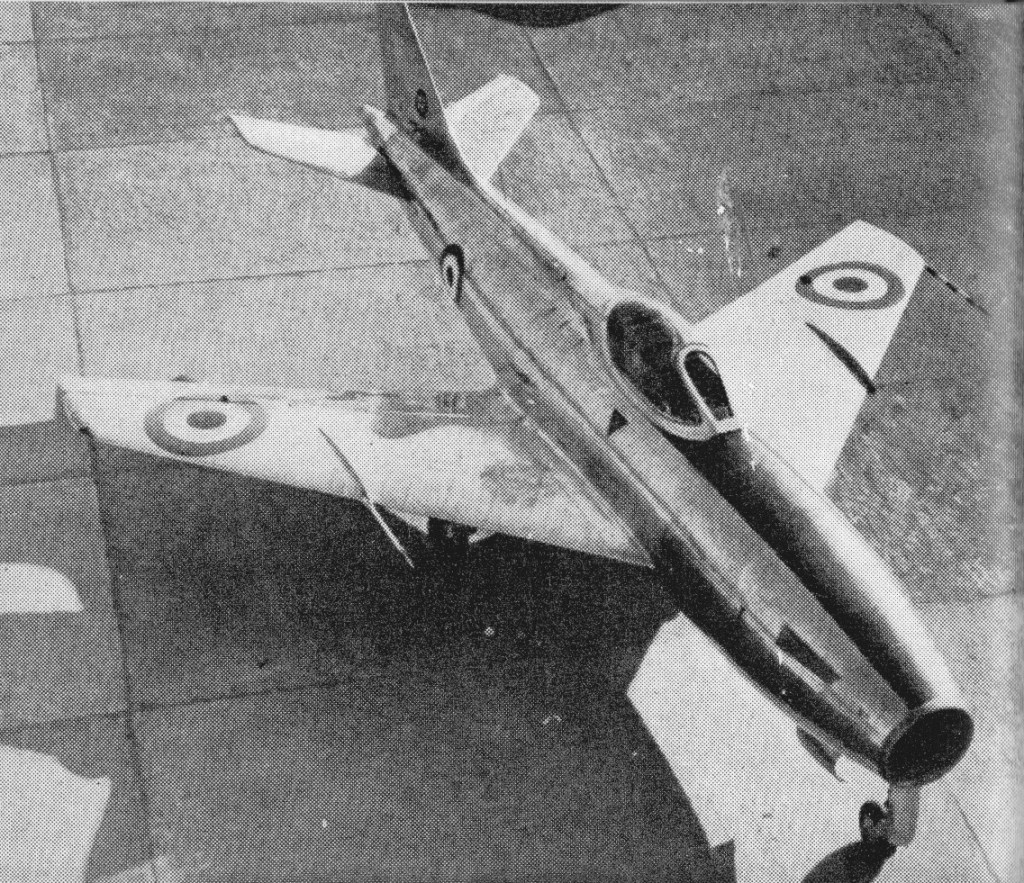
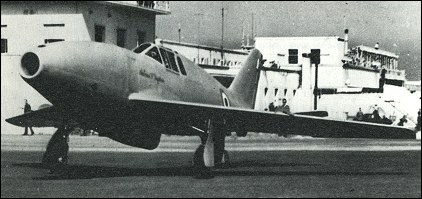
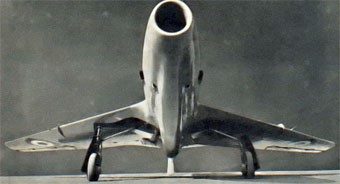
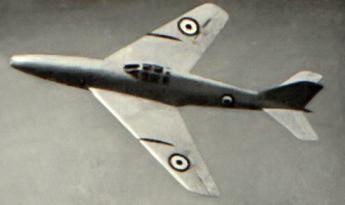
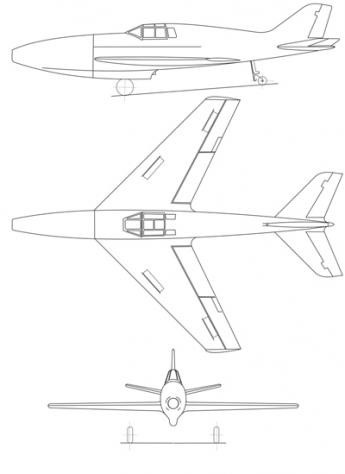
From the initial Sagittario prototype, Sergio Stefanutti subsequently developed the Sagittario II, which made its maiden flight on 19 May 1956. Powered by a Rolls-Royce Derwent 9 turbojet, this more advanced aircraft was virtually a new design and of all-metal construction and built by Aerfer. The Sagittario II was the first aircraft of Italian design to exceed Mach unity when it reached Mach 1.1 in a dive on 4 December 1956.
Engine: 1 x Rolls-Royce Derwent 9 turbojet, 1633kg Wingspan: 7.5 m / 24 ft 7 in Length: 9.5 m / 31 ft 2 in Height: 6.627 ft / 2.02 m Wing area: 14.50 sq.m / 156.08 sq ft Loaded weight: 3300 kg / 7275 lb Empty weight: 2300 kg / 5071 lb Max. speed: 1020 km/h / 634 mph Service Ceiling: 14000 m / 45950 ft Range: 413 nm / 765 km / 475 miles Armament: 2 x 30mm cannon Crew: 1
After tests with a 45° sweptback wing fitted to an otherwise standard Ambrosini S.7, thus nicknamed Freccia (Arrow), the designer Sergio Stefanutti designed the Sagittario (Archer) while he was director of SAI Ambrosini in Passignano sul Trasimeno in 1951.
Early studies for the new project, named Turbofreccia, instaled two Turbomeca Palas, positioned in the fuselage just behind the pilot’s seat, with air intakes n the wing roots. This arrangement was finally abandoned by Stefanutti who preferred the new Marboré II of 380 kg thrust. The engine is located in the front part of the fuselage, with a nose air inlet. The exhaust nozzle opens behind the trailing edge of the wing.
The construction is entirely of wood. The aircraft retained the basic fuselage of the Super S.7 married at a new 45 degree swept wing and swept tail surfaces. The retractable main landing gear comprises two front wheels and one rear wheel.
Intended mainly for aerodynamic research into transonic compressibility, the Sagittario flew for the first time on 5 January 1953. From this initial prototype Stefanutti subsequently developed the Sagittario II, which made its maiden flight on 19 May 1956, piloted by Guidantonio Ferrari, at Aviano.
Engines: 2 x Turbomeca Marboré II, 380 kg thrust Wingspan: 7.50 m / 24 ft 7 in Length: 9.32 m / 30 ft 7 in Wing area: 16.60 m² / 157.15 sq.ft Normal weight: 1750 kg Loaded weight: 5070 lb Maximum level speed: 560 Km / h / 349 mph at 13,123 ft Time to 6000 m: 16 min 30 sec Range: 354 mi Endurance: 1h.35