First flown April 1930 Model A built for a new Cairns-designed engine
Aircraft
Cairns Development Co / Cairns Aircraft Corp
USA
Started in late 1928 as the Cairns Development Company; was taken over by Cairns Aircraft Corporation in August 1929. Began to develop advanced-design all-metal low-wing monoplane. First product was the Model A, first flown April 1930; second design evaluated by the U.S. government but most of the 1930s dedicated to development work. Model A built for a new Cairns-designed engine, and in 1938 Models B and C.
Cain Aircraft Corp
Established January 1,1931, this company designed and produced a two-seat lightweight sporting aircraft known as the Cain Sport. It was powered by a 95 hp Cirrus engine, license-built by the U.S.American Cirrus Engine (ACE) Corporation.
Cailler-Magnenat 1910 monoplane
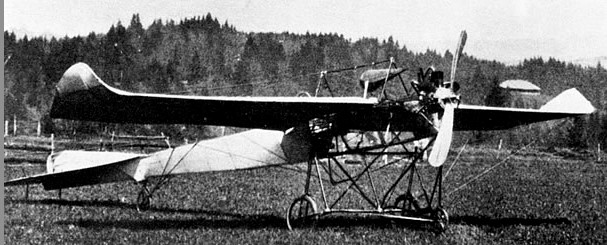
Georges Cailler, born in Vevey, Switzerland as the eldest son of Alexandre Cailler, founder of the well-known chocolate factory in Broc. He built four aeroplanes and flew them between Broc and Epagny. The parts of flying machines of Cailler were built by workers of the the chocolate factory. At the age of 18, he began construction of a biplane with the help of his friend Henri Magnenat from Lausanne, but their machine did not bring expected satisfaction. The trials with the new monoplane took eight days in spring 1910. The boys flew several hundred meters to a height of about 8 meters. They are believed to be the first Swiss aviators to fly a monoplane built entirely in Switzerland by Swiss. The machine is often attributed to Cailler alone.
Cailler-Magnenat
Georges Cailler, born in Vevey, Switzerland as the eldest son of Alexandre Cailler, founder of the well-known chocolate factory in Broc. He built four aeroplanes and flew them between Broc and Epagny. The parts of flying machines of Cailler were built by workers of the the chocolate factory. At the age of 18, he began construction of a biplane with the help of his friend Henri Magnenat from Lausanne, but their machine did not bring expected satisfaction. The trials with the new monoplane took eight days in spring 1910.
CAG Toxo
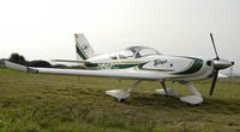
CAG Toxo is available with bigger engines in VLA version.
Toxo ultralight
Stall: 35 kt / 40 mph / 64 kmh
Cruise: 119 kt / 137 mph / 220 kmh
VNE: 189 kt / 217 mph / 350 kmh
Empty Weight: 284 kg / 626 lbs
MTOW Weight: 450 kg / 992 lbs
Climb Ratio: 1400 ft/min / 7,5 m/s
Glide Ratio: 16
Take-off distance (50ft obstacle): 160 ft / 49 m
Landing distance (50ft obstacle): 250 ft / 76 m
Cadet Aeronautics Cadet UT-1
In 1942 Dawydoff obtained the plans and the rights to produce the Slingsby Cadet under licence from Fred Slingsby. Dawydoff had the plans redrawn to US measurements, the structural strength increased, plus a new tow hook and wing rigging design. The wing is assembled using just one 4 ft (1.2 m) long pin per wing.
The UT-1 is built predominantly from wood, with the fuselage wooden framed and covered in plywood. The wing and tail are also wooden-framed and covered in doped aircraft fabric covering. The two-spar wing is supported by dual struts.
Dawydoff’s plan was to gain government support to provide the UT-1 in kit form for assembly by schools and clubs. The government money was not forthcoming and the post-war period saw a large number of surplus military training gliders saturate the market. As a result, only one UT-1 was completed, first flying in 1943. It is now located in the National Soaring Museum.
Wingspan: 38 ft 5 in (11.71 m)
Wing area: 172.5 sq ft (16.03 m2)
Aspect ratio: 8.5:1
Airfoil: Go 426
Empty weight: 276 lb (125 kg)
Gross weight: 450 lb (204 kg)
Maximum glide ratio: 14.7:1 at 30 mph (48 km/h)
Rate of sink: 210 ft/min (1.1 m/s) at 28 mph (45 km/h)
Wing loading: 2.6 lb/sq ft (13 kg/m2)
Crew: one
Cadet Boorabee
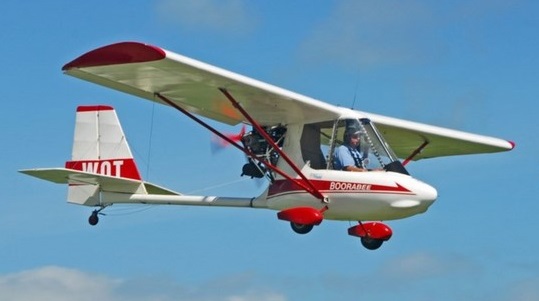
Tom Cadet designed and built the Mk1 Boorabee in 1992. The Mk1 Boorabees flew with a Rotax 503and the first aircraft has had at least 3 different engines including an HKS fitted in 2010.
The original fuselage pod mould for the Boorabee was made from the two halves taken from a crashed Rotec Panther, then modified by making the front more pointed and taking the aft section up to the wing. Tom also added a sheet alloy floor pan. A Maxair Drifter contributed the aluminium tube boom and empennage.
Dave Donohoe, a colleague of Tom Cadet, developed the Boorabee’s airfoil. This wing was mated to a new fuselage mould to use a 4 x 3 inch rectangular boom and Dave called the result the Shuttle.
For the Boorabee’s wing, Tom used fibreglass/Kevlar ribs with a glass/Kevlar leading edge. The main spar caps are 40 x 1.6mm drawn alloy tubes with 1.2mm sheet web plates; the rear spar is a 44 x 1.6mm tube.
Boorabees are extremely docile aircraft with few if any vices. The Mk1s are really powered gliders without air brakes (better than 12:1 glide) they tend to float so it requires a special technique to spot land them.
Cadet built two Mk1 Boorabees then made new moulds and simplified the design for the Mk2.
Three versions of the Boorabee appeared. The Mk 1 has a 30ft wing span. That of the Mk 2 was reduced to 29ft, and a new mould was made to improve the shape of the fuselage pod. Alloy shear plates were used to simplify wing construction, and flaperons adopted. Kevlar was used extensively to lighten the aircraft. Both the first Mk 1 and Mk 2 were registered in 1993.
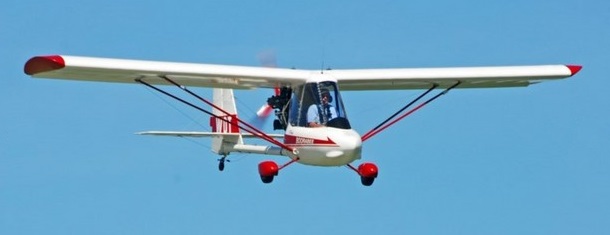
A lengthened pod, offering more foot space for the rear-seat passenger, was introduced with the Mk 3, which also had the shorter wing.
The choice of powerplant was usually the Rotax 582 or 618. A Rotax 503 was used by Bob Evans of Evans Head for his Mk 2, completed as a single seater with a more rounded tail.
There were nine Boorabees built in total before Cadet gave the fuselage plug to Dave Donohoe who modified it for a rectangular boom tube. Dave’s Shuttle shared the same wing but the boom, tail, undercarriage and controls were vastly different. Cadet loaned the moulds to persons he trusted, and gave them the CAD plans at no cost.
For several years, Tom freely provided scale drawings to those interested in building a Boorabee, the use of his moulds, and builder support. A dozen or so Boorabees were completed by local builders.
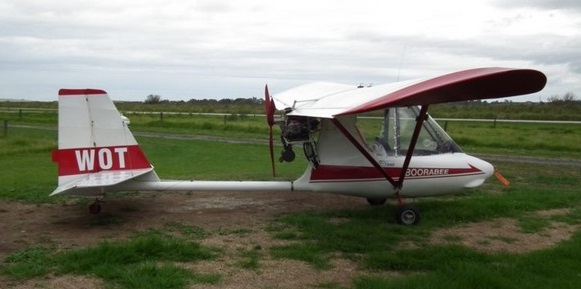
As with all pusher aircraft, the airflow around the rear of the fuselage was a problem, causing slight instability in yaw as well as reduced thrust from the propeller. After experiments on the Mk 1s a line of vortex generators on the fuselage immediately solved the issues. Because the two blades of the original propeller disturbed the air at the wing trailing edge in unison, resulting in uncomfortable vibration at certain speeds, a three-blade propeller was found to be necessary. Apart from these annoyances the Boorabee proved very successful, with hundreds of hours logged by each aircraft.
No more Boorabees were built because it required a great deal of effort by Cadet for builder assistance and it became very difficult to get the 5″ boom tube and necessary drawn tubing to build the wing. He still had the moulds years later.
The first Boorabee has flown thousands of hours.
Boorabee Mk1
Engine: HKS 700 E 60hp
Wingspan: 9.2 m / 30 ft
Length: 5.85 m
Empty Weight: 284 kg
Maximum Take Off Weight: 554 kg
Fuel Capacity: 94 litres
Never exceed: 90 Kts
Cruise Speed: 60Kts
Stall Speed: 30 Kts
Take off roll: 200 meters
Rate of Climb: 500 ft per minute
Endurance: 10 hours
Seats: 1
Mk 2
Wing span: 29 ft
Mk 3
Wing span: 29 ft
CAARP
Cooperative des Ateliers Aeronautiques de la Region Parisienne initially specialized in modification and repairs. Began manufacture of components for sailplanes under license, and in 1965 contracted from Scintex-Aviation to produce Super Emeraude light aircraft. Prototype only of C.P.100 two-seat version of Emeraude was built. CAARP became associated with Avions Mudry et Cie in manufacture of CAP 10 and 20 aerobatic aircraft in the early 1970s, being responsible for building of CAP 20 and fuselages for CAP 10. Final assembly of the CAP 10 was undertaken by Mudry at Berney, the companies being merged in 1978.
Bylinkin, Iordan and Sikorsky BIS No. 2 biplane
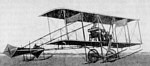
The 1910 BIS No. 2 biplane was designed and built by Bylinkin, Iordan and Sikorsky in Russia.
Span: 26’3″
Length: 26’3″
Weight loaded: 473 lb

