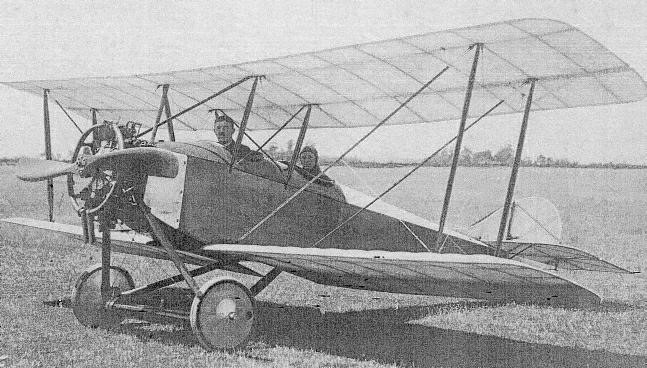
The first NZ designed and built land-biplane, strongly reminiscent of a Sopwith Tabloid, was designed and built at the Canterbury (NZ) Aviation Co Ltd workshops at Sockburn, near Christchurch, the two persons most concerned with the construction being Mr C M Hill, the company’s chief flying instructor, and Mr J G Mackie, the engineer.
The working drawings for this unnamed biplane were chalked out on the black-painted wall of one of the early Sockburn hangars, which full size drawings was apparently quite satisfactory as the biplane performed well in the air. The drawings were so “permanent” that they could still be seen, according to Mr W S Dini, as late as 1938 when he left the RNZAF after 14 years’ service. Cupboards had been built along the rear wall of the hangar in later years, and these helped in no small measure to preserve the drawings.
The aeroplane was rolled out of its hangar on 17th January 1919, and was a two-seater fitted with a 30 h.p. Anzani radial motor which was originally used to power one of the School’s Caudron biplane trainers. Main spars were of ash and the wing struts were of cedar, with bracing wires encased in cedar streamlines. Ailerons were fitted (instead of the Caudrons’ wing-warping and the wings had a slight dihedral. The aircraft, according to the Lyttelton Times of 18th January’ was “produced with little or no effort”. Wings and fuselage were fabric-covered.
Mr Hill made the first solo flight in the biplane on 17th January and found that it had a good rate of climb and was light on the controls. It also had a shallow gliding angle for its type, and Mr Hill predicted that it would be suitable for aerobatics. He said on landing that he had never before tested an aeroplane in which everything was so satisfactory, and he praised Mr Mackie’s work in high terms. The only alteration he recommended after the first flight was a small one to the control circuits to enable the aeroplane to be flown hands-off in level flight. He found that, trimmed hands-off, it tended to climb slightly. A very short landing was made after that first flight, another good feature.
Plans were then made for a flying tour to Invercargill, the aeroplane to be flown by Mr Hill and demonstrations and passenger flights to be given at selected centres. Passengers would also be booked between several of the towns to be visited, and it was thought that with a full tankage of 27 gallons of petrol, two people could be carried about 200 miles in still air.
The longest passenger flight in NZ on record, according to the Lyttelton Times, was made on 18th January 1919 when Mr Hill took off from Sockburn for a 28 minute flight over Christchurch and New Brighton, with Mr E S Fleming as passenger. This presumably would be the longest passenger flight made by an aircraft of the Canterbury (NZ) Aviation Co.Ltd. Mr Fleming, of the Riccarton Flour Mills, was a brother of Mr W H P (Herby) Fleming of Gore, who had also booked a flight between Gore and Invercargill during the forthcoming tour. Mr E S Fleming’s flight was made at between 2 and 3,000 feet, and there were “no engine troubles”. Later flights the same day were made with passengers Mr A V Smith and Mr Notman.
The southern flight was never made as the biplane was completely wrecked and Mr Hill killed on 1st February. It had been the custom for an aeroplane of the Canterbury (NZ) Aviation Co. Ltd to make a flight over the Racecourses at Addington and Riccarton on Race days, and Mr Hill had been requested to fly over the Riccarton meeting on the 1st. The Hon. H F Wigram, chairman of the Company, asked the Chairman of the Jockey Club if he would like to have an exhibition flight over the Racecourse that Saturday afternoon as an added attraction, and so it was arranged with Mr Hill. Mr Hill took off from Sockburn at 3.11 pm and set course for the Racecourse’ where he appeared just as the Lyttelton Plate was being run. He circled twice, and finally flew low over the course, where he was cheered by the crowd as he went past.
Mr Hill waved to the crowd, and then circled again to get more height. Another wide sweep over the course was made at a height of 2000 feet, and then the aeroplane disappeared into cloud. On his reappearance, he dived the aeroplane and came over in a loop. It would appear that the aircraft had some difficulty in going over the top, and soon went into another dive. This final dive was made towards the crowd, and as the aircraft climbed into its second loop, a distinct crack was heard and the port wings collapsed. Mr Hill tried to hold the aircraft straight but this was impossible and the aeroplane then disappeared from sight behind a belt of trees.
When members of the public arrived at the scene of the crash Mr Hill was dead and the aeroplane completely wrecked. At the subsequent inquest and investigation it was found that a flying wire had broken and this in turn had caused the other flying wire to break. The main spars had then cracked and the whole port wing assembly folded up. It was said that ordinary piano wire had been used for the flying wires, instead of cable.
Mr Hill had not previously attempted any aerobatics with the aeroplane and indeed had not permitted anyone else to fly it until he had completely tested it to his satisfaction. It had only made a very few flights at the time of the accident and it was fortunate that no passenger was being carried at the time.
The Coroner, Mr T A B Bailey SM, found “That on 1st February, while the deceased was making an exhibition flight over the Riccarton Racecourse, and attempting to loop the loop, one wing of the machine collapsed and the machine fell to the ground, the deceased being killed as a result of the fall, The collapse of the wing appears to have been due to the breaking of one of the flying wires. The machine was built under the personal supervision of the deceased, who was a competent mechanic and he expressed himself satisfied with the machine”.
Engine: 30 h.p. Anzani
Wingspan: 23 ft 6 in
Length: 20 ft
Wing area: 220 sq.ft
All-up-weight: 500 lbs
Fuel capacity: 200 lbs
Seats: 2