Caproni

One of the companies form¬ing part of the industrial empire founded by Count Gianni Caproni in 1908 was Caproni Vizzola, originally an important pilot training school, but from 1934 a design and construc¬tion organization as well.
Company’s founder, Count Gianni Caproni di Taliedo, built and flew his first aircraft in May 1910. Count Gianni Caproni di Taliedo designed his first heavy bomber in 1913. Caproni’s big biplane bombers had a demoralizing effect on ground troops during the Austro-Italian conflict, more by virtue of their size and threatening ap¬pearance than their destructive power, and led to a series of immense triplane bombers during World War I. The first was de¬signed in mid-1915 and was designated Caproni Ca. 40. A later development, the Ca.42.
At one time, largest aircraft manufacturer, the Caproni group comprised more than 20 companies, of which the principal aircraft building members were Aeroplani Caproni Trento, Caproni Aeronautica Bergamasca, Caproni Vizzola SpA, Compagnia Nazionale Aeronautica, Aeronautica Predappio SpA, and Officine Meccaniche Reggiane SpA. The Isotta-Fraschini aero- engine company was also part of the group.
The most prolific company in the group was the Compagnia Aeronautica Bergamasca, which began aircraft design in 1927, joining the Caproni group in the ‘thirties. The chief designer was Cesare Pallavicino, formerly chief designer to Ernesto Breda, and initially the original designs produced by Bergamasca were given Caproni-Bergamaschi designations, but later “Berga- maschi” was dropped and aircraft emanating from the Bergamo works could only be identified by their type numbers, which were in the 300 series.

After formation of Regia Aeronautica in associating with various partners until First World War. 1923 Caproni achieved success with such military aircraft as the Ca 1 -Ca 5 series of large tri-motor biplane and triplane bombers
During the 1920s, a retrospective series of manu¬facturer’s designations was applied to war¬time Caproni designs, in an endeavour to clarify different variants. Under this system the prototype Ca.1 was designated Ca 31 and the Fiat engined Ca 1 was allocated Ca 32; to avoid confusion between the two systems.
Achieved an international reputation with the Ca 36, Ca 73 and Ca 74. The following decade produced the Ca 101, Ca 111, and Ca 133 range of aircraft and a series of multipurpose reconnaissance/light bomber/transport types, production of which was shared with the Bergamasca subsidiary.
Early post-war publicity gained by Ca 60, an enormous eight-engined ‘triple-triplane’ of 1921, intended to carry 100 passengers, which was shared with the Bergamasca subsidiary.
Cantieri Aeronautici Bergamaschi had been absorbed by Caproni in 1931. Initially built Ca 100 and Ca 101, then built the new aircraft to the designs of Ing Cesare Pallavicino.

In the mid ‘thirties Caproni-Vizzola activities were expanded and a fully-equipped factory built. The plant was primarily engaged on sub-contract work building the Breda Ba 65 attack aircraft, but in 1938 its first original designs, the F.4 and F.5 single-seat fighters appeared, powered respectively by the 1,025-h.p. Isotta-Fraschini Asso 121 R.C.40 and the 840-h.p. Fiat A.74 R.C.38 radial. Designed by Ing. Fabrizi, a pre-production batch of fourteen of the radial-engined F.5 fighter was built immediately prior to Italy’s entry into the war, but like most of Italy’s fighters of this period the F.5 was under-powered (maximum speed being 326 mph) and under-armed (two 12.7-mm. guns). Nevertheless, a squadron was equipped with the F.5 for a short period and employed for the night defense of the area surrounding Rome.

One of the fourteen F.5 fighters was re-engined in 1941 with a 1,050-h.p. DB 601 engine. This conversion was designated F.6, but the most interesting development was the F.6Mz powered by the 1,250-h.p. Isotta-Fraschini Zeta engine (which was also to have been installed in the Reggiane Re 2004). The F.6Mz flew for the first time late in 1942 and was to have carried an armament of four 12.7-mm. guns or two 12.7-mm. and two 20-mm. guns. Maximum speed was 404 mph, but the Zeta engine was insufficiently developed for operational service, and the F.6Mz progressed no further than the prototype stage.

Major production types during 1934-1944 were A.P.1 single-seat fighter, followed by the family of multi-purpose twin-engined aircraft: Ca 309 Ghibli; Ca310/310 bis Libeccio; Ca 311 Libeccio; Ca 312 bis Libeccio; Ca 314, and 316.
More than 2,500 examples of the Ca 100 training/touring biplane were built during the 1930s; the Ca 161 bis, a single-seat single-engined biplane, set an international altitude record of 17,083m that remains unbeaten today in its class. The Caproni-Campini CC-1 of 1940 was Italy’s first and the world’s second aircraft to fly by jet propulsion, though it was not powered by a turbine. During the Second World War the company was chiefly concerned with the production and development of the Ca 310-Ca 314 multipurpose twin-engined aircraft and with the Reggiane Re. 2000-Re 2005 series of single- seat fighters. During the lifetime of the group some 180 different types were built, in addition to licensed construction of almost as many by other designers.
The parent company went bankrupt in 1950. Aeroplani Caproni Trento survived the bankruptcy and in May 1952 flew Italy’s first postwar jet light aircraft, the F.5, designed by Dott Ing Stelio Frati.
In 1969, Caproni – Vizzola began producing in his workshops 30,000 m² located near the airport of Milan – Malpenza.

Caproni Vizzola Costruzioni Aeronautiche SpA was formerly the Scuola Aviazione Caproni, the oldest flying school in Italy, and became the last surviving part of the company until bought by Agusta in 1983, producing the Calif series of sailplanes and finally the C22J Ventura two-seat very light basic trainer with two Microturbo turbojet engines, first flown 1980. Earlier it remodeled the Ca 133 for ambulance and military transport duties and assisted in production of the Breda Ba 65. Its first original design had been the F.4 single-seat fighter designed by Ing F Fabrizi, flown in 1940. Prototype F.6 had more powerful engine.
Capone Aérogyroplane

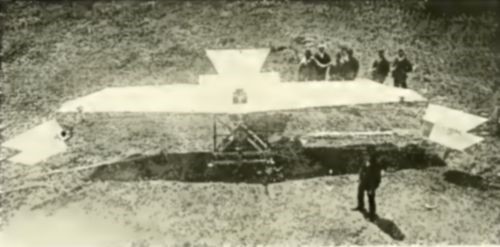
Federico Capone’s machine was called l’Aérogyroplane because of the way it was powered. A small motorcycle engine of 4.5 hp drove double pairs of swinging blades symmetrically disposed at the end of wings. The blades worked like rotors in the initial stage of flight and then their position could be changed from horizontal to vertical. The latter was to give horizontal action to the machine. Built by Ceccarelli in Naples, testing was not very successful, as the machine was partially wrecked by a gale on April 30, 1905. The repaired machine was later sent off from a high launching position and managed to fly a certain distance.

Capital Aircraft Air Trainer / Royal Air Trainer / Derickson Air Trainer

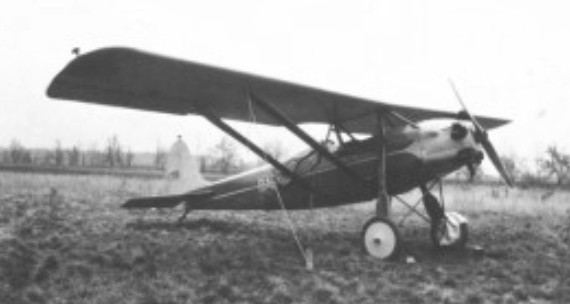
The aircraft was designed by Prof. Peter Altman of the University of Detroit. At that time it was named the Derickson Air Trainer.

John and Donalt Thomas acquired the design rights in 1928 and formed a company under the name Capital Aircraft Corporation located in Lansing, Michigan.

They built only one aircraft, registration number X795K. The airframe was initially built as a seaplane powered with a 60 hp LeBlond 5-D engine, which was exchanged with a 90 hp 7-D when later converted as a landplane. Span was 34 ft, length 25 ft, useful load 535 lbs, Vmax 105 mph, Vc 85 mph, Vso 30 mph, and range 400 miles.

In 1929 Capital Aircraft Corporation was relocated in Royal Oak, Michigan, and was renamed the Royal Aircraft Corporation.

Capella Javelin / T-Raptor

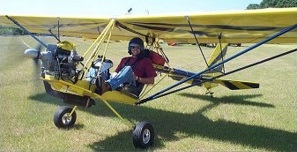
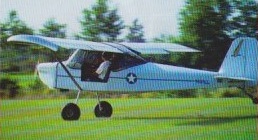
The Capella Javelin is a family of American open cockpit, high wing, tractor configuration, conventional landing gear-equipped ultralight aircraft that were designed by J. Reid Howell and produced in kit form by Capella Aircraft of Austin, Texas and intended for amateur construction.

First flying in 1998, the single seat Javelin I was designed to comply with the American FAR 103 ultralight regulations, including that category’s maximum 254 lb (115 kg) empty weight. The 2001 cost was US$6000 without engine, propeller, instruments or covering supplies.

The design features an open frame fuselage of welded 4130 steel tubing, with the pilot’s and passenger’s seats bolted to the frame. The horizontal stabilizer and tail fin are also constructed of welded steel tubes. The wing is framed from riveted aluminium tubing with all flying surfaces covered in doped aircraft fabric. The wing is equipped with full span ailerons.

The conventional landing gear includes sprung-steel main gear and a similarly sprung steerable tail wheel. The open cockpit design provides good visibility while taxiing.

The standard engine supplied by the manufacturer for the single seat version was the 28 hp (21 kW) Rotax 277, but it was reported that the aircraft was underpowered with that engine installed. The throttle control is of a unique motorcycle grip type.

Original factory kit options included a cockpit pod and windshield, brakes and steel tube powder coating.
The single-seat Javelin was developed into a tandem two-seater, designated the Javelin II and then further developed into the T-Raptor ultralight trainer. The T-Raptor uses a wider and more enclosed fuselage, with optional bubble-windowed doors, to allow cool weather flying and was intended to be marketed to ultralight schools.

Capella Aircraft went out of business in late 2007, and the type is no longer in production.

Variants:

Javelin I
Single seat open cockpit ultralight
Engine: 1 × Rotax 277, 28 hp (21 kW)
Wingspan: 28 ft 0 in (8.53 m)
Wing area: 112 sq ft (10.4 sq.m)
Length: 18 ft 0 in (5.49 m)
Height: 6 ft 0 in (1.83 m)
Empty weight: 240 lb (109 kg)
Gross weight: 575 lb (261 kg)
Fuel capacity: 5 US gallons (19 litres)
Maximum speed: 63 mph (101 km/h, 55 kn)
Cruise speed: 60 mph (97 km/h, 52 kn)
Stall speed: 26 mph (42 km/h, 23 kn)
Range: 140 mi (220 km, 120 nmi)
Service ceiling: 12,500 ft (3,800 m)
Rate of climb: 400 ft/min (2.0 m/s)
Seats: one

Javelin II
Two seats-in-tandem open cockpit ultralight trainer powered by a 50 hp (37 kW) Rotax 503 engine. It was reported as being in development in 1998 and forecast to be available at the end of 1998.

T-Raptor
Two seats-in-tandem ultralight trainer powered by a 50 hp (37 kW) Rotax 503, 64 hp (48 kW) Rotax 582 or 60 hp (45 kW) HKS 700E four stroke engine. The T-Raptor has an expanded-width steel cage to provide a more enclosed cockpit and is a development of the Javelin II.

Capella Aircraft Corp Capella

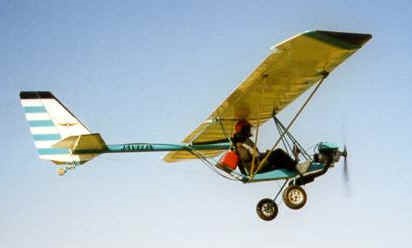
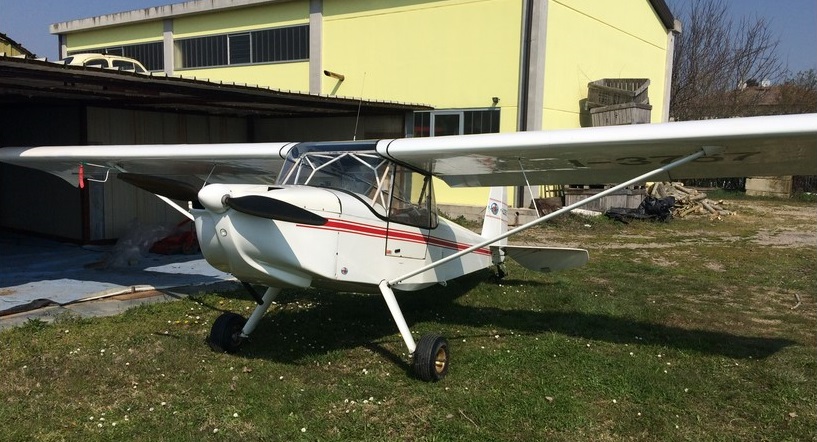
Capella Single Seat

Desined by J. Reid Howell
The Capella SS first flew in 1988.
Folding wing optional.

The FW2T has a dacron covered spaceframe fuselage, while the strut braced wings are fabricated from sheet dural, pop riveted.

FW2T

The Capella XLS first flew in 1990.
Capella Aircraft Corp received certification in Germany for the Capella XLS model FW2C80 and Capella SS model FW1C50.
The Capella XS first flew in 1990.
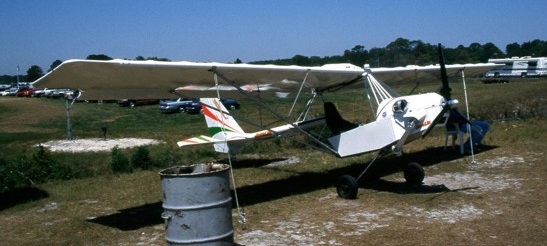
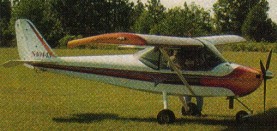
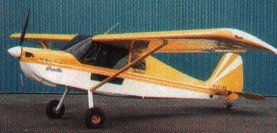
The Capella Fastback first flew in 1995.

Capella Fastback

Capella SS
Engine: Rotax 503, 50 hp.
HP range: 40-50.
Speed max: 112 mph.
Cruise: 102 mph.
Stall: 34 mph.
ROC: 980 fpm.
Take-off dist: 130 ft.
Landing dist: 130 ft.
Service ceiling: 10,000 ft.
Fuel cap: 7 USG.
Weight empty: 360 lbs.
Gross: 650 lbs.
Height: 5.67 ft.
Length: 17.33 ft.
Wing span: 27.5 ft.
Wing area: 110 sq.ft.
Seats: 1.
Landing gear: nose or tail wheel.

Capella XLS
Engine: Rotax 912, 80 hp.
HP range: 65-80.
Speed max: 121 mph.
Cruise: 119 mph.
Stall: 41 mph.
ROC: 1450 fpm.
Take-off dist: 200 ft.
Landing dist: 150 ft.
Service ceiling: 10,000 ft.
Fuel cap: 22 USG.
Weight empty: 560 lbs.
Gross: 1100 lbs.
Height: 5.67 ft.
Length: 18.4 ft.
Wing span: 28.5 ft.
Wing area: 114 sq.ft.
Seats: 2.
Landing gear: nose or tail wheel.

Capella XS
Engine: Rotax 582, 65 hp.
HP range: 65-80.
Speed max: 116 mph.
Cruise: 111 mph.
Stall: 41 mph.
ROC: 1200 fpm.
Take-off dist: 175 ft.
Landing dist: 115 ft.
Service ceiling: 10,000 ft.
Fuel cap: 10 USG.
Weight empty: 480 lbs.
Gross: 1100 lbs.
Height: 5.67 ft.
Length: 18.4 ft.
Wing span: 28.5 ft.
Wing area: 114 sq.ft.
Seats: 2.
Landing gear: nose or tail wheel.

Capella Fastback
Engine: Rotax 912, 80 hp.
HP range: 65-80.
Speed max: 121 mph.
Cruise: 120 mph.
Stall: 36 mph.
ROC: 1450 fpm.
Take-off dist: 200 ft.
Landing dist: 150 ft.
Service ceiling: 10,000 ft.
Fuel cap: 10/22 USG.
Weight empty: 560 lbs.
Gross: 1100 lbs.
Height: 5.7 ft.
Length: 18.5 ft.
Wing span: 28.5 ft.
Wing area: 114 sq.ft.
Seats: 2.
Landing gear: tail wheel.

Capella FW2T
Engine: Rotax 912, 80 hp
Wing span: 8.63 m
Wing area: 10.62 sq.m
MAUW: 450 kg
Empty weight: 265 kg
Fuel capacity: 52 lt
Fuel consumption: 14 lt/hr
Max speed: 180 kph
Cruise speed: 155 kph
Minimum speed: 58 kph
Climb rate: 3.8 m/s
Certification: VZ
Seats: 2
Kit price (1998): $13,795

Capelis XC-12   

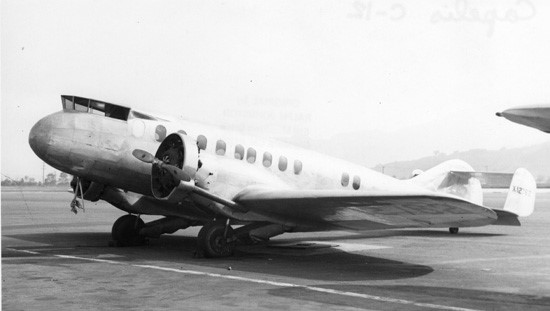
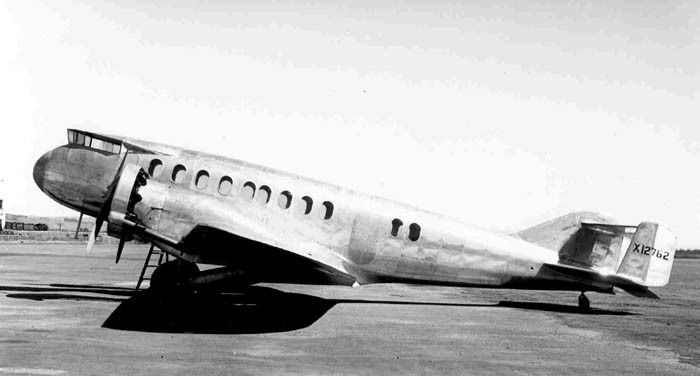
The Capelis Safety Airplane Company Ltd XC-12 was a 1933 aircraft design that most notably was used as a prop in the films Five Came Back, The Flying Tigers, The Falcon in Danger, and Immortal Sergeant. The aircraft featured unusual twin horizontal tail structures supported by three vertical tail surfaces. Construction and finishing methods involved using sheet metal screws which ultimately led to the abandoning of the project.

The original design by Socrates H. Capelis was issued U. S. patent #1,745,600 in 1930. The patent comprised a modified application with a half-span dorsal wing mounted rearward on top of the cabin and two additional engines mounted on the wings. The project was funded by local Greek restaurateurs as a promotional aircraft; it was constructed with help from University of California students.

A less radical design by Dr. John E. Younger featured all-metal construction; the aircraft was built as an all-metal, low-wing, retractable gear, twin engine transport with a triple vertical tail supporting a dual (biplane arrangement) horizontal stabilizer. The wing used a large box-spar construction with corrugated skin panels. The partly retracting landing gear extended automatically when the throttle was closed.

Following a 1938 incident, the XC-12 was modified at Glendale, California: The forward slanting eight-piece windshield was modified to a four piece that slanted rearward, and the passenger windows were squared off to look more like a Douglas DC-3.

On April 15, 1938, the XC-12 suffered minor damage from a forced landing after running out of fuel while flying over Fresno, California. The main wing spar construction was bolted together, and many of the metal skin panels were attached with P-K sheet metal screws rather than with permanent rivets. These tended to vibrate loose, requiring tightening or replacing every few flights, constituting a safety hazard that would later ground the aircraft. With promotional tours abandoned after the 1938 crash, the aircraft’s flying career was over.

The aircraft was purchased by RKO in March 1939, after which the studio’s insurance company permanently grounded the aircraft. Used as a full-size prop, the transport appeared only in ground roles in RKO’s feature films made during World War II; flying sequences used a scale XC-12 shooting miniature. The aircraft became an RKO back lot relic, falling into worse repair during the 1940s until it was completely scrapped some time around 1950. The XC-12 miniature continued to be used in later feature films.

The aircraft was featured as a prop in Five Came Back (1939), The Flying Tigers (1942), and Immortal Sergeant (1943). In RKO’s Dick Tracy’s Dilemma (1947) the XC-12 was shown somewhat dismantled, and in Daredevils of the Clouds (1948), after which it was apparently scrapped.

Filmography:

Five Came Back (RKO) 1939 (aircraft and model)

Flying Blind (Paramount) 1941 (model)

King of the Zombies (Monogram) 1941 (model and disassembled fuselage)

Flying Tigers (Republic) 1942 (aircraft and model) John Wayne guides in a crippled XC-12 with an engine on fire, and later uses it as an improvised bomber

Invisible Agent (Universal) 1942

Immortal Sergeant (20th Century Fox) 1942/1943 (aircraft and model)

Adventures of the Flying Cadets (Universal) 1943 (model)

Night Plane from Chungking (Paramount) 1943

The Falcon in Danger (RKO) 1943 (while a Lockheed Model 10 Electra aircraft model is used for the in-flight scenes, the full-size aircraft appears as a wreck)

Wings Over the Pacific (Monogram) 1943 (model)

The Purple V (RKO) 1943

Action in Arabia (RKO) 1944

Passport to Destiny (RKO) 1944

Jungle Queen (serial) (Universal) 1945; re-edited into Jungle Safari a 1956 feature film

Dick Tracy’s Dilemma (RKO) 1947 The aircraft is shown somewhat dismantled in this movie, but not scrapped

Daredevils of the Clouds (Republic) 1948 (model)

Jungle Goddess (Lippert Pictures) 1948 (model)

Tarzan’s Magic Fountain (RKO) 1949 (model)

On the Isle of Samoa (Columbia) 1950 (model)

China Gate (Globe Enterprises) 1957 (model)

Specifications:
Powerplant: 2 × Wright Cyclone R-1750, 525 hp (391 kW) each
Propeller: 2-bladed
Wingspan: 55 ft (17 m)
Wing area: 500 sq ft (46 m2)
Airfoil: Modified USA 45
Length: 42 ft (13 m)
Height: 12 ft (3.7 m)
Empty weight: 6,500 lb (2,948 kg)
Gross weight: 9,500 lb (4,309 kg)
Fuel capacity: 145 gal
Maximum speed: 190 kn (220 mph, 350 km/h)
Cruise speed: 170 kn (190 mph, 310 km/h)
Stall speed: 53 kn (61 mph, 98 km/h)
Service ceiling: 28,000 ft (8,500 m)
Capacity: 12