Civil Aviation Department of India KS-I Kartik / KS-II Kartik

Several Civil Aviation Department aircraft were named after lunar related periods; Kartik (Sanskrit: कार्तिकः) is the eighth month of the Indian national calendar. The glider named after it was one of at least five designed by S. Ramamrithram at the Civil Aviation Department.

Produced at the Technical Centre of India’s Civil Aviation Department, the Kartik high performance single seater that first flew in prototype form, designated KS-I, on 18 March 1963. It performed successful stalling and spinning trials that same day and was followed by a second prototype.

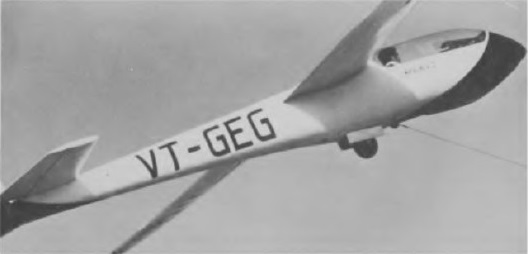
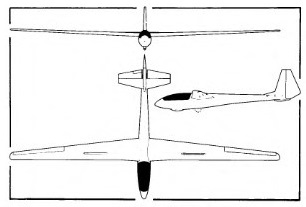
It was a single seat, high performance machine, fairly conventional apart from the wing planform of the first variant, the KS-I Kartik. Rather than the usual taper, its 15 m (49 ft 3 in) span, high, cantilever wing had inner and outer rectangular panels of different chord, 200 mm (7.9 in) narrower outboard. This approximated taper and was simpler to build with fewer different sized ribs. The mid-wing joins were blended with short tapered sections of the trailing edge; the leading edges were straight. Overall there was 1° of forward sweep. The wing structure was wooden, consisting of a single main spar with plywood skinning forward from it around the leading edge to form a torsion resisting box, a secondary rear strut and diagonal drag struts at the wing roots. Fabric covering was used aft of the main spar. The wing was mounted with 1.50° of dihedral. It was fitted with ply covered, wood framed ailerons and had wooden air brakes which opened above and below at mid-chord.

The Kartik’s fuselage was a ply skinned, wooden framed semi-monocoque with an aluminium nose cap. The cockpit was ahead of the wing leading edge with a removable perspex canopy. Oxygen was an option. Aft, the fuselage tapered gently to the tail surfaces which were straight tapered and square tipped. Its tailplane, mounted at the top of the fuselage, was positioned forward of the fin so the rudder, which reached down to the keel, only required a small cut-out for operation. The fin and the tailplane leading edge were ply covered, the remainder fabric. The starboard elevator carried a trim tab.

Ramamrithram provided the Kartik with similar landing gear to that of his earlier Bharani: a fixed Palmer/Dunlop unsprung monowheel without a brake, a rubber sprung, steel shod forward skid and a tail skid with tennis balls as a spring. The pilot sits under a rearward opening hinged Perspex canopy, and oxygen equipment is optional.

Flight testing of the KS-I showed that the double rectangular wing was not a success and a third prototype, designated KS-II, first flew on 4 May 1965 and this had a conventional tapered wing to allow flight evaluation of the relative performances of the two wings; fabric-covered slotted wooden ailerons replaced the KS-l’s plywood-covered wooden ones. Area and span remained the same, though the airbrake area increased. A wheel brake was added and maximum take-off weight increased by about 7%. Other changes in the KS-II included a slight increase in fuselage length (100 mm / 3.9 in and a reduction in cockpit height, and second, third, fourth and fifth prototypes of the KS-II were test flown during February 1967, March and May 1968 and May 1969, plus a sixth prototype in 1970.

The third and subsequent aircraft incorporated several improvements, including a reduction in fuselage height, now fitted with a rear hinged canopy, and larger air brakes, while the ninth KS-II Kartik, flown in 1976, has the air brakes replaced by trailing edge slotted flaps.
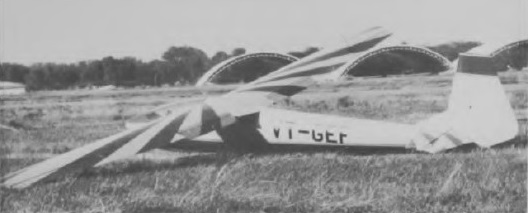
KS-II Kartik

The KS-II was type certificated in 1965 and during the first Indian National Gliding Rally, held in 1967, the Kartik scored many successes, including setting a national speed record over a 200km (124 mi) triangular course.

Variants:
KS-I Kartik
First two prototypes, first flown 18 March 1963. Double rectangle wing.

KS-II Kartik
First flown 4 May 1965. Straight tapered wing. Seven built.
Specifications:

KS-II Kartik
Wingspan: 15.00 m (49 ft 3 in)
Height: 2.26 m (7 ft 5 in)
Wing area: 13.54 m2 (145.7 sq ft)
Aspect ratio: 16.6
Airfoil: NACA 643618
Length: 7.37 m (24 ft 2 in)
Empty weight: 210 kg (463 lb)
Max takeoff weight: 320 kg (705 lb)
Water ballast: None
Maximium wing loading: 23.63 kg/m2 (4.86 lb/sqft)
Maximum speed in smooth air: 200 km/h (124 mph; 108 kn)
Maximum speed in rough air: 140 km/h (87 mph; 76 kn).
Stall speed: 58 km/h (36 mph; 31 kn)
Max aero-tow speed: 71 mph
Maximum glide ratio: 31 at 75 km/h (47 mph; 40 kn)
Rate of sink: 0.6 m/s (120 ft/min) minimum, at 65 km/h (40 mph; 35 kn)
Crew: One
Civil Aviation Department of India HS-1 / HS-2 Mrigasheer

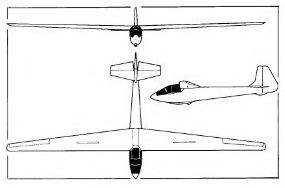
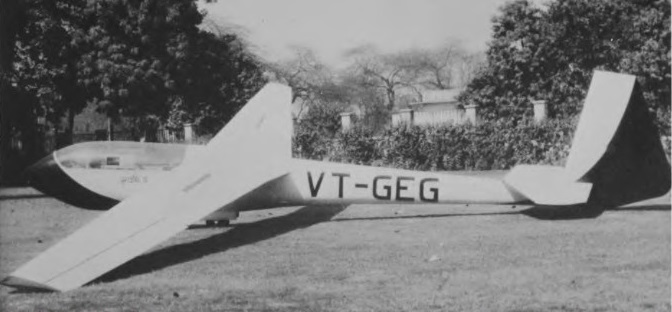
To succeed the earlier KS-II Kartik high performance single-seater the Technical Centre started design of another Standard Class sailplane known as the HS-1 Mrigasheer (मृगशिरा – “Orion”). The HS-1 is a single-seat Standard Class sailplane designed and developed at the Technical Centre by the team of designers and engineers led by Mr K. B. Ganesan, Director of Research and Development.

It was an orthodox design with a high wing, slender, tapering fuselage, and conventional empennage. Construction was wooden throughout.

The original version, the HS-1, made its first flight in November 1970. This had a higher aspect ratio wing than the Kartik’s with Wortmann wing sections instead of the earlier design’s NACA 64-series aerofoils. This was further developed into the HS-2 Mrigasheer under a design team lead by Mr K. B.Ganesan the centre’s Director of Research and Development, and the prototype of this made its first flight in April 1973. The following month it was flown into second place in the first Indian national gliding championships held at Kanpur. A second prototype, based on the aerodynamic design of the first, made its first flight in May 1977; this has trailing edge slotted flaps instead of the first prototype’s upper surface air brakes, and a glassfibre reinforced plastic tailplane and elevators of different aerofoil section.

HS-2 Mrigasheer

The Mrigasheer is of plywood-covered wooden construction and the high wings are two-spar structures with a plywood leading edge torsion box and plywood covering aft of the main spar, the wooden flaps and ailerons being hinged on the rear spar. The semi-monocoque fuselage is plywood-covered, as is the fin, but the rudder is fabric covered. There is a retractable unsprung monowheel with a drum-type brake, as well as a rubber-sprung nose skid with a replaceable steel shoe and a similarly sprung tail skid. The pilot sits under a long forward-opening jettisonable one-piece canopy.

The HS-2 differed from its predecessor in having slotted flaps instead of airbrakes, and a completely redesigned tail. This has glassfibre-reinforced plastic horizontal tail surfaces of different aerofoil section.The wooden two-spar wings incorporate a plywood leading edge torsion box with plywood covering aft of the main spar. The rear spar carries the hinges of the wooden flaps and ailerons. The fuselage consists of a semi-monocoque wooden structure with plywood covering.

HS-2
Length: 7.59 m (24 ft 11 in)
Wingspan: 15.00 m (49 ft 3 in)
Height: 2.50 m (8 ft 3 in)
Wing area: 11.24 sq.m (121.0 sq ft)
Aspect ratio: 19.9
Wing section: Wortmann FX-61-184/163/60-126
Empty weight: 237 kg (522 lb)
Gross weight: 335 kg (739 lb)
Water ballast: None
Max wing loading: 29.54 kg/sq.m (6.05 lb/sq.ft)
Maximum speed: 213 km/h / 133 mph / 115 kt
Max rough air speed: 80 kt (148 km/h)
Max aero-tow speed: 71.5 mph
Maximum glide ratio: 32
Rate of sink: 0.58 m/s / 120 ft/min / 1.9 ft/sec
Crew: One pilot

Civil Aviation Department of India TG-1 / ATS-1 Ardhra / Hindustan Aeronautics ATS-1 Ardhra

This tandem two-seater advanced training sailplane was designed by the Technical Centre of India’s Civil Aviation Department at New Delhi; it was formerly designated TG-1.

Of conventional wooden construction with fabric covering the ATS-1 resembles its predecessor, the single-seat HS-II Mrigasheer, although the cantilever shoulder wings have 3° of forward sweep and are plywood-covered multi-spar structures with fabric covered trailing edges. The plywood plain ailerons are also fabric covered; no flaps are fitted but there are wooden air brakes in the upper and lower wing surfaces. The tail unit is of similar construction to the wings, with a trim tab in the starboard elevator. The fuselage is a semi-monocoque wooden structure and there is a non-retractable rubber-sprung monowheel with an expanding shoe brake, plus a rubber-sprung skid under the nose and a tail skid.

The two pilots sit in tandem under a long one-piece blown flush-fitting canopy.

The prototype, VT-GEJ, first flew on 5 March 1979 and was certificated by the Indian DGCA in November that year. Plans for large scale production were underway early in 1980 for the National Cadet Corps and civil clubs. The second prototype which was then under construction has 2° geometric twist (washout) from 50% span to the wing tips, and the dihedral increased to 3°.

The Indian Air Force ordered fifty examples in the early 1980s to be produced by Hindustan Aeronautics and the type was approved for use for flying by cadets.

ATS-1 Ardhra
Length: 8.61 m (28 ft 3 in)
Wingspan: 16.50 m (54 ft 2 in)
Airfoil – Root: FX 61-184
Airfoil – tip: FX 61-184
Height: 2.46 m (8 ft 1 in)
Wing area: 21.8 m2 (235 ft2)
Aspect ratio: 12.5
Empty weight: 328 kg (723 lb)
Gross weight: 508 kg (1,120 lb)
Maximum speed: 210 km/h (130 mph)
Max aero-tow speed: 77.5mph
Min sinking speed: 2.56 ft/sec
Best glide ratio: 28:1 a 54 mph
Rate of sink: 0.8 m/s (160 ft/min)
Crew: Two, pilot and instructor

Civil Aviation Department of India Revathi

The Civil Aviation Department Revathi was a light civil utility aircraft designed in India principally for use by that country’s flying clubs.

The Revathi was a conventional, low-wing monoplane with fixed tailwheel undercarriage and two seats side-by-side with an optional third seat behind them. The fuselage construction was of welded steel tube, with the forward section skinned in aluminium and the tail section in fabric. The wings were of all-metal construction and originally fitted with wooden flaps and ailerons that were later replaced with metal surfaces. The tail surfaces were also originally wooden but later replaced with metal.

The Revathi first flew on 13 January 1967 and received Indian type certification in January 1969.

The prototype’s wings and fuel system were later revised, and the resulting configuration was designated the Revathi Mk.II. It first flew in this configuration on 20 May 1970. It received its Indian type certificate on 31 October 1972.

Revathi Mk.II
Crew: One pilot
Capacity: 1-2 passengers
Length: 24 ft 10 in (7.58 m)
Wingspan: 30 ft 10 in (9.40 m)
Height: 9 ft 9 in (2.97 m)
Wing area: 152 ft2 (14.1 m2)
Empty weight: 1,408 lb (639 kg)
Gross weight: 2,120 lb (962 kg)
Engine: 1 × Rolls-Royce Continental O-300-C, 145 hp (108 kW)
Maximum speed: 120 mph (193 km/h)
Range: 400 miles (643 km)
Service ceiling: 11,500 ft (3,505 m)
Rate of climb: 600 ft/min (3.0 m/s)

Civil Aviation Department of India MG-1   

The Technical Centre of the Indian Civil Aviation Department began Design work on the MG-1 motor glider in October 1981. It was a low wing monoplane with spruce and plywood wings with a forward sweep of 1.5° at quarter chord mounted with 3.25° of dihedral. The ailerons were fabric covered; there were no flaps but wooden airbrakes extended above and below the wing. The cantilever, unswept empennage was similarly constructed and the low set tailplane carried elevators with a trim tab on the starboard side.

The fuselage of the MG-1 was steel framed and fabric covered with the exception of a glass fibre engine cowling. This housed a conventionally nose mounted, 74.5 kW (100 hp) flat four Continental O-200 piston engine driving a non-retractable propeller. Its cockpit seated two side by side under a rearward sliding canopy. The conventional undercarriage had main wheels with rubber cord shock absorbers and brakes, assisted by a steerable tailwheel.

Only one MG-1 was built. It made its first flight on 30 May 1983 and gained certification in December 1985.
Specifications

Engine: 1 × Rolls Royce Continental O-200-A, 75 kW (100 hp)
Propeller: 2-bladed Hoffmann V62R/170Y, 1.70 m (5 ft 7 in) diameter adjustable pitch
Length: 8.00 m (26 ft 3 in)
Wingspan: 16.50 m (54 ft 2 in)
Height: 2.50 m (8 ft 2 in) in flying attitude
Wing area: 21.83 m2 (235.0 sq ft)
Airfoil: Wortmann FX-61-184
Empty weight: 560 kg (1,235 lb) equipped
Max takeoff weight: 748 kg (1,649 lb)
Fuel capacity: 60 L (13.2 Imp gal; 15.8 US gal)
Maximum speed: 245 km/h (152 mph; 132 kn) power off, smooth air
Cruising speed: 160 km/h (99 mph; 86 kn) economical, 75% power
Stall speed: 62 km/h (39 mph; 33 kn) powered; 70 km/h (44 mph; 38 kn) power off
Range: 500 km (311 mi; 270 nmi) maximum fuel
Service ceiling: 4,575 m (15,010 ft) service
g limits: 5.3/-2.65 power off
Maximum glide ratio: 26:1 at 105 km/h (65 mph; 57 kn), power off
Rate of climb: 6.0 m/s (1,180 ft/min)
Rate of sink: 1.0 m/s (200 ft/min) minimum, at 90 km/h (56 mph; 49 kn), power off
Wing loading: 34.3 kg/m2 (7.0 lb/sq ft) maximum
Take-off run: 170 m (558 ft)
Landing run: 135 m (443 ft)
Crew: 2

Civilian Coupe

Civilian Coupe II

Designed by H.D.Boultbee in 1928 the C.A.C. Mk I Coupe, a two-seat, high-wing cabin monoplane tourer, was built at Burton-on-Trent, near Hull. Initially powered by an 85 hp ABC Hornet engine, the prototype G-AAIL was first flown in July 1929 and was demonstrated publicly at Heston that same month.

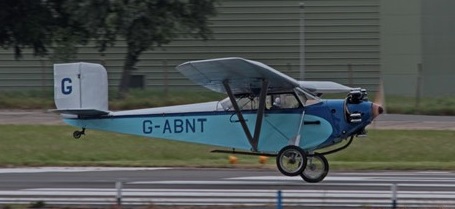
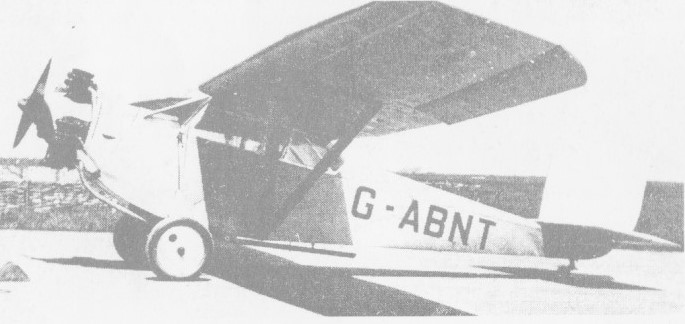
A factory was set up at Hedon to produce the improved Coupe II powered by a 100 hp Genet major radial engine. Two aircraft were built in 1930, G-ABFI and G-ABFJ, and two more, G-ABNT and G-ABPW, in 1931. Customers were hard to find and a sixth was never completed.

Coupe II

G-ABNT cn 0.2.3 was first registered to Civilian Aircraft on 10 September 1931. It was not sold until February 1933 when it was delivered to S.B.Cliff at Woodley. After moving to Whitchurch it was re-sold to G.O.Rees at Pengham, Cardiff in October 1933. G-ABNT was stored at Carmarthan from 1939 until early 1978 when it was purchased by P.A.Mann, who moved it to Biggin Hill for restoration.

Coupe II
Engine: Armstrong Siddeley Genet Major I, 100 hp
Wingspan: 35 ft 6.5 in
Length: 19 ft 4 in
AUW: 1500 lb
Max speed: 110 mph

Civilian Aircraft Co

UK
The Civilian Aircraft Company Ltd was formed at Burtonon- Trent by Harold D. Boultbee, formerly assistant chief designer of Handley Page Ltd. Its sole product was the C.A.C. Mk I Coupe, a two-seat, high-wing cabin monoplane tourer built at Hedon, near Hull, and flown July 1929. A novel design for its time, there were initial difficulties and only five were built. Last four designated Mk II Coupe (uprated Armstrong Siddeley Genet Major engine); company closed in 1933.

Cirrus Designs ST50        

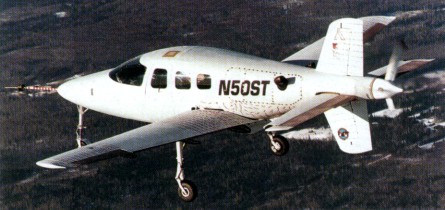
Contracted by Israviation to develop, design and build the “proof of concept” prototype of the turboprop ST50, the Cirrus ST50 engineering prototype first flew on December 7, 1994. The all new five seater is being developed by Cirrus Designs in the US and Israviation in Israel. Cirrus is responsible for the design while Israviation will manufacture the aircraft.

Engine: Pratt & Whitney PT6.
Seats: 5.