1919; 60 built, a DH-3 replacement
DH-5A a higher-powered version of 1928, with steel-tube fuselage (22 built).
Aircraft
EFW DH-2 / EFW DH-3
A tractor design of A. Haefeli which went into production as developed DH-3 (110 of these two-seaters built).
EFW DH-1
A pusher design of A. Haefeli (six built in 1916) showing Ago influence
EFW (Eidgenössische Flugzeugwerke) / F+W / EKW / Eidgenossische Konstruktions Werkstätte / Federal Construction Workshop / Eidgenossiches Flugzeugwerke / Elbe Flugzeugwerke / Fabrique Federale D’avions
Eidgenössiche (Constructions) Werkstätte was formed at Thun early in First World War. Made aircraft to designs of A. Haefeli, who was earlier with Farman and Ago. First was DH-1 pusher (six built in 1916) showing Ago influence; DH-2 was tractor which went into production as developed DH-3 (110 of these two-seaters built). DH-4 was fighter prototype of 1918; DH-5 (1919; 60 built) a DH-3 replacement; DH-5A a higher-powered version of 1928, with steel-tube fuselage (22 built). To a government specification of 1934 it built the C-35 multipurpose two-seat biplane as a replacement for the Fokker C.V-E, which it resembled, and which the company had produced jointly with Dornier since 1932.
The Eidgenos¬sische Konstruktions Werkstatte (EKW) built the Fokker C.V E under licence.
EKW (Eidgenossische Konstruktions Werkstätte, or Federal Construction Workshop) became EFW.
In 1932 Dornier production was resumed in Germany. The Swiss factory subsequently became the Eidgenossisches Flugzeugwerk. Founded 1934 as government-run R&D organization, with manufacturing, maintenance and upgrading capabilities. In an official specification of 1934 the company had designed the C-36 monoplane.
Newly named EFW, it revived the design in 1938 and built 160 as C-3603. Of C-3604 development, only 13 were built.
EFW began in 1955 manufacturing the Ilyushin Il-14P under licence, as well as development of the Baade 152.
After the war became responsible for Swiss license production of various foreign aircraft for Swiss Air Force, including the British Vampire, Venom and Hunter (under Hawker Siddeley contract), several versions of French Mirage and US F-5E/F combat aircraft, plus French Alouette III helicopter. Produced C-3605 as turboprop conversion of wartime C-3603 fighter-bomber, used for target-towing.
Adopted F + W title in 1972 from former EFW and two other used names. Subsequent work has included assembly of Hawk trainers, Hornet fighters, component production for Airbus and McDonnell Douglas airliners, manufacture of missiles, and more.
Later became a subsidiary of the European Aeronautic Defence and Space Company (EADS),
EFF Prometheus II / EFF Prometheus PV
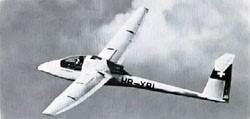
The Prometheus is a production of EFF / Entwicklungsgemeinschaft für Flugzeugbau / Association for the development project and airplane building. It is is a high performance side-by-side glider with two Microturbo 90 kp thrust engines. A self-launching glider, its engines can be stopped and reset running at will.
One was built, registered in 1978 as HB-YBI, and the name Prometheus PV.
With a wingspan of 19.4 m, it weighs 707 kg unladen and 900 at full load. Its radius of action powered flight exceeds 500 Km
In 1980, the manufacturer reported a radio navigation facility and a transponder allowing it to integrate seamlessly restriction in controlled airspace and major airport.
The Prometheus II is linked to an engineer in Switzerland, Ulrich La Roche , who sought to reproduce with WINGGRID, some aerodynamic effect on birds. This work began in the first wind tunnel at Emmen between 1993 and 1994. In 1996, an encounter with Prof . Dr. – Ing. Hans -Reinhard Meyer- Piening would offer the opportunity to validate the concept of a real WINGGRID demonstrator.
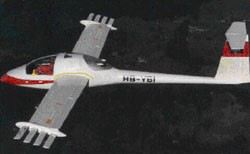
In 1997, the Prometheus was chosen for this experiment. To this end, the size was reduced to 12 m. They hoped a glide ratio of 15 to 17, but experience showed that it was 25. The Prometheus II is a high performance glider with a fineness approaching 40, but with a high wing loading.
EEUFMG CB-1 Gaivota / CB-2 Minuano / CEA-UFMG CB-1 Gaivota / CEA-UFMG CB-2 Minuano
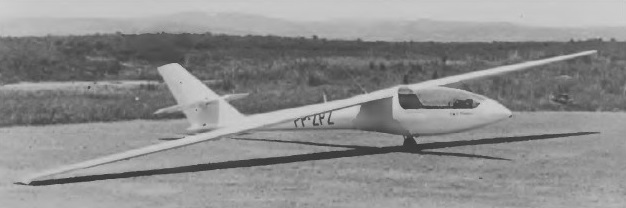
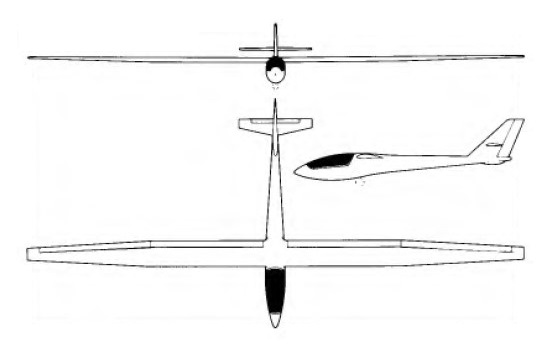
Named after a strong, cold wind common to southern Brazil, the Minuano high performance single-seater was designed by Professor Claudio Pinto de Barros, head of the CEA (Centro de Estudos Aeronauticos, or Air Research Centre) of the Engineering School at Minas Gerais Federal University – the Escola de Engenharia da Universidade Federal de Minas Gerais, or EEUFMG.
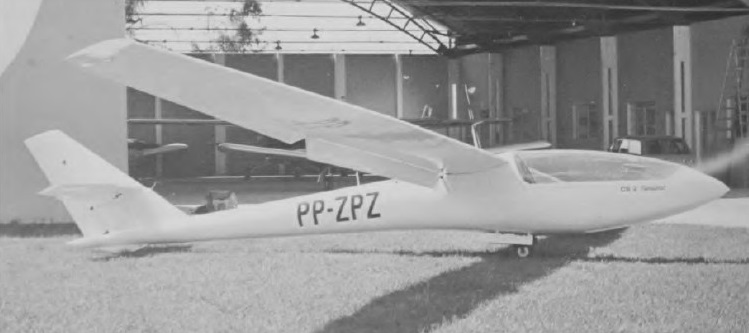
The Professor had completed his first sailplane design, the CB-1 Gaivota, when he was a student; design work on the Minuano began in 1969, construction started in 1971 and the prototype first flew on 20 December 1975. Four more Minuanos were ordered, the second being due for completion by the end of 1978, and this incorporates several modifications, being designated CB-2/B.
The cantilever high wing has a single aluminium alloy main par, and the wing skin is of plywood/glassfibre honeycomb sandwich. The flaps and ailerons, which are interconnected, are similar except for having wooden spars and the flaps can be used as air brakes by deflecting up to 90°. Up to 176lb of water ballast can be carried. The all-wood fuselage is a semimonocoque, and there is a retractable unsprung monowheel with an internal shoe brake, and a sprung tailskid. The tail surfaces are plywood covered, and stiffened with foam plastics, and the all-moving tailplane has a trim tab in each half.
CB-2 Minuano
Wing span: 15.0 m / 49 ft 2.5 in
Length: 7.0 m / 22 ft 11 in
Height: 1.43 m / 4ft 8.25 in
Wing area: 10.2 sq.m / 109.8 sq ft
Wing section: Wortmann FX-61 -163/60-126
Aspect ratio: 22.0
Empty weight: 214 kg / 472 lb
Max weight: 304 kg / 670 lb
Water ballast: None
Max wing loading: 29.8 kg/sq.m / 6.1 lb/sq ft
Max speed: 140 kt / 260 km/h
Stalling speed: 35 kt / 65 km/h
Min sinking speed: 0.55m/sec / 1.8 ft/sec at 39 kt / 72 km/h
Max rough air speed: 86.5 kt / 160 km/h
Best glide ratio: 38 at 48.5 kt / 90 km/h
CB-2/B
Span:49 ft 2.5 in
Length: 22 ft 11.75 in
Height: 4 ft 8.25 in
Wing area: 109.8 sqft
Aspect ratio: 22.0
Empty weight: 507 1b
Max weight: 882 lb
Max speed: 161 mph (in smooth air)
Max aero-tow speed: 99 mph
Min sinking speed: 1.97 ft/sec at 51.5 mph
Best glide ratio: 39:1 at 59 mph
EEUFMG / CEA-UFMG / Center for Aeronautical Studies at the Federal University of Minas Gerais
Professor Claudio Pinto de Barros was head of the CEA (Centro de Estudos Aeronauticos, or Air Research Centre) of the Engineering School at Minas Gerais Federal University – the Escola de Engenharia da Universidade Federal de Minas Gerais, or EEUFMG.
The CEA-311 Anequim was built by students of the Center for the study of Aeronautical Engineering at the Federal University of Minas Gerais in Belo Horizonte, Brazil, directed by Professor Paulo Iscold.
The school’s program was started in the early 1960s with a sailplane named CB-1 Gaviota, which was engineered by professor Cláudio Pinto de Barros, who founded CEA at age 25.
CEA stands for the Portuguese name for the Center for Aeronautical Studies. The number 3 denotes an airplane (1 is for sailplane and 2 is for ultralight). And the remaining two numbers are the order numbers for the design. Only seven airplanes have been built at the school, but Anequim is the 11th design produced.
EEL ULF-2
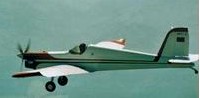
Designed by Deiter Reich, only technical plans were available. Approx. 3000 hours to build.
Price (1998) 990 DM (Plans)
Plans price 2009: 15000 EURO
Constructed with wood, the ULF-2 has a Citroen Visa engine.
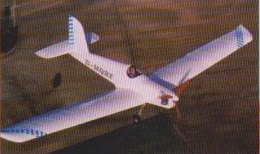
Stall: 24 kt / 28 mph / 45 kmh
Cruise: 65 kt / 75 mph / 120 kmh
VNE: 76 kt / 87 mph / 140 kmh
Empty Weight: 205 kg / 452 lbs
MTOW Weight: 325 kg / 717 lbs
Climb Ratio: 600 ft/min / 3,0 m/s
Glide Ratio: 17
Take-off distance (50ft obstacle): 490 ft / 150 m
Landing distance (50ft obstacle): 330 ft / 100 m
Engine: Citroen Visa II, 32 hp
Wing span: 11 m
Wing area: 13.9 sq.m
MAUW: 300 kg
Empty weight: 185 kg
Fuel capacity: 30 lt
Max speed: 140 kph
Cruise speed: 100 kph
Minimum speed: 45 kph
Climb rate: 3.5 m/s
Fuel consumption: 3.8 lt/hr
Seats: 1
Certification: Vz
Plan price (1998): 1 046,50 DM
EEL ULF-1
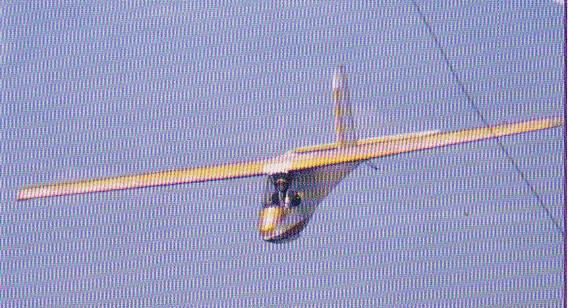
Light sailplane circa 1998, designed by Deiter Reich.
Price (1998) 990 DM (Plans)
Weight: 50 kg
Wing span: 10.4 m
Wing area: 13.4 sq.m
Vne: 80 km
Stall: 30 km
Glide Ratio: 16
EEL
1998: Heimeranstr 61, D-80339 Munchen, GERMANY
Light glider and aircraft designer / builder

