Elliots of Newbury (EoN)

Elliots of Newbury grew out of an old-established joinery works that had existed oa a part of the Albert Works, Newbury, Berkshire site since the mid-nineteenth century. After the 1914-18 wat a change to furniture manufacture was made. During the Second World War Elliots became involved with glider manufacture, one of a number of furniture manufacturers that co-operated in the building of the large transport gliders. Elliots built about one third of the total Horsa production including the development of the hinged nose for the Mark 2 version, and it was also responsible for powered version of the Hamilcar glider. However, Elliots prime interest was the making of furniture. At the end of the war, when the contracts for transport gliders were coming to an end, the firm was hoping to resume furniture manufacture but, for technical reasons, was not “designated” by the Board of Trade for the manufacture of “Utility” furniture.

Early in 1945 the company was approached by Chilton Aircraft Ltd to make one pair of wings for the Chilton Olympia. Elliots had, by then, already planned to manufacture the Newbury Eon four-seat light aircraft but they agreed to make one pair of wings only for the Chilton prototype. Elliots refused to sell Chilton’s the wing jigs and maintained legal rights and ownership of their own manufactured jigs. Chilton’s later gave up all aircraft work and an agreement was subsequently reached whereby Elliots purchased from Chilton the production rights, fuselage jigs, and work in hand on all Olympia sailplanes.

Quantity production of the Eon Olympia commenced in 1946, and was followed in 1948 by the production of two further ex-German designs, the Grunau Baby sailplane and the SG.38 primary glider. Elliots, and their design consultants Aviation & Engineering Products Ltd, introduced improvements in each of the designs before commencing production.

Meanwhile, the Newbury Eon aircraft had its first flight in August 1947, and, in conjunction with their consultants, they produced a Design Study and tendered to the Air Ministry specification T.16/48 for a two-seat training aircraft in competition with Percival, Handley Page, and Auster. No further aircraft were produced by Elliots but aircraft parts were made, under sub-contract.

In 1954 a new version of the Olympia was produced as the original design was nearly fifteen years old. The Olympia 4, later known as the 401, was the first in a series of gradual stages of improvement and led to the 402 in 1956, the 403 in 1957, and finally, in 1958, to the Open Class 419 with its companion the 415 for the fifteen-metre Standard Class. Limited production of these latter types was then initiated. A completely new Standard Class sailplane was introduced in 1961 known as the Type 460. This was put into production and became very popular in Britain, resulting in a special version, the Type 465, being developed for the 1965 World Championships.

In the summer of 1965 the Managing Director of Elliots, M H.C.G. Buckingham died. He had been a keen supporter of the gliding movement for many years. After his death Elliots carried out a review of the firm’s activities and decided that it was time to end glider production due to its increasing unprofitability. A joint advertisement in the April 1966 “Sailplane & Gliding” announced that Slingsby Sailplanes Ltd had taken over the production of Eon Sailplanes. However, no Elliots designed gliders were ever built at Kirkbymoorside although spares were supplied and repairs undertaken.
Ellehammer VI / Ellehammer 1910 Monoplane

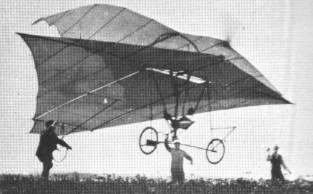
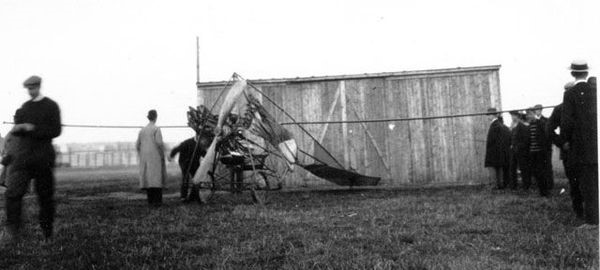
This machine has sometimes been called “Ellehammer”, and while the aircraft was capable of flight, its performance was rather modest, and as a consequence was nicknamed “graesslaamaskinen” (the grass cutting machine, or “Lawn-mower”) in the newspaper Ekstrabladet. With a six-cylinder Ellehammer radial engine and triangular fuselage shape in typical Ellehammer style, the ribs including the cloth could be pushed inboard along the main spar, which then could be folded along the fuselage. The main spars are still in transverse position in this photograph; believed to have been taken at “Kløvermarken” in 1910. Frederik Moltke was to compete with this machine for the first crossing-flight over the Øresund to Sweden. Unfortunately the airplane was not ready when Robert Svendsen had then already overflew the waters.

Span: 27’9″
Length: 24’7″

Ellehammer Aeroplane

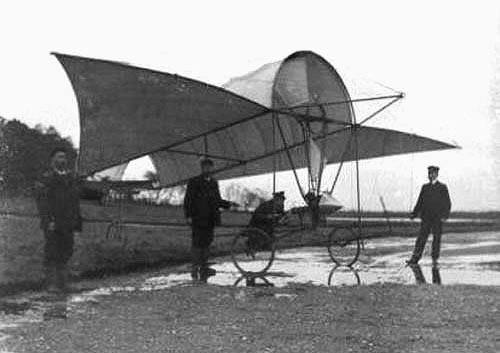
Danish inventor Jacob Christian Hansen Ellehammer’s 1905 first full-scale attempt did not fly. Ellehammer then experimented with an upper “sail”, added it to the machine, and succeeded in making brief tethered ascensions from a circular track on September 12, 1906. Since the island of Lindholon, on which tests were carried out, was too small for a straight flight to have been attempted.

Ellehammer IV Article

Many people acknowledge J.C.H.Ellehammer of Denmark as the first to fly in Europe because of a reported 42 m hop about 20 inches above the ground made on 12 September 1906.

Ellehammer’s work does not seem to have relied on the designs of his predecessors. He did fail to develop a workable control system. Lack of funds finally forced Ellehammer to abandon his experiments.

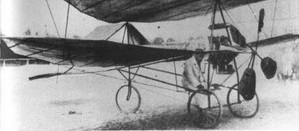
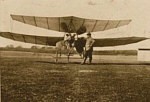
1908 Ellehammer IV

Engine: Ellehammer air cooled radial, 20 hp.
Prop: 4-blade.
Wing span: 30 ft 11.75in (9,35 m).
Length: 20 ft 4 in (6,20 m).
Height: 10 ft 8.25in (3.26 m).
Wing area: 398.3 sq. ft (37.00sq.m).
Gross weight: approx 397 lb (180 kg).
Speed: 35 mph (57 kph).
Seats: 1.

1908 Ellehammer IV
Span: 39’4″
Weight: empty 290 lb
Speed: 42 mph

Ellehammer, J.C.H.

Jacob Christian Ellehammer was first apprenticed as a watchmaker, he then qualified as an electrical engineer; he made one of the earliest motor-cycles built in Denmark, and also designed his own internal combustion engines. His 3-cylinder piston engine of 1903 was perhaps the world’s first radial engine, and his experiments in aviation, started two years later, embraced monoplanes, biplanes, triplanes, flying boats and helicopters.

Ellehammer Article

After the 1912 helicopter, Ellehammer then put aside his helicopter experiments until about 1930, when he began to evolve some new projects. One of these was, in effect, a parasol monoplane in whose wings was a huge circular cut-out with two contra-rotating rotors turning inside it. Even more novel was a proposal in the mid-1930s for a helicopter driven by compressed air. As with the previous project, only a working model was built, powered by a vacuum cleaner motor. In the full-sized aircraft Ellehammer proposed to have a radial engine driving a powerful air compressor. A substantial pylon over the fuselage was topped by a metal disc, made to rotate by the reaction from expelling compressed air through slots in its underside. The centrifugal force of the rotating disc was sufficient to unsheath four spring-loaded rotor blades; when take-off had been accomplished, these were retracted back into the disc and the compressed air stream diverted to an efflux at the rear of the aircraft to give it forward movement.

Elite Macro

The Macro is an all metal low wing monoplane. The cantilever wind consists of a built up “I” beam spar with hand beaten aluminium ribs. The monocoque fuselage is of 2024T3 aluminium. A twin seat version was under construction which will have twin wing mounted engines.

Engine: Fuji Robin 244.
Prop: 81 cm x 38 cm pitch.
Wingspan: 7.0m.
Length: 3.96m.
Weight: 89.8 kg.
Fuel capacity: 18 ltr.
Econ cruise speed: 56 kts.
Stall: 35kts.

Elitar Sigma

Sigma 4

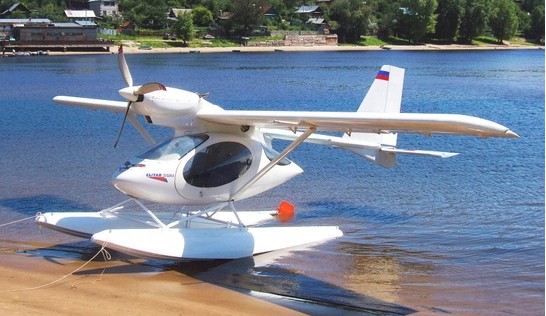
The Sigma 4 was designed for training, tourism and sport.
The airplane was designed according to requirements of JAR VLA

Engine: Rotax 912 ULS
Power: 100 hp
Take-off weight: 544 kg
Emty weight: 360 kg
Max speed: 115 knts
Cruise speed: 90 knts
Minimal speed: 30 knts
Rate of climb: 8 m/s
Take off distance(nil wind): 70 m
Landing distance (nil wind): 100 m
Range: 700km
Perfomance overload: +4-1
Flaps: electric

Elias TA-1

The Elias TA-1 was a 1920s American biplane training aircraft built by Elias. Only three aircraft were built for evaluation by the United States Army Air Service. The TA-1 (a United States military designation Trainer Aircooled No. 1) was designed to meet a United States Army requirement for a training aircraft for the air service. The TA-1 was a conventional two-seat biplane.

Engine: Lawrence R-1, 104 Kw
Crew: Two
Span: 10 m