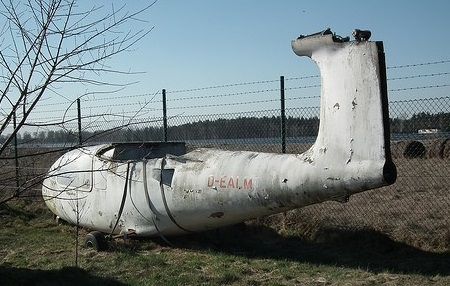
Had the center section built integrally with the fuselage.
Aircraft
Eshelman Chestonal Co
USA
Formed 1942. Made several experimental types, notably FW-5 (“The Wing”), having center section built integrally with the fuselage, and a low-wing monoplane in which a tubular steel spar formed the fuel tank. Latter type revived after the war as E.F.100 Winglet.
Escofet II
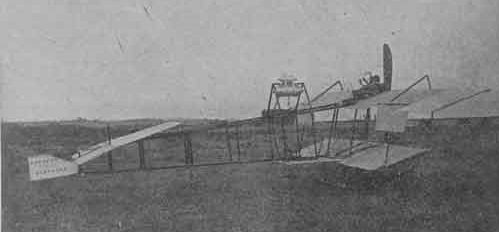
The Escofet II was built by the brothers Escofet; Rodolfo, Carlos, Julio and Armando in Uruguay, bankrolled and probably mostly designed by Enrique Martinez Velazco. It flew in August, 1910.
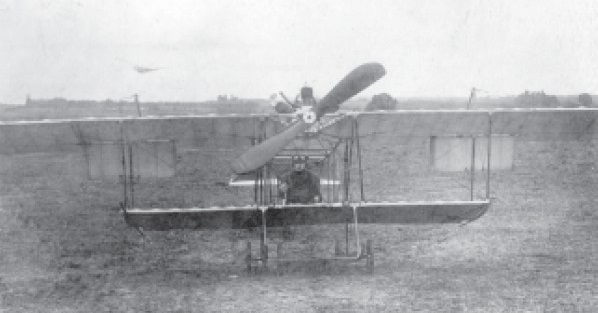
Span: 6.7 m
Length: 4.6 m
Ery 1911 monoplane
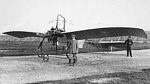
Designed and built by Ery in 1911.
Erospace Darling
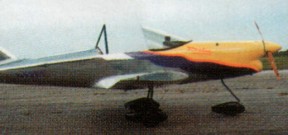
Features a laminer flow, rivetless wing.
Engine: Rotax 447, 40 hp
HP range: 40-100
Wing span: 20 ft
Wing area: 57 sq.ft
Height: 5.5 ft
Length: 16.5 ft
Top speed: 135 mph
Cruise: 125 mph
Stall: 50 mph
Range: 400 sm
Rate of climb: 1100 fpm
Takeoff dist: 520 ft
Landing dist: 400 ft
Service ceiling: 15000 ft
Fuel capacity: 12 USG
Empty weight: 325 lb
Gross weight: 620 lb
Seats: 1
Baggage capacity: 2.5 cu.ft / 20 lb
Landing gear: nose
Erla 5
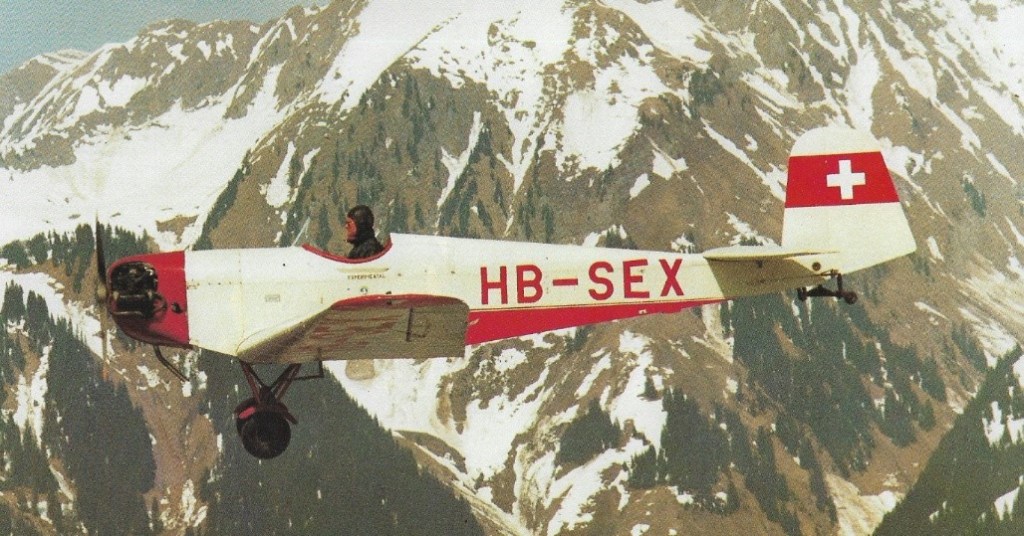
A single-seat monoplane with an engine of 20 hp.
ERLA-Maschinenwerk GmbH
Germany
Though established in 1934, the real beginnings were in 1933 as Nestler und Breitfeld of Erla. Type Erla 5 was a single-seat monoplane with an engine of 20 hp. From 1934 undertook quantity production of Arado Ar 65 and Ar 68, He 51 and Bf 109 (including early “C” sub-type from 1937, as well as numerous later variants). Also produced assemblies for other military types.
Ericson 1909 Biplane
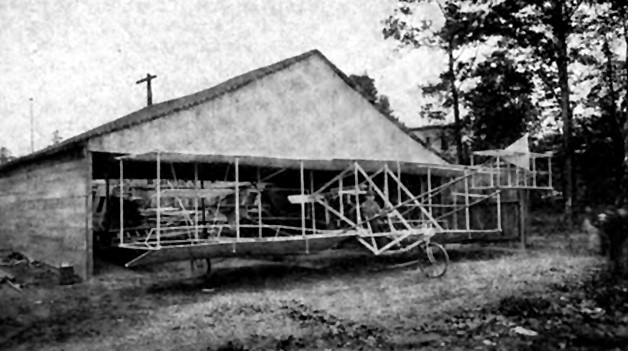
The first machine built by Louis G. Ericson, president of the Eureka Soap Company, Springfield, Massachusetts, USA, and member of the Springfield Aeronautical Club. It was a pusher biplane of Curtiss type with variable incidence lower wings with a span of 30″, a 4-cyinder. Knox 225 auto engine, removed from Ericson’s own Buick, and a total weight of 800-900 lbs. No flight was recorded. Ericson built three more machines. All crashed, and the last crash broke his hip and forced him to retire from aviation.
ERCO (Engineering Research Corp.)
USA
Established 1930, Henry Berliner was the founder of Berliner Aircraft Company, and founder of Engineering Research Corporation, Riverdale, Maryland- producer of the Ercoupe.
After making important components for other aircraft, designed and built the novel Ercoupe monoplane, developed from the original Weick “easy-to-fly” type and first flown in October 1937. Fred E. Weick was the company’s chief engineer. The type was notable for its control system, which eliminated rudder pedals, and was first marketed in 1940. Production ceased on U.S. entry into Second World War, when company was fully engaged in defense contracts. Difficulty of obtaining duralumin led to redesigned Ercoupe of composite construction in 1941. In August 1941 one was used to demonstrate benefits of jet-assisted take-off (JATO) compared with conventionally- powered aircraft. Two examples were bought by U.S. Army as experimental radio-controlled targets. After the war civil Ercoupe production was resumed.
Equator Aircraft Turbo Equator / Poeschel P.300 Equator
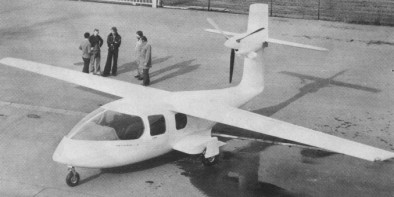
An eight place, high wing, fiberglass am¬phibious single with a 400 hp Allison 250 turbo¬prop mounted near the top of the vertical stabilizer. Intended to be amphibious, the main gear retracts into sponsons that stabilise the hull on water.