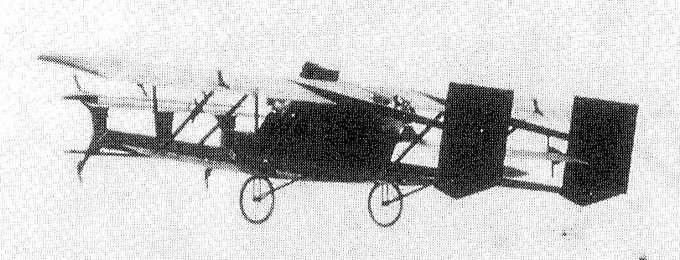
The one and only model of the Frabjous Corporation’s BiSkiLi.
The one and only model of the Frabjous Corporation’s BiSkiLi.
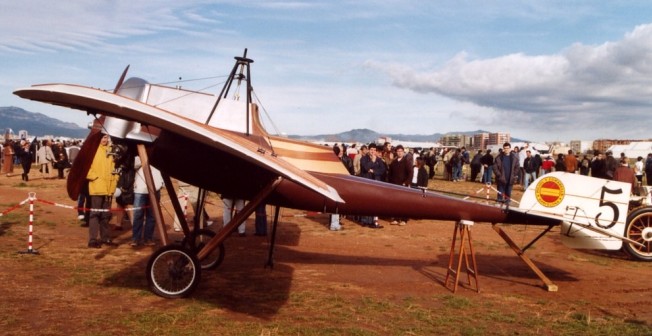
FPAC / Fundació Parc Aeronàutic de Catalunya

Australian designed and built, this is a microlight that will travel at 100 kts and stalls at 27kts using around 15ltr an hour. Equipped with electric trim, flaps, wing lights, and strobe light, the doors and fuel caps ae lockable.


100
200
Engine: Subaru EA81, 130 hp
Wing Span: 8.70m
Airfoil Section: Chris Mark 4
Length: 6.10m
Height: 2.30m
Gross Weight: 600 kg
Empty Weight: 340 kg
Fuel Capacity: 88 Litres
Baggage: 30 kg
Top Speed: 120 Kts
Cruise Speed: 100 Kts
Stall Speed: 38 Kts
VNE: 130 Kts
Rate of Climb: 1500 ft/min
Endurance: 6 hrs
Glide Ratio (engine idle): 12:1
Fuel Consumption: 15 ltr/hr
Take Off Distance: 100 m
Landing Distance: 100 m
Design Loads: +6G – 4G
Landing Gear Track: 2.12m
Seats: 2
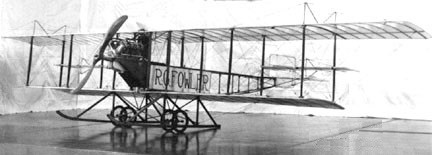
Four or five 1912 Fowler-Gage were built for exhibition pilots Robert Fowler (aka Fowler-Gage with 80hp Hall-Scott A-3, occasionally on floats), Roy Francis, Phil Parmalee, and J Clifford Turpin.
The design was carried forward to the twin-prop Patterson-Francis.
The Fowler-Gage was donated to Smithsonian in 1950 and restored for display by NASM in 1988.
Engine: 60-80hp Hall-Scott A-2/-3
Wingspan: (upper) 41’0″ to 42’8″
Wingspan: (lower) 30’0″
Speed: 60 mph
Seats: 1
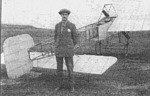
The 1910 Fournier monoplane was designed and built by Heraclio Alfaro Fournier in Spain.
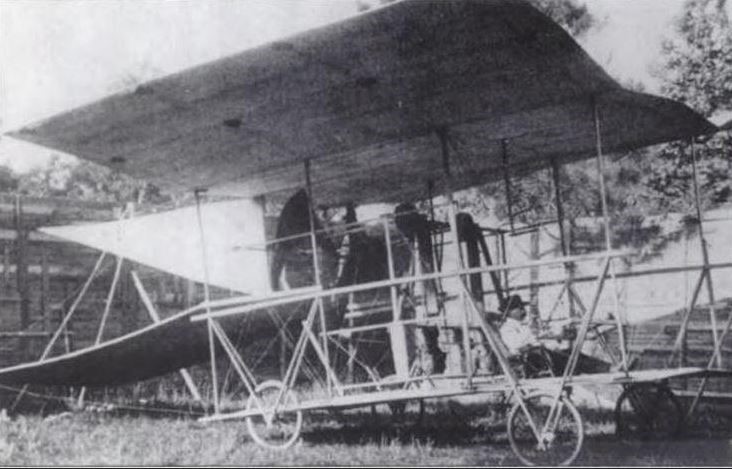
This aircraft was built by John Ellis Fowler, around 1902.
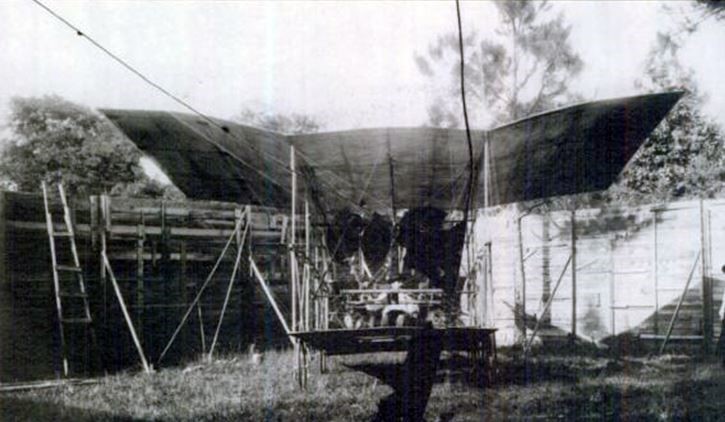
It was built and tested at Monroe Park, a baseball sportsground in Mobile, Alabama.
The RF-10 two-seat motor glider is a development of the RF-9 but primarily of glassfibre instead of wooden construction, as the latter is now considered too expensive in labour costs.
It has a wing built in four sections and incorporating some carbon-fibre componets, as well as folding capability for easier hangar storage. Engine is an 80hp Limbach L2000 or – for customers in the United States – an 80hpmRevmaster with turbocharger and dual ignition. Fuel capacity is increased over the RF-9’s to 8.8 Imp gallons, and the mainwheels are larger.
The prototype RF-10 first flew in the spring of 1981 and production was due to start by September.
One RF-10 had been ordered for a projected London-Australia record flight in 1982.
Span: 57ft 0 in
Length: 26 ft 0 in
Empty weight: 1,168 lb
Min sinking speed: 2.6 ft/sec at 50 mph
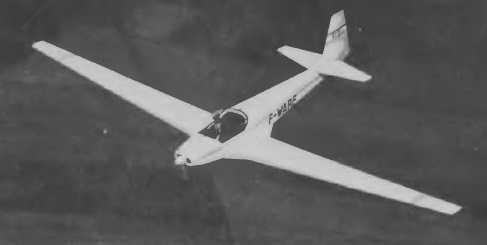
Designed by M Rene Fournier, the RF-9 is basically a side-by-side two-seater development of his earlier Avion-Planeur RF4D and RF5 which were manufactured in Germany under licence by Sportavia Pützer. Sportavia Pützer went bankrupt in 1977 not long after the first prototype RF-9 had made its maiden flight on 20 January that year, and while the first production aircraft was being built. The second prototype, which is representative of production aircraft, has a lighter undercarriage, new air brakes and trailing edge flaps.
The RF-9 motor glider is intended for training and is of conventional all-wood construction; the cantilever low wings have dihedral from the roots and on the prototype differ from the RF4D’s and RF5’s in having electrically-actuated trailing edge flaps as well as air brakes in the upper surfaces. The outer part of each wing can be folded inward for easier hangarage, and has connect/disconnect aileron controls. The semi-monocoque fuselage is broadly similar to the RF4D’s with a polyester skin, but it is cut down behind the one piece cockpit canopy, which opens upwards and rearwards and gives exceptional visibility. Full dual control is provided. The tail unit is similar to the RF4D’s, with a small dorsal fin. Instead of the monowheel and outriggers of the RF4D and RF5, the RF-9 has a conventional inwards-retracting under-carriage and a steerable tailwheel, also retractable.
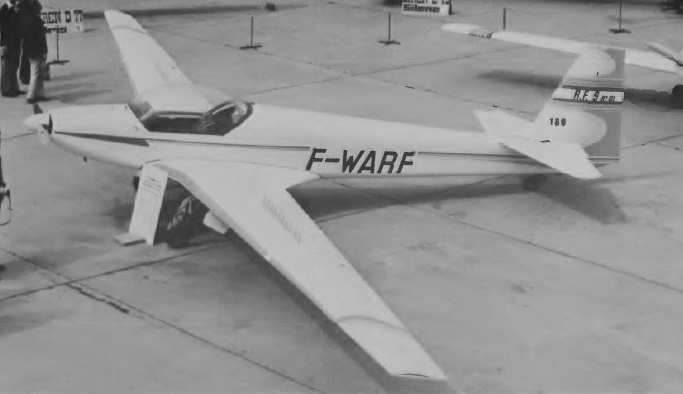
The engine is a 68hp Limbach SL 1700E ‘flat four’ driving a Hoffmann two-blade fixed-pitch propeller; a variable-pitch prop from the same manufacturer can be fitted if required, as can VHF radio and oxygen equipment. The fuel capacity is 6.6 Imp gallons.
Engine: Sportavia Limbach SL 1700E, 50 kW / 68 hp
Prop: Hoffmann two-blade variable-pitch
Span: 17.0 m / 55 ft 9.5 in
Length: 7.86 m / 25 ft 3 in
Height: 6 ft 0 in
Wing area: 18.0 sq.m / 193.75 sq ft
Wing section: NACA 643618
Aspect ratio: 16.0
Empty weight: 530 kg / 1,168 lb
Max weight: 750 kg / 1,653 lb
Fuel capacity: 30 litres / 6.6. Imp Gal
Water ballast: None
Max wing loading: 38.8 kg/sq.m / 7.59 lb/sq ft
Max speed SL: 119 mph / 102 kt / 190 km/h
Stalling speed: 35.5 kt / 65 km/h
Max cruising speed: 99 mph
Min sinking speed: 0.80 m/sec / 2.56 ft/sec at 50 mph / 43.5 kt / 80 km/h
Best glide ratio: 28:1 at 62 mph
Take-off run: 100 m / 328 ft
Range: 600 km / 324 miles
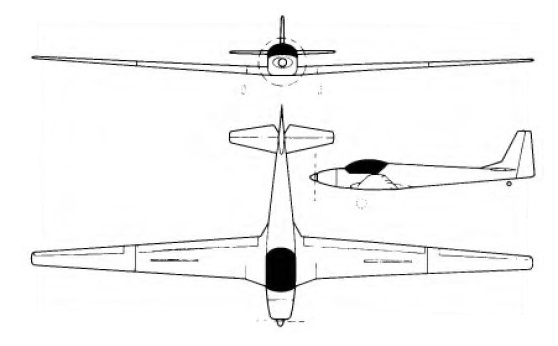
A later development of the RF4D was the Avion-Planeur RF7 which was very similar to it except for a wing span reduced to 30ft 10in, an increased tailplane span and a more powerful engine very similar to the RF5’s.
Construction of the prototype RF7 began in July 1969 and it first flew on 5 March 1970.
Powerplant is a 68hp Sportavia-Limbach SL 1700D dual ignition ‘flat four’ engine driving a Hoffman two-blade fixed pitch metal propeller of 4ft 9.75in diameter, and the RF7 has 8.4 Imp gallons of fuel, with a 5.5 Imp gallons auxiliary tank optional. Wing area is now 108sq ft and aspect ratio is 8.8; the maximum cruising speed at sea level is now 137mph.

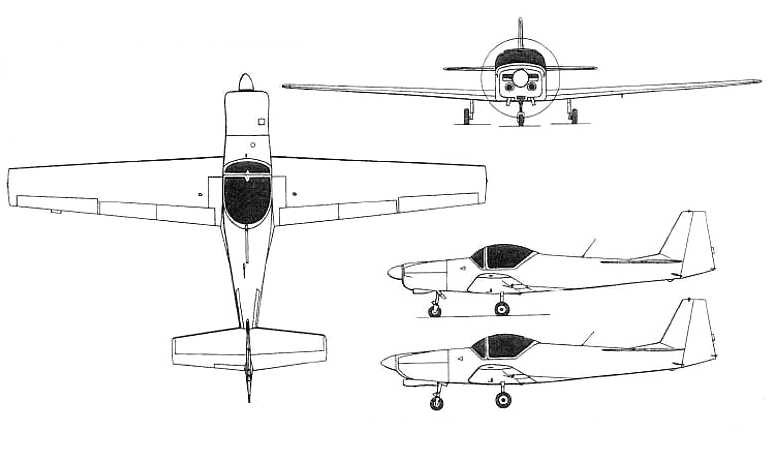
At the end of the 1960s, many touring four-seater were produced in Europe and Sportavia in West Germany believed the need for a three-four-seater. A prototype was ordered from René Fournier in 1969, with the prospect of financial support from the German federal government.
Significantly departing from the motor gliders designed by René Fournier, the new aircraft was a wooden monoplane with a low cantilever wing and fixed tricycle undercarriage, with a Continental O-200 engine of 100 hp. The hoped-for federal aid will not materialize.
A prototype (D-EHTD) was built anyway, with the first flight taking place in 1973, but it was too late to launch a new aircraft on the market.
In addition to the RF-6, the production of a two-seater side-by-side school RF-6B version was planned, René Fournier considering that it was possible to offer an alternative to the Cessna 150. Built in wood, with load factors allowing elementary aerobatics (+ 6G / -3G). The flight test for certification specifies that “the rate of climb is rather disappointing and that the sequences in aerobatics lead to a systematic loss of altitude”. The prototype took to the air in 1974 and 50 production units were built in France until 1980.
Fournier constructed a facto¬ry in a wood across the runway from his workshop and launched series production of the side by side, two seat aerobatic trainer, which has the very classic appearance and flying qualities typical of his work.
M. Fournier established subsequently Avions Fournier at Nitray, near Montlouis, to develop a revised version of his RF-6 Sportsman, designated RF-6B; first flown March 12, 1974. The prototype was powered by a 90-hp (67-kW) Rolls-Royce 0-200-E engine driving a fixed-pitch metal propeller, and certification was achieved in April 1975 as the RF-6B.
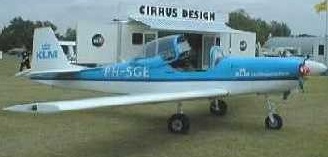
On 4 March 1976 the first of five pre-production aircraft flew for the first time, powered by a 100-hp (75-kW) Rolls-Royce Continental 0-200-A engine with a fixed-pitch wooden propeller, as adopted for all subsequent production examples.
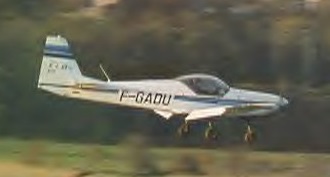
Certification of the 120 hp version of the RF 6B was obtained in France on 7 November 1980 and Vickers-Slingsby embarked on production of a batch of 10 under licence. The prototype was RF 6B number 44, the previous 43 powered by the 100 hp O-200-A engine.
Production ceased after 45 RF-6Bs had been built, the last of these being a development aircraft with a 118-hp (88-kW) AVCO Lycoming O-235 and production has been taken over by Slingsby Engineering in the UK, and the first British-built RF-6B was scheduled to fly in May 1981. A small batch of wooden aircraft was followed by a glass fibre version.
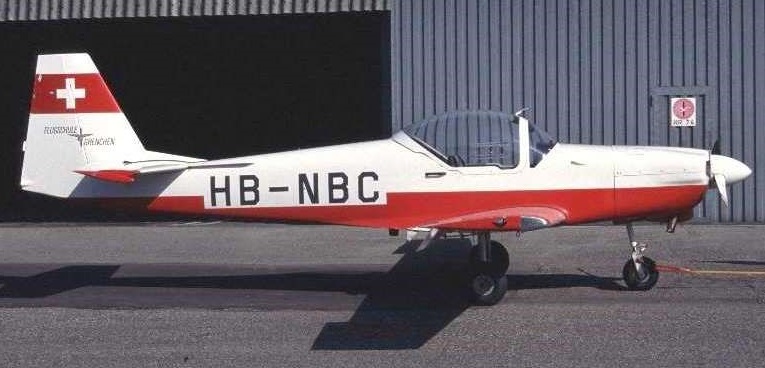
The rights were sold to Slingsby in Great Britain which produced a version in composite materials, the Slingsby T67 Firefly.
The RF-5C four-seater evolution of the RF-6, produced in 1973 by Fournier in collaboration with Manfred Schliwa at the request of Sportavia, who still believed they could place a European aircraft on the German market. Four RF-6C (c/n 6001/6004) were built by Sportavia before the Lycoming 125 hp engine was replaced by a 180 hp O-360. They had a fiberglass covering, bubble canopy and fixed tricycle gear. It is a conventional side by side design, cross country, trainer and fully aerobat¬ic, a 200 mph airplane.
The Sportavia RS-180 was the standard version of the RF-6C with a Lycoming 180 hp engine. Only 18 examples were built (c / n 6004/6022).
RF-6B
Engine: Rolls-Royce Continental 0-200-A, 100-hp (75-kW)
Span: 34 ft 5 ½ in (10.56 m)
Wing area: 139.9 sq ft (12.60 m²)
Length: 22 ft 11 ¾ in (7.19 m)
Height: 8 ft 3 in (2.37 m);
Empty weight: 1,102 lb (500 kg)
Maximum take-off 1,653 lb (750 kg)
Fuel capacity: 80 lt
Maximum speed: 124 mph (200 km/h) at sea level
Cruising speed: 112 mph (180 km/h) at 4000 m
VNE: 257 km / h
Stall: 74 km / h
ROC: 3.5 m / s
Range max fuel: 404 miles (650 km)
Take-off distance: 455 m
Landing roll: 415 m
Seats: 2