GAZ / Leningrad North Factory State Enterprise / GAZ No.3 Krasni Liotchik

Central building of the former GAZ No.3 aviation factory in Leningrad.

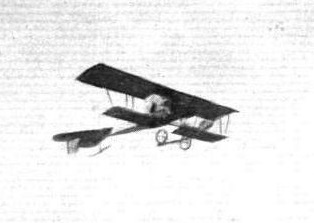
The V. A. Liebediev Aviation Factory Stock Company was created on the outskirts of Petersburg, near the village of Novaya Dirievnya and very close to the Komendantski airfield. Its origins are linked to the sportsman and aviation lover V. A. Liebediev. A law student at the University of Petersburg, he decided to abandon his studies and cycling to study aviation at the Farman School in Paris, France. Upon returning to Russia in 1909, he decided, together with his brother and Captain S. A. Ulyanin, to create the Petersburg Aviation Society (PTA), with the financial support of the businessman Lomach.

In 1914 Liebediev built several productive buildings next to the village of Novaya Dirievnya and very close to the Komendantski airfield, which formed the basis of the new aviation factory known as the “VA Liebediev Aviation Stock Company” and intended primarily for the construction of low-cost aviation models. license, although a short time later, models of their own design began to emerge, which carried the brand “Lievied” (Swan).

By 1917 Liebediev decided to increase production, but unfortunately his plot at the Komendantski airfield did not allow an increase, so he was forced to build new facilities in Taganrog, Penza and Yaroslavl.

By that time around the Komendantski airfield, several aviation factories had already sprung up with their assembly workshops and hangars. Among them the “Gamayún” factory of S. S. Schetinin, the Russian-Baltic Wagon Factory, the factories of Slysarienko, Porojóvchkov, Meltser, Zass, Lanski. By 1918, more than half of the country’s aeronautical technology factories were located around this aerodrome.

On March 13, 1918, by order of the newly created Soviet government, it was decided to close all the aeronautical factories in Petrograd, move the production of the “Ilya Muromets” bomber to the interior of the country and evacuate all the machinery and equipment from the city. This measure affected the small factories of Slyusarienko, Porojovschikov and Grigorovich, which were closed and their personnel and machinery transferred to other factories.

By the decree published on June 28, 1918, all aviation factories were nationalized and the Main Directorate of the Aeronautical Industry known as Glavnoavia was created for their direction. This organization, which began to function on January 1, 1919, was originally subordinated to the United Council of the Economy (VSNJ according to the acronym of Vsiesoyuzni Soviet Narodnovo Jozyaistva), but as of December 22, 1919 it was led by the Council of the Military Industry (SVP).

Created in Saint Petersburg in 1919 as GAZ No.3 “Krasni Liotchik”, on the basis of the nationalized Russian-Baltic Wagon Factory (RBVZ), Slyuzarienko Factory, Schetinin “Gamayún” Factory and V. A. Liebediev Factory. Between 1925 and 1927 it was the productive base of the OMOS directed by D. P. Grigorovich.

The first task of the new organization was to continue the development of hydrofoils for naval aviation. It was decided to develop new models on the basis of the successful Grigorovich / Schetinin M-9. In the “Gamayun” factory in Petrograd there were still several M-9s in different stages of construction, as well as parts and pieces of these models. Unfortunately on June 16, 1921 this factory caught fire, being practically destroyed. The little that was saved was sent to the RBVZ and the old factory in Lievediev.

After the restructuring of the economy and by Resolution of the SNJ SR of December 17, 1918, the aviation factories of Schetinin, Liebediev, Slyusarienko, Grigorovich, Meltser, Semionov, Russo-Baltic and Russian Renault were unified into a productive group under the Directorate of the Petrograd Aviation Factories Directorate (“Aviapravlenie”), subordinate to the SNJ Metal Section in the Northern Region. The balance report of this organization relating to the period between September 1918 and October 1919 defined:
“In January of this year the large factories of the Petrograd region were nationalized: Aeronautical Stock Company of SS Schetinin (“ Gamayún ”), Aeronautical Stock Company of VA Liebediev, aeronautics department of the Russian Wagon Factory -*Baltic. Small factories such as the Grigorovich Experiment Factory and the Porojovchikov Experiment Station were closed and their personnel and materials transferred to other factories in Petrograd. The plans were partly delivered to the “Gamayún” dedicated to naval airplanes and partly to Mosca, which builds the Porojóvchikov-4 training aircraft. The machine tools have been distributed among other factories. The factories of the Petrograd region have been unified in terms of management under Aviachast and Glavnoavia, being subordinate to the latter ”.

In April 1919 the “Aviaprablenie” was reorganized as the Directorate of the North Region and on December 22, 1919, in correspondence with Resolution No. 1171 of the Presidium of the VSNJ, Glavnoavia and its 10 companies were transferred to the jurisdiction of the Council of the Military Industry (SVP), known as Promsoviet, with the main objective of supplying the Red Army and the Fleet. The unified Petrograd factory was renamed the State Aviation Factory (GAZ) No.3 “Krasni Liotchik” (Red Pilot).

In 1920 the Directorate of the North Region became the First Unified State Aviation Factory and between 1921 and 1923 the Directorate of the First Central Unified Aviation Factory of the PSNJ in Petrograd.

In 1924, Factory No.3 was damaged by a flood, destroying several models and damaging the hangars and workshops. At the end of that year, D. P. Grigorovich arrived in Petrograd from Moscow, who engaged in work to recover this facility and here in 1925 he would organize the Experimental Department of Naval Construction (OMOS according to the acronym of Otdiel Morskovo Opytnovo Samoliotostroyenia).

OMOS brought together the best Soviet specialists in the construction of naval aviation and most of them some years later would end up becoming successful aeronautical constructors. In October 1925 as Grigorovich’s second was A. N. Sidielnikov; construction manager – V. L. Korvin; aerodynamic and resistance calculations – K. A. Vigand and V. N. Belyayev (for a short time), A. L. Guimmelfarb and Z. I. Zhurbin; builders – P. D. Samsonov and V. B. Shavrov; drawing bureau – N. G. Mijelson. The group numbered only a few dozen people.
The first major task of the GAZ No.3 was the preparation for the serial construction of the I-2 fighter and its development I-2bis. This model remained in production together with the U-1 and its version with MU-1 floats.

The OMOS would be responsible for the design and construction of a series of experimental models that accumulated failure after failure, so that at the end of November 1927 Grigorovich and his collective were transferred to Moscow, located at Factory No.22 in Fili, in a new structure subordinate to the TsKB, which received the designation OPO-3 (Opytni Otdiel – 3 or Experimental Department – 3).

Until the mid-1920s the facilities at the Komendantski airfield were used solely for aeronautical maintenance and repair.

As of February 1925, GAZ No.3 became subordinate to the State Trust of the Aeronautical Industry of the USSR VSNJ.

On October 1, 1927, aeronautical construction became subordinate to the NKAP. In this period all the factories (not only those of aviation), began to work in the closed (secret) military system and received a new name. The GAZ No.3 was renamed NKAP Factory No.23. With the beginning of the Great Patriotic War she was evacuated to Novosibirsk (a small part to Kazan). Only repair shops remained in Leningrad.

On September 22, 1944, in the facilities of repair bases No.1 and No.2 of the evacuated Factory No.23 a new aviation factory was created, which received number 272 from the NKAP.

This factory mass-produced various models of light and trainer aircraft, primarily designed by A. S. Yakovlev’s OKB. These models include the Yak-11, the Yak-12 multipurpose aircraft, the Yakovlev Yak-18 trainer and multifunctional aircraft, and the Yak-24 heavy twin-rotor helicopter.

After the end of the war, the Aviation Factory No.272 was established in its facilities, which at the end of the 1950s was reoriented to the production of anti-aircraft systems. From 1967 it was renamed the North Leningrad Factory.

From 1967 the factory was renamed the North Leningrad Factory.

In 1976 the factory became the North Leningrad Factory Productive Union.

Since the late 1970s the company began production of the advanced S-300 PMU multi-channel launch container missiles. In parallel and as part of the diversification of production towards the civil market established by the CPSU congress, the manufacture of some 20 lines of electrical appliances and household utensils was assumed.

As of November 1994, the factory changed its name again to the Leningrad North Factory State Enterprise.

In the company since 1994 began the introduction into production of the motorcycle “Pegas”. Currently the factory continues to produce a whole family of motorcycles with domestic and imported engines.
Gavilan 358

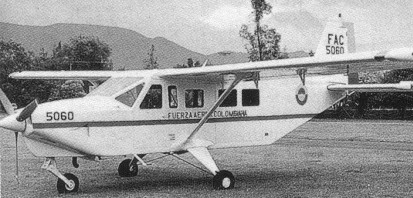
A 1998 addition to the Fuerza Aerea Colombiana (FAC) inventory was the indigenous Gavilan 358 eight seat light utility aircraft. Four were ordered by the FAC, the first of which was delivered on June 16 1998 after the type had achieved US FAA FAR Part 23, Amendment 46 type certification on May 26. Including these four, manufacturer El Gavilan SA had firm orders for 11 aircraft and was building an initial production batch of 12, which will include a number of the turboprop Model 508T, under development. A second production aircraft was delivered to TSS of Guatemala on June 17 and a third to Aeroexpreso of Bogota while the next export sale was due for delivery to Deobal of Argentina.

Gaunt No. 2 Baby

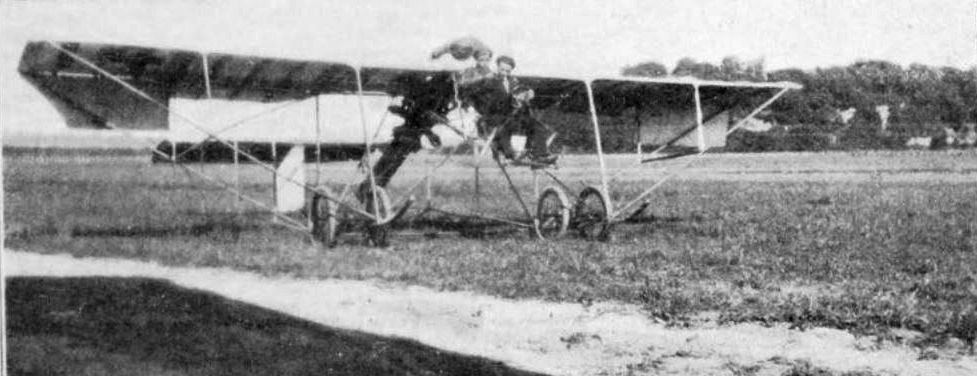
John Gaunt’s first biplane (1910) and his monoplane (1911) both crashed during attempts to get airborne, but biplane no.2 ‘Baby’ was much more successful. It had a lower wingspan which was somewhat less than that of the upper wingspan. The wings and interplane struts formed a single bay structure with additional pairs of interplane struts close to the fuselage in place of cabane struts, and an outward-leaning single strut on each side from the lower wingtip to the overhanging upper plane. The wings were unusual for the time, being covered not with fabric but thin plywood sheets. These were sewn together through eyelets inserted into them. Lateral control was provided by wing warping.

The fuselage was rectangular in cross-section and tapered towards the tail. A deep chord tailplane with highly swept leading edges and a pair of elevators with rounded trailing edges was mounted on top. At least part of the rudder projected below the fuselage. It was protected from the ground by a long tailskid, mounted well below the fuselage on a long post which also extended above the fuselage and appears, in a photograph, to have carried a small flag. The pilot’s open cockpit was positioned close to the trailing edge of the wing, which had a large cutout to improve visibility. The main undercarriage was built around a central skid, mounted on a pair of transverse V-struts to the fuselage. The two landing wheels were mounted on a split axle, attached to the skid.

The Baby was powered by a 30 hp (22 kW) Alvaston twin-cylinder, horizontally-opposed, water-cooled engine in the nose. It drove a two-blade propeller and was cooled by a pair of rectangular radiators, mounted longitudinally on the top edges of the fuselage, between the engine and the pilot, with their top edges attached to the lower surface of the upper wing.

John Gaunt flew his aircraft successfully for the first time on 12 June 1911 from his base on Southport sands in Lancashire, England. On 23 June, he covered a total of about seven miles, still flying mostly in straight lines. In the first week of July, he increased the distance covered, despite a member of the crowd he had attracted, who, unnoticed, bent one elevator out of shape and almost caused a crash. By 24 July, he had achieved flights of 30 minutes and reached an altitude of 300 ft (100 m). On 4 August, he made his first cautious turn but turns on windy days remained a problem into early September. That month, the Baby was flown successfully by another pilot, W.S Leveson-Gower, who posed no problems for the aircraft despite weighing 70 lb (32 kg) more than Gaunt.

It seems the aircraft flew again in the summer of 1912, but that a crash on 22 August ended its career.

Powerplant: 1 × Alvaston 2-cylinder horizontally opposed, water-cooled
Propeller: 2-blade Gaunt, 7 ft 0 in (2.13 m) diameter
Wing area: 208 sq ft (19.3 m2)
Empty weight: 600 lb (272 kg)
Maximum speed: 50 mph (80 km/h, 43 kn)
Stall speed: 35 mph (56 km/h, 30 kn)
Crew: one

Gatling 1873 Aeroplane

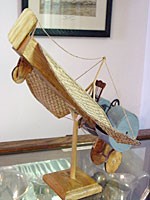
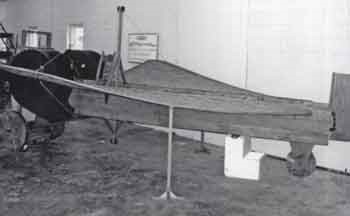
Designed and built in North Carolina by James Henry Gatling, the brother of Richard Jordan Gatling, the inventor of the infamous machine gun, the aeroplane, also called the “Turkey Buzzard”, is the first known man-powered aircraft built and flown in America. On a brisk Sunday afternoon in the fall of 1873, Gatling, sitting in the cockpit of his invention, with hands and arms furiously turning the cranks of his fan blowers, reportedly glided a little over 100 feet from a platform constructed approximately 12 feet above the ground.

Replica

Gates Lear 60 / Bombardier Learjet 60

The Learjet 60 was announced in October 1990 as the replacement for the Model 55C, from which it is derived. A proof of concept airframe flew for the first time on 18 October 1990 powered by one Garrett TFE331-3A and one PW305 engine. The first twin-PW305-powered Learjet 60 made its first flight from Mid-Continent Airport, Wichita, on 13 June 1991, and certification and early deliveries are targetted for the end of 1992. The Model 60 is the largest of the Learjet family and incorporates new fuel-efficient engines, a fuselage 0.07m wider and stretched by 1.43m, a ‘glass cockpit’, ‘steer by wire’ nosewheel, and an optional higher MTOW of 10478kg. Thrust reversers and single-point refuelling are also standard equipment, and the aircraft features a full galley, together with an aft toilet. By mid-1991, Learjet claimed to have sold the first full year’s production to customers in seven countries.

Gates Lear 60 Article

Bombardier Learjet 60 9H-AFJ

Engines: 2 x Pratt & Whitney Canada PW305 turbofans, 1995kg
Take-off weight: 10319 kg / 22750 lb
Wingspan: 13.34 m / 43 ft 9 in
Length: 17.88 m / 58 ft 8 in
Height: 4.47 m / 14 ft 8 in
Wing area: 24.57 sq.m / 264.47 sq ft
Max. speed: 858 km/h / 533 mph
Ceiling: 15545 m / 51000 ft
Range: 4441 km / 2760 miles

Gates Lear 56

Learjet’s Longhorn series combines a revolutionary wing design, two of the most advanced engines introduced to the market, and 51,000-foot performance. The line of five aircraft has been designated the Learjet 28 and Learjet 29, both powered by General Electric turbojets, and the Learjet 54/55/56, and those three are powered by twin Garrett AiResearch fanjets. All the models are designed with a larger wing incorporating near-vertical winglets that have replaced the traditional Learjet tiptanks. The wing’s increased aspect ratio and super-critical winglets provide substantial aerodynamic improvements that in turn produce greater fuel efficiency and improved flight performance at high and low altitudes. The wing also has been responsible for significantly improved short-field performance. The balanced field length is 3,520 feet for the 54/55/56 series.

Engines two 3,650-lb. s.t. Garrett AiResearch fanjets.
Gross wt. 20,000 lb
Empty wt. 10,257 lb
Fuel capacity 1,194 USG.
Top speed 550 mph.
Stall 100 mph.
Initial climb rate 4,700 fpm.
Ceiling 51,000 ft.
Range 3, nm.
Balanced field length 4,160 ft.
Seats 12

Gates Lear 55

At the 1977 Paris air show Gates Learjet announced details of its new Learjet 50 series. This was intended to comprise the Learjet 54, Learjet 55 and Learjet 56 with longer and larger cabins, all powered by twin Garrett AiResearch fanjets. The 55 was to have advanced wings incorporating NASA-developed winglets and this last feature gave rise to the name Longhorn.
The larger wing incorporating near-vertical winglets that have replaced the traditional Learjet tiptanks. The wing’s increased aspect ratio and super-critical winglets provide substantial aerodynamic improvements that in turn produce greater fuel efficiency and improved flight performance at high and low altitudes. The wing also has been responsible for significantly improved short-field performance. The balanced field length is 3,520 feet for the 54/55/56 series.
Only the Longhorn 55 has been developed, construction of the first airframe starting in April 1978 after successful testing of an aerodynamic prototype of the wing on a Learjet 25. The first of two Learjet 55 prototypes was flown initially on 19 April, 1979, and certification and delivery of the first production aircraft were recorded on 18 March 1981 and 30 April 1981 respectively.
The Model 55 followed the same overall configuration as earlier members of the Learjet family, and accommodated a crew of two on a separate flight deck and up to 10 passengers in the main cabin. In September 1986 the company announced the Model 55B, offering a new interior, ‘glass’ cockpit, improved take-off performance and increased range, all of which increased the aircraft’s operational flexibility. One year later, the Model 55C was revealed, fitted with rear underfuselage ‘Delta Fins’ giving improved directional stability at all speeds and reducing the landing speed, and thus removed the need for a stick puller/pusher.
Launched in 1987 was the Model 55C, which has a longer fuselage and deeper cabin than the 31. The engines were more powerful 3,700 lb st (16,46 kN) units and winglets and Delta-Fins were also standard.
Later versions are the 55C/ER extended-range version fitted with an extra tank holding 1175kg of fuel in the tailcone, and the Model 55C/LR giving even-longer-range through the installation of a further 322-litre fuel cell behind the standard fuselage tank. Typical configuration of this version is two crew and seven passengers. Around 150 Model 55 variants had been built by the end of 1990 and the version is to be superseded by the Learjet 60 during 1992.

LR-55 Learjet Longhorn 55
Engines: 2 x Garrett TFE 731-3A-2B, 3700 lbs thrust.
Seats: 12.
Length: 55.1 ft.
Height: 14.7 ft.
Wingspan: 43.8 ft.
Wing area: 265 sq.ft.
Wing aspect ratio: 7.2.
Maximum ramp weight: 20,750 lbs.
Maximum takeoff weight: 20,500 lbs.
Standard empty weight: 12,530 lbs.
Maximum useful load: 8220 lbs.
Zero-fuel weight: 15,000 lbs.
Maximum landing weight: 17,000 lbs.
Wing loading: 73.7 lbs/sq.ft.
Power loading: 2.6 lbs/lb.
Maximum usable fuel: 6682 lbs.
Best rate of climb: 4380 fpm.
Certificated ceiling: 51,000 ft.
Max pressurisation differential: 9.4 psi.
8000 ft cabin alt @: 51,000 ft.
Maximum single-engine rate of climb: 1250 fpm @ 200 kts.
Single-engine climb gradient: 379 ft/nm.
Maximum speed: 483 kts.
Normal cruise @ 41,000ft: 456 kts.
Fuel flow @ normal cruise: 1014 pph.
Stalling speed gear/flaps down: 103 kts.
Balanced field length 3,900 ft

Learjet 55C
Engines: 2 x Garrett TFE731-3A-2B turbofans, 1678kg
Max take-off weight: 9525 kg / 20999 lb
Empty weight: 5832 kg / 12857 lb
Wingspan: 13.35 m / 43 ft 10 in
Length: 16.80 m / 55 ft 1 in
Height: 4.48 m / 14 ft 8 in
Wing area: 24.57 sq.m / 264.47 sq ft
Max. speed: 884 km/h / 549 mph
Cruise speed: 744 km/h / 462 mph
Ceiling: 15545 m / 51000 ft

Gates Lear 54

Learjet’s Longhorn series combines a revolutionary wing design, two of the most advanced engines introduced to the market, and 51,000-foot performance. The line of five aircraft has been designated the Learjet 28 and Learjet 29, both powered by General Electric turbojets, and the Learjet 54/55/56, and those three are powered by twin Garrett AiResearch fanjets. All the models are designed with a larger wing incorporating near-vertical winglets that have replaced the traditional Learjet tiptanks. The wing’s increased aspect ratio and super-critical winglets provide substantial aerodynamic improvements that in turn produce greater fuel efficiency and improved flight performance at high and low altitudes. The wing also has been responsible for significantly improved short-field performance. The balanced field length for is 3,520 feet for the 54/55/56 series.

Engines: 2 x 3,650-lb. s.t. Garrett AiResearch fanjets
Gross wt: 10,216 lb
Fuel capacity: 825 USG.
Top speed: 550 mph
Stall 100 mph.
Initial climb rate 5,380 fpm.
Ceiling 51,000 ft.
Range 2,300nm.
Balanced field length: 3,520 ft.
Seats 12

Gates Lear 50

Gates Learjet Corporation reached a major milestone on 28 March 1980 when it delivered the 1,000th Learjet a Century III 35A. Learjets have now flown over one billion miles during more than 2.6 million flight/hr. The occasion was also marked by the roll out of the first production widebody Learjet Longhorn 50 series business jet.