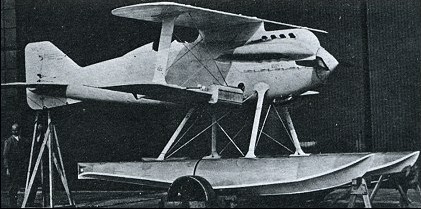
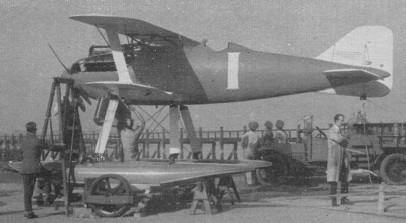
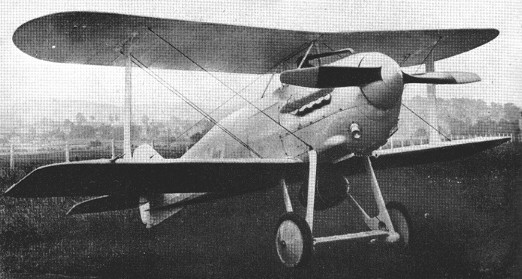
Built for 1925 Schneider Trophy races. The Gloster IIIA (High Speed Flight N-195) was the most successful of all the Gloster Schneider entries. It came 2nd in the 1925 race held in Baltimore, USA. The winner was Doolittle in the renowned Curtiss R3C-2. A second IIIA (N-194) was held in reserve for this race.
Engine: 1 x Napier Lion VII, 522kW Max take-off weight: 1343 kg / 2961 lb Empty weight: 1033 kg / 2277 lb Wingspan: 6.10 m / 20 ft 0 in Length: 8.18 m / 26 ft 10 in Height: 2.95 m / 9 ft 8 in Wing area: 14.12 sq.m / 151.99 sq ft Max. speed: 405 km/h / 252 mph
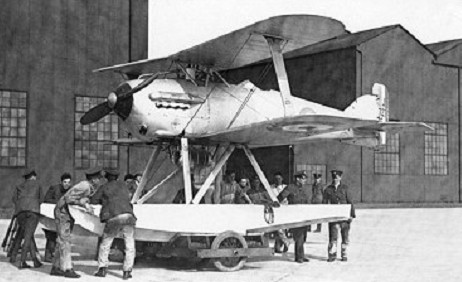
During early 1923 the Mars I was given extensively modified wings, had the fuel and water header tanks transferred within the fuselage to lose the view-limiting cabane structure, and had a more powerful Lion engine installed, being re-designated Gloster I. After winning the Aerial Derby of 1923, it was acquired by the RAF and with float landing gear, was used by the RAF’s High Speed Flight at Felixstowe for training purposes.
Engine: 1 x Napier Lion, 395kW Max take-off weight: 1202 kg / 2650 lb Empty weight: 894 kg / 1971 lb Wingspan: 6.10 m / 20 ft 0 in Length: 7.01 m / 22 ft 12 in Height: 2.84 m / 9 ft 4 in Wing area: 15.33 sq.m / 165.01 sq ft Max. speed: 354 km/h / 220 mph
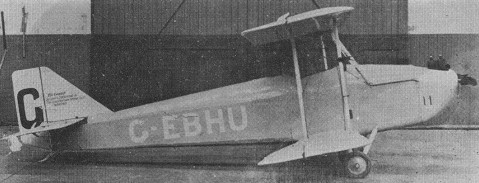
The Gloster G.14 Gannet, G EBHU, was registered on August 15, 1923 to the Gloucestershire Aircraft Co. Ltd. it was designed by H. P. Folland and built for the 1923 Lympne Trials, from which it retired when its 750cc Carden two stroke engine had cooling troubles. In 1924 it was re engined with a 698cc Blackburne Tomtit, with which it had a top speed of 72 m.p.h. Although its registration was cancelled on January 25, 1928, the Gannet was exhibited at the 1929 Aero Show at Olympia.
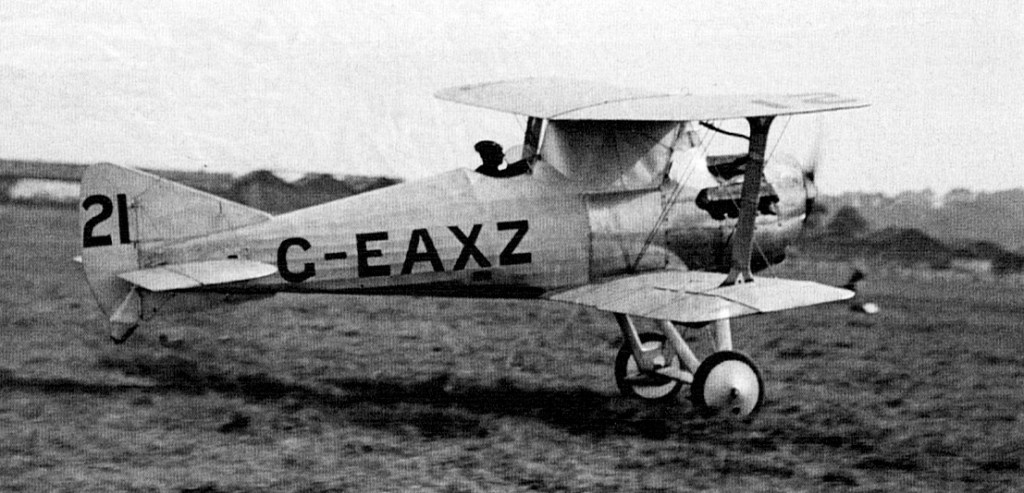
Britain’s Gloucestershire (Gloster) Company designed, built and flew the Mars 1 single seat racer in three weeks, as the prototype for a new fighter. It won the Aerial Derby in 1921, 1922 and 1923, and set up a British speed record of 196.6 mph.
Jimmy James, Gloster test pilot, taking off from Hendon at the start of the Aerial Derby on 16 July 1921. James won the Hendon-West Thurrock-Epping-Essex-Hertford-Hendon at 163 mph winning trophy and £600.
Designed by H. P. Folland, the Mars I or ‘Bamel’ was a single-seat racing biplane: the greater part of the fuselage, landing gear and tail unit being constructed from components similar to those used in the well-known Nieuport Nighthawk, which the company took over in 1920.
Engine: 1 x Napier Lion, 336kW Max. speed: 316 km/h / 196 mph
Formed in 1917 as the Gloucestershire Aircraft Company Ltd. to take over subcontract work from the Aircraft Manufacturing Company and H. H. Martyn & Co Ltd. of Cheltenham. D.H.4 and D.H.6 fuselages had been built by Martyn, and by the end of the war the company had supplied 461 Bristol Fighters and 165 RAF F.E.2bs, as well as Nieuport Nighthawks and other fuselages. Fifty Nighthawks, renamed Sparrowhawks, were built for Japan to a 1920 order, and were shortly followed by the first true Gloucester aircraft, the Bamel single-seat racing biplane, designed and built in less than four weeks. H. P. Folland, joined the company soon after the Bamel’s completion. A line of biplane fighters followed, the Grebe and Gamecock being notable successes, and in 1926 the company was renamed Gloster Aircraft Company Ltd. moving its main factory to Hucclecote, Gloucester. Up to 1930, all but one of their machines had been single-engined, the exception being the A.S.31, which was not originally a Gloster design but based on the de Havilland DH.67B.
Joining the Hawker Siddeley Group in 1934, Gloster continued fighter production with the Gauntlet and Gladiator, the latter being the RAF’s last biplane fighter. Henry Folland, Gloster’s chief designer, would leave Gloster when it was taken over by Hawker in 1937.
During the Second World War Gloster built 2,750 Hurricanes and 3,330 Typhoons, and produced Britain’s first jet aircraft to specification E.28/39, the first of two single-jet prototypes flying in 1941 and leading to the twin-jet Meteor of 1944. A total of 3,545 Meteors was produced by Gloster and Armstrong Whitworth. Gloster’s final production aircraft was the twin-jet delta-wing Javelin all-weather interceptor, flown in 1951, of which 435 were produced for the RAF. Gloster ceased aircraft production in 1956. Gloster, Armstrong Whitworth and Avro joined Hawker Siddeley Aviation in 1965.
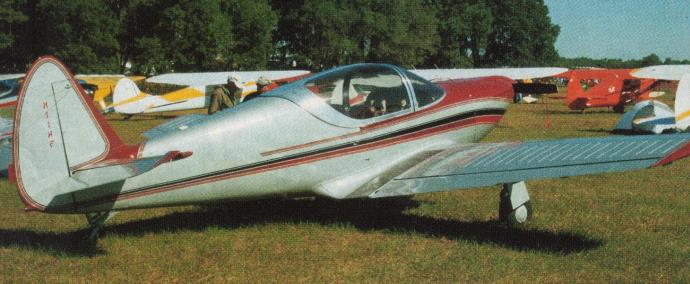
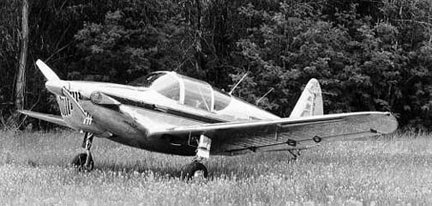
These all-metal side-by-side two seaters had retractable undercarriage and offered a ‘fighter-like” aircraft yet was powered by a small engine. Globe Swifts were priced at $2,995.
Texas Engineering & Manufacturing Co built 329 Globe Swifts under licence before Globe went bankrupt in August 1947, when it acquired rights in this aircraft. Temco priced the Swift at $3,250-3,750.
Temco GC-1B Swift
Including Globe production 1,093 were built from 1946 to 1951.
In 1989 Piper planned to produce the “sexy, spirited” SwiftFury, a 200 hp Lycoming powered 200 mph plus cruise update of the two seat Globe Swift designed in the late 1940s. Piper advised that some 350 SwiftFury orders have been placed with the 1989 price being US$118,900.00.
Formed originally as the Bennett Aircraft Corporation to manufacture aircraft from Duraloid, a new type of bonded plywood. Produced twin-engine eight-seat monoplane, the BTC-1, about 1940. Company reorganized and renamed Globe Aircraft Corporation in 1941. First design under new name was the GC-1 Swift, a two-seat light monoplane with retractable landing gear and Continental engine. Development stopped by war, but produced postwar from 1945. Company built also Beech 18s for U.S. Government during Second World War.
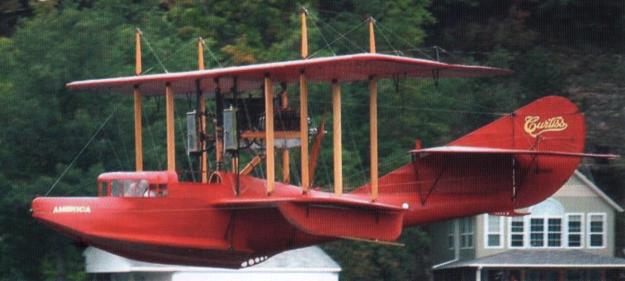
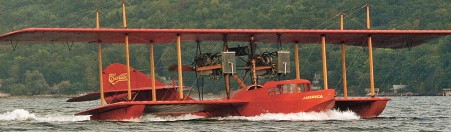
Construction of the replica Curtiss H-1 America began in the spring of 2004 and a total of 6000 man hours went into the construction at the Glenn H. Curtiss Musem at Hammondsport, New York. It has been built using the same materials as the originals with the exception of the glue and fabric covering. At Keuka Lake, New York, attempts were made to fly the replica but despite rigging changes and engine tuning it refused to fly.
The engines were then changed from the 90 hp OX-5 units to counter rotating OXX-6 of 100 hp. The aircraft then flew at Keuka Lake, New York on 13-14 September 2007, piloted by Jim Poel.
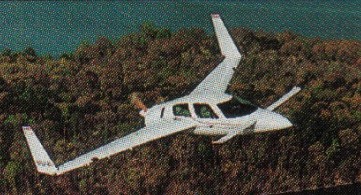
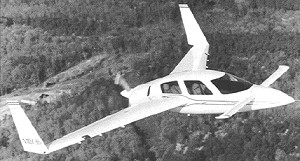
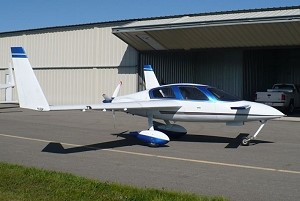
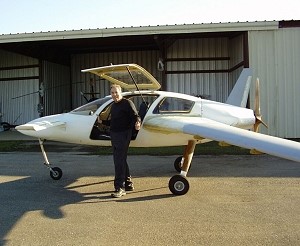
Initially referred to as the Speed Queen SQ2000, the SQ2000 was a new design following the lines of the Velocity etc., but with more rounded fuselage lines. The SQ2000 was designed by Stan Montgomery, and the prototype (which had the undercarriage of an Infinity) made its first flight in 1997 under the power of one 200hp Lycoming IO-360-C1A engine.
prototype N10736
The basic SQ2000 could be completed as a 2-seater with as very large baggage compartment or as a 4-seater.
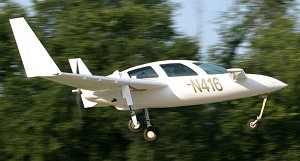
Paul Lee’s SQ2000 N416 fully retractable undercarriage
The SQ2000 features a cantilever mid-wing with tip rudders and a canard, a four-seat enclosed cabin accessed via doors, fixed or optionally retractable tricycle landing gear and a single engine in pusher configuration. The aircraft is made from composites. Its 26.58 ft (8.1 m) span wing has a wing area of 104.0 sq ft (9.66 m2). The cabin width is 48 in (120 cm). The acceptable power range is 160 to 260 hp (119 to 194 kW) and the standard engine used is the 200 hp (149 kW) Lycoming IO-360 powerplant.
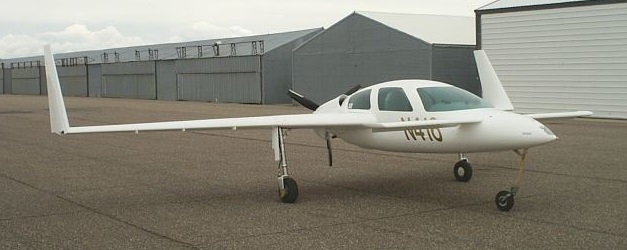
N440DH, David Hanson’s SQ2000, fixed main gear
Like many canard designs, the SQ2000 has lengthy runway requirements. The standard day, sea level take-off run is 1,600 ft (488 m), while the landing roll is 1,500 ft (457 m).
The SQ2000 lacks flaps and has a high landing speed. The overall cabin height of the SQ2000 has more headroom since the seats are mounted lower. The kit is more complete as it uses molded wings and canards.
Several examples had been completed and flown by 2005, including one by Mr. Paul Lee with one 200 hp Franklin 6A-350-C2 engine and one by Mr. David Kanson with one 200 hp Lycoming IO-360 engine.
SQ2000 aircraft were observed with Velocity style undercarriage (retracting into the fuselage) and with a KLS-developed undercarriage, which had straight undercarriage members retracting inwards into the wings.
Paul Lee’s N416 fully retractable undercarriage
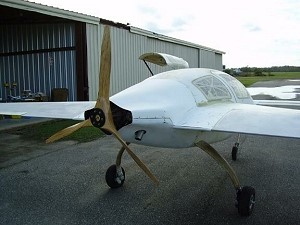
One particular SQ2000 was christened the Rotor-EZ by its builder, Paul Conner, who fitted one Mazda 13B rotary engine instead of the typical Lycoming, and a one-piece wooden propeller.
Paul Conner’s Rotor-EZ during construction
The aircraft made its first flight on 11 December 2004, but was lost in a fatal accident in May of the following year.
Rotor-EZ
Conner Rotor-EZ
Several models were planned for amateur construction and available from Glassic Composites, LLC, which planned various models: the SQ2000 XP, similar to the SQ2000, but with lower empty weight and suited for 150-200hp engines such as one Lycoming O-320 or Lycoming O-360 series (one example seems to have been built but probably not completed); the SQ2001, a three-seater with a passenger in the rear of the cabin; and the SQ2002, a so called 2+2 version with children’s seats. Yet none of these variants was built, and when
The SQ2000 was available with fixed or retractable undercarriage. The basic structures are moulded with spars. The SQ2000 first flew in 1993. The kit price in 1997 was US$22,000 for the SQ2000, and US$34,900 for the SQ2000 XP.
Less than a dozen aircraft were either completed or in construction in 12 years, and only eight on the US civil register. One reason probably lies in Glassic’s lack of credentials and the subsequent takeovers of the company’s assets.
Known completions are; SQ2000 N10736 (prototype), N416, N330DW, N2396M, N2366R, N206SQ, and N440DH. SQ2000 XP N971CL and the Rotor-EZ N2992P.
Glassic Composites ceased its activities and as of 1999, and was taken over by KLS Composites, a company formed by SQ2000 builders Messrs. Keith Register and Stan Montgomery.
Wing area: 104.2 sq.ft MTOW: 2250 lb Empty wt: 1100-1250 lb Useful load: 1000 lb Payload w/full fuel: 748 lb Max wing load: 21.0 lb/sq.ft Pwr load: 11.0 lb/hp Cabin length: 83 in Cabin width front: 47 in Cabin width rear: 42 in Cabin head room: 41 in
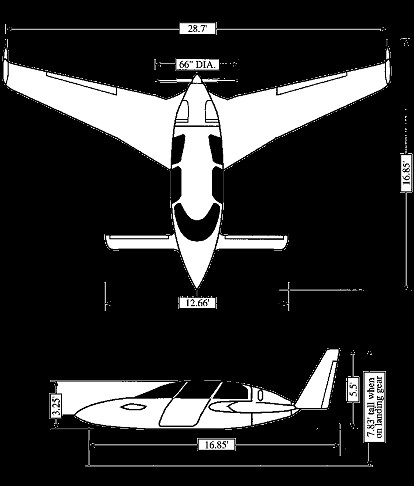
Prototype Engine: 1 x 200 hp Lycoming IO-360-C1A Wingspan:27.8 ft. Length: 16.85 ft. Height: 7.83 ft Maximum speed: 258 mph Cruise speed: 225 mph ROC: 2,.200 ft./minute Ceiling: 25,000 ft. Range: 800 miles
SQ2000 Top speed: 250 mph Cruise: 230 mph Stall: 67 mph Range: 900 sm Rate of climb: 2200 fpm Takeoff dist: 1700 ft Landing dist: 1700 ft Service ceiling: 25,000 ft Engine: Lycoming IO-360, 200 hp HP range: 150-250 Fuel capacity: 42 USG Empty weight: 1200 lb Gross weight: 2250 lb Height: 7.8 ft Length: 17.5 ft Wing span: 28.7 ft Wing area: 104 sq.ft Seats: 4 Landing gear: retractable nose
SQ2000 XP Top speed: 270 mph Cruise: 235 mph Range: 1035 sm Rate of climb: 2200 fpm Takeoff dist: 1500 ft Landing dist: 1500 ft Engine: Lycoming IO-360C-1C, 200 hp HP range: 150-200 Fuel capacity: 52 USG Empty weight: 1100 lb Gross weight: 2100 lb Height: 7.8 ft Length: 17.4 ft Wing span: 28.6 ft Wing area: 104 sq.ft Seats: 4 Landing gear: retractable nose or retractable tail
SQ2000 XP Powerplant: 1 × Lycoming O-360, 200 hp (150 kW) Wingspan: 26 ft 7 in (8.10 m) Wing area: 104.00 sq ft (9.662 m2) Length: 17 ft 6 in (5.33 m) Empty weight: 1,200 lb (544 kg) Gross weight: 2,250 lb (1,021 kg) Fuel capacity: 42 U.S. gallons (160 L; 35 imp gal) Maximum speed: 260 mph (420 km/h, 230 kn) Cruise speed: 230 mph (370 km/h, 200 kn) Range: 851 mi (1,370 km, 739 nmi) Service ceiling: 25,000 ft (7,600 m) Rate of climb: 2,200 ft/min (11 m/s) Wing loading: 21.6 lb/sq ft (105 kg/m2) Crew: one Capacity: three passengers
Paul Lee’s N416 (The following are at 1850 lbs. & 117 CG) Empty weight : 1410 lbs. (1394 lbs. without 9 qt. oil) Engine : Franklin 6A-350-C2, 200 hp Propeller : 66″ 3 blade, IVO magnum in-flight adjustable Fuel Capacity : 35 gal. (includes 2.25 gal. in supplementary tank) Landing gear: all-three wheels retractable Climb: 2000 ft./min (105kts, 2000 dens alt.) Ceiling: 18,000+ ft. (still doing 200+ ft./min) Best glide ratio : @ 19:1 (105 kts., 3000 dens alt.) Fuel efficiency : best about 5 gal. per hour near 120 kts. Canard stall : 66 kts. Takeoff distance : @ 1500 ft., rotate at 80 kts. (IVO electric adjustable prop.) Landing rollout distance: approx 2000ft Speed: 180 kias (3000 dens alt., 2800 rpm) Crew/passengers: 2-4