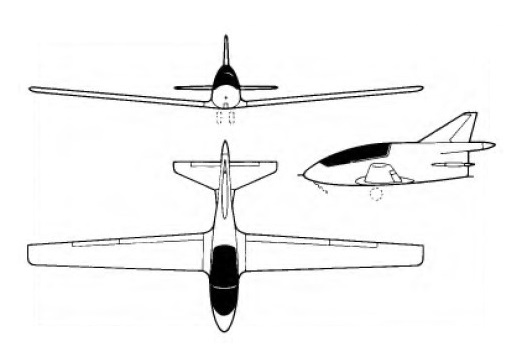
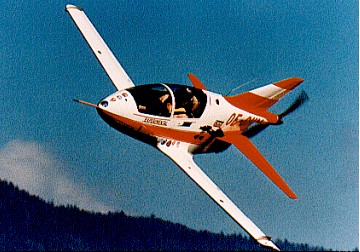
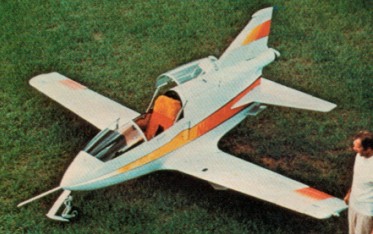
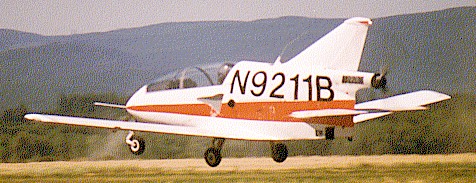
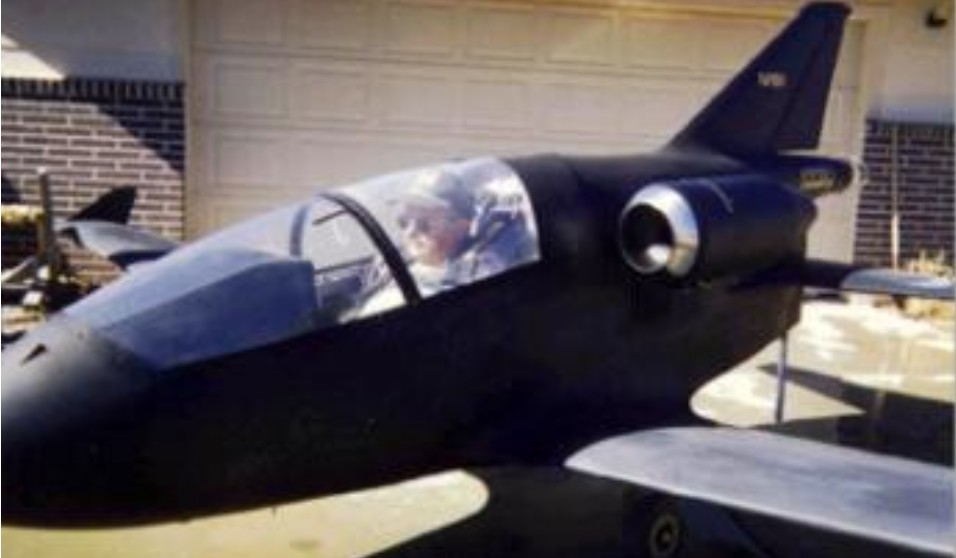
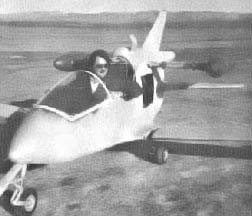
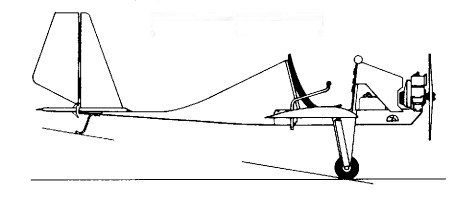
Essentially a single-seat version of the BD-4, it incorporates the same ease of construction aimed at the novice builder while utilizing the same German-made Hirth engine originally used in the BD-5. This high-wing, all-metal ship seats one person in an en¬closed cockpit and stands on tricycle gear of the non-retractable type.
BD-4 Aircraft BD-6 Engine: Hirth, 60 hp HP range: 40-90 Speed max: 165 mph. Cruise: 148 mph Range: 650 sm. Stall: 51 mph. ROC: 1500 fpm Take-off dist: 700 ft Landing dist: 100 ft. Service ceiling: 21,000 ft Fuel cap: 20 USG Weight empty: 410 lbs. Gross: 675 lb Height: 6.2 ft Length: 15.6 ft. Wing span: 21.5 ft Wing area: 64 sq.ft Seats: 1. Landing gear: nose or tail wheel.
Bede Corp LLC BD-6 Engine: HKS 700E, 60 hp HP range: 50-80 Cruise: 140 mph Range: 980 sm. Stall: 51 mph. ROC: 1200 fpm Take-off dist: 450 ft Landing dist: 500 ft. Fuel cap: 20 USG Weight empty: 570 lbs. Gross: 800 lb Length: 19.3 ft. Wing span: 21.5 ft Wing area: 56 sq.ft Seats: 1. Cockpit width: 24 in Landing gear: nose or tail wheel.
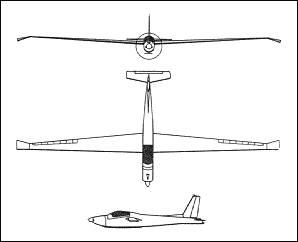
The BD-5S is the sailplane version of the Bede BD-5 Micro single-seat light aircraft, and this engineless version made its first flight in 1975. It differs principally in having a wing span increased by 10ft 5in / 3.17 m, a revised cockpit layout and a redesigned undercarriage in which the backwards-retracting nosewheel of the BD-5 and BD-5J is replaced by a similarly retracting nose skid and the outwards retracting mainwheels are replaced by a pair of side by side twin mainwheels retracting into the fuselage. The main gear door opens forward and can also be used as an air brake. The rear-engined BD-5’s low-set tailplane and rear fuselage shape, with its fairing housing the propeller shaft (in the BD-5) or jet exhaust (in the jet-powered BD-5J), is retained.
The BD-5S, like the powered BD-5 variants, is designed to be suitable for amateur construction from plans and kits. Construction is all-metal and the low wings are attached to the fuselage simply by sliding the tubular spar on to the wing root section and securing it on each side by two bolts. The ailerons are conventional and the flaps extend almost the full trailing edge span and can be lowered through four positions to a maximum of 60°. The pilot is seated under a large detachable framed canopy. A feature is the side-mounted control stick.
BD-5S Span: 27 ft l0 in / 8.48 m Length: 13 ft 6.75 in / 4.13 m Wing area: 60 sq.ft / 5.57 sq.m Aspect ratio: 12.88 Wing section NACA 641212 Empty weight: 225 lb / 102 kg Max weight: 425 lb / 193 kg Max wing loading: 7.09 lb/sq ft / 34.65 kg/sq.m Min sinking speed: 0.95 m/sec / 3.12 ft/sec at 30 mph Max diving speed: 174 kt / 322 km/h) Stalling speed: 34 kt / 63 km/h Best glide ratio: 23:1 Water ballast: None
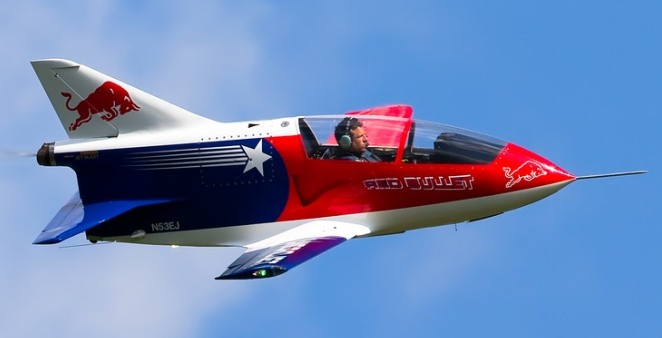
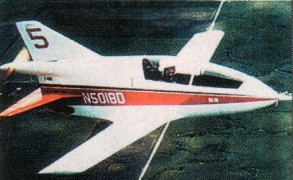
The BD-5 is a high performance single-place, low-wing, pusher-configuration sport plane. Design features include all-metal construction, mechanical retractable landing gear among the industry finest, detachable wings, and wrist action side stick control as in modern day fighter aircraft. Originally developed in the early 1970’s the aircraft was designed to day VFR requirements for use in sport and recreational flying, including limited aerobatic capability. Originally it was powered by a 40-hp Hirth snowmobile engine and was fitted with a wingspan of 14 feet. More recently the wingspan was stretched to 17 feet and the more powerful Xenoah three-cylinder two-stroke engine was installed. The pilot is seated under a transport canopy forward of the engine in a heated cockpit. The landing gear is fully retractable, and the entire fuselage/wing structure is constructed of light alloy materials.
Oshkosh 1973 was the year the BD.5 appeared and it provided a spectacular show in the hands of Les Bervan, Bede’s test pilot. It performed both in long and short winged versions and with a retracting gear. The jet powered BD-5J also made its first public appearance.
BD-5J
The BD 5J was powered by a 100 kg (202 lb) thrust Microturbo jet engine, spans 5.18 m (17 ft), and is fully aerobatic. After the collapse of Bede, the BD-5 became available as modified conversions such as the Alturair BD-5. BD-Micro Technologies, in late 1995, offered enhanced BD-5 kits. Enhanced BD-5 Kits are designed to be assembled in the shortest time with the least hassle. Components (Wings, Flaps, Ailerons, Vertical Stabilizer, Horizontal Stabilator, Rudder, Fuselage, Landing Gear, and Nose Gear Box) come predrilled on factory jigs. Machined, welded, and difficult to form parts are supplied. The .032” thickness wing skins with modified leading edge improves stall and slow flight control.
Flightline BD-5T Turboprop
The BD-5T Turboprop kit features everything except paint & avionics. With the standard components (Wings, Flaps, Ailerons, Vertical Stabilizer, Horizontal Stabilizers, Rudder, Fuselage and Landing Gear) pre-drilled on factory jigs, and machined, welded, and difficult to form parts are supplied. The BD-5T features a fuselage superstretch of 13.4 in and supplementary wingspar system, detachable wings and control system (20 minutes for assembly or removal), and detachable horizontal stabilizer. Power is from a Quantum H-95 turboshaft engine and Quantum III Propeller. The propeller is developed specifically for turbine engines, weighs 11 lbs including hub and 3 blades. The Quantum turboprop powerplant system (engine & propeller) was designed for the BD-5T. It is a constant speed, torque variable turboshaft engine based on Solar T-62 series components. Flightline Series® BD-5B kit features a complete airframe package- less engine, engine systems, paint & avionics. With the standard Wings, Flaps, Ailerons, Vertical Stabilizer, Horizontal Stabilizers, Rudder, Fuselage and Landing Gear) pre-drilled on factory jigs, and machined, welded, and difficult to form parts supplied, construction time is around 900-1000 hours. Assembled quickly and easily with common skills. Engines can be in the Hirth 2706, Xenoah range.
In 1992, Ed (“Skeeter”) and Richard Karnes started BD Micro Technologies Inc. (BMT), beginning a long journey to update the BD-5 with modern technology while using current building techniques. After many years of research and development, BMT has successfully incorporated many improved design features in an aircraft lineup called the “Flight Line Series” or “FLS” kits.
FLS safety advances include improved stall characteristics, increased pitch stability, reduced airframe fatigue, and modern technology integration focused on increasing systems reliability while reducing pilot workload. Lewis, who formed Lewis & Clark Performance LLC, collaborated with BMT to build the first complete FLS Microjet.
The Flightline Series BD-5J Microjet airframe kit features a complete airframe package requiring 600 to 800 hour construction time. Components (Wings, Flaps, Ailerons, Vertical Stabilizer, Horizontal Stabilizers, Rudder, Fuselage and Landing Gear) are pre-drilled on factory jigs and the fuselage preassembled to “On the Gear” stage. Machined, welded, and difficult to form parts are supplied. Parts are manufactured to aircraft industry standards. The Flightline Series BD-5J Microjet has FLS turbine structural airframe enhancements and a fuselage stretch, 5.2 in. (optional 13.5 in superstretch). The BD-5J has fuel quick disconnects, NACA jet engine intake scoops, Super Spar (supplementary wing spar system), Microjet disc brakes, a Hartwell canopy latch system, and a 5-point safety harness system. With adjustable seating and side stick control, the retractable landing gear cycles in one second. Detachable wings and control system takes 20 minutes for assembly or removal. The horizontal stabilizer is also detachable. The engine is also equipped with an attenuator designed to cut thrust.
BD-5J
Alturair produced a modification of the standard Bede BD-5 to accept an alternative engine.
William ‘Wild Bill’ Brooks Cornville (Arizona) BD-5J Trijet
Bill Brooks flew a BD-5B with a Solar T62, then modified it with 3 HJFS-100 55 Kp units (pod 2 and 1 in the fuselage) and a canard in the front. It is more than probable that he never flew in this configuration.
It was bought by Dave Dearing in 2004 who changed it to standard 5J (the wing is still that of a 5B). Engine side, Dave acquired a Christmas Penny NPT301.
EMG G8-2-130 powered BD-5
Leolan McRorey was the first owner of BD-5 to have equipped it with two Gluhareff EMG G8-2-130 pulse jets. These jets are mounted on a steel rod to each side of the rear fuselage. This configuration was chosen to create a separation between the motors and to avoid the propagation of sound waves.
The small size of the BD-5 managed to board 50 liters of propane in two tanks, a 20 and 30 liter.
Instead of installing a dual throttle, he decided to change the position of the two engines, close to the fuselage.
The BD-4 is a two/four seat utility aircraft designed by Jim Bede to be built by homebuilders with simple shop tools and no previous experience. The BD-4 was first introduced in 1968. Only the wings are constructed of fiberglass. Each wing panel is built around 24 glass fibre “panel ribs”, which are slid over a 6½” diameter extruded aluminium spar to which they are secured by epoxy resin and tube clamps. Each wing then slides for 12 inches over a smaller centre section tube. The fueselage is an all metal structure of bolted together design made of 2024-T3 formed angles. The skins are “Pop” riveted or bonded to the primary structure. The all metal empennage consists of a swept fin and rudder and an all moving tailplane. The main undercarriage legs are formed from 2024-T3 aluminium plate which rotates on a pivot point in the fuselage, shock absorption being rubber in compression. The nose wheel is non-steerable. Fuel is carried in the panel ribs, the normal capacity is 24 Imperial gallons in each wing. Engines from 108 to 200 h.p. have been fitted, giving up to 190 mph If built with a fuselage extension it’s a true 4-seater. Fuel tanks can be up to 80 USG (or even more). The BD-4B is a kit-built high-wing 2- or 4-place all metal cruiser that the builder can configure for either tricycle or tailwheel landing gear. The 2-place, 1550 lb. gross weight BD-4B is stressed for 9 Gs positive and negative. Designed for a range of Lycoming aircraft engines, specially designed parts and plans were available from BedeCorp, or some parts and materials could be purchased out of stock from aviation suppliers. Specified materials are stock items and sizes widely available in the US and Canada, and many other countries. Specially designed parts are limited, including the aluminum honeycomb-construction ribs and the tubular spar for the new all-metal wings. Although the BD-4B meets or exceeds the structural requirements for certified aircraft as specified in FAR – Part 23, it is not certified, and is intended for construction and operation only as an amateur-built airplane. The all-metal wings of the BD-4B with 0.50 inch metal honeycomb panels used to fabricate the ribs, which are bonded to the tubular spar with the same adhesive used in US military fighters, and then the metal skin is bonded to the edges of the ribs and rear spar. This design results in a “wet” wing, with lower drag than the original. The new wing is available in kit form from BedeCorp, or you can build it yourself with detailed instructions. The BD-4B has a bolt-together frame. This drastically cuts the need for welding, although some aircraft parts still require a skilled welder. The BD-4C is derived from the popular BD-4B. On the surface the changes look small, however, the effect is more than substantial. The cabin is 4 inches wider. This provides for more comfort in the cabin. The section after the cabin has been stretched 14 inches. This provides more space for the rear seats in both leg and hip room. The all-metal wings of the BD-4C is available in kit form from BedeCorp. The vertical and horizontal tails come bonded and ready to go at no extra charge. The BD-4C also meets or exceeds the structural requirements for certified aircraft as specified in FAR – Part 23, it is not certified, and is intended for construction and operation only as an amateur-built airplane. The BD-4C fuselage is an all-metal internally stressed design, with bonded .016 and .020 aluminum skin, blind-riveted load-carrying components. The wings are all-metal “wet” cantilever high wings with a 64-415 modified airfoil. The bonded wing skin is rivet-free except for the trailing edge spar. Ribs are one-half inch aluminum honeycomb. Flap deflection is 10, 20, and 30-degrees. Flaps and ailerons are designed to be interchangeable and are torque-tube controlled. Ready-to-mount 6.5-inch O.D. tubular main wing spars of 6061-T6 aluminum are sleeved for fast assembly to the fuselage spar. The three-piece spar assembles quickly, is light and strong and permits foldable wing option. The horizontal stabilator is an all-flying design with 2.5-inch OD 2024-T3 center spar, 63 009 airfoil. 36-inch chord, 88-inch span, and light aluminum honeycomb ribs. The preassembled fin, rudder and stabilator are bonded to ribs, and load-carrying components are blind-riveted The BD-4C can be built in either tricycle gear or tail-wheel configuration. Standard fuel capacity is 48 US gallons, using wing tanks in six between-the-ribs wing bays. However, it is possible to expand fuel capacity using as many as ten bays in 160-HP and-up configurations, giving the plane a nine-hour cruising range with a restricted cabin weight envelope.
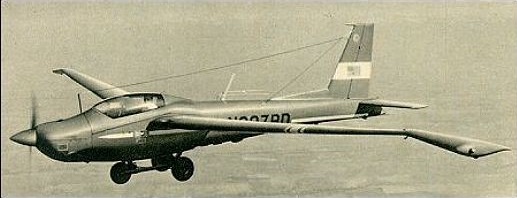
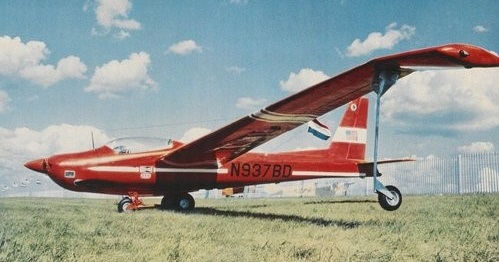
The BD-2 was a specially built airplane to demonstrate and establish world distance records. It was developed by modifying a Schweizer 2-32. The wings were completely sealed to hold a large quantity of fuel. The wing tips were developed and two main fuselage tanks permitted a total fuel capacity of 565 gallons. The fuselage was designed to house a 210 hp Continental IO 360 engine.
Through the plane’s development, Jim Bede learned that if the BD-2 had enough range to fly around the world, the aircraft would only be required to carry 2.5 pounds of fuel for every pound of dry weight.
The BD-2 wingtips were an innovative idea of an extended, reverse tapered wingtip. Designed in both function and shape, the wingtips allowed the BD-2 to improved everything from the efficiency of its flight characteristics, range of the aircraft, and overall wing strength.
The BD-2 used a tricycle landing gear assembly that could be dropped once the aircraft was sufficiently airborne in order to reduce weight, and would land using a wooden skin fixed under the cockpit, and the engine shut off and propeller feathered. The aircraft included a 25 lt liquid oxygen container that provided 5 days-worth of breathable oxygen, radios, and a Bendix autopilot system. Jim Bede made the first and all flights of the BD-2 including two long-distance test flights.
The first flight lasted 31 hours and went from Wichita, Kansas to Baltimore, Maryland to Jacksonville, Florida to Miami, then across the Gulf of Mexico to Corpus Christi, Texas, and finally back to Wichita. The second test flight, which lasted 33 hours, started in Cleveland, Ohio and went to Wichita, Kansas, then off to Minneapolis, Minnesota to Green Bay, Wisconsin; across Lake Michigan to Toledo, Ohio; to both Buffalo and Elmira, New York and finally, returned to Cleveland, Ohio during the Labor Day air show at Cleveland’s Burke Lakefront Airport. On November 7, 1969, Bede took off from Port Columbus Airport in Ohio in an attempt to set a new closed course record, which is measured based on the total distance of completed laps. He departed at 8:58am Friday to fly to Kansas City, Missouri and back. After completing nine complete laps, at 3am Monday morning the BD-2 lost all electrical power, but was able to make one last radio message to Indianapolis Control Center. He was able to alert operations at Columbus Airport and his flight surgeon Dr. Charles Billings. Three others rendezvoused mid-air with Jim and guided him safely back to the Toledo Airport. At 7:01am Monday morning, he landed, his total time in the air at a total of 70 hours and 15 minutes. The BD-2, with its incredible means of flight, set three world records. First, was the longest solo flight. Second, a new closed course record for any category of propeller driven aircraft of 8974 miles. It broke a B-29 record set in August of 1947 by Lieut. Col. Lassiter. Lastly, it broke the record for a closed course for that weight category. Bede took off with 451 gallons, which was the same amount of gallons the used by Lindberg on the flight to Paris, and completed it with a 121 gallons remaining.
Engine: 1 × Continental IO-360C, 210 hp Wingspan: 63 ft 0 in (19.20 m) Wing area: 192 sq ft (17.8 sq.m) Aspect ratio: 20.7:1 Length: 27 ft 7 in (8.41 m) Empty weight: 1,725 lb (782 kg) Max takeoff weight: 5,600 lb (2,540 kg) Cruise speed MTOW: 156 mph (136 kn; 251 km/h) Cruise speed at 2,200 lb (998 kg): 108 mph (94 kn, 174 km/h) Never exceed speed: 194 mph (169 kn; 312 km/h) Stall speed: 62 mph (54 kn; 100 km/h) at 1,900 lb Range: 20,500 mi (17,814 nmi; 32,992 km) estimated, still air Endurance: 120 hr (estimated) Crew: 1
Jim Bede designed the BD-1 as a straightforward low wing, tricycle undercarriage, single-engined light aircraft seating two people in a side-by-side cockpit. This low cost trainer was intended to compete with the Cessna 150 and Piper Cherokee 140. Bede flew the prototype (N6248D) on 11th July, 1963.
By August 1964, Bede Aircraft reported more than 1000 orders had been placed for the BD-1 and envisioned building 20-30 planes a day.
During 1964, the American Aviation Corporation was formed to bring new life to the promising BD-1 design. The prototype AA-1 Yankee N888M first flew on March 2nd, 1967. The AA-1 was a little larger than the original BD-1 with a more powerful 115hp Lycoming 0-235-C2C engine.
The two-place BD-1 cost $2500 with a re-manufactured Continental A65.
Prototype Engine: Lycoming O-235. 108 hp Cruise: 150+ mph Stall: 54 mph Span: 23 ft Length: 18 ft 6 in Height: 9 ft 2.5 in
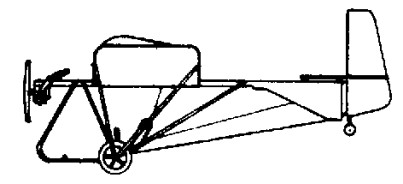
Single seat single engined high wing monoplane with conventional three axis control. Wing has unswept leading and trailing edges, and constant chord; cruciform tail. Pitch control by elevator on tall; yaw control by fully flying rudder with additional fin; roll control by spoilers; control inputs through stick for pitch/roll and pedals for yaw. Wing braced from below by struts; wing profile single surface. Undercarriage has three wheels in tail dragger formation; no suspension on tailwheel and bungee suspension on main wheels. No ground steering. No brakes. Aluminium tube framework, without pod. Engine mounted at wing height driving tractor propeller. The Beaujon Mach .07 was aimed at amateur constructors, being available only as a sheet of plans.
Length overall: 18.5 ft, 5.61 m. Sweepback: 0 degs Total wing area: 165 sq.ft, 15.3sq.m
Single seat single engined low wing mono¬plane with conventional three axis control. Wing has unswept leading and trailing edges, and constant chord; conventional tail. Pitch control by elevator on tail; yaw control by fin mounted rudder. Control inputs through stick for pitch/roll and pedals for yaw. Wing braced from below by struts; wing profile FX 72 MS 150 modified; double¬surface. Undercarriage has two wheels with tailskid. Fuselage partially enclosed. Engine mounted above wing driving tractor propeller. The Easy Flyer was one of the earliest microlights offered in plan form for amateur constructors. Designed by H Beaujon, it was first built in 1976 and offered for sale the following year. It is of classical configuration, remaining very close to the traditional aircraft concept, and differs really only in those aspects of specification and performance where change was essential to qualify it as an ultralight. H Beaujon was one of the first designers to advise using two-¬stroke engines for aeronautical use, and in this instance chose a Rockwell JLO L 395 single cylinder motor weighing 59 lb (27 kg).
Engine: Rockwell JLO L 395, 24.5hp at 5500rpm. Prop diameter/pitch: 46×20 inch, 1.04 x 0.45 m Power/unit area: 0.28 hp/sq.ft, 3.0 hp/sq.m. Length overall: 15.3 ft, 4.64 m Height overall: 4.8ft, 1.42m. Wing span: 25.1ft, 7.87m Total wing area: 89 sq.ft, 8.3sq.m Constant chord at root: 3.8ft, 1.11m Wing aspect ratio: 7.5/1. Empty weight: 175 lb, 79kg Max take off weight: 372 lb, 169kg. Payload: 197 lb, 89kg. Max wing loading: 4.18 lb/sq.ft, 20.4kg/sq.m. Max power loading: 15.2 lb/hp, 6.9kg/hp Max level speed: 79mph, 128kph. Cruising speed: 65mph, 104 kph Stalling speed: 28 mph, 46 kph. Max climb rate at SL: 490 ft/min, 2.5 m/s.