Borovkov-Frolov D

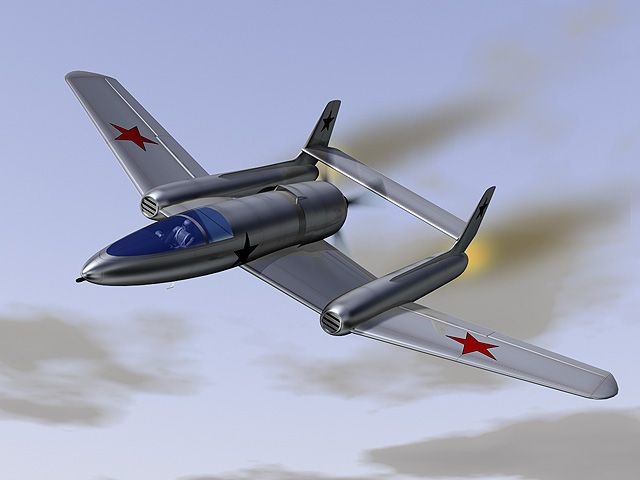
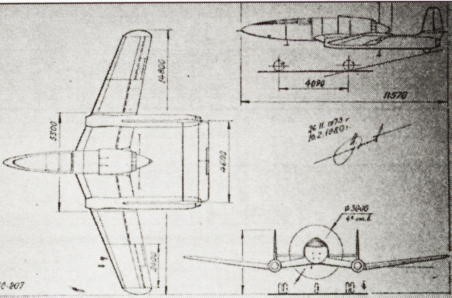
The ‘D’ design was started in 1941 by Alexei Andreeyevich Borovkov & Ilya Florenteyevich Florov as a mixed power fighter with a piston engine and Merkulin ramjet booster. A 1,500 kW (2,000 hp) Shvetsov M-71 engine was intended to be the main powerplant but it is unclear how the thermodynamic cycles of the two engines were to be linked. Similar aircraft were built later in the German-Soviet War using the main engine to drive a propeller and a compressor to supply air to a ramjet/afterburner booster, both the Su-5 and MiG-13 were produced in limited numbers but the performance gains were limited and soon eclipsed by turbo-jet engines.
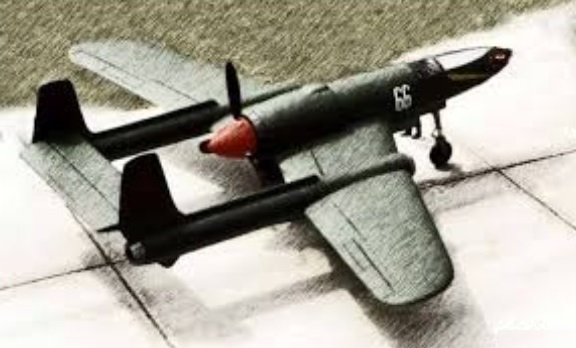
The ‘D’ was to have been a gull- winged monoplane with high set wing, of stressed skin construction with exceptionally smooth skin stabilised by underlying corrugated structure. The cockpit featured a pneumatic ejection system which rotated the seat downwards and fired it clear of the propeller arc.

A heavy armament of two 37 mm (1.457 in) Nudelman-Suranov NS-37 cannon and two 20 mm (0.787 in) ShVAK cannon was included, but all work was abandoned with the German invasion of 1941.

Powerplant: 1 × Shvetsov M-71, 1,600 kW (2,200 hp)
Powerplant: 1 × Merkulov DM-12 ramjet
Wingspan: 14.8 m (48 ft 7 in)
Length: 11.67m
Wing area: 35m²
Top Speed: 837km/h (with ramjets)
Max. Cruise Speed: 600km/h (without ramjets)
Crew: 1
Armament:
2x 37 mm (1.457 in) Nudelman-Suranov NS-37 cannon
2x 20 mm (0.787 in) ShVAK cannon
Borisevic P-200

Very strong airplane, steel tube fuselage aluminum covered, with all metal wings and empennage. Equipped with a ballistic parachute. 2009 Price: 20000 USD

Stall: 32 kt – 37 mph / 60 kmh
Cruise: 67 kt – 78 mph / 125 kmh
VNE: 84 kt – 97 mph / 156 kmh
Empty Weight: 370 kg / 816 lbs
MTOW Weight: 570 kg / 1257 lbs
Climb Ratio: 1000 ft/min / 5 m/s
Glide Ratio: 7.2
Take-off distance (50ft obstacle): 520 ft / 160 m
Landing distance (50ft obstacle): 460 ft / 140 m

Bonsall Mustang MkII

The single seat Bonsall Mustang MkII, often referred to as “The Pride of Yorkshire”, was built by D.C. Bonsall in the United Kingdom in 2011. The unique 8/10th scale replica of a P-51 Mustang aircraft has wooden frame/spars with fibreglass wings and skin, titanium fuel tanks and many titanium fittings.

It is a UK LAA Permit to Fly aircraft, maintained per UK LAA Maintenance Requirements.

Capable of 200 kts and powered by a 300 hp Lycoming IO-540 engine and McCauley 3-blade B3D36C431-B propeller it is registered G-BDWM S/N PFA 073-10200.

It was for sale in 2019 with an asking price of £120,000.

Gallery

Bonney Gull       

Leonard Bonney, an aviation pioneer and one-time First World War US Army and Navy flying instructor. Bonney became obsessed with the shape of a gull’s wing, which he believed to be the most efficient and capable wing form in nature. He set out to design an airplane that mimicked its qualities.

Through mechanical mechanisms he sought to be able to vary the wing’s incidence and sweep. The design, wind tunnel testing and fabrication of the Bonney Gull took him almost five years. At a time when a new airplane cost about $3,000, the Gull’s development cost was $83,000.

The aircraft had so many new features and looked so unpredictable that Bonney could not get a test pilot to take it up—so he did it himself. On 4 May 1928 at Curtiss Field, Long Island after a quick flight in another aircraft to refresh his skills, he took the Gull into the air on its first flight. At a height of about 50 feet, the porpoising aircraft nosed over and dove straight into Long Island. Leonard Bonney was killed.