Brunsmann 1928 Ornithopter

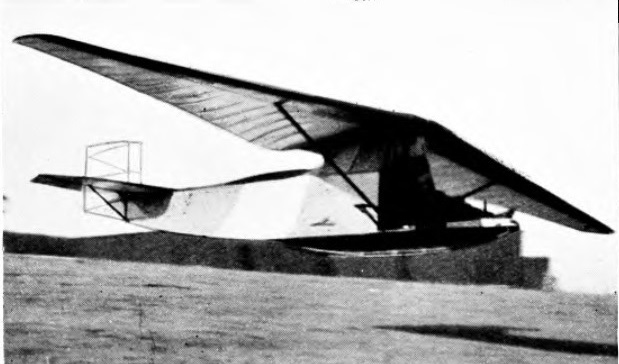
Erhard Brunsmann had built a flapping machine with which short flights were made during 1925. Encouraged by this, he built a sailplane of 44 ft span with a wing area of 130 sq.ft by 1928.

The machine has tapered wings and a usual tail unit, but the main planes are hinged at the centre ao allow up and down movement and are braced by a pair of struts, one to each wing, attaching just behind and below the pilot.

No lateral control was provided, but side movement of the control column actuated the rudder.

The sailplane was first tested as a normal glider, and had similar performance, after which flapping flights were carried out, which increased the speed and about doubled the distance possible with fixed wings.
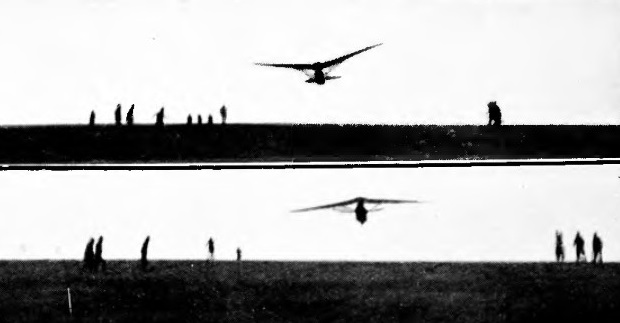
The machine was being tested at Wasserkuppe in 1931.
Brunsmann 1910 Schwingenflieger

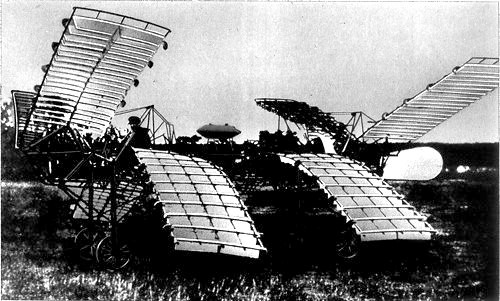
This machine was built for the inventor, Erhard Brunsmann of Berlin-Eichwalde, Germany, by Edmund Rumpler in Berlin-Johannisthal. The tandem wings were driven by a complex patented crank mechanism and it was intended that control would be achieved by differential flapping of the wings, rather than by separate control surfaces. Lange dismisses it in little more than two lines as a “Fehlkonstruktion”.

Brumah Midget Monoplane            

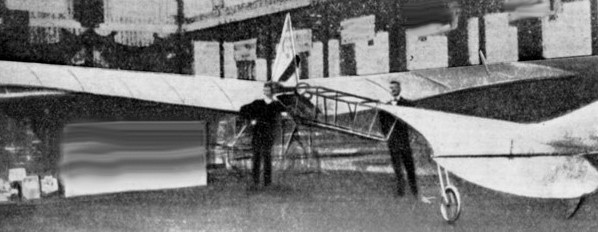
The “Brumah I” was the first machine built by the two seventeen-year-old Harry A. Bruno and Bernard H. Mahon (hence the name) of Montclair, New Jersey, crashed on its first flight from the barn. The Brumah II, with a span of only 16 feet, was called the world’s smallest monoplane. It was flown on sled runners down an ice-coated hill on Christmas Eve 1910. It crashed then too but might have been re-built, but there is no indication that it was ever actually fitted with a motor.

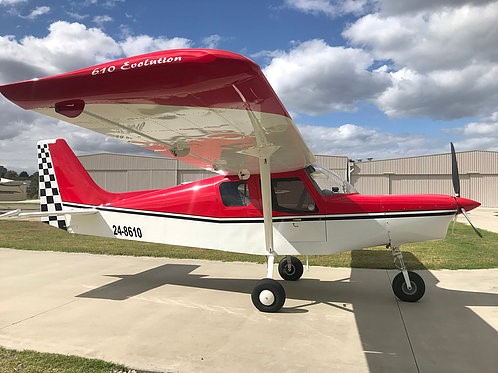
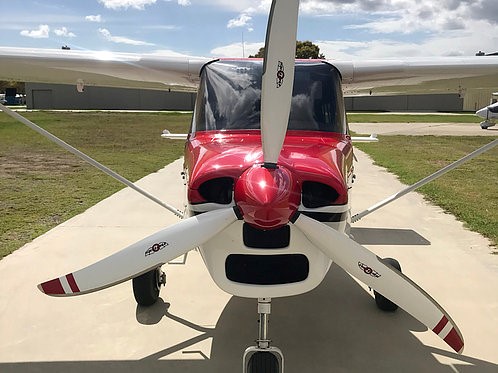
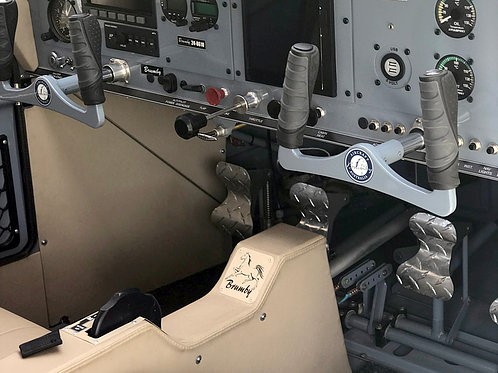
Brumby 610 Evolution

An Australian-made light sport aircraft factory built circa 2015.

Feature include:
Cabin heat
Electric flaps
Rudder trim
Adjustable seats
Steerable nosewheel / dual brakes
Wiring for lighting and circuit breakers ready for full lights
Dual fuel valves (right and left wings)
Electric fuel gauge
Wheels 6” high profile
Full front oleo strut
Compass

Engine: Rotax 912ULS
Propeller: Sensenich ground-adjustable, 3 blade
MTOW: 600kg
Fuel capacity: 136 Lt
Top speed: 100kts IAS

Brügger MB.2 Colibri

Development of the Colibri MB-1 led to the MB.2 A wood and fabric construction, single seat, stressed for aerobatics: +11 and -6G. Suitable power is the VW1600.

Gallery

Engine VW.
Span 19ft 8.25in.
Wing Area. 88.25 sq.ft.
Length 15ft 9in.
Max. wt. 7271bs.
Empty wt. 4741bs.
Cruise 86kt / 99 mph / 160 kmh
Climb Rate: 600 ft/min / 3 m/s
Stall: 32 kt / 37 mph / 60 kmh
VNE: 103 kt / 118 mph / 190 kmh
Empty Weight: 190 kg / 419 lbs

Brueggemann El Bandido

El Bandido was designed by Clarence Brueggemann, of Norfolk, Neb. First flight was made during May 1970. Its cantilevered low wing uses the Clark- Y airfoil. Its modified 45-hp VW engine drives a two-bladed Thoyer metal prop.

Engine VW 1600cc, 45 hp.
Gross weight 630 lbs
Empty weight 380 lbs.
Fuel capacity 8 USgal.
Wingspan 18 ft.
Length 13ft
Vmax 120 mph.
Cruise speed 110 mph.
Climb rate 700 fpm.
Takeoff run 200ft
anding roll 300ft
Ceiling 11,000 ft.

Browne 1911 Octoplane

Carl Dryden Browne, formerly one of the “generals” in the famous Coxey Army of unemployed men who marched on Washington in 1894, built what he called an octoplane. It was equipped with a stationary elliptic plane, running lengthwise of the machine, measuring 4 feet at its widest part and tapering to a point at each end, designed to act as a stabilizer. The motive power was furnished by a 30-horsepower motor, operating a tractor propeller and two large four-bladed revolving planes on each side, similar to the paddles of a sidewheel steamer. The span of the machine was 26 feet and the length 28 feet. The elevating and vertical control surfaces were similar in shape and operation to those of a standard Curtiss.