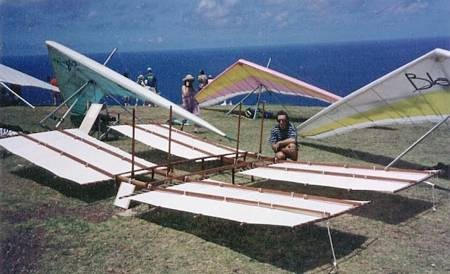
A replica of the Hargrave Tandem Monoplane Glider of 1894 built by Rob De Groot, photographed at the Hang Gliding World Championships of 1994 – the 100th anniversary of the glider designed and built by the Australian pioneer Lawrence Hargrave. As the originals only flight was unsuccessful, Hargrave shied away in his career from monoplanes, adopting instead the idea of biplanes (box-kite designs). The tandem wing monoplane however, became a concept Langley later saw fit to continue with his Aerodrome in 1903.

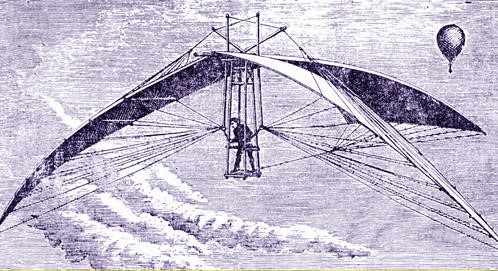
In 1864, a Belgian shoemaker named Vincent de Groof designed an apparatus which was a sort of cross between beating wings and a parachute. His plan was to cut loose with it from a balloon, and to glide down in a predetermined direction by manoeuvring the supporting surfaces. He endeavoured to make a practical experiment, both in Paris and in Brussels, but it was only in 1874 that he succeeded in doing so in London.
The apparatus consisted of two wings, each 24 feet long, moved by the arms and the weight of the operator, and a 20 foot long tail which could be adjusted using one’s feet.
De Groof first went up on June 29, 1874, from Cremorne Gardens, London, attached to the balloon of Mr. Simmons. He came down safely, and claimed to have cut loose at a height of 1,000 feet. Subsequently however, it was stated by others that in fact he had not, on this occasion, cut loose at all, but had descended still attached to the balloon. In any event, he went up again on July 5 following, with the same balloon, and on this occasion he really did cut loose. The result was disastrous. In his descent, as soon as pressure gathered under the moving wings, they were seen to collapse together overhead into a vertical position, bringing De Groof down like a stone and killing him on the spot.
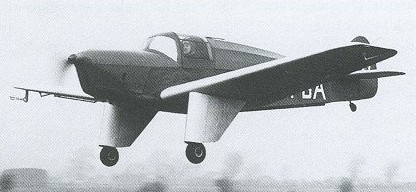
The first machine incorporating the S.C. Hart-Still wing was the 1937 Deekay “Knight” two seat cabin monoplane. The wings of this aircraft are in wood, but developments for the use of plastic materials was to be extended to the production aircraft of the company. One completed; scrapped during war.
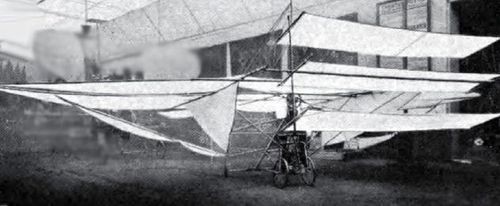
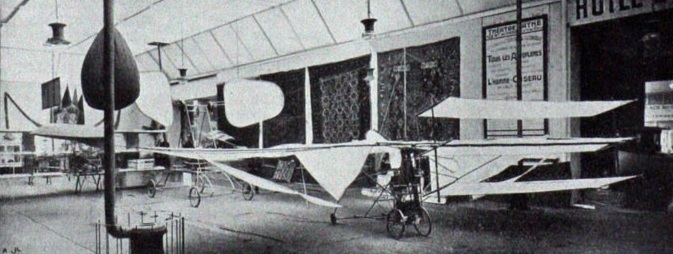
The aeroplane of Baron Jean de Crawhez on display at the Eighth Annual Belgian Motor Show, held in Brussels from the 16th through to the 26th of January 1909. In the background of M. Crawhez’s aeroplane is the ornithopter of M. de la Hault, both Belgian machines.
The 1910 De Coster “Flugi” monoplane was designed and built by Charles de Coster in France.
Span: 26’3″
Length: 26’3″
Weight empty: 639 lb
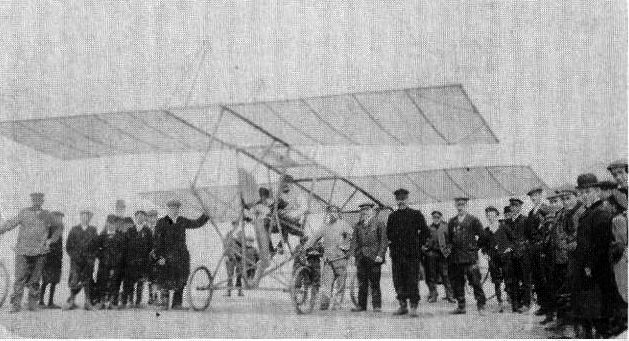
Emmanuel Honoré Decommines, known as Georges Decommines, was born in Ostend, Belgium, on 14 February 1879. His brother Louis Decommines helped him with the construction of this airplane. The tractor propeller was driven by a 25 hp Anzani, which was financed by his aunt. On the first flight attempt, on the morning of May 15, 1910 on the beach of Ostend, Belgium, refused to start and on the second threw a propeller blade through the fuel tank, causing a fire which burned both the plane and the pilot/builder, but both were able to recover and try again. After repair, the machine crashed while attempting to take off. The builder, with minimal damage this time, took the hint and scrapped it, but he would come back with another design the year after.
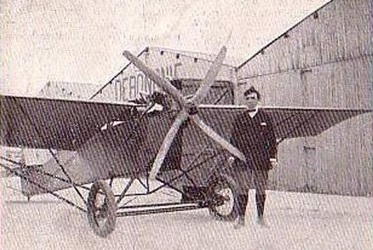
Édouard Eugène Joseph Ghislain opened a workshop in Nieuport-Groenendyck, with his first monoplane coming out 1910. A second with characteristic curved wings appeared in 1911 and another in 1912. Although building three different monoplanes his firm was principally in propeller production. The works folded in 1914 with the beginning of the war.
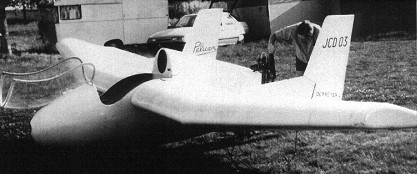
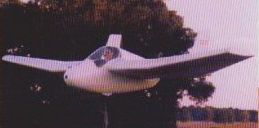
The “Pélican” flying wing was designed by Jean-Claude Debreyer based on the AV-36. Unlike that machine, however, it is not designed for soaring but only for inexpensive powered flight. The designer’s goal was to produce a machine that was easy to build, ultra-light and low in cost, which explains the choice of the flying wing configuration, the low aspect ratio of the wing and the tandem landing gear. The prototype was built of wood with a few laminated parts; the wing section was the same as that of the AV-36 (Fauvel F4 17%). The two-stroke engine, mounted at the rear of the short fuselage, between the two fins, drives a two-bladed propeller directly. The Air Est Services, based in eastern France, offers a kit version, built of composite materials, named JCD-03. It can be equipped with a 12 hp Solo engine or a 24 hp Koenig which gives a considerable improvement over the original performance figures.
The Pelican is transformed into the Eagle by substituting a 24 hp direct drive Konig for the Solo.
Wing span: 7.92 m
Length: 3.10 m
Wing area: 12.0 sq.m
Airfoil: Fauvel F4 17%
Empty weight: 85 kg
Max. weight: 175 kg
Engine: Solo 15 ch
Propeller diameter: 75 cm
Takeoff run: 150 / 200 m
Stall speed: 45 km/h
Cruise speed: 75 km/h
Endurance: 3 hours
Air Est JCD-03 Eagle
Empty weight: 90 kg
Wing span: 7.2 m
Wing area: 12 sq.m
Fuel capacity: 20 lt
Engine: Konig SC 430, 24 hp
MAUW: 200 kg
Seats: 1
Max speed: 130 kph
Cruise speed: 90 kph
Minimum speed: 40 kph
Climb rate: 3 m/s
Fuel consumption: 8 lt/hr
Kit price (1998): 45 000 F sm
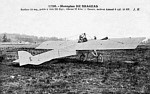
The 1911 De Brageas monoplane was designed and built by De Brageas in France.
Span: 36′
Length: 19’8″
Weight: 705 lb net
Speed: 50 mph