Design of an agricultural aircraft, to a specification laid down by the Brazilian Ministry of Agriculture, was initiated in May 1969 by the Departmento de Aeronaves of the nation’s Centra Te’chnico de Aeronautica. Following the establishment of EMBRAER on 2 January 1970, responsibility was transferred to EMBRAER.
The first prototype, registration PP-ZIP, was flown for the first time on 31 July 1970, at Embraer’s headquarters in São José dos Campos, State of São Paulo.
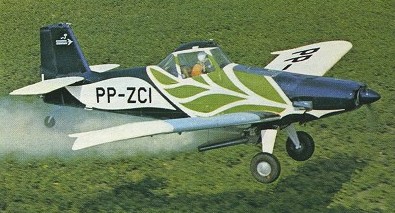
Designated originally EMBRAER EMB-200 Ipanema (the name was chosen in honor of the Ipanema farm, located in Iperó, 128 km (80 miles) far from the city of São Paulo), the aircraft was a cantilever low-wing monoplane of all-metal construction with fixed tailwheel landing gear and power provided by a 260 hp / 194kW Avco Lycoming O-540-H2B5D engine, fixed-pitch propeller, hydraulic spraying system, and a 580 liter hopper.
Brazilian type certification was gained on 14 December 1971 and initial production versions were the EMB-200 and EMB-200A which differed by having fixed-pitch and variable-pitch propellers respectively. The Corsário de Aviação company from the State of Goiás, ordered ten aircraft, in March 1971, and was the Ipanema’s first customer. In February 1972, the first airplane, registration number PT-GBA, was delivered and entered service in the fight against pests that threatened cotton crops.
In 1974, after 73 EMB-200 series aircraft had been built, production of an improved EMB-201 began; this latter differed by having a 224kW IO-540 engine with a constant-speed propeller and detail improvements.
In November 1973, the 100th airplane was delivered to Serviços Agro Aéreos do Sul. In 1975, Uruguay’s Ministry of Agriculture and Fishing ordered ten Ipanemas, along with five EMB 110 Bandeirantes, marking Embraer’s first exports. A total of 200 EMB-201s was built.
In 1977, the updated EMB-201A first flown on 10 March, entered production. This introduced a new wing profile, improved systems and revisions in cockpit layout.
In 1980, Embraer acquired Indústria Aeronáutica Neiva, a company founded in 1954 and that produced small airplanes. With the merger of the two companies, the Ipanema’s production was transferred to Botucatu, São Paulo, in 1982. A total of 355 had been ordered by 1990, bringing total Ipanema sales to more than 630. In 1988, by which time 600 had been delivered, a further improved Ipanema was launched, but without a new designation, and options include a three-bladed Hartzell propeller, larger wheels, more powerful 300 HP engine, tail wheel with a larger diameter, new shock absorbers and wing profile, among others.
The EMB-201R is a single-seat glider-tug aircraft for the Brazilian Air Force. Three were built for the Air Force Academy gliding club. Brazilian Air Force designation U-19.
Certified in November 2015, the EMB-203 with a 320 hp Lycoming engine, has a wingspan of 13.3 m and its winglets redesigned, increasing control and improving the efficiency of spraying.
By August 2010, the Ipanema is the leader of Brazil’s agricultural aviation, with more than 1,100 planes delivered and 75% of the fleet in operation, nationwide.
On 15 March 2005, the 1000th Ipanema was delivered. Coincidentally, that was also the first model with the 320 HP ethanol-powered engine, which is the same fuel developed in Brazil used mainly by the nation’s automobiles. The project was developed in a partnership with the Department of Aerospace Science and Technology (Departamento de Ciência e Tecnologia Aeroespacial – CTA). From that point on, Embraer began to offer ethanol conversion kits for the airplanes powered by aviation gasoline (AvGas). Currently, around 25% of the Brazilian fleet uses ethanol.
EMB-200 Engine; 1 x Avco Lycoming IO-540-H2B5D, 260hp Wingspan: 36 ft 9 in / 11.20 m Length: 24 ft 4.5 in / 7.43 m Max payload norm: 1212 lb / 550 kg Max payload restricted: 3963 lb / 1800 kg Cruise 67%: 114 kt / 131 mph / 211 kph ROC SL: 705 fpm / 215 m/min Max range: 507 nm / 584 mi / 941 km Seats: 1 Hopper capacity: 149.5 ImpG / 680 lt Cockpit length: 3 ft 11.25 in / 1.20 m Cabin width: 2 ft 9.5 in / 0.85 m Cabin height: 4 ft 4.5 in / 1.34 m
EMB-201A Engine; 1 x Avco Lycoming IO-540-K1J5D, 300hp / 224kW Max take-off weight; 1800 kg / 3968 lb Empty weight; 1011 kg / 2229 lb Wingspan; 11.20 m / 36 ft 9 in Length; 7.43 m / 24 ft 5 in Height; 2.22 m / 7 ft 3 in Wing area; 19.94 sq.m / 214.63 sq ft Max. speed; 225 km/h / 140 mph Cruise speed; 204 km/h / 127 mph Ceiling; 3470 m / 11400 ft Range; 877 km / 545 miles
EMB-202 Powerplant: 1 × Textron Lycoming IO-540-K1J5D, 224 kW (300 hp) Wingspan: 11.69 m (38 ft 4 in) Length: 7.43 m (24 ft 5 in) (tail up) Height: 2.20 m (7 ft 3 in) (tail down) Wing area: 19.94 m2 (214.6 sq ft) Aspect ratio: 6.9:1 Empty weight: 1,020 kg (2,249 lb) Max takeoff weight: 1,800 kg (3,968 lb) (restricted category) Fuel capacity: 264 litres (70 US gal; 58 imp gal) usable fuel Hopper capacity: 950 litres (250 US gal; 210 imp gal) liquid or 750 kilograms (1,650 lb) dry Maximum speed: 230 km/h (140 mph, 120 kn) Cruise speed: 213 km/h (132 mph, 115 kn) (75% power) Stall speed: 92 km/h (57 mph, 50 kn) (power off) Never exceed speed: 272 km/h (169 mph, 147 kn) Range: 938 km (583 mi, 506 nmi) Service ceiling: 3,470 m (11,380 ft) Rate of climb: 4.7 m/s (930 ft/min) Take-off run to 15 m (50 ft): 332 metres (1,089 ft) Landing run from 15 m (50 ft): 412 metres (1,352 ft) Crew: 1 pilot
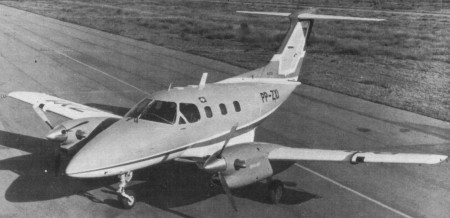
The pressurised EMBRAER EMB-121 Xingu featured a reduced-span version of the EMB-110P wing, a fuselage of circular cross-section similar to that of the Brasilia, and followed the same general configuration with twin turboprop engines and retractable tricycle landing gear, but differed by having a cantilever T-tail.
The first pressurized twin turboprop general purpose transport to be built in Brazil, it had accommodation for a crew of two and nine passengers. The prototype Xingu (PP ZXI) flew for the first time on 10 October 1976, followed by the first production aircraft just over six months later. The Xingu has PT6A 28 engines, six psi pressurisation, an anticipated cruise of 265 knots at 12,000 feet, a five to nine place cabin and max gross of 11,000 pounds. The original version, designated EMB-121A Xingu I, was powered by two Pratt & Whitney Canada PT6A-28 turboprop engines. From this was developed the EMB-121A1 Xingu II with 559kW PT6A-135 turboprops, these being available also as retrofits for the Xingu I. Thirty-two earlier machines were later reworked to this standard. A prototype of the EMB-121V Xingu III was flown. It was generally similar to its predecessors except that it had the fuselage lengthened by 0.89m, and was powered by two 634kW PT6A-42 engines. Seating the same number of passengers but in greater comfort, the Xingu III featured an optional ‘club’ layout for seven passengers, with folding tables and a galley. A total of 111 were built, including six for use by the special transport group of the Brazilian air force under the designation VU-9 as a VIP transport. Other users include the French navy and air force with 41 aircraft as multi-engined trainers and liaison aircraft, and five others serve with the SABENA pilot training school. Production of the Xingu 121 ended in 1986.
EMB-121A Xingu I Engines: 2 x Pratt & Whitney Aircraft of Canada PT6A-28 turboprops, 507kW Max take-off weight; 5670 kg / 12500 lb Loaded weight; 3620 kg / 7981 lb Wingspan; 14.45 m / 47 ft 5 in Length; 12.25 m / 40 ft 2 in Height; 4.74 m / 15 ft 7 in Wing area; 27.5 sq.m / 296.01 sq ft Max. speed; 450 km/h / 280 mph Cruise speed; 365 km/h / 227 mph Ceiling; 7925 m / 26000 ft Range; 2270 km / 1411 miles
EMB-121 Xingu II Engine: 2 x P&WAC PT6A. Installed pwr: 1120 kW. Span: 14.4 m. Length: 12.2 m. Wing area: 27.5 sq.m. Empty wt: 3710 kg. MTOW: 5670 kg. Payload: 780 kg. Cruise speed: 465 kph. Initial ROC: 550 m / min. Ceiling: 8540 m. T/O run: 580 m. Ldg run: 560 m. Fuel internal: 1720 lt. Range/payload: 1630 km with 780 kg. Capacity: 7 pax.
EMB-121V Xingu III Engine: 2 x 634kW PT6A-42 Length: 13.09 m. Span: 14.4 m. Wing area: 27.5 sq.m. Capacity: 7 pax.
Encouraged by the successful penetration of the commuter airline market by the EMB-110 Bandeirante, EMBRAER initiated design studies for a completely new and pressurised twin-turboprop regional airliner in September 1979.
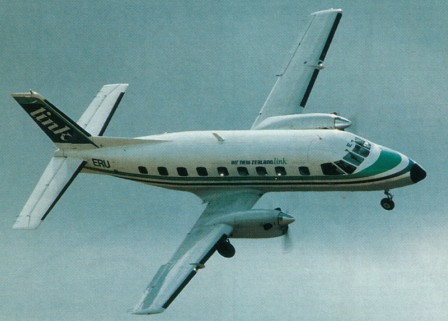
Designated the EMBRAER EMB-120 Brasilia, the prototype flew for the first time on 27 July 1983 and certification was achieved by May 1985. Primary design objective was to carry a full 30-passenger payload for up to three 185km sectors without refuelling. The fuselage has an interior diameter of 2.28m and a cabin height of 1.76m, the aisle being offset by the two-and-one seating arrangement. In cargo configuration the Brasilia has a maximum available cabin volume of 31.1cu.m and is fitted with a cargo door in the starboard side of the rear fuselage. Powered by advanced-technology Pratt & Whitney Canada PW118 turbo-props driving four-bladed Hamilton Standard 14RF-9 propellers, the engines can be ground-run without turning the propellers to facilitate speedier turn-rounds, thus obviating the need to shut down during loading or unloading. The starboard engine can act as an auxiliary power unit, to provide ground electrical power and cabin air-conditioning, but a conventional APU is optional. Composite materials equivalent to ten per cent of the aircraft’s basic empty weight have been used in the construction of the Brasilia. Deliveries began in June 1985 and by 1990 more than 500 orders and options had been recorded, for operators in three continents. In addition to airline use, the EMB-120 Brasilia is in service with the Forca Aerea Brasileira as the C-97 and VIP VC-97. By early 1991 more than 200 had been delivered and the production rate was six per month. The EMB 120ER model is the basis for Embraer’s regional jets.
Embraer EMB 120 Brasilia Engines: 2 x Pratt & Whitney Aircraft of Canada PW118 turboprops, 1342kW / 1,800 shp Props: 4 blade Length: 65 ft 7 in / 20.0 m Height: 20 ft 10 in / 6.4 m Wingspan: 64 ft 11 in / 19.8 m Wing area: 424.102 sqft / 39.4 sq.m Max take off weight: 25357.5 lb / 11500.0 kg Weight empty: 15589.4 lb / 7070.0 kg Max. weight carried: 9768.2 lb / 4430.0 kg Max. speed: 328 kts / 608 km/h Landing speed: 87 kts / 162 km/h Cruising speed: 260 kts / 482 km/h Initial climb rate: 2125.98 ft/min / 10.80 m/s Service ceiling: 29806 ft / 9085 m Wing loading: 59.86 lb/sq.ft / 292.00 kg/sq.m Range: 945 nm / 1750 km / 1087 miles Crew: 2 Payload: 30pax
In 1965 a government initiative to develop a light twin turbo-prop for the Brazilian Air Force led to the formation of Embraer four years later. Though initially this design requirement was for a military transport of only 7-9 seats, it was quickly realised that a substantial civil market also existed. Designed under the guidance of French designer Max Holste, the first of three prototypes, designated YC-95, flew for the first time on 26 October 1968. Though initially still only a 7-9 seater, the final design had the development potential to be stretched to meet the larger 15-seat and upward commuter market. The first EMB.110 flew on August 9, 1972, and deliveries to the Brazilian Air Force began in February 1972.
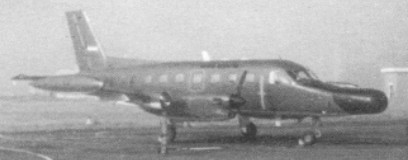
In early 1973 the first three production EMB-110 Bandeirantres were formally delivered to the Brazilian Air Force. At about this stage an airworthiness certificate was also granted for the 15-seat civil version, the EMB-110C and later that year a further three were delivered to the private domestic airline Trans Brazil. Powered by twin 680 shp Pratt and Whitney PT-6A-27 turboprops with reversible pitch and auto feathering capability, these first Bandeirantes had a range of around a thousand miles and speeds up to 220 knots. Seating was for 15 passengers and two crew. However it was not until 1975 that the Bandeirante achieved its first real breakthrough, when the Brazilian Government established a third-level network. Though in part this was to release the major carriers from the necessity to continue servicing uneconomical routes with large aircraft, the other result was to provide a vastly extended market for the Bandeirante. Over the next few years a number of third-level carriers re-equipped with Embraer’s commuter-liner until some 45 Bandeirantes were in service throughout Brazil on the regional network. Embraer produced the P1 and P2 variants, specifically designed for the export market. Both aircraft engined with the PT6A-34 of 750 shp, and carry up to 21 passengers in three-abreast seating. Each model is identical, except for their door arrangement. The P1 Bandeirante being designed as a quick change airliner with airstairs at the front and big top-hinged cargo door at the rear. The P2 version comes with dual airstairs front and rear, for fast whistlestop turnarounds. Both aircraft are designed for a 30,000 hour life cycle. France issued airworthiness certfication in late ‘77. U.S. and United Kingdom certification followed in August 1978. A cantilever low-wing monoplane, primarily of metal construction, the Bandeirante has a conventional fuselage and tail unit, retractable tricycle landing gear and power provided by two Pratt & Whitney Aircraft of Canada PT6A-34 free-turbine turboprops in wing-mounted nacelles. The two Pratt & Whitney PT6A turboprop engines are flat-rated at 750 shp maximum continuous power at 2,200 propeller rpm. The propellers are three-blade Hartzells with automatic synchronization and full beta-control reversing. Seating varies according to role, but the EMB-110P2 has accommodation for a maximum of 21 passengers. There’s a crew/passenger door at the front and passenger/baggage door at the rear, both on the port side. By the beginning of 1979, 219 Bandeirantes of various models had been sold to some 40 operators around the world. The Bandeirante was available in more than 14 versions, differing in their equipment for specialized missions. The EMB-110B1 Bandeirante was specially developed for aerophotogrammetric missions. Gyro-stabilised camera platform, electrically-operated ventral sliding camera hatch and dark-room cum toilet, all make for a specialised aircraft which can nevertheless still be easily reconverted back to a basic transporter. Other specialist use versions include the EMB-110S1 for geophysical survey. Equipped with the more powerful PT6’s from the P1 and P2 aircraft, and with increased fuel capacity, the S1 has up to nine hours endurance.
Military versions of the EMB.110 are the P1K utility transport and the P1K SAR. The P1K SAR is fully equipped for over-water and overland search and rescue missions, as well as for medevac duties. This has accommodation for observers and a variety of rescue equipment, plus space for up to six stretcher patients. Five are operated by the Brazilian air force under the designation SC-95B. Others are the EC-95B calibration and XC-95B rain research versions.
EMB-111
The EMB-111 was developed as a land based maritime reconnaissance aircraft to meet the needs of the Comando Costeiro (Coastal Command) of the FAéB (Brazilian Air Force) and the first example (2262) flew on 15 August 1977. Based on the EMB 110 Bandeirante, it differed primarily by the in¬troduction of a nose radome for search radar and the addition of wingtip fuel tanks and began to enter service in April 1978. In use with the Brazilian Air Force and the Chilean Navy. Powered by a pair of 750 shp (560 kW) Pratt & Whitney PT6A-34 turboprops, the EMB¬111 features a nose-mounted ALL AN/APS-128 (SPAR-1) search radar, a wing mounted searchlight, tip tanks, wing-tip fuel tanks and wing hard-points for the carriage of weapons. Ordered for the Brazilian air force, which designates them P 95, the first entered service in 11 April 1978 with ten hours endurance. Examples have been supplied also to the Chilean navy and the air force of Gabon.
When production ceased in 1990, 500 Bandeirantes had been ordered and built, variants including the EMB-110, EMB-110/C-95, EMB-110 A/EC 95, EMB-110B/R-95, EMB-110B1, EMB-110C, EMBHOE(J), EMB-110K1/C-95A, EMB-110P, EMB-110P1K and EMB-110S1. The final production versions, progressive developments of earlier aircraft, included the EMB-110P1/C-95B for quick-change passenger/cargo operations; EMB-110P2/C-95C third-level commuter transport; and two versions corresponding to the foregoing for operations at a higher gross weight which have the respective designations EMB-110P1/41 and EMB-110P2/41 A pressurised version designated EMB-110P3, did not proceed.
EMB-110 Engines: UACL, 600shp. TBO: 3500hr. Max cruise: 228mph. Econ cruise: 183mph. Fuel cap: 2920lb. Service ceiling: 25,500ft. SE service ceiling: 10,000ft. ROC: 1700fpm. SE ROC: 300fpm. Min field length: 1803ft. Payload with full fuel: 901lb. Max range: 1109sm. High speed range: 1020sm. Max payload: 1966lb. Range with max payload: 315sm. Seats: 8. Gross wt: 12,410lb. Equipped empty wt: 9380lb. Useful load: 3030lb.
EMB-110P2 Engines: 2 x P&W PT6A-34, 750 shp / 559kW Props: Hartzell 3-blade, 93-in. Seats: 21. Length: 49 ft 6 in / 15.08 m Height: 16 ft 2 in / 4.92 m Wingspan : 50.262 ft / 15.32 m Wing area : 312.156 sqft / 29.0 sq.m Wing aspect ratio: 8.1. Maximum ramp weight: 13,073 lbs. Maximum takeoff weight: 13,007 lbs. Standard empty weight: 7955 lbs. Maximum useful load: 5118 lbs. Zero-fuel weight: 12,015 lbs. Maximum landing weight: 12,566 lbs. Wing loading: 39.9 lbs/sq.ft. Power loading: 8.3 lbs/hp. Maximum usable fuel: 2948 lbs. Best rate of climb: 1660 fpm. Service ceiling: 22,500 ft. Maximum single-engine rate of climb: 428 fpm @ 115 kts. Single-engine climb gradient: 214 ft/nm. Single-engine ceiling: 11,000 ft. Maximum speed: 230 kts. Normal cruise @ 10,000ft: 225 kts. Fuel flow @ normal cruise: 638 pph. Endurance at normal cruise: 4.1 hrs: Stalling speed clean: 92 kts. Stalling speed gear/flaps down: 73 kts. Turbulent-air penetration speed: 169 kts. Takeoff distance (50 ft.): 2,215 ft Landing distance (50 ft.): 2,790 ft. Crew: 2 Passenger capacity: 21
EMB-111 Engines: two 750 shp Pratt & Whitney Aircraft of Canada PT6A 34 turboprop. Wing span: 52 ft 4.5 in (15.96m). Length: 48.655 ft / 14.83 m Height: 15.551 ft / 4.74 m Wing area: 312.156 sq.ft / 29.0 sq.m Max take off weight: 15435.0 lb / 7000.0 kg Cruising speed: 172 kts / 318 km/h Wing loading: 49.41 lbs/sq.ft / 241.0 kg/sq.m Range: 1458 nm / 2700 km Crew: 5
The history of the two-seater glider EL-2-M began in the early 1930s. At that time, Ludvík Elsnic, Slávek Rodovský, František Pešta, Jarmila Králová (since March 15, 1939 in Rodovská), Josef Horák, Mr. Vonráček and others met in the workshops of the gliding department of the then Masaryk Aviation League in Maniny in Prague, and debated the bad situation, in which the Czech gliding was in. The fleet is minimal, a few gliders and gliders of mostly German design, made in an amateur way, mostly without any support and any interest of the official authorities. In the end, all the discussions came to a clear conclusion: if you want to fly, build a glider yourself.
The situation gradually changed when the discussants heard that Walter was preparing an auxiliary aircraft engine for gliders. Then Slávek Rodovský stated that he could use his own funds to finance the construction of a glider. The nature of the meetings at Maniny changed, and the discussions took on a working character. At the beginning, it was decided on the type of glider, and the idea became a two-seater, allowing easy installation of the auxiliary engine.
At the last meeting on September 1, 1933, it was already clear that it would be a strut parasol with a seat for the passenger at the center of gravity and with the possibility of attaching an auxiliary engine to the console above the canopy. The original design provided for the engine version as the main one. Ludvík Elsnic based his own designs on the glider, which was named EL-2M. EL as Elsnic, 2 perhaps as Elsnic’s second design in order or more likely a two-seater aircraft, M as a motor. Construction according to the first drawings began on November 1, 1933.
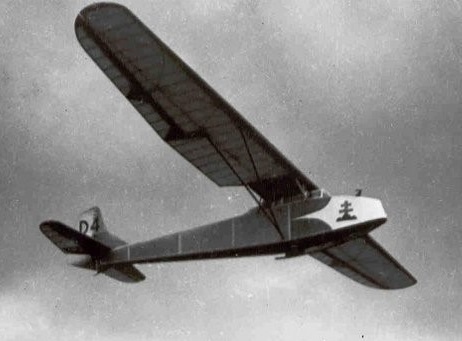
The financial costs of the construction were reduced by items for wood and plywood, which were largely begged for by the architect Vavrouš. However, the rest of the material had to be paid for, which was mainly the concern of Slávek Rodovský. All visitors to the workshop in Maniny shared their work. As soon as he came, he immediately got a job, maybe just gluing the ribs. The new glider grew mostly out of the enthusiasm of the people who devoted all their free time to it. Josef Tláskal watched over the workshop design, all fittings were made by Josef Horák, and Pešta, Rodovský, Králová, Vondráček and others took part in the production of small parts. Despite the dedication of all the “builders” of the new glider, the construction took longer than expected, so that only on June 15, 1934, everyone could say “done!”. It was also decided at that time to name the prototype. He received an emblem in the form of a gray wolf’s head in a (probably) blue target on both sides and the inscription “Gray Wolf” below it. The originator of the name was the main sponsor of the construction, Slávek Rodovský, it was derived from the name of his scout unit.
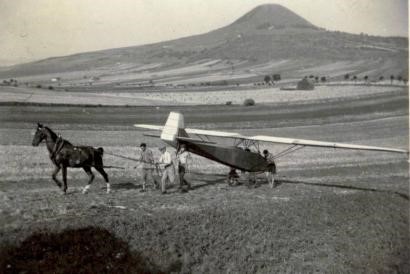
Rodovský also flew the new prototype himself, the very next day, June 16, 1934. The first takeoff was made by pulling behind the car using a longer rope. On June 17, the flight continued with two aero tows. The EL-2M prototype flew for about 9 hours that day. After a whole month, tests of the new glider continued, during which the performance, dexterity and flight characteristics were determined. The gray wolf belonged to the category of aircraft that were said to have “succeeded”. This is evidenced by the fact that the measured performances (such as sagging) were slightly better than calculated. In the same way, the flight characteristics fully complied with the mission of the aircraft, which, according to the test report, could be flown at almost 25 km / h without stalling, while the wings were still sensitive. He let himself be forced into a stall, and he came out of it very soon. He willingly performed partial acrobatics. Based on these tests, the EL-2M glider was approved on 13 July 1934 by the commission of the then Ministry of Public Works of the Czech Republic for normal operation. Immediately afterwards, the glider was demonstrated by MLL gliders on an air show in Terezín, where it was transported by airlift. Later, the Gray Wolf took part in other events.
From the beginning, there was great interest in the Gray Wolf among the gliding community. Requests for drawing documentation only flocked to the headquarters of the then Masaryk Aviation League (hereinafter referred to as MLL). At the same time, the price of the documentation, including the license for one copy, was not at all low at the time, reaching CZK 650. Only a set of hull drawings cost 470 CZK. The first sets of drawings were sent to interested parties at the end of November 1934.
Meanwhile, the prototype underwent a “baptism” at the first gliding race in Raná in September 1934. The gray wolf was piloted on them by the designer Ludvík Elsnic. Soon after the start of the race during one of the first landings in the wet ground, he damaged the fuselage, repaired the next day, but the whole competition was successful. On September 6, for example, the time reached 1 hour and 15 minutes. He completed some competition flights with a passenger, for example, on September 6 with Jarmila Králová, he lasted 58 minutes in the air. EL-2M Gray Wolf was finally evaluated as the second-best glider of the competition after Zlín Z-VII Akéla.
Although Slávek Rodovský performed acrobatics on the Gray Wolf, the aircraft was not registered in the “acrobatic aircraft” category. Therefore, during 1935, a new calculation was made and the wing struts were strengthened. After this modification, on May 30, 1935, the glider was recognized by the Ministry of Public Works as fully capable of acrobatics in a single-seat class. It has been adopted by MLL clubs as a welcome extension of glider capabilities.
In February 1935, a prototype of the Gray Wolf underwent its first motorization in workshops in Maniny. It was equipped with an older motorcycle air-cooled two-cylinder engine Blackburn inverted V configuration with a declared power of less than 12 kW (16 hp). The engine was installed on a canopy on a small pyramid of tubular construction with a thrust propeller on a long shaft. An aerodynamically shaped petrol tank was mounted in front of the engine in one unit. The origin of the engine is not clear, it may have been an engine from the DH-53 aircraft (delivered to the Czech Republic in the 1920s from England) or once imported for the BH-16 prototypes. But even here he proved unsatisfactory. The first test flights of the Gray Wolf prototype with a big black six on the rudder took place at Raná in the second half of February 1935, but there was no question of success. During the first flight, the long shaft twisted, the propeller flew away and damaged the fuselage. Also other flights in Kbely in the period 23.3.- 7.4.1935, the longest of which did not exceed 15 minutes, did not go without problems. The engine did not run regularly, did not deliver the expected power and the long drive shaft caused great problems. Irregularities in operation could also be caused by overcooling the engine. During the tests in Kbely, it was started either with the help of a rubber rope or by stretching on the rope behind the car. Eventually, however, Blackburn was removed and in the summer the prototype continued to fly only as a motorless. It was not until November 1935 that the engine was reinstalled, but without success. At the beginning of 1936, the prototype of the Gray Wolf was exhibited at the sports aviation exhibition at the Prague Sample Fairs with Blackburn installed, but after the exhibition, the engine was definitively removed.
At about the same time, the prototype probably received instrumentation for the first time. Until then, it flew without any instruments, by the pilot’s feel and the occasionally tied strip of fabric on the wing strut. There is speculation as to whether the equipment was in connection with the motorization of the prototype, but the existing low-quality photographs from the tests on Raná rather exclude this. It is not known what were installed, as no clear photograph or written or drawing document has yet been found to show this. Some photos of the prototype show a “pitotka” on the upper part of the bow and an unidentified “alarm clock”. There is also a short film shot of the prototype Gray Wolf behind the “brandy” at Raná from 1935, which shows a special aerodynamic cover from above on the fuselage in front of the front cockpit in the form of an opaque plate or pyramid. It can be deduced that its only purpose was to cover a set of instruments that did not fit inside the fuselage.
At the beginning of 1935, 7 EL-2Ms were flying. One of them was also item no. 5, called DINKA and built in early 1935 in Náchod.
“Gray Wolf”, which was the name used for all built two-seater EL-2M, served in MLL clubs throughout the country. At the end of April 1935, Slávek Rodovský and his prototype took part in the first national Štefánik glider races in Banská Štiavnica. He then tested the gliding terrain near Žilina, where he flew for more than three hours in two takeoffs. The first woman in the Czech Republic, Jarmila Králová, passed the “C” test on the prototype EL-2M on May 14, 1935. The same glider was at the second gliding races on Raná in July 1935 and reached the highest elevation of all competitors after the start with a rubber rope: 625m. The glider was often used for its pleasant flight characteristics to verify new gliding terrain, for example in October 1935 in the Iron Mountains, etc. It was also flown in winter, which required a considerable dose of self-denial and warm clothing as the cabin was open. The performance of Jarmila Králové with Rodovský on January 12, 1936 in Raná, when she reached the then longest flight of a two-seater two-seater in the Czech Republic in the length of 4 hours and 11 minutes, arouses respect even today. In this context, it should be noted that the normal time of all flights of Gray Wolf gliders was most often in the order of minutes at that time, and only a few individuals knew about the possibilities of thermal flying.
There was a fatal injury to the pilot of the Gray Wolf, rtm. Bedřich Chovanec which destroy the prototype. It was May 7, when the tow rope near the village of Světlá nad Sázavou broke during the aero towing from Prague to Olomouc. Both aircraft landed safely in an emergency, the tow plane was piloted by the then Sergeant František Peřina, later a famous fighter war pilot. After repairing the tow rope, both planes took off to continue the flight. During the start at a height of about 50 m, however, the left and right wing of the Gray Wolf was torn off. The hull crashed. The pilot was seriously injured and died after being transported to a hospital in Německý (now Havlíčkův Brod). The cause of the disaster was allegedly the high speed of the lift at the start and a sudden unexpected gust of wind.
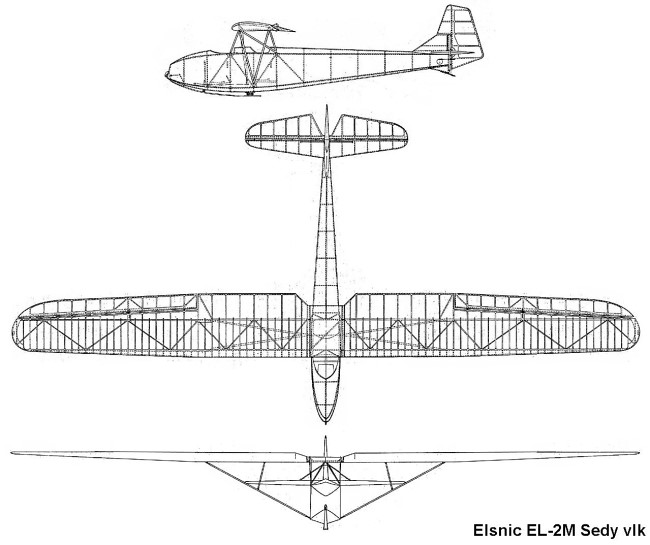
The EL-2M is an all-wood two-seater glider of the “parasol” type with a canopy wing made of metal tubes, of which the visible ones are profiled either by a wooden body or are made of special tubes of teardrop-shaped cross-section. With the help of four permanent pin holders on the back of the canopy, it is possible to install an auxiliary motor with a traction or thruster propeller about above the center of gravity.
The wing is divided, with two main and three auxiliary beams. Each half of the wing consists of 23 ribs with a G 633 profile and 20 ribs (semi-ribs – only the upper part). The wing is fastened to the canopy made of metal tubes with a diameter of 20 mm by means of pins, each half is supported by a tubular profiled V-shaped strut. The plywood also covers the root part of the wing up to the third rib, and further strengthens the cover at the tenth rib, from which the aileron begins. It also strengthens the end arch of the wing. The other upholstery material is air canvas. The aileron is designed in a similar way, the plywood mainly covers and connects the second and third auxiliary beam. The plywood also forms a profiled cover of the entire tubular canopy. The hexagonal cross-section is a lattice structure with a plywood cover, consisting of twelve hull partitions. The hinges for the rudder and the height stabilizer are attached to the latter. According to the construction documentation, the diagonal reinforcements of the plywood cover are between the second and sixth fuselage bulkheads, some amateur builders applied them to the entire fuselage, which is evident from the photos. The cockpit is open, normally without a protective plate, only with the lining of the edge of the hole. In at least one case, however, there was also a version with an amateur-made and installed covered cabin of the “Kränichov” type, which is evidenced by existing photographs of the Gray Wolf operated somewhere in Slovakia (the author saw it, but did not obtain it). The rear seat is exactly in the center of gravity, which allows the glider to operate as a single-seater. Access to the rear seat is quite difficult, the passenger must stretch backwards from the front seat after opening the roof door on the top of the cockpit between the front and rear seats and after folding down the front seat backrest. The instrumentation was not a standard accessory for the Gray Wolves. If the gliders were equipped with devices, then the additional installations were always not documented and can be seen from only a few photographs. Foot and manual control is a double cable, guided by the fuselage.
The landing gear consists of a simple ash rail underlain by three rubber blocks, two of which are under the cockpit under the fourth bulkhead. At the end of the fuselage under the keel (from the eleventh to the twelfth fuselage bulkhead) it is complemented by a steel spring spur. The prototype documentation is hand-drawn variants, which Ings. At the bow of the fuselage is a sling for a rubber starting rope, it was also used for aero tows and autostartes. For some specimens it was a simple steel hook, for others it was a device similar to today. Tail surfaces. The elevator stabilizer with a span of 3.5 m is a simple construction with one beam, covered with plywood thickness. 1.2 mm. It is attached to the fuselage by inserting the beam into the exact cutout in the twelfth fuselage bulkhead and securing with pins to the fittings on the eleventh bulkhead. It is reinforced by a pair of struts to the keel. The double-girder elevator is suspended rotatably at five points, it is covered with canvas except for the parts covered with plywood formed by two beams and the inner part of the rudder. The keel firmly connected to the fuselage is completely covered with plywood. The rudder is partially aerodynamically balanced in the upper part, covered with plywood at the front and lower part, otherwise covered with canvas.
The gray wolf was built in Bratislava, Choceň, Náchod, Butovice, Užhorod, Plzeň, Slaný, Kutná Hora, Roudnice nad Labem, Humpolec, Stará Paka, Povážská Bystrica, Přibyslav, Mladá Boleslav. Boleslav, Adamov, Olomouc, Zlín, Velká Bytča and many other places. At the turn of 1931/32, the staff of the local military crew, Staff Captain Josef Koukolík, founded the local group of the Masaryk Aviation League (MLL), which focused on aircraft modelling. Some of its members soon became interested in gliding. Emil Seige and his friend Jaroslav Hauser (since 1947 Horský) became its pioneer and also instructor. For their work and hobby, they found an extraordinary understanding with the director of the State Vocational School of Wood, Ing. Augustine Puchta, who enabled them to build gliders and gliders in a school body shop under the expert guidance of teacher Josef Hartman. The first Zögling test glider was built at the school in 1933/34. Later, it was the turn of more structurally demanding gliders, aircraft “Přerov type I, II, III” by experienced designers Jan Hrbek and Ing. Elsnice. Finally, a two-seater glider EL-2M “Gray Wolf” was built here in the school’s workshop. At least ten copies of Gray Wolf were produced in Kralupy nad Vltavou by František Kochman. In the summer of 1936, about 25 new Gray Wolves were completed, and by then at least ten were flying.
Because not everywhere were suitable conditions for downhill flying with a rubber rope, which was the most common way of gliding at the time, and aero tows were expensive for many MLL gliding departments, cars were quite commonly used for take-offs. Costs also decreased in other ways. MLL gliders in Roudnice nad Labem, for example, delivered a new Gray Wolf in 1936, agreed with the Prague Gliding Department of the ARČS and operated flying in Kbely with aero tows.
The national gliding races were held for the first time in Slovakia, near Žilina. Among other types, three EL-2Ms competed there, all in the single-seater category. They were named “Straník” with pilot Ladislav Vaníček, “Šumava” with pilot Maňák and “Pelikán” with pilot Antonín Zrna. However, in the large field of more modern gliders, they did not succeed significantly. However, this did not reduce the interest in the Gray Wolves, as the need for a two-seater school with pleasant flight characteristics continued to grow. This is evidenced, among other things, by the production plan for another twenty of these gliders, compiled by the MLL headquarters for 1937. In that year, the EL-2M gliders flew as trainers’ throughout the country. They did not take part in the competitions very much, at the fourth national sailing competition in 1937 only one flew on Straník, with the name “Chalan”, from the MLL sailing department from Velká Bytča. Pilot Klein flew for the entire race for a total of 4 hours and 9 minutes and was evaluated as the best on the school glider.
In the year of 1938, other EL-2M gliders were built. They often flew in the program “1000 pilots republic” as a kind of voluntary prelude to subsequent motor training.
“Such training was completed, for example, by the legendary Slovak RAF fighter pilot Otto Smik, who allegedly fondly remembered it during the war.”
After the mobilization in May in 1938, the races at Straník near Žilina were abandoned and from 1 May to 19 June, the 5th MLL National Trade Union Competition was announced at Rané. The proposals allowed to compete at other airports and also only on Sundays. During this competition, quite a few accidents occurred at Rané. Among other things, A. Šubrt damaged the bow of the “Gray Wolf”. On Thursday, June 16, the President of the Republic, Dr. Edvard Beneš. M.j. was presented in flight the Humpolec motorized Gray Wolf and Rodovsky acrobatics on the Gö-1 “Falcon”.
In 1938 was the second catastrophe of thr EL-2M type. On Kozák on June 26, 1938, the Železný Brod glider Karel Peroutka died when his Gray Wolf lost speed while in a turn and crashed. The third victim of flying the EL-2M was Jaroslav Koula from Kerhanice nad Orlicí on September 11, 1938, after the Gray Wolf collided with the Grünau Baby glider. Jaroslav Valenta from Prague saved himself after the collision. It was the first and last victim on Rana before World War II. The attempt to fly on the slope at Vysoká u Německého, today Havlíčkův Brod in 1938, ended after the accident. The cases described were human fault, piloting error, so it had no effect on the popularity and use of other Gray Wolves. Other clouds rolled over their flying, clouds beginning in World War II. After the occupation in March 1939, these gliders flew “freely” only in Slovakia. The gliders were taken over by the German.
It is difficult to find out how many EL-2M gliders were actually built during the occupation of the republic in 1939. There is a photograph of the glider with a clearly visible serial number 31. However, it is not clear whether the serial numbers were assigned together with the sent set of production documentation or when the completed specimen was flown. The first option is more likely to apply. Pessimistic estimates of the number of actually built specimens are close to the number of 50 pieces, realistic approx. 55 – 60. It could mean that the Gray Wolf was probably the most widespread two-seater glider in Europe before World War II.
The second motorized “gray” was a glider built by the gliding (or, as it was also called at that time – the MLL sailing department) in Moravian Ostrava. There they used a new Walter Atom engine from 1935, a four-stroke flat air-cooled two-cylinder with an output of 18.5 to 21 kW (25 to 28 hp) at 2600 to 3000 rpm, a dry weight of 40 kg, a displacement of 1.1 liters and compression ratio 5.2: 1. It was reportedly installed with a thruster, but the photo shows an engine on a tubular pyramid above a canopy of a wing with a propeller. It was mainly used for training students of gliding who have already passed the “B” exam.
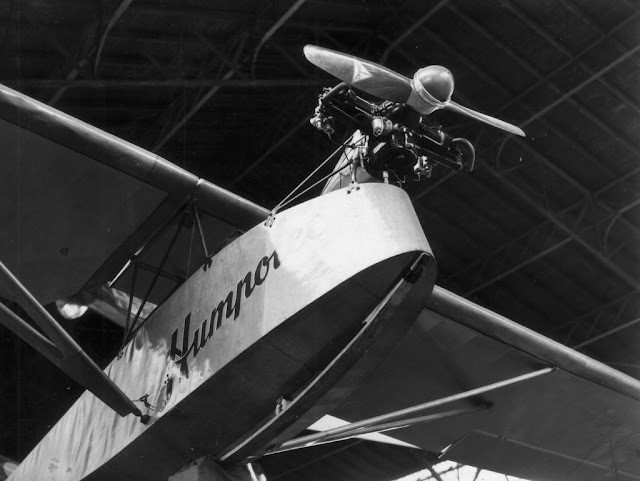
The most famous motorized Gray Wolf was “Humpolec I” from 1937. An active MLL branch has been operating in the town of the same name since 1934. It was created spontaneously after Ludvík Elsnice’s lecture on sport flying and non-motorized in particular, which was organized for the public by the local Sokol Committee in the spring of 1934. Members of the local branch of the MLL with instructor Mr. Karel Doubek began flying the glider in 1934. Later, they acquired another glider Zlín V and school glider “Kamarád”. In October 1936, the construction of the Gray Wolf began in the workshops of MLL Humpolec. It was to be motorized from the beginning. The members of the local branch decided to address the issue of engine location somewhat differently than the original design had envisaged. They installed the engine on the bow, not on the ready handles on the wing canopy. The designer of this change was Jiří Smrčka. It involved necessary modifications to the basic design of the EL-2M. The external dimensions of the glider have been retained, but the longitudinal members have been strengthened, diagonals have been added to the fuselage, the wing has been moved partially forward and both seats to the rear to maintain the center of gravity. The Walter Atom was placed on a tubular bed above the front of the fuselage. According to some sources, the fuel tank was located in the bow, but the photos from the flight show the location in the center of gravity between the seats for the pilot and the passenger.
Virtually all members of the then (and members!) MLL gliding department in Humpolec took part in the construction, the witnesses highly praise Mr. Karel Dvořák – carpenter and Mr. Stanislav Prokop – mechanical locksmith. According to records from the time of construction of the glider, approximately 1,800 hours were worked on its production and the total construction cost was CZK 24,000. The costs were largely covered by a subsidy from the Ministry of Public Works, which is not so surprising in this case, considering that the chairman of the local Humpolec branch of MLL was the then district governor, Mr. Jaromír Němeček.
The flight was carried out on 11 April 1937 by Ludvík Elsnic himself, while a load in the form of a 50 kg sandbag was placed on the second seat. The first start using a rubber rope with an engine running at full throttle took place on a small hill behind Humpolec between the roads to Jiřice and Brunka. There are a number of photos. Ludvík Elsnic was allegedly very satisfied with both the flight characteristics and the workshop design, as well as with the solution of placing the auxiliary engine on the bow. Many others flew after him the same day. Then the glider received a new “coat” with a large inscription “HUMPOLEC” on the fuselage and was ceremoniously baptized on Sunday, May 17, 1937 in Humpolec, surrounded by, among other things, gliders Zlín IV and Z-V and glider “Kamarád”. The ceremony began at 10:00 in the morning on the Upper Square. The protector of the baptism was Division General Ing. Jaroslav Fajfr, other guests were the famous pilot Maj. Hess, the then mayor of Humpolec, Jan Šimek, etc. The district governor, Mr. Jaromír Němeček, was present at the baptism as the chairman of the local branch of MLL. The baptism itself was performed by Mrs. Růžena Motejlová by placing a bouquet of flowers on the cabin of the glider. The “Atom” engine was also started demonstratively. Sergeant Motyčka demonstrated over the square in an Avia 122. An abridged audio recording of the entire baptism was broadcast on national radio the same afternoon. In addition to photographs from the baptism, there is reportedly an amateur film.
In mid-June 1937, together with other aircraft “Humpolec” was exhibited at the National Air Show in Prague, where it flew “along its axis” with the pilot L. Elsnic. After the show, he flew from Kbel Airport. It was flown back to Humpolec by the then leader of the MLL promotional squadron, Capt. Uncle. “Humpolec” flew, piloted by Mr. Smrčka, Rudolf Steyskal and others, and became quite popular in the republic. Even well-known gliders from Prague, such as Stejskal, Vahala and others, even came to Humpolec to fly a glider. Among other things, the well-known acrobatic pilot Sergeant Motyčka, a member of the acrobatic group Cpt. Fr.Novák.
In 1937, the Gray Wolf flew for about 30 hours without any problems. Even in 1938, “HUMPOLEC I” served the Humpolec without any problems. On June 16, 1938, this EL-2M was demonstrated at Rané to President Beneš, who visited the airport. At that time, the glider was already equipped with a windshield and the propeller received a spinner. It was part of the last gliding races on Raná before the war.
The use of the Humpolec motorized Gray Wolf in Czech hands was not ended until the occupation by Germany in 1939. The last flight in Czech hands was completed by “HUMPOLEC I” on March 13, 1939. The Germans came to Humpolec on March 16. They took the glider to the airport in Německý Brod and allegedly flew there until it was destroyed.
The plywood cover on the back of the fuselage is relatively weak, which in some modes allegedly caused the “tail” to twist imperceptibly, but this is not at the expense of safety. The minimum landing speed is about 40 km / h. For motorized versions, the flight characteristics depended on the load (mostly single-pilot engine versions flew, only in Moravská Ostrava it was used more regularly as a two-seater), engine power, propeller type and efficiency and, last but not least, weather, especially air temperature. The motorized versions all started with a rubber rope or autostart, they were not able to do so on their own.
The Walter Atom engine from “HUMPOLCE I” was discovered in Waltrovka in 1945 and returned to the Humpolec gliders. It was built into the prototype “HUMPOLEC II”, which was Pitrman’s second-hull. Construction of a two-seater motor glider with a thrust engine in the fuselage nacelle. The new glider was never completed.
Another motorized version was a copy of the Gray Wolf from MLL Lysá nad Labem. In 1938 they used a two-stroke inverted two-cylinder Pejšek JPK-20 (established in 1937 at the company Josef Pejšek Kralupy nad Vltavou) with an output of 15 kW (20 hp) at 1700 rpm. Again, it was a classic installation above the wing canopy. The engine was arranged as a push, the engine bed was designed as an aerodynamic cover with an integrated gas tank. The motorcycle worked reliably, according to period information, the glider climbed very well with it. In July 1938, pilot Jindřich Hnilička reached an altitude of 2800 m. By the end of 1938, this Gray Wolf allegedly flew for 21 hours to the complete satisfaction of its owners. However, the occupation in March 1939 also marked the end of his career.
The staff of the Aviation Museum in Kbely had been trying to get this glider into the collections since the beginning of the museum’s existence. They once received word that there was an unfinished copy of the Gray Wolf in Humpolec in the 1950s. However, it turned out that nothing of it had survived in the early 1970s.
In the spring of 1972, the museum staff established contact with the creator of the EL-2M, Ludvík Elsnic. As a witness to the beginnings of our sailing, he handed over a number of rare photographs and other documents to the museum. Of course, there was also talk of the Gray Wolf. “Then I’ll come on Thursday and describe the negatives!” said goodbye once as he left the museum. And on Thursday, August 9, 1972, he came. He was carrying a package in his armpit. “My mistress has such a good memory! I mentioned the Gray Wolf at home, and she says: You, Ludvík, there are some drawings in the attic! And they were.”
Several months have passed. In mid-October 1972, two museum workers went to Slovakia to search for the Avia C-2 aircraft. Unsuccessfully. The road also took them to Trenčín. And when they were in Trenčín, they went to see “Uncle” Kralovič, a well-known Slovak aeroclub glider. Coincidentally, the existence of the Gray Wolf’s drawings was mentioned. “Send them to me, I’ll see what they think could be done. I promised you something to do in the museum anyway,” Anton Kralovič offered. And so at the end of October, the drawings of the Gray Wolf came to Trenčín. In November 1972, a rudder, wing ribs, fuselage bulkheads, etc. began to be built in the Kralovič apartment.
Gradually, word spread among the “air people” that a Gray Wolf was being built in Trenčín. Perhaps this also contributed to the phone ringing in the Kbel Museum in mid-January 1973. Called Pavel Vančura, then editor of the Aviation and Cosmonautics magazine.
“His colleague Luděk Štětka from the World of Engines editorial office, looking at photos of old gliders, including the Gray Wolf, said that his uncle had a similar plane at home in the attic.” The reaction of the museum staff was quite normal. In cooperation with the L + K editorial office, they set out to verify this track as soon as possible. On January 25, 1973, the search party headed to the address: Josef Duben, Lipí u Náchoda. But no one was home at the address given. Mr. Duben worked part-time on the ski lift. Fortunately, the searchers discovered his wife, and she willingly let the “guests” into the ground. “There really were wings of an old glider, but the fuselage was missing. To a timid question, whether somewhere by chance…. Mrs. Dubn replied, “Yes, there is something else in the shed, we wanted to burn it!”
To everyone’s delight, it was really the hull of the Gray Wolf! Nobody even expected such a successful completion of the search operation. Even Anton Kralovič did not want to trust the telegram to stop the construction of the replica that the original Gray Wolf had been found. Until he received an invitation to take over the “wolf” for repairs, he lived in fear that he had fallen victim to a bad joke.
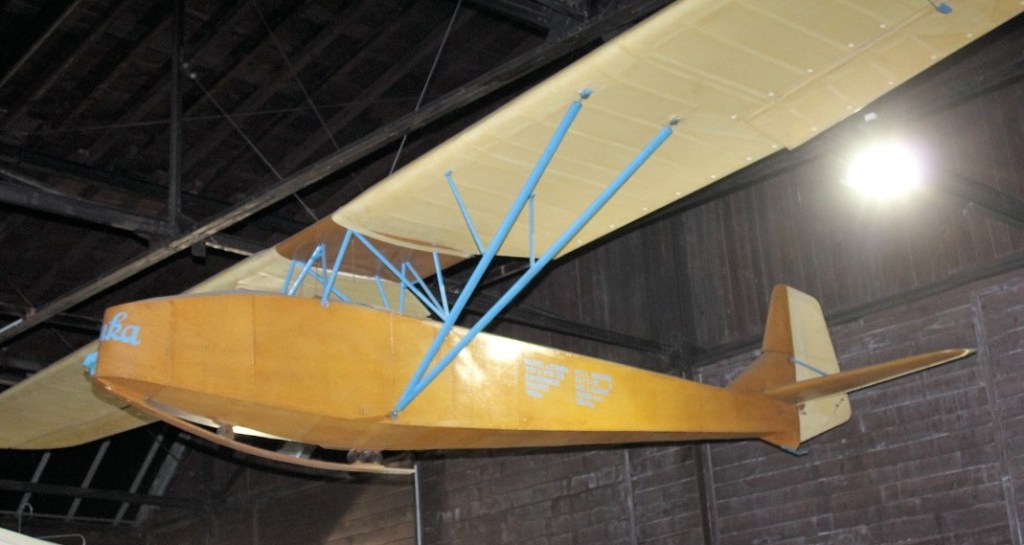
And so, on February 9, 1973, L. Elsnic, Anton Kralovič, the editors of L + K and the staff of the Aviation Museum met in Lipí u Náchoda with Mr. Josef Dubn. Josef Duben donated the EL-2M glider. However, it was characteristic of Czech conditions that he had previously offered a glider to the then National Technical Museum, and that did not even answer him. Individual parts of the glider left their hiding places in the attic and shed in Lipí, moved to the back of a truck, and traveled to Trenčín at night. Another was already the work of a group of enthusiasts from the Trenčín Aeroclub led by Anton Kralovič. It was necessary to peel off all coatings, repair ribs and partitions, then coat everything again and finish the surface treatment. Some newly made parts according to drawings by Ludvík Elsnice were used, such as a rudder, but many parts were additional. However, no one was in a bad mood, the Gray Wolf was, and it was original! After six months of intensive work after working hours, on Saturdays and Sundays, the repair of Gray Wolf No. 5 was completed. Anton Kralovič never admitted it, but witnesses claim that he “jumped” into the air with the repaired Gray Wolf before his transfer to Prague. The glider was transported to Kbel on August 9, 1973. He spent nineteen days folded in an exhibition on the ground, then was definitively assembled and hung under the ceiling of the hall. It left this place only once, when moving to the newly opened hall – a hangar of the Wagner type, in which the museum exhibits aircraft focused on the period 1918 – 1938.
A search of the history of the preserved Gray Wolf specimen gradually revealed that this was indeed the fifth piece produced. It was completed at the beginning of 1935 (some sources speak only of 1936, but Mr. Duben insisted on 1935, which would correspond to the assigned serial number) from the funds of the local group MLL in Náchod. He was given the name “Dinka” (bears them on the bow) after the then necessary patron, who paid a quarter of all expenses. “Two young boys from Letov” came twice everywhere to supervise the construction. According to Josef Dubn, Mr. Bergman from Náchod also indirectly helped in the construction, giving the sailors free to eat at the time. Even the money saved in this way went to the construction of the glider.
It is not known today where the fifth Gray Wolf specimen flew. Among other things, it took off in Hradec Králové with the help of autostartes at the military training ground, Na Žďárkách, in the vicinity of Náchod and elsewhere. Surprisingly, it flew the most in the winter, as in the summer the local farmers levied charges for destroying the grass. “Šeďas” flew to the full satisfaction of the local MLL gliding unit until the war. With the arrival of the Nazis, it “disappeared” and spent the entire war in the double wall of Mr. Dubn’s barn. It flew again after the war, but only sporadically. Witnesses recalled that, probably due to the unretained coating of the upholstery canvas, its glide on the slope was significantly lower than that of the Grünau Baby flying at the same time. The last time it flew on May 1, 1949, it was actually black. It flew 10 minutes on the slope, and it was probably the last ten minutes in the history of this glider, if we disregard his unconfirmed jump after the repair in Trenčín in 1973.
In the summer of 2005 Ing. Ivo Pujman (from Beroun) looked into possibilities to finish a replica of this glider, which he and his friend Josef Dlouhy began building.
Span: 13.5 m Length: 6.8 m Wing chord: 1.36 m Wing area: 18 sq.m Elevator span: 3.5 m Empty weight: 130 kg Flight weight: 200 – 330 kg Wing load: 11.1 – 18.33 kg / sq.m Min. descent 1 person: 0.95 m / s Min. descent 2 person: 1.3 m / s
EL-2M Humpolec Empty weight with fuel: 200 kg Take-off weight with fuel max: 340 kg Climb: 1 – 2 m / s Cruise speed: 100 km / h
EL-2M from MLL Lysá nad Labem Ceiling: 2800 m Consumption: 7 l / hour of flight
After Ben Ellison reviewed a Widgeon, Ben & Marty Ellison, & Ross Mahon designed the Gewduck around the Widgeon’s shortcomings and, one by one, eliminated them. They started designing the aircraft in 1990. The design involved a hired structural engineer and coaching from David Thurston, and the goal was an airplane that could carry 6 people and 300 lb of cargo.
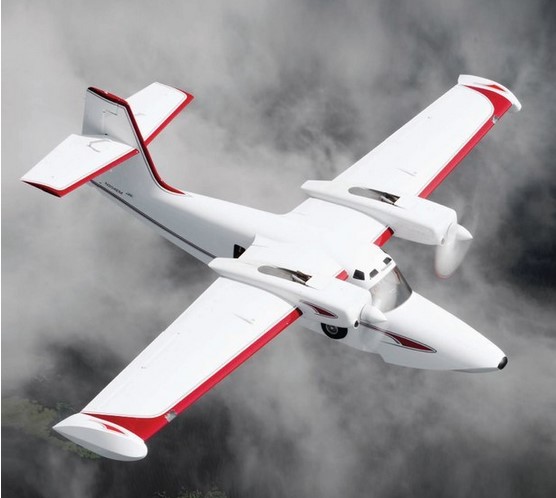
Gweduck twin engine, six place, 600 hp amphibian. Construction is fibreglass, vinyl-ester resin and carbon fibre. All of the Gweduck’s akins are glass-foam-glass sandwiches of varying thicknesses. The fuselage sides and the wing skins are 3/8 in thick with the closed-cell, polyurethane Last-A-Foam (commonly used in the boating industry).
The landing gear borrows heavily on Grumman concepts with machined billet A-arms pulling the oleo struts up into the fuselage sides and the sealed landing gear wells.
The fuselage basically uses three moulded parts: the sides, the aft bottom, and the forward bottom ahead of the step, which is ¾ inch thick. The entire hull is totally sealed.
The windshield is 3/8 in thick to transfer some of the bow loads up to the top of the hull.
The fuselage is designed to be hosed out with salt water to wash. There is no metal from shoulder-level down, and everything drains into the bilge and is pumped overboard.
The wing has two molded-sandwich skins, top and bottom, and the molded ribs are bonded to the lower skin while it’s still in the mold. The spar is two C-sections back-to back with carbon fibre caps. They bolt the C-sections together and insert 3/8 in aluminium plates between the webs where the wings bolt into the fuselage. Once the top skin is bonded on, the bolts joining the spar halves are superfluous.
The main spar is at 39% and there is a front spar at 10% chord. The leading edge is non-structural for easy repair.
The airfoil is a 15% thick Ribblet, and the ailerons are linked to the flaps, so they go down 15 degrees as the externally hinged Fowler flaps come down 30 degrees.
All of the fuel is in the wings with none in the fuselage. The normal capacity is 200 USG but outboard auxiliary tanks increase the total capacity to 360 USG.
Engines: 2 x Lycoming IO-540, 300 hp Prop: MTV-9, reversible Wing span: 52 ft 6 in Span floats down: 48 ft Height: 10 ft 10 in Empty weight: 4200 lb MAUW: 6000 lb Fuel cap: 200 USG + 180 USG aux Cruise speed: 100 kt Fuel burn econ cruise: 19.5 USG/hr Seats: 6 Power loading: 10 lb / sq.ft Wing laoding: 20 lb/sq.ft
The first three marks of Olympia, which formed the bulk of the production of this type, differed little from the DPS Meise, but in the 1950s Elliotts began development of a new family of high performance Olympia variants incorporating laminar flow wings, and leading to the Olympia 419, which was sufficiently different from the first three marks of this design as to be almost a new type.
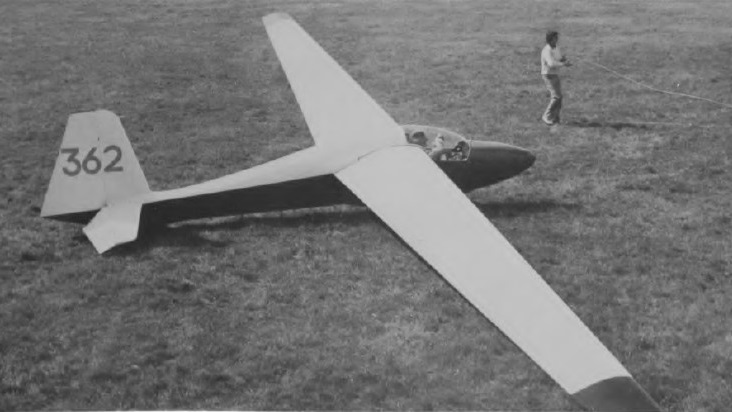
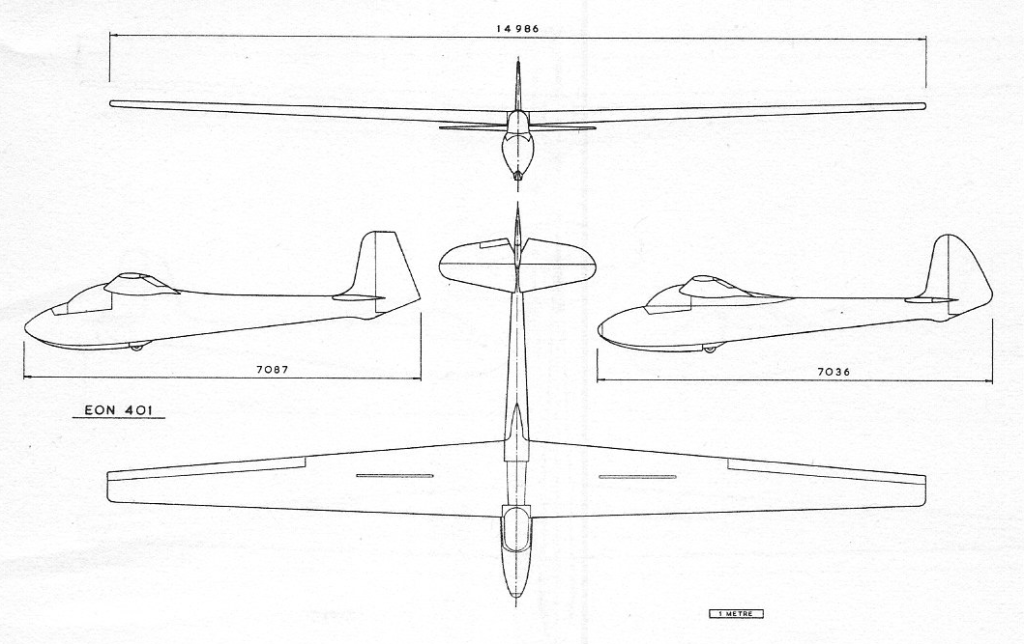
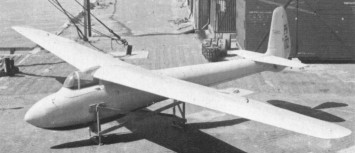
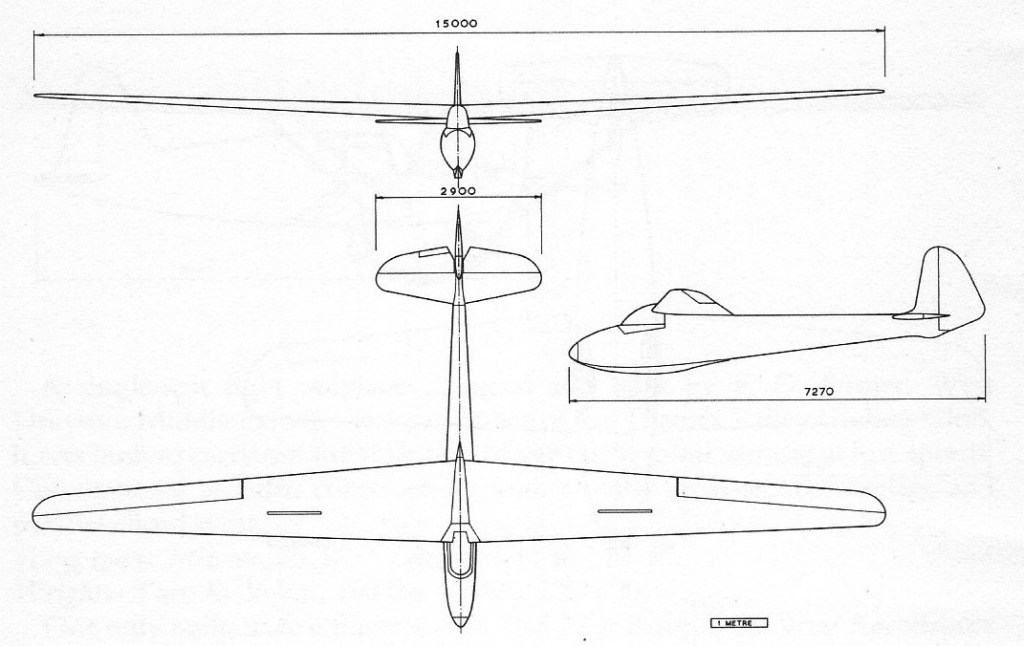
First of these new variants was the Olympia 4, later known as the 401, first flying in 1954, which was a Mk 2, G-ALNF, fitted with a laminar flow wing of NACA 64-series section, identical in span (15m) and plan form to the previous wing. The 401 had a revised fuselage nose section, square-cut rudders and elevators. Frise ailerons were featured but these were found to have only marginal power at low speeds and, after the 401’s debut in the 1954 World Gliding Championships, these were enlarged and the wing itself modified. G-ALNF was then fitted with a 17m span wing of the same aerofoil sections at root and tip, thus becoming the Olympia 402; aileron chord and span were increased. It was flown by Bill Ivans of the USA into fifth place in the 1956 World Championships, but was lost in an accident on the last day of the competition.
For the 1956 World Championships the Olympia 4 prototype was converted to 17 m / 55 ft 3.5 in as the Olympia 402.
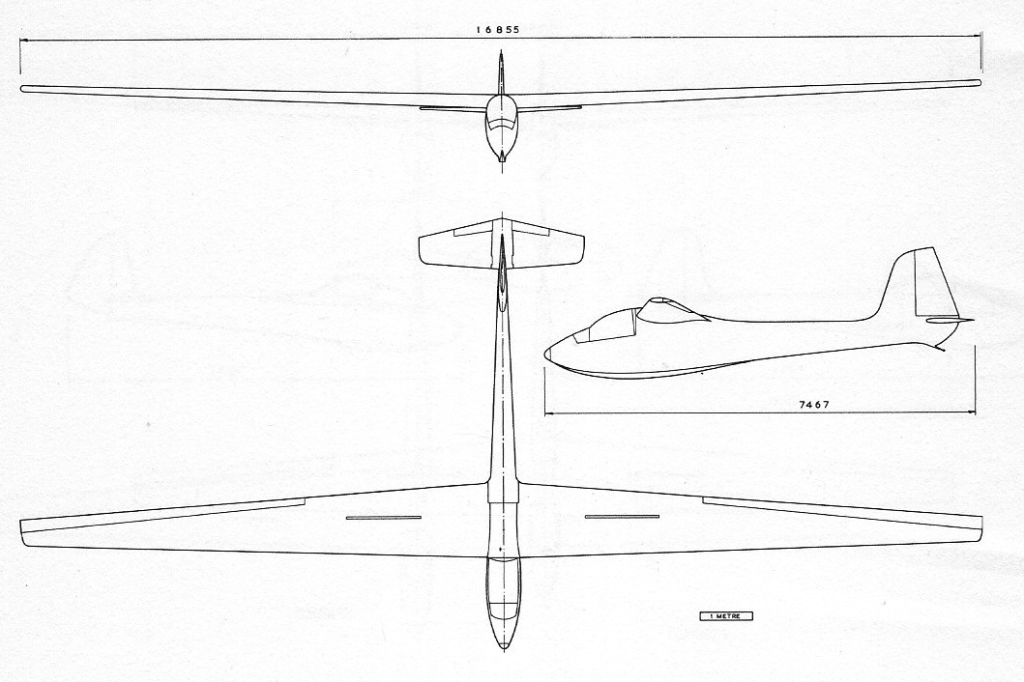
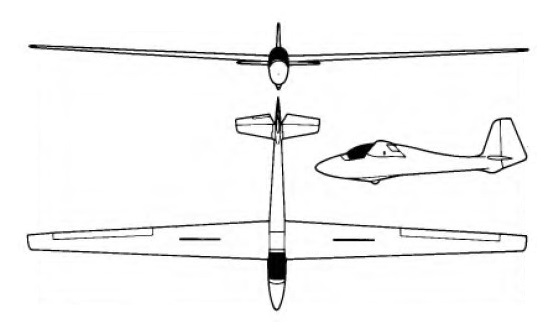
The Olympia 4 / 401 was succeeded by the Olympia 403 prototype, G-APEW, which retained the 17m span wing with a slightly thickened root but introduced some important design changes; this made its debut at the 1957 British national championships. The tail surfaces were entirely redesigned with increased area, the tailplane now being an all-moving surface which could be hinged upwards for transport. It had an anti-balance and trimming tab which at first covered the full span but was later reduced to half span. The fuselage was extended 10in forward by inserting an extra bay between the main bulkhead and the cockpit, and both the cockpit canopy and fuselage ‘neck’ were widened, that part of the fuselage under the wing being redesigned. The first flight of the 403 was in 1957.
The 403 was subsequently fitted with type 419 tailplane.
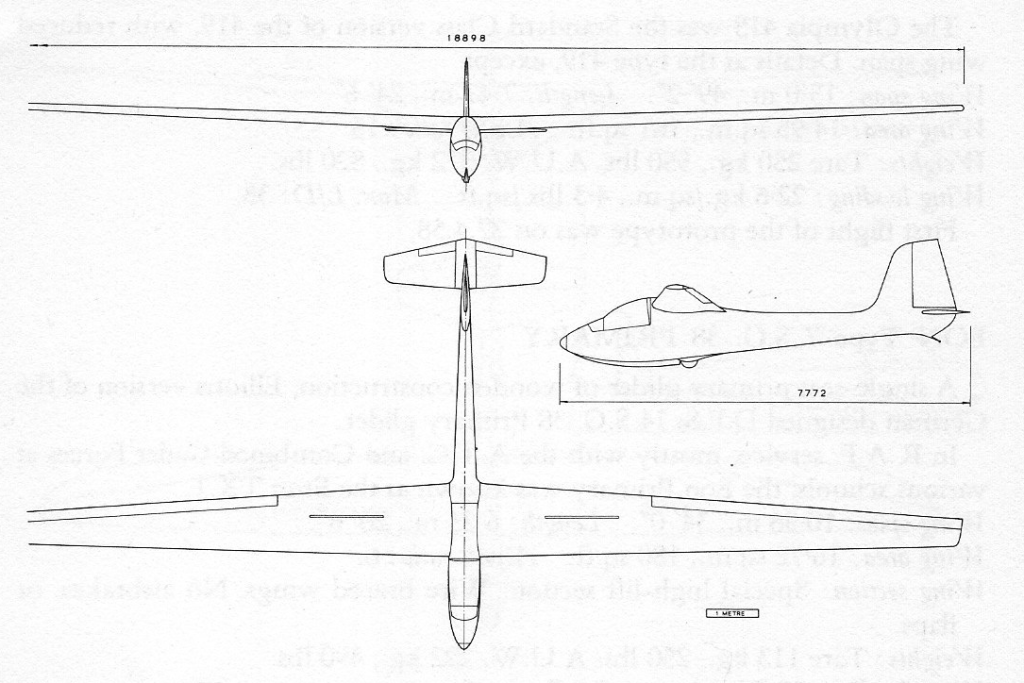
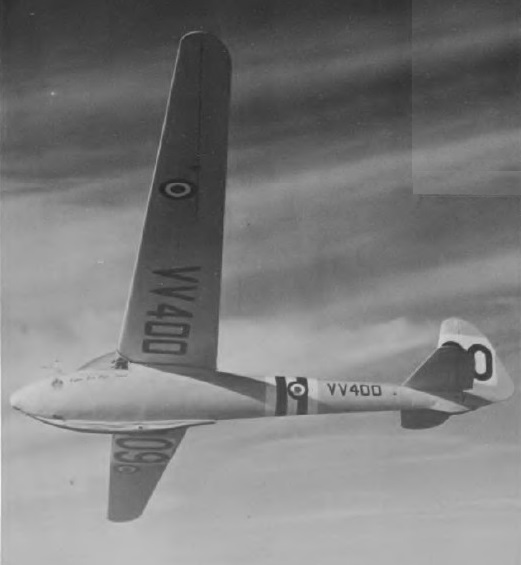
The next variant was the Olympia 419, which had the wing span increased to 18.9m (62ft), longer span Frise ailerons, a slightly longer nose than the 403 and greater rudder area, these changes giving better low speed performance and tailplane balance than the 403. The NACA 64-series laminar flow wing section was used. The 419 was constructed mainly of spruce, and all surfaces were covered by birch ply except for the rudder, tailplane and wings inboard of the ailerons. Balsa wood was used extensively as a filling for the wing ribs and as a non-structural material for wing tips and fairings.
The undercarriage consisted of a jettisonable twin wheel main unit and a tailskid, and the main landing skid under the forward fuselage was of stainless steel. Both the Olympia 419 prototype and the Olympia 415, which was a 15m span version of it, first flew in 1958; the latter did not go into production but the 419 was marketed at a price of £2,150 and in the end eight were built. These put up some good performances in both World and British National championships flown by such pilots as Nicholas Goodhart and Peter Scott.
On the 419X there was a main skid only, with droppable wheels.
The Olympia 415 was the Standard Class version of the 419, with reduced wing span. The first flight of the prototype was on 27 April 1958.
Variants:
EoN Type 5 Olympia 4 New wing section Wingspan: 15.0 m / 49 ft 2 in Length: 7.27 m / 23 ft 10 in Wing area: 15.33 sq.m / 165 sq.ft Aspect ratio: 15 Wing section: NACA 64,3 618 root / 64,4 421 Empty weight: 204.12 kg / 450 lb AUW: 322.0 kg / 710 lb Max L/D: 36
EoN Type 5 Olympia 401 Revised 4, with new nose and square-cut empennage. 180 mm (7 in) shorter. Wingspan: 15.0 m / 49 ft 2 in Length: 7.09 m / 23 ft 3 in Wing area: 15.33 sq.m / 165 sq.ft Aspect ratio: 15 Wing section: NACA 64,3 618 root / 64,4 421 Empty weight: 204.12 kg / 450 lb AUW: 322.0 kg / 710 lb Max L/D: 36
EoN Type 5 Olympia 402 As 4, modified for 1956 World Gliding Championships with 17.0 m (55 ft 3.5 in) span. Wingspan: 17.0 m / 55 ft 3.5 in Length: 7.27 m / 23 ft 10 in Wing area: 15.33 sq.m / 165 sq.ft Wing section: NACA 64,3 618 root / 64,4 421 Empty weight: 204.12 kg / 450 lb AUW: 322.0 kg / 710 lb Max L/D: 36
EoN Type 6 Olympia 403 1957 development of Olympia 402, with strengthened and shortened fuselage (7.47 m (24 ft 6 in). New fin and rudder, all moving tailplane.
Eon Type 6 Olympia 415 1958 Standard class (15.0 m (49 ft 3 in)) span version of 419. Span: 49 ft 3 in / 15.0 m Length: 24 ft 6 in / 7.47 m Wing area: 161 sq.ft / 14.95 sq.m Aspect ratio: 15 Empty weight: 550 lb / 250 kg Max weight: 820 lb / 372 kg Wing loading: 22.6 kg/sq.m / 4.3 lb/sq.ft Min sinking speed: 1.84 ft/sec at 46 mph Best glide ratio: 35:1 at 52 mph
Eon Type 6 Olympia 419 / 419X Long span, long fuselage version of 403. Span: 62 ft 0 in / 18.9 m Length: 25 ft 6 in / 7.77 m Wing area: 186 sq.ft / 17.28 sq.m Aspect ratio: 19.9 Empty weight: 606 lb / 275 kg Max weight: 900 lb / 408 kg Wing loading: 21 kg/sq.m / 4.3 lb/sq.ft Min sinking speed: 1.84 ft/sec at 46 mph Best glide ratio: 38:1 at 52 mph
EoN 463 Span: 49 ft 2.5 in / 15.0 m Length: 21 ft 0 in / 6.4 m Height: 5ft 8 in Wing area: 132 sqft / 12.26 sq.m Aspect ratio: 18.0 Wing section: NACA 643618/421 Empty weight: 400 lb / 181 kg Max weight: 630 lb / 286 kg Water ballast: None Max wing loading: 23.33 kg/sq.m / 4.78 lb/sq ft Max speed: 136 mph / 117.5 kt / 218 km/h (in smooth air) Max rough air speed: 74 kt / 137 km/h Stalling speed: 30 kt / 56 km/h Min sinking speed: 2.2 ft/sec / 0.67 m/sec at 42.5 mph / 37 kt / 69 km/h Best glide ratio: 32:1 at 48 mph / 42 kt / 78 km/h
Just after the war, when sporting gliding was getting started again, it was evident that there would be a need for new sailplanes to supplement the surviving prewar ones, and to fill the gap until such time as postwar designs could go into production it was a logical step to build some of the best German prewar designs, some captured examples of which had been brought to Britain, in British factories.
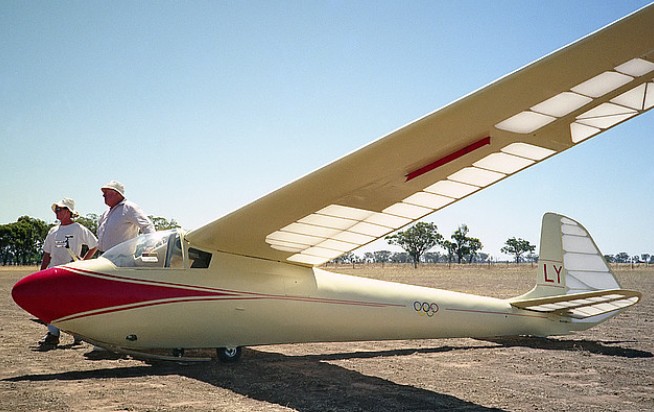
A combination of a desire to make use pre-war glider experience and refusal by the Board of Trade to allow Elliotts to return to its prewar furniture-making activities led to a decision to enter glider manufacturing, starting with the production of an improved version of the well known DPS Meise known as the Olympia. The Olympia’s heritage goes back to when Hans Jacob’s glider won the contest to design a standard glider for the 1940 Helsinki Olympic Games (hence the Olympia name). Elliotts of Newbury took up the production of an internally modified version of this glider after the war, with the first example flying in mid January 1947.
This was originally to have been built in Britain by Chilton Aircraft Co Ltd, makers of the prewar DW1 ultralight, but after building a prototype, first flying in January 1947, Chilton disposed of the manufacturing and sales rights and associated drawings to Elliotts in 1952.
An initial production batch of 100 was started; the type soon proved to be popular with private owners and clubs, also being exported to a number of countries.
A single-seat sailplane of conventional wooden construction, Elliots improved and developed version of the Chilton Olympia, The Olympie 1 had no flaps, but airbrakes were fitted. The undercarriage was the main skid, plus tail skid. The prototype had its first flight at White Waltham on 17 January 1947, and the price in 1947 was £495.
The Olympia was built in three versions differing only in the landing gear; the Mk 1 had a central steel-sheathed ash skid under the forward fuselage very similar to the Meise’s, while the Olympia 2 had a built-in fixed central monowheel and the Mk 3 had a jettisonable dolly wheel landing gear.
A one-piece quickly detachable bubble canopy for the pilot with a sliding ventilation and clear-vision panel on the port side replaced the Meise’s framed canopy, and there was an aerobatic harness and provision for a back-type parachute.
Otherwise the Olympia is very similar to the Meise; the high cantilever wings are of wooden construction with plywood and fabric covering, with D-spars in the leading edge and DPS air brakes, while the wooden ailerons are fabric-covered. The all-wooden monocoque fuselage has a luggage compartment under the wing root with an access door on the port side. The tail unit is of wooden construction with plywood and fabric covering, and there is a trim tab in the starboard elevator. Price of the Olympia 2 in 1960 was £850.
Six Olympia gliders were built by Fokker under licence.
Olympia 1 Wingspan: 15.0 m / 49 ft 2 in Length: 7.27 m / 23 ft 10 in Wing area: 15.33 sq.m / 165 sq.ft Aspect ratio: 15 Wing section: Gottingen 549 root / 676 tip Empty weight: 204.12 kg / 450 lb AUW: 303.9 kg / 670 lb Wing loading: 20 kg/sq.m / 4.09 lb/sq.ft Max L/D: 25 Min sink: 0.67 m/sec at 63 kph / 2.2 ft/sec at 39 mph
Olympia Mk.II Span: 49 ft 2.5 in Length: 21 ft 5 in Wing area: 161.5 sq.ft Aspect ratio: 15.0 Empty weight: 430 lb Max weight: 670 lb Max speed: 129 mph Min sinking speed: 2.2 ft/sec at 39 mph Best glide ratio: 25:1 at 45 mph
Olympia 2B Wing span: 15.0 m (49 ft 2.5 in) Length: 6.61 m (21 ft 8 in) Wing area: 15.0 sq.m (161.5 sq ft) Wing section: Gottingen 549/676 Aspect ratio: 15.0 Empty weight: 195 kg (430 lb) Max weight: 304 kg (670 lb) Water ballast: None Max wing loading: 20.27 kg/sq.m (4.15 lb/sq.ft) Max speed: 112 kt (208 km/h) Stalling speed: 27 kt (50 km/h) Min sinking speed: 0.67 m (2.2 ft)/sec at 34 kt (63 km/h) Max rough air speed: 69 kt (128 km/h) Best glide ratio: 25 at 39 kt (72.5 km/h)