F&FW Diamant / Swiss Federal Institute of Technology Ka-Bi-Vo / HBV Diamant

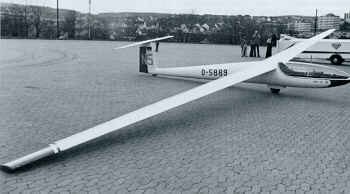
Diamant 18

The ideal of an all-glassfibre sailplane was achieved in several stages, the first being development of the fuselage and tail unit designed by Thomas Bircher and J von Voornveld at the Swiss Federal Institute of Technology in Zurich under the direction of Professor Rauscher. A prototype fuselage was built in 1962 and was flown with the plywood and fabric wings of a Schleicher Ka 6CR, the resulting aircraft being designated Ka-Bi-Vo.

The Diamant’s development was now gradually taken over by Plug- und Fahrzeugwerke AG FFA, and the next stage was the HBV-Diamant 15 which used the 15m span Hutter H-30TS wings of the Glasflugel H 301 Libelle. This first flew on 5 September 1964 and 13 of this variant were subsequently built; the Libelle’s wings being glassfibre balsa sandwich shells without ribs, featuring ailerons that gave partial downward movement when the flaps were lowered, and there were glassfibre dive brakes forward of the flaps.

The HBV-Diamant 15 was followed by the generally similar Diamant 16.5, with wings of increased span (16.5m) designed and built by FFA; a total of 41 of this variant were built. This was the first all glass fiber production sailplane, not using balsa or other wood sandwiched between the fiberglass layers.

1967

The Diamant 18 is an 18 m development of the 16.5, first flying in February 1968, with extended inboard wing and flap sections and a new wingtip cap. like the Diamant 16.5, water ballast an be carried in the wing roots. The monocoque fuselage is an epoxy-glassfibre sandwich with foam inserts, and the tail unit is of the same construction, the allmoving one-piece tailplane being mounted on top of the fin. As well as a small tailwheel (a tailskid is optional) there is a manually-retractable monowheel with a brake, and another feature is a glassfibre ring spring shock absorber; the tow release retracts with the landing gear. The pilot sits in a semi-reclining position under a long forward sliding one-piece canopy, and there is provision for radio and oxygen.

At least one Diamant 18 was substantially modified by Dan Pierson of Los Angeles, CA to have a 19.0 m / 62.3 ft wing carrying 145 kg / 320 lb of water ballast bringing the gross weight up to 673 kg/ 1,480 lb.

The HBV Diamant and Diamant 16.5 are ATC, while the Diamant 18 is EXP.

A powered version of the Diamant 18 known as the EFF Prometheus 1 made its first flight on 21 June 1971, powered by a 176lb st Microturbo Eclair II turbojet mounted behind the cockpit. The Prometheus was developed by EFF – Entwicklungsgemeinschaft fur Flugzeugbau der Akademischen Fluggruppe, and it was later converted back to a standard Diamant 18.

Variant:
EEF Prometheus 1

Diamant 16.5M
Wing span: 16.5m / 54.2ft
Wing area: 12.2sq.m / 143sq.ft
Empty Weight: 270kg / 595lb
Payload: 138kg / 305lb
Gross Weight: 408kg / 900lb
Wing Load: 30.91kg/sq.m / 6.29lb/sq.ft
Water Ballast: 0
No. of Seats: 1
No. Built: 43
L/DMax: 42 100 kph / 54 kt / 62 mph
MinSink: 0.55 m/s / 1.80 fps / 1.0 kt
Aspect ratio: 20.5
Airfoil: Wortmann FX-62-Z-153

Diamant 18
Wing span: 18.0 m / 59 ft 0 in
Wing area: 14.28 sq.m / 153 sq.ft
Airfoil: Wotmann FX-62-Z-153 mod.
Length: 7.72 m / 25 ft 4 in
Height: 1.35 m / 4 ft 5 in
Empty Weight: 280 kg / 617 lb
Payload: 160 kg / 353 lb
Gross Weight: 440 kg / 970 lb
Water ballast: None
Wing Load: 30.8 kg/sq.m / 6.34 lb/sq.ft
Max speed: 149 mph / 129 kt / 240 km/h
Max rough air speed: 108 kt / 200 km/h
Stalling speed: 32.5 kt / 60 km/h
MinSink: 0.52 m/s / 1.71 fps / 1.01 kt at 45 mph / 39 kt / 72 km/h
L/DMax: 45 at 100 kph /54 kt / 62 mph
Aspect ratio: 22.7
No. of Seats: 1

Florov 4302

By 1944 Dushkin, who was working on the NII-1 of the NKAP, created a new version of the RD-2MZV reactive engine. This new power plant used a fuel pumping system, consisting of kerosene and nitric acid. Its main feature was the presence of two chambers, a large 1,100 kg thrust and a small 300 kg.

This allowed taking off and reaching the maximum height with the two chambers and then using the force of the small one in horizontal flight. This was able to save fuel and achieve a considerable increase in engine operating time.

Initially it decided to install this engine in the interceptor “Malyutka” of NN Polikarpov, which was projected in 1944, but his sudden death did not allow the builder to finish the job.

During state tests of the RD-2MZV, developed in May 1945, a joint thrust force of 1500 kg was achieved at take-off, 1250 kg as normal thrust and 500 kg as minimum thrust. Working only the small chamber, a thrust of 300 kg was achieved and the minimum thrust was 100 kg. The weight of the engine with all its aggregates reached 224 kg. The production of 30 power sets was approved with the delivery of the first on March 10 and the last on August 10, 1946.

Factory No. 165 was selected as the engine manufacturer, which was to work closely with other plants. Assembly and control tests were entrusted to the NII-1.

At that time, the experimental aircraft with a liquid reactive engine designed by IF Florov was already being built in the NII-1. This aircraft had begun to be projected two years ago, when by GOKO resolution No. 5201 issued on February 18, 1944, the Reactive Technique Institute (NII-1), transferred to the NKAP, was given the task of dedicating itself to the development of reactive engines. The leadership of the NII-1 was assigned to the head of the NII VVS PI Fiodorov and as his replacement was appointed VF Boljovitinov.

The new managers of the NII-1 enjoyed aeronautical construction. For this reason, in parallel to the main tasks of the institute, linked to the creation of reactive engines by the Isayev and Dushkin collectives and turbojets by AM Lyulka, it was decided to build an experimental aircraft from a project developed by Boljovitinov and Florov. This task was approved by the 18 Principal Directorate of NKAP, responsible for the reactive technique.

It was proposed to build two variants of the aircraft: one with an Isayev powerplant, which was named “4302” and another with the Dushkin engine, which was named 4303.

According to the project, the “4302” should have a flying weight of 2320 kg. The maximum speed at sea level had to reach 1010 km / h (M = 0.82), 1015 km / h (М = 0.88) at 5000 meters and 1050 km / h (М = 0.99) at 15000 meters. The ascent time at 15,000 meters was calculated at 2 minutes 22 seconds and the practical ceiling at 18,850 meters. The expected flight time was 46 minutes.

Both projects were conceived to test the powerplant itself, as well as the aerodynamic characteristics of flying at high speeds. Another primary objective was the study of the pressure distribution laws by the wing profile and the calculation of overloads in flight, especially in turbulence generation areas.

It was planned to build a total of six copies of which the first two would be used for the preparation of the flight personnel and the rest for the development of the experiments.

The institute’s productive capacities were scarce, so the construction was contracted to Factory No.21 named in honor of Sergo Ordzhonikidze and located in Gorky city.

Working drawings were ready on 1 January 1946 and once delivered the factory started production. The first two were ready for delivery in March.

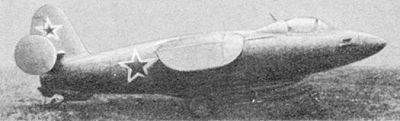
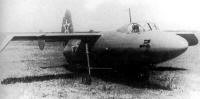
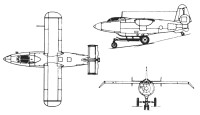
The “4302” was designed as an experimental all-metal monoplane. The wing design was straight, with a constant section throughout the span. In order to improve directional stability and reduce the effect of turbulence at high speeds, the wingtips were angled 45º downwards. The wing profile used was the TsAGI 13145 with laminar flow and thickness of 13%.

The fuselage, also metallic, had a cigar shape with a circular cross section, with a diameter of 1,150 mm at its widest part. At the bottom of the nose was the towing hook.

The tail unit was cantilever type and terminated in vertical washer-like surfaces. The empennage was constructively integrated into the fuselage. All the coating, including the rudders and ailerons, was metallic.

The landing gear was one of the most complex elements. For the first flights a fixed gear with three wheels obtained from a Lavochkin La-5 was used. Later, the “4302” was equipped with a retractable ski for landing and took off using an ejectable forklift. The landing ski was constructed of stainless steel and featured a hydraulic release system. In the middle portion of the ski profile were two grooves to fix the trolley, which was constructed of steel tubes.

The main 650x200mm wheels featured disc brakes. The 400x150mm double wheel front unit had a hydraulic damper. To reduce the lift of the truck once it was separated from the plane, the braking system was activated automatically after release. When the truck was detached, the ski was retracted.

By this time the leadership of NKAP had changed (instead of AI Shajurin, MV Jrunichev had been appointed) and this structure became the Ministry of Aviation Industry (MAP). The new MAP managers had a negative reception towards the plane, considering that the NII-1 had “meddled” in a task that was not within its competence. For this reason, as of February 1946, all financing for this project was withdrawn.

The new director Ya. L. Bibikov and VF Boljovitinov wrote directly to Stalin, explaining that at 1 April of 1941 the first issue of flight he was at 70% completion and continue the work the prototype would be ready for state tests for the month of July.

The vice-president of the Council of Ministers of the USSR, NA Bosniecienski, who after Malenkov’s departure, attended the aviation, ordered Khrunichev and Vershinin to seek a solution to the dilemma. Reluctantly, Khrunichev was forced to give in.

The new VVS chief, Marshal Vershinin reacted differently. On the one hand, he appreciated scientific work, especially in the field of military aviation, but on the other hand he was offended, since the experimental production plan was approved by the NKAP during the period of his taking office, he decided to support the NII-1.

Together with the new VVS chief engineer, IV Markov issued a communication in which he recognized the great value that an interceptor with these features would have for the VVS and requested that state tests be carried out in 1946.

In response, Khrunichev replied that the data presented by the NII-1 should be subject to a review and created a ministerial commission to do so.

The commission was chaired by Professor IV Ostoslavski and included the main builder of OKB-155, AI Mikoyan, the head of department of TsAGI VN Matvieyev, the group head of the 7th MAP Directorate, IV Loktiev and the head of the (Directorate of the MAP, VV Yakolievsky The result of the commission, presented in June 1946, yielded the following results:

“… the maximum speed of the plane will be between 900 and 950 km / h instead of 1000 – 1100 km / h and the ceiling will be limited to 12000 – 13000 meters instead of 20 000 m, due to the absence in the airplane from a sealed cabin. The duration of the flight presented in the letter is 46 minutes. The commission considers that the maximum flight autonomy will be 5 minutes. “

The commission’s results were based on the results obtained with the straight-wing Bisnovat 5, which had been unable to obtain the proposed speed. Florov replied that his aircraft had been designed with the latest strength requirements in mind and with the correct wing selection recommended by TsAGI.

Despite the commission’s report the MAP was instructed to finish and test the experimental specimen “4302”.

In response to the MAP meeting in September 1946, Khrunichev severely criticized the NII-1 leadership and demanded to reorganize the institute’s activity on a purely scientific and not practical profile. The minister ordered to separate the group of builders from the institute and give them a constructive base to continue their activity.

As the new director of the NII-1, MV Keldysh was appointed and in its new structure were three collectives: OKB-1 from LS Dushkin, OKB-2 from AM Isayev and OKB-3 from MM Bondaryuk and a department of gunpowder accelerators.

Jrunichev decision of the bureau of buildings Florov was renovated. The personnel and the productive base were placed under the direction of Bisnovat. Under these conditions, NII-1 survived one more year, until in 1948 it was absorbed by TsIAM. The Dushkin and Bondaryuk groups passed to this institute. Isayev’s group would go to NII-8 of the Ministry of Armaments, dedicating itself to the construction of reactive rocket engines.

By the fall of 1946 one in glider configuration without an engine) was ready for testing and was sent to the LII. Another Isayev-powered example was in the completion phase. Under pressure from the military, the MAP was forced to continue the construction of this copy to deliver it to the LII. With so much pressure, the works on the “4302” could not be carried out to the expected magnitude. It is stated that three examples were completed.

The flights were started in 1947. In total, 20 flights were executed, of which 19 were carried out in the version without an engine. The Isayev jet engine flight was executed by test pilot AK Pajomov in August. This flight started smoothly, but towards the end of the engine work pieces were damaged and nitric acid fumes filled the cabin.

Pajomov managed to land the plane. After this flight, the jet engine aircraft development program was closed. By then, significant progress had been made in the development of turbojet engines capable of high thrust.

After this Ilya Florov went on to dedicate himself to scientific activity, defended his candidacy thesis and later his doctorate, going on to direct a scientific group. He would never design airplanes again.

4302
Powerplant: A 1,100 kg thrust AM Isayev liquid reactive engine
Wingspan: 6,932 m
Wing area: 2 m²
Length: 7.152 m
Height: 3.06 m
Maximum takeoff weight: 2398 kg
Maximum speed achieved: 520 km / h
Calculated top speed: 950 km / h
Accommodation: 1
Flight Team Sinus

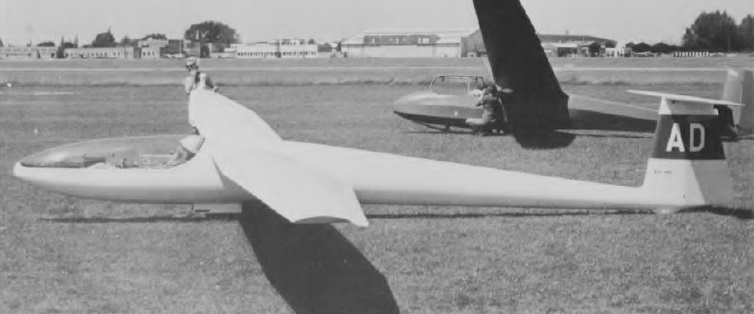
The Sinus is an all composite motorglider. The prop folds into a housing in the engine cver.

Engine: Rotax 503, 52 hp
Wing span: 14.95 m
Wing area: 12.80 sq.m
MAUW: 450 kg
Empty weight: 225 kg
Fuel capacity: 64 lt
Max speed: 186 kph
Cruise speed: 165 kph
Minimum speed: 55 kph
Climb rate: 3.5 m/s
Fuel consumption: 9 lt/hr
Certification: vVz
Seats: 2
Price (1998): 60 950 DM

Flightstar Spyder

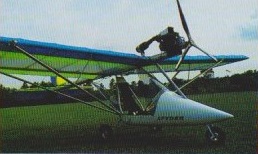
The Flightstar Spyder is a single seat Ultralight type aircraft. The light weight airframe allows maximum performance on minimum installed powerand the Spyder was designed to accept the Rotax 447 and 503 engines on Flightstar’s dynafocal type engine mount. The front fairing and windshield come as standard equipment on the Spyder. The Spyder features conventional three axis controls with full span ailerons, steerable nose wheel and side mounted control stick. The standard fuel tank has a 5 USG capacity with a 10 USG capacity tank as an option. Equipped with the Flightstar wingfold system, the Spyder is easy to assemble and easy to care for.

Standard equipment includes a 42hp rotax 447 aircooled engine w/cowling, composite front fairing w/tinted lexan windshield, high lift wing with streamlined struts, vibration isolated instrument panel, durable aluminum and stainless custom hardware, rugged chromemoly cage and landing gear, heavy duty stamped dynofocal engine mount, anodized airframe for corrosion protection, and 3 point pilot restraint harness.

Optional equipment includes a 48 hp Rotax 503 aircooled engine with supercowl, full instrument package, four point harness, complete electrical system, in-flight adjustable trim, 3 blade composite propeller, azusa drum brake system, rear floor pan, and brs ballistic parachute system. The Flightstar Spyder can be upgraded to full Formula configuration.

Optional equipment also includes the HKS 700E (680 C.C. 60 HP @ 6200 RPM) with 2.58 TO 1 reduction ratio. Propeller options include the Tennessee prop. co. 2-blade, 66” dia and IVO-prop. 3-blade 62”.
The airfoil is the Flightstar FS-I-2 12% thick.

Engine: Rotax 447FA, 42 hp
Reduction; 2.58-1
Wing span: 30 ft.
Wing area: 144 sq.ft.
Height: 7 ft 10 in.
Length: 16 ft 6 in.
Weight empty: 127 kg / 280 lbs.
Gross weight: 650 lbs.
Structural Limit W/Rotax 503: 750 lb
Fuel cap: 5-10 USG.
VNE: 83 kt / 96 mph / 154 kmh
Cruise 75%: 65 mph.
Range 10 USG: 220 sm.
Stall: 36 mph.
ROC: 660 ft/min / 3 m/s
Take-off roll: 205 ft
Take-off distance (50ft obstacle): 350 ft / 107 m
Landing dist: 180 ft.
Service ceiling: 14,000 ft.
Glide Ratio: 8:1
Sink rate: 400 fpm
Aspect Ratio: 6.25
Roll Rate (45 To 45): 2.8 sec
Seats: 1.
Landing gear: nose wheel.
Cockpit width: 41 in

Engine: Rotax 447, 42 hp
Wing span: 9.14 m
Wing area: 13.40 sq.m
MAUW: 295 kg
Empty weight: 126 kg
Fuel capacity: 38 lt
Max speed: 160 kph
Cruise speed: 105 kph
Minimum speed: 42 kph
Climb rate: 5 m/s
Fuel consumption: 9.5 lt/hr
Certification: VZ
Seats: 1

Engine: Rotax 582, 65 hp
Wing span: 9.8 m
Wing area: 14.63 sq.m
MAUW: 450 kg
Empty weight: 236 kg
Fuel capacity: 40 lt
Max speed: 154 kph
Cruise speed: 120 kph
Minimum speed: 62 kph
Climb rate: 3.3 m/s
Seats: 2
Fuel consumption: 17 lt/hr
Certification: Vz
Kit price (1998): US$15.595

Flightstar Formula

Engine: Rotax 447, 42 hp.
Height: 7.5 ft.
Length: 16.5 ft.
Wing span: 30 ft.
Wing area: 144 sq.ft.
Fuel cap: 10 USG.
Weight empty: 320 lbs.
Gross: 750 lbs.
Speed max: 96 mph.
Cruise: 75 mph.
Range: 180 sm.
Stall: 28 mph.
ROC: 1100 fpm.
Take-off dist: 120 ft.
Landing dist: 180 ft.
Service ceiling: 14,000 ft.
Seats: 1.
Landing gear: nose wheel.

Flightstar II

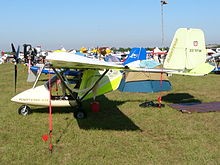
Flightstar designer Tom Peghiny built the first Flightstar in the mid-1980s for the US FAR 103 Ultralight Vehicles category with its maximum 254 lb (115 kg) empty weight requirement. The two-seat Flightstar II soon followed to fill the role of a trainer. The designs quickly became commercial successes and the basic design has been extensively developed over time. By 2007 over 700 single seaters had been sold.

All models are constructed from anodized aluminum tubing assembled with bolts. The fuselage is suspended from a keel tube that also mounts the engine at the front, the tail at the back and the wings. The wings are strut-braced and utilize jury struts. The wings and tail surfaces are covered in pre-sewn Dacron envelopes, which reduces construction time. The wings have full-span ailerons, while the tail features conventional elevators and rudder. The landing gear is a tricycle gear arrangement with bungee suspension on the main wheels. The nosewheel is steerable and mainwheel brakes are an available option. The reported construction time for the single seat models is 100 hours.

The Flightstar II is LSA legal.

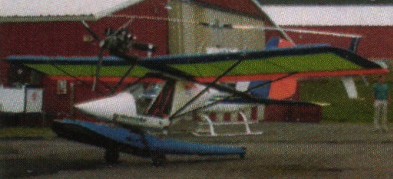
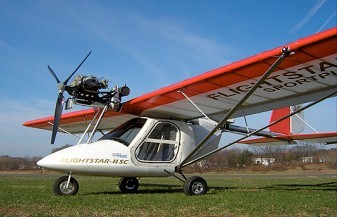
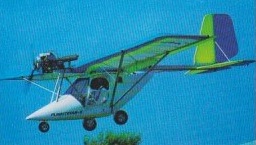
The Flightstar-IISC is the Sport Cabin version of the IISL. The IISC includes all that’s needed to enclose the plane for more comfort and all season flying. The cabin parts include the Fastback rear enclosure, composite cabin fairings, door posts, Lexan roof and zippered sport doors. The IISC was developed with the sport pilot in mind. The large wing allows predictable slow flight handling and quiet low throttle cruising. The IISC features the 54HP dual carb, dual ignition, Rotax 503 with the Flightstar 503 Super Cowl. The optional engines include the 64HP Rotax 582 liquid-cooled twostroke and the 60HP HKS 700E four-stroke engine. The Flightstar II was shown at the ’98 Sun ‘n Fun with an HKS 700 engine.

The Rotax 503 engine installation on a Flightstar II

Standard equipment includes high lift wing with streamlined struts, Flightstar wingfold system, vibration isolated instrument panel, 10 USG rotational molded fuel tank w/sump, full dual control system, chromemoly cage and landing gear, heavy duty stamped dynofocal engine mount, anodized airframe for corrosion protection, and point pilot restraint harnesses.

Optional equipment includes, full instrument package, 4 point harnesses, complete electrical system. in-flight adjustable trim, 3 blade composite propeller, azusa drum brake system, and brs ballistic parachute system.
The Flightstar II SC airfoil is the Flightstar FS-II-2 13% thick.

Flightstar IISC

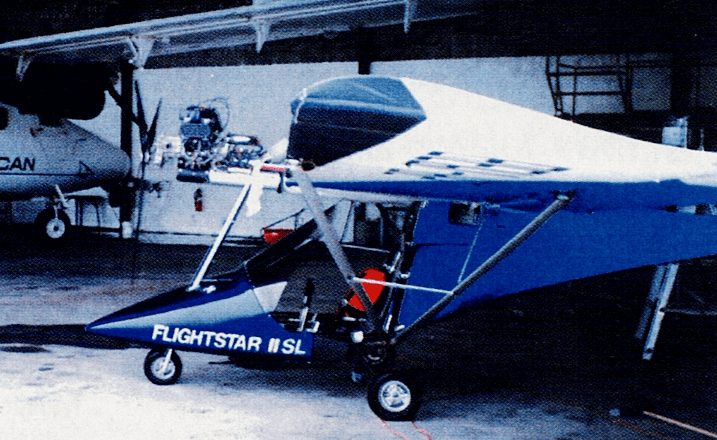
The Flightstar-IISL combines the open air freedom of ultralight type flying and the fun of being side by side with your passenger. With a 120 hour assembly time and the Flightstar wingfold system, the IISL is fitted with full dual controls. The wide stance landing gear for cross wind landings and light wing loading offers easy handling and landings. The airframe is designed for the rigors of flight training and is tested to last. The IISL offers the same standard and optional equipment as the IISC.

The full engine options are the Rotax 503FA (496 C.C. 54HP @ 6800 RPM) with 2.58 TO1 reduction ratio, and the HKS 700E (680 C.C. 60 HP @ 6200 RPM) with 3.47-1 reduction ratio. Propeller options include Tennessee prop. Co. 2-blade, 68” dia, Ivo-prop. 3-blade 68”, and Powerfin F model 70” diameter.

March 1993

The Flightstar II kit, including engine, cost US$15,395 in 1997.
The Flightstar II-SL kit, including engine, cost US$13,795 in 1997.

Flightstar IISL

The two seat models all have side-by-side seating and have folding wings. The aircraft were also produced under licence in India by Albatross Flying Systems.

In 2009 the Flightstar single and two-seat, high wing, single engined kit aircraft produced by Flightstar Sportplanes of South Woodstock, Connecticut, rights, tooling and parts inventory were sold to Yuneec International of China when Flightstar Sportplanes’ business was wound up.

In July 2009 a new single seat model was exhibited at EAA AirVenture Oshkosh as the Yuneec e-Spyder electric-powered version.

Gallery

Flightstar II
Engine: Rotax 503, 54 hp.
Height: 7.5 ft.
Length: 19 ft.
Wing span: 32.5 ft.
Wing area: 162 sq.ft.
Fuel cap: 10 USG.
Weight empty: 420 lbs.
Gross: 970 lbs.
Speed max: 96 mph.
Cruise: 65 mph.
Range: 180 sm.
Stall: 36 mph.
ROC: 700 fpm.
Take-off dist: 200 ft.
Landing dist: 300 ft.
Service ceiling: 14,000 ft.
Seats: 2.
Landing gear: nose wheel.

Flightstar II SL
Engine: Rotax 503FA, 48 hp.
HP range: 42-65.
Height: 7.5 ft.
Length: 19 ft.
Wing span: 32.5 ft.
Wing area: 160 sq.ft.
Fuel cap: 10 USG.
Weight empty: 365 lbs.
Gross: 500 lbs.
Speed max: 96 mph.
Cruise: 55 mph.
Range: 165 sm.
Stall: 34 mph.
ROC: 600 fpm.
Take-off dist: 150 ft.
Landing dist: 300 ft.
Service ceiling: 13,000 ft.
Seats: 2.
Landing gear: nose wheel.
Cockpit width: 41 in

Flightstar II SC
Engine: Rotax 503FA, 48 hp.
Wing Span 32 ft
Length 19 ft 7 in
Height 7 ft 10 in
Wing Area 157 Sq. Ft.
Empty Weight 385 Lbs.
Gross Weight 950 Lbs.
Fuel Capacity 10 USG.
Cruise Speed (@ 75%) 65 mph
Stall Speed (Vso) 36 mph
Vne 96 mph.
Climb Rate 600 Fpm.
Aspect Ratio 6.53
Max. Range (W/10 USG) 200 Miles.
Roll Rate (45 To 45) 2.8 Sec.
Takeoff Roll 205 Ft. ‘
Glide Ratio 7 To 1
Sink Rate 450 Fpm

Flightstar II-SC
Engine: HKS 700E, 52 hp
HP range: 52-80
Length: 16 ft
Wing span: 32 ft
Wing area: 160 sq.ft
Fuel capacity: 10 USG
Empty weight: 465 lb
Gross weight: 992 lb
Cruise: 70 mph
Stall: 38 mph
Range: 230 sm
Rate of climb: 700 fpm
Takeoff dist: 200 ft
Landing dist: 300 ft
Seats: 2
Cockpit width: 41 in

Engine: Rotax 582, 65 hp
Wing span: 9.8 m
Wing area: 14.63 sq.m
MAUW: 450 kg
Empty weight: 236 kg
Fuel capacity: 40 lt
Max speed: 154 kph
Cruise speed: 120 kph
Minimum speed: 62 kph
Climb rate: 3.3 m/s
Seats: 2
Fuel consumption: 17 lt/hr
Certification: Vz
Kit price (1998): US$15.595

Flight Dynamics Seasprite

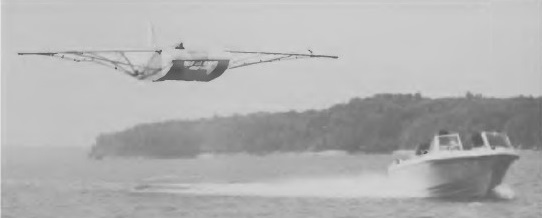
This single- or two-seat homebuilt glider is distinguished by an aerofoil-shaped fuselage and bat-like sailwing type wings, the tail unit being carried on an aluminium boom. It is an unpowered Stage 1 version of an aircraft which, in fully developed powered form, will be known as the Flightsail VII, the Seasprite being of more simplified construction, and it is being marketed as plans to amateur constructors.

The fuselage is a framework of aluminium tubing, the sides and top of which are covered with polyethylene foil, except for the upper part of the nose section, which has a transparent covering of polyester film and Plexiglas. Alternatively, the structure can be covered with aluminium foil for only a minimal weight increase, and this has a much longer life. The underside of the fuselage has catamaran-type twin floats, built of plastics with a plywood covering, enabling the Seasprite to be operated off water if so desired.

The wings are of triangular planform with aluminium tube leading edges and wire trailing edges, the whole being covered in polyethylene. They can be folded rearwards when not in use but are otherwise braced to the fuselage sides. The wing tips pivot about their leading edges to provide roll control. The tail is built as a single fin/tailplane unit pivoting only in the vertical plane for control in pitch.

The pilot sits in an open cockpit in the centre section, to the right of the aluminium boom carrying the tail unit, and his weight is balanced by a counterweight at the port wing tip if a second pilot or passenger is not carried.

One Seasprite has been fitted with twin tail booms preparatory to adding a small pusher engine between them, this being an interim stage, as the Seasprite II, in the development of the Flightsail VII.

Wingspan 34 ft 0 in
Length 20 ft 0 in
Height 8 ft 0 in
Wing area: 166.0 sqft
Aspect ratio: 6.96
Empty weight: 165 lb
Max weight: 500 lb
Lift off speed 30 mph
Cruise speed 35 mph
Max aero-tow speed: 35 mph
Best glide ratio: 6:1 at 50 mph