Garrison OM-1 Melmoth

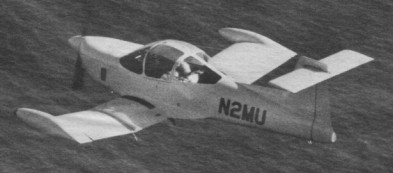
The Melmoth first flew in 1973 and was developed by Peter Garrison from the British Practavia Sprite (also partly a Garrison project). The Melmoth represented considerably more work than the average homebuild and was more of a research prototype than a backyard project. The Melmoth was conceived and designed as an exercise in extreme efficiency in all aspects of flight. It carried an unusually large amount of fuel for an aircraft of its size with a 41-gallon main tank and two 35-gallon tip tanks on each wing, which yielded the exceptional range. Some of the Melmoth’s extras included double-slotted flaps, adjustable incidence ailerons, autopilot, and retractable landing gear.
Melmoth weighs 1,500 pounds empty, seating three, and carrying 940 pounds of fuel in wing and tip tanks. The area of the 23 foot wing is only 92 square feet. No additional fuel is used for ocean flights, the standard tankage providing a range of about 3,000 nm.
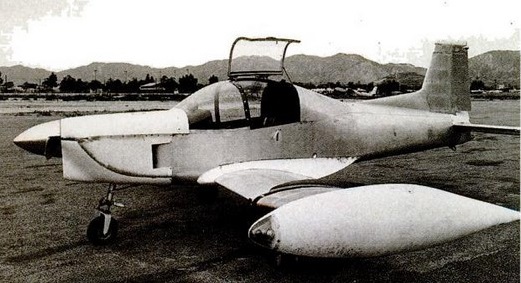
Double slotted Fowler flaps keep the stalling speed within reason; wing mounted spoiler/airbrakes provide sudden drops and other surprises. The approach speeds and the ride resemble those of a medium twin, but the control forces and responses are more what you would expect from a small, short-coupled airplane. The roll rate, for instance, is about 100 degrees per second, and the airplane is stressed for aerobatics. High cruise at normal weights is 170 to 175 knots, but flight plan 160 block to block, at about nine gallons an hour.
Melmoth carries full IFR equipment, with Collins Micro Line and Narco avionies, Silver Fuel Guard, Safe Flight angle of attack indicator, Edo Aire Mitchell Century 1 autopilot, Sanyo stereo radio and cassette player and a Sunair H F radio for ocean flights. There is also a homemade electronic gadget that automatically switches fuel tanks every five minutes. The retractable tricycle landing gear, flaps and airbrakes are all hydraulically operated by an electric pump.
The flying qualities are generally good, but some areas need improvement. Melmoth yaws excessively in turbulence, and neutral lateral stability makes it a poor instrument airplane without the aid of the wing leveler. The cabin, though very roomy, is noisy, and the seats are not comfortable on long flights; the rear seat, furthermore, is not only uncomfortable but also hard to get into and out of.
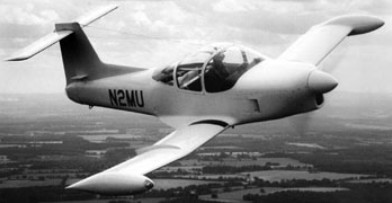
The high approach speeds and the potential for excessive sink rates with full flaps take pilots new to the airplane by surprise, though with practice and planning Melmoth can be satisfactorily operated on 2,000 foot unpaved run¬ways

The aircraft was destroyed on 16 July 1982 in a highly unusual accident in which a landing aircraft struck Melmoth while waiting on the ground at the end of a runway. Garrison was holding short of Runway 19R at Orange County Airport for takeoff clearance when he was hit broadside by a Cessna 210 that was approaching to land.

Garrison survived the accident and proceeded to design and construct a replacement.

Engine Continental IO-360-A, 195-hp.
Wingspan 23 ft
Length 21 ft 6 in
Gross Wt. 2950 lb.
Empty Wt. 1500 lb.
Fuel capacity 154 USG.
Top speed 209 mph.
Cruise speed 201 mph
Stall 80 mph.
Climb rate 1800 fpm.
Takeoff distance (50’) 2500 ft.
Landing distance (50’) 2500 ft.
Range 3400sm.
Seats: 2-3.
Garric Warbirds Yak-3

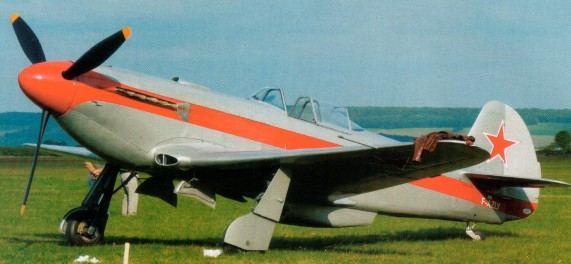
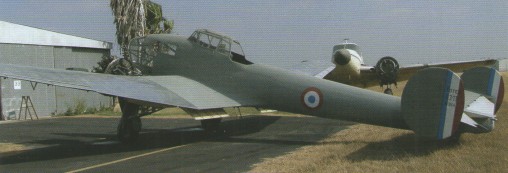
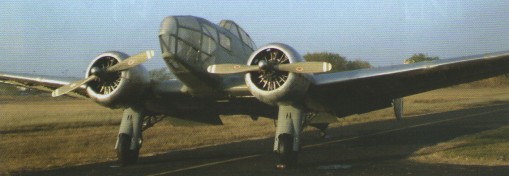
This replica Yak-3 was built by Jean-Marie Garric of Garric Warbirds based in Texas. Imported to France by Jean-Luc Langeard in 2003, it was damaged on 11 April 2003 on one of its first flights. The damaged Yak-3 was then acquired by Stephane Canu who returned the airframe to Garric Warbirds for repairs, while the wing was repaired in Normandy and a new Allison engine acquired in the USA.

Garnier Olga

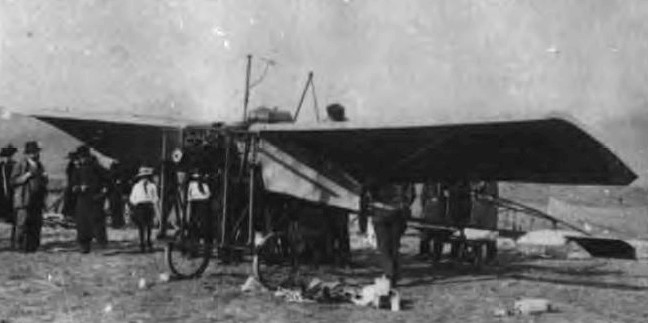
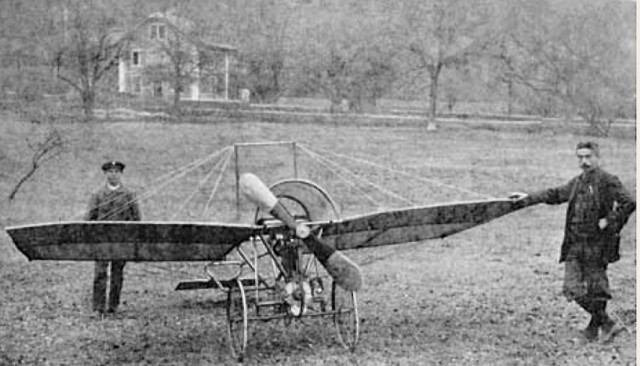
The 1910 “Olga” was the second monoplane design by Leonce Garnier of Biarritz, France. It was reportedly based on a Blériot XI fuselage, but had different, more angular, wings and tail surfaces. The engine was reported as a Darracq, which is unlikely since it was of V-2 or fan-3 configuration. The plane was probably taken over by Georges Leforestier, who made its first flights in March 1910. Leforestier crashed to his death in Huelva (Spain) in 1911, in what was probably the by then much modified “Olga”.

Gardan GY-120

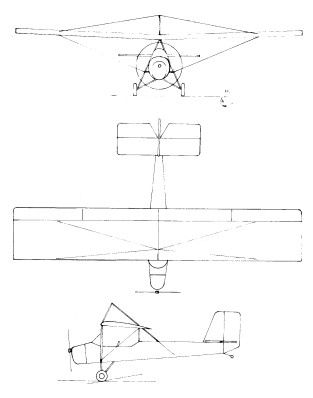
Tandem two seat single engined high wing monoplane with conventional three axis control. Wing has unswept leading and trailing edges, and constant chord; cruciform tail. Pitch control by elevator on tail; yaw control by fin mounted rudder; roll control by half-span ailerons; control inputs through stick for pitch/roll and pedals for yaw. Wing braced from above by kingpost and cables, from below by cables; wing profile Gardan (high lift airfoil); double surface. Undercarriage has three wheels in tail dragger formation; steel-spring suspension on tailwheel and rubber suspension on main wheels. Push right go -right tailwheel steering connected to yaw control. Optional brakes on main wheels. Aluminium tube framework, with optional pod. Engine mounted below wing driving tractor propeller. All aluminium airframe with Dacron covering.
For his first ULM, Yves Gardan opted for an all metal construction covered in Dacron in order to make industrial manufacture easier. With a high lift airfoil which he has designed himself, the wing of his GY 120 is also fitted with flaps covering most of the span, which are separate from the ailerons and have three positions: 10, 20 and 30 degree depression. It is worth noting that the load sheet for this aircraft complies to the FAR23 Utility category applicable to aircraft of less than 3.70 tonne (4.08 US ton, 3.64 Imp ton) according to international law.
Design work started in June 1982 and the building of the prototype in October of the same year, its first flight being programmed for the 15 May 1983. The motor on the prototype is a Hirth 270R 03E of 40hp, but the aircraft is designed to receive any engine usable as a tractor and developing 35 60 hp. Options include a fuselage fairing, complete dual control equipment, differential brakes on the main wheels, floats and skis specifically designed for the GY 120, an instrument panel and load carrying pods (agricultural or military).

Engine: Hirth 270R 03E, 40 hp at 7000 rpm.
Propeller diameter: 55 in (1.40m).
Toothed belt reduction, ratio 2.71-1.
Power per unit area 0.21 hp/sq.ft, 2.3 hp/sq.m.
Fuel capacity 7.9 US gal, 6.6 Imp gal, 30.0 litre in main tank; 7.9 US gal, 6.6 Imp gal, 30.0 litre in reserve.
Length overall 19.0 ft, 5.80 m.
Height overall 8.211, 2.50m.
Wing span 32.9ft, 10.00m.
Constant chord 5.9ft, 1.75m.
Dihedral 2 deg.
Sweepback 0 deg.
Tailplane span 9.2ft, 2.80m.
Fin height 4.3ft, 1.30m.
Total wing area 189 sq.ft, 17.5sq.m.
Total aileron area 20.5 sq,ft, 1.90sq.m.
Fin area 7.5 sq.ft, 0.70sq.m.
Rudder area: 7.0 sq.ft, 0.65sq.m.
Tailplane area: 15.3 sq.ft, 1.42sq.m.
Total elevator area: 14.0 sq.ft, 1.30sq.m.
Wing aspect ratio 5.711.
Wheel track 5.9 ft,1.80 m.
Wheelbase 14.9 ft, 4.50 m.
Tailwheel diameter overall 5 inch, 13 cm.
Main wheels diameter overall 16 inch, 40 cm.
Empty weight 320 lb, 145 kg.
Max take off weight 751 lb, 340 kg.
Payload 431 lb, 195 kg .
Max wing loading 3.97 lb/sq.ft, 19.4 kg/sq.m.
Max power loading 18.77 lb/hp, 8.503kg/hp.
Load factors design; +6.6, 3.3 ultimate.
Max level speed 75 mph, 120 kph.
Never exceed speed 87 mph, 140kph.
Max cruising speed 68mph, 110 kph.
Economic cruising speed 47mph, 75kph.
Stalling speed 24 mph, 38 kph.
Max climb rate at sea level 500 ft/min, 2.5 m/s.
Min sink rate 370 ft/min at 40 mph, 1.8 m/s at 65 kph.
Best glide ratio with power off 10/1 at 40mph, 65 kph.
Take off distance 130 ft, 40 m.
Land¬ing distance 115ft, 35m.
Service ceiling 8200ft, 2500m.
Range at average cruising speed 240 mile, 400 km.

Gardan GY-80 / SOCATA GY.80 Horizon

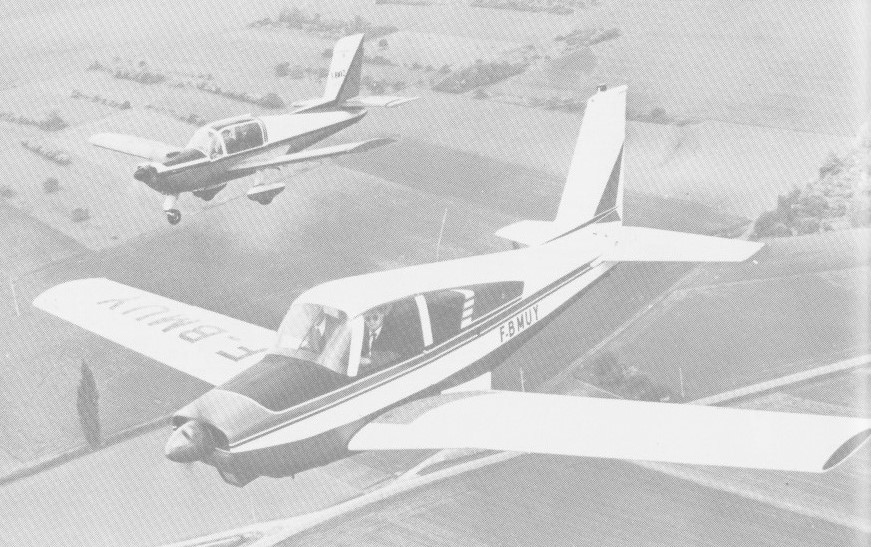
In 1960 the GY 80 Horizon 180hp tourer appeared. This single engined machine won the Cannes International Grand Prix in 1966, beating the highest performance twins of the time by covering in 23 h of flight a distance of 3443 mile at 152 mph average (5540 km at 245 kph).

The Horizon had a run of 270 in France, Aerospatiale having ac¬quired the production licence, but its succes¬sor the GY 100 in 1969 was never produced commercially.

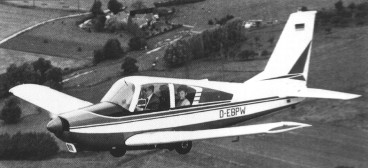
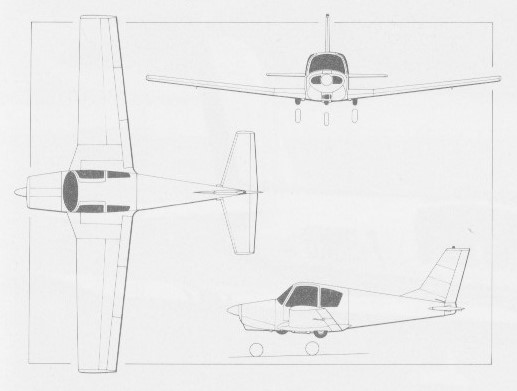
One of SOCATA’s first products was the four-seat GY.80 Horizon under licence. The type first flew in July 1960 and is of all-metal construction with standard low-wing monoplane configuration and full span Fowler-type flaps and Frise-type ailerons. All three tricycle landing gear units retract to the rear and leave their wheels partially exposed.

The GY-80 was built in four basic versions. Standard versions have 160 hp or 180 hp engine and fixed pitch propeller. A constant speed propeller was available optionally with either engine.

The first 75 aircraft have the 119-kW (160 hp) O-320-D engine driving a fixed-pitch two-blade wooden propeller, later aircraft having more power and a constant speed three-blade propeller.

Production of 260 aircraft last to 1969.

GY.80-150

GY.80-180 Horizon
Engine: l x Avco Lycoming O-360-A, 134kW (180hp).
Span: 9.70m (31 ft 9.75in).
Length: 6.64m (21ft9.5in).
Max T/O weight: 1150kg (2,535lb).
Max speed: 155 mph at sea level.
Operational range: 777 miles.

SOCATA GY-80 Horizon
Engine: Lycoming O-320-D, 160 hp
Prop: fixed pitch
Wing span: 31 ft 10 in / 9.70 m
Length: 21 ft 9.5 in / 6.64 m
Cabin length: 7 ft 2.5 in / 2.20 m
Cabin width: 3 ft 7 in / 1.10 m
Cabin height: 4 ft 1 in / 1.25 m
Empty weight equipped: 1334 lb / 605 kg
MTOW: 2315 lb / 1050 kg
Max cruise 75% 8200ft / 2500m: 124 kt / 143 mph / 230 kph
ROC SL: 660 fpm / 201 m/min
Service ceiling: 13,450 ft / 4100 m
Range 44 ImpGal / 200 lt fuel: 512 nm / 590 mi / 950 km
Seats: 4
Baggage capacity: 88 lb / 40 kg

SOCATA GY-80 Horizon
Engine: Lycoming O-360-A, 180 hp
Prop: fixed pitch
Wing span: 31 ft 10 in / 9.70 m
Length: 21 ft 9.5 in / 6.64 m
Cabin length: 7 ft 2.5 in / 2.20 m
Cabin width: 3 ft 7 in / 1.10 m
Cabin height: 4 ft 1 in / 1.25 m
Empty weight equipped: 1360 lb / 617 kg
MTOW: 2535 lb / 1150 kg
Max cruise 75% 8200ft / 2500m: 130 kt / 150 mph / 240 kph
ROC SL: 850 fpm / 258 m/min
Service ceiling: 14,800 ft / 4500 m
Range 44 ImpGal / 200 lt fuel: 674 nm / 777 mi / 1250 km
Seats: 4
Baggage capacity: 88 lb / 40 kg

SOCATA GY-80 Horizon

Gardan GY-20 Minicab / GY-201 / GY-30 Supercab

GY.20

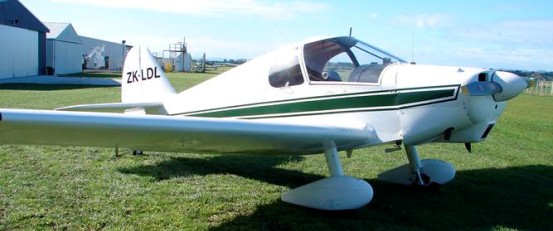
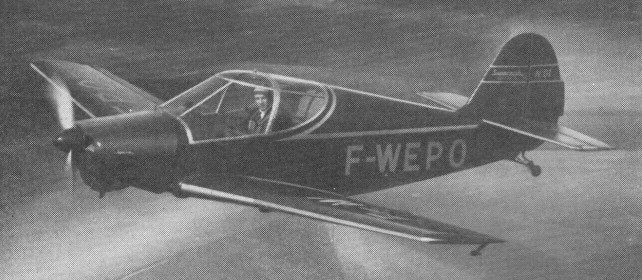
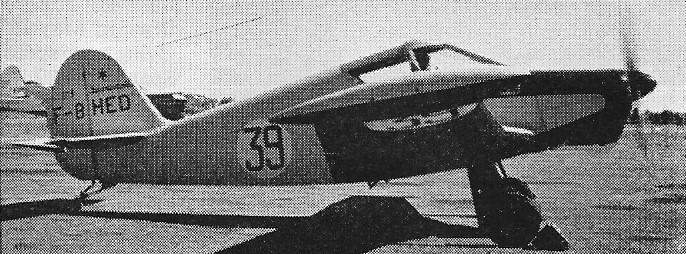
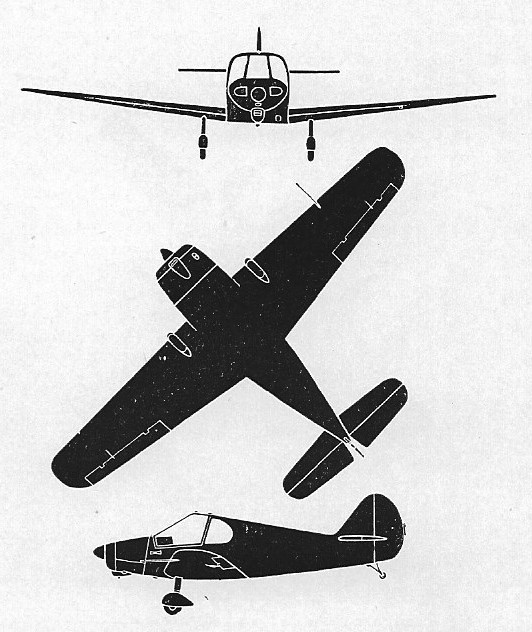
M. Yves Gardan designed the GY 201 Minicab in 1949 as a two seater with side by side seating and dual control, which first flew in 1949. The fuselage is a wooden open girder structure; the forward part around the cockpit being plywood lined, the remainder fabric covered. The fin is built integral with the fuselage. The tailplane is a single piece plywood covered structure, and the elevator and rudder have fabric covered wooden frames. The wing section is NACA 23015 at the root and 23010 at the tip. The wing structure consists of a laminated spruce and plywood main box spar, a diagonal drag spar and a rear false spar, with lattice type ribs. Forward of the main spar is plywood covered to form a torsion box, the remainder of the wing being fabric covered. Split flaps are installed. The two main undercarriage legs are mounted on the main spar with rubber in compression springing. An 11 Imp. gallon fuel tank is fitted just behind the firewall.

The GY-20 Minicab first flew in February 1949.

In 1949 his GY 20 Minicab won the world record for speed and distance in a straight line for an aircraft of less than 1102 lb (500kg) maximum gross weight, flying from Paris to Rabat in 10h of flight, 1135 mile being covered at 109mph average (1826km at 185kph) with a Continental 65hp motor. More than 100 Minicabs were made and it is still being built by US homebuilders under the name of Cavalier in 1983.

In 1952, the 90hp version of the Minicab appeared, with retractable undercarriage and called the Super Cab.
Continental engines from 65 to 100 h.p. may be installed.

GY.20

Production was entrusted to the Constructions Aernautiques du Bearn, which delivered the first aircraft in 1952, and support for this light type subsequently passed to SIPA (the Société Industrielle Pour l’Aeronautique). There were two production variants of the Minicab, the GY.20 and GY.201, these differing from each other only in details of equipment and other small features.

GY-30

The GY-30 Supercab first flew in February 1954 with refinements including retractable undercarriage, fixed tip tanks and 90 hp Continental C-90. Two of a pre-production batch of five were ordered for evaluation by the Service de l’Aviation Legeres et Sportive.

GY-30 Supercab

One of the French G.A.B. Supercabs was undergoing fully-instrumented test flying at Villacoublay; Jacques Noetinger is the pilot.

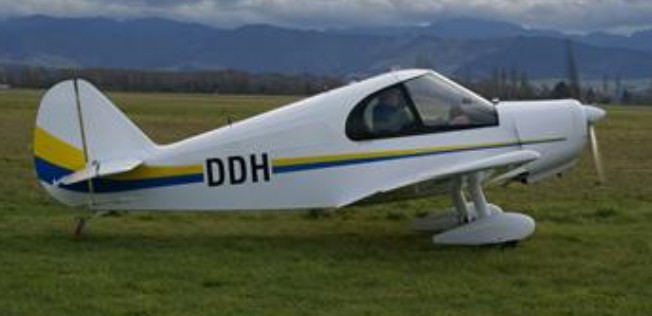
Produced in limited numbers between 1952 and 1958, the design was acquired by A.W. Ord-Hume in Britain, who anglicised the plans. Adjusted them for home builders, the aircraft has subesequently proved extremely popular. The aircraft is marketed in North America as the Hawk BM.4 by Miranda Aircraft of Canada.

Variation:
Barritault JB.01

Gallery

GY-20
Engine: Continental A65-8, 65 hp
Wingspan: 24 ft 11 in
Length: 17 ft 10.5 in
Height: 5 ft 5 in
Wing area: 107.6 sq.ft
Empty weight: 595 lb
Loaded weight: 1069 lb
Max speed: 124 mph
Cruise: 112 mph
ROC: 680 fpm
Range: 466 mi

Engine: l x Continental A65-8, 48.5kW (65hp).
Span: 7.59m (24ft 11 in).
Length: 5.45m (17 ft 10.5 in).
Max T/O weight: 485 kg (1,069 lb).
Max speed: 124 mph at sea level.
Operational range: 466 miles.
Seats: 2

Engine: Continental, 90 h.p.
Span: 25 ft 0 in.
Length: 17 ft 0 in.
Wing Area: 107 sq. ft.
Empty Weight: 750 lb.
Loaded Weight: 1235 lb.
Wing Loading: 11.5 lb/sq. ft.
Max. Speed: 124 mph.
Cruise Speed: 110 mph.
Stall Speed: 50mph.
Initial Climb: 680 fpm.
Range: 360 miles.

Engine: Continental O-200A, 100 h.p.
Cruise: 120 mph
ROC: 1000 fpm.
Span: 25ft
Length: l7ft l0in
Empty weight: 800lb
Gross weight: 1234 lb

Engine: Revmaster VW, 65 hp. Stall: 38 kt / 43 mph / 70 kmh
Cruise: 97 kt / 112 mph / 180 kmh
VNE: 107 kt / 123 mph / 198 kmh
Empty Weight: 270 kg / 595 lbs
MTOW Weight: 485 kg / 1069 lbs
Climb Ratio: 600 ft/min / 3 m/s
Take-off distance (50ft obstacle): 1150 ft / 350 m
Landing distance (50ft obstacle): 1080 ft / 330 m

GY-30 Supercab
Engine: Continental C90, 90 hp
Max speed: 170 mph
Cruise: 146 mph
ROC: 767 fpm
Service ceiling: 16,400 ft
Range: 746 mi
Empty weight: 880 lb
Loaded weight: 1348 lb
Wingspan: 26 ft 10 in
Length: 18 ft
Height: 5 ft 5 in

GY.20

Gammeter Orthopter

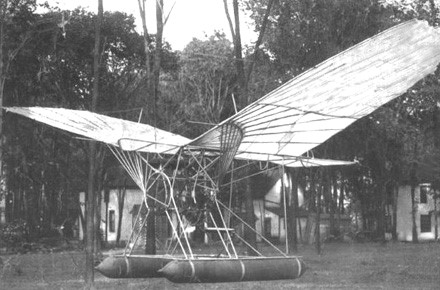
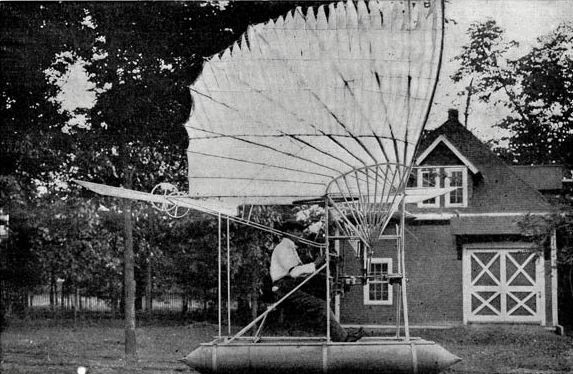
Built by Harry C Gammeter in 1907, the single place Orthopter had bamboo-and-silk flapping wings, double-hinged to the fuselage and flapping 75 strokes per minute. It reportedly “took-off in unmanned tethered flight” after developing a thrust of 24 lb, but was not developed further. “Originally, a horizontal flywheel turning at 1500rpm was used for stabilization but was later removed.”

It was listed as an entrant in Flying Machine events at 1907 Intl Aeronautic Tournament in St Louis MO, 21-24 Oct 1907. Gammeter was member of Aero Club of America and president of Aero Club of Cleveland about that time, also invented and patented in 1903 the multigraph duplicating machine (“Ditto machine”).

Engine: Curtiss, 7hp @ 1200rpm
Wingspan: 30’0″
Length: 12’0″
Gross wt: 440 lb

I am trying to find if a Gammeter orthopter or ornithopter still exists in an old barn or hangar somewhere. Harry Gammeter was my greatgreat uncle. Thank you.
Roger Gammeter
rkgam1972@twc.com
17 Mar 18