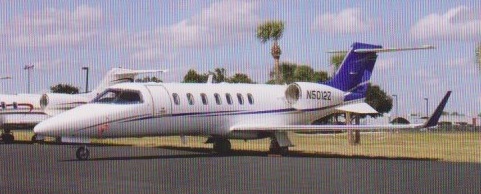
Gates Lear 55

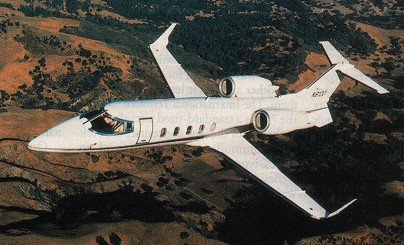
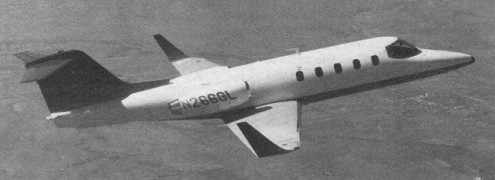
At the 1977 Paris air show Gates Learjet announced details of its new Learjet 50 series. This was intended to comprise the Learjet 54, Learjet 55 and Learjet 56 with longer and larger cabins, all powered by twin Garrett AiResearch fanjets. The 55 was to have advanced wings incorporating NASA-developed winglets and this last feature gave rise to the name Longhorn.
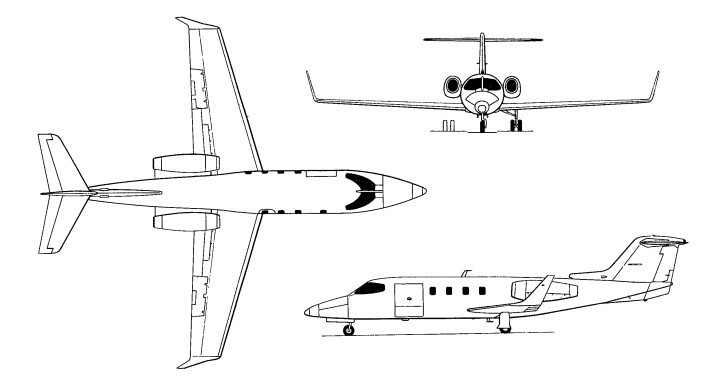
The larger wing incorporating near-vertical winglets that have replaced the traditional Learjet tiptanks. The wing’s increased aspect ratio and super-critical winglets provide substantial aerodynamic improvements that in turn produce greater fuel efficiency and improved flight performance at high and low altitudes. The wing also has been responsible for significantly improved short-field performance. The balanced field length is 3,520 feet for the 54/55/56 series.
Only the Longhorn 55 has been developed, construction of the first airframe starting in April 1978 after successful testing of an aerodynamic prototype of the wing on a Learjet 25. The first of two Learjet 55 prototypes was flown initially on 19 April, 1979, and certification and delivery of the first production aircraft were recorded on 18 March 1981 and 30 April 1981 respectively.
The Model 55 followed the same overall configuration as earlier members of the Learjet family, and accommodated a crew of two on a separate flight deck and up to 10 passengers in the main cabin. In September 1986 the company announced the Model 55B, offering a new interior, ‘glass’ cockpit, improved take-off performance and increased range, all of which increased the aircraft’s operational flexibility. One year later, the Model 55C was revealed, fitted with rear underfuselage ‘Delta Fins’ giving improved directional stability at all speeds and reducing the landing speed, and thus removed the need for a stick puller/pusher.
Launched in 1987 was the Model 55C, which has a longer fuselage and deeper cabin than the 31. The engines were more powerful 3,700 lb st (16,46 kN) units and winglets and Delta-Fins were also standard.
Later versions are the 55C/ER extended-range version fitted with an extra tank holding 1175kg of fuel in the tailcone, and the Model 55C/LR giving even-longer-range through the installation of a further 322-litre fuel cell behind the standard fuselage tank. Typical configuration of this version is two crew and seven passengers. Around 150 Model 55 variants had been built by the end of 1990 and the version is to be superseded by the Learjet 60 during 1992.

LR-55 Learjet Longhorn 55
Engines: 2 x Garrett TFE 731-3A-2B, 3700 lbs thrust.
Seats: 12.
Length: 55.1 ft.
Height: 14.7 ft.
Wingspan: 43.8 ft.
Wing area: 265 sq.ft.
Wing aspect ratio: 7.2.
Maximum ramp weight: 20,750 lbs.
Maximum takeoff weight: 20,500 lbs.
Standard empty weight: 12,530 lbs.
Maximum useful load: 8220 lbs.
Zero-fuel weight: 15,000 lbs.
Maximum landing weight: 17,000 lbs.
Wing loading: 73.7 lbs/sq.ft.
Power loading: 2.6 lbs/lb.
Maximum usable fuel: 6682 lbs.
Best rate of climb: 4380 fpm.
Certificated ceiling: 51,000 ft.
Max pressurisation differential: 9.4 psi.
8000 ft cabin alt @: 51,000 ft.
Maximum single-engine rate of climb: 1250 fpm @ 200 kts.
Single-engine climb gradient: 379 ft/nm.
Maximum speed: 483 kts.
Normal cruise @ 41,000ft: 456 kts.
Fuel flow @ normal cruise: 1014 pph.
Stalling speed gear/flaps down: 103 kts.
Balanced field length 3,900 ft

Learjet 55C
Engines: 2 x Garrett TFE731-3A-2B turbofans, 1678kg
Max take-off weight: 9525 kg / 20999 lb
Empty weight: 5832 kg / 12857 lb
Wingspan: 13.35 m / 43 ft 10 in
Length: 16.80 m / 55 ft 1 in
Height: 4.48 m / 14 ft 8 in
Wing area: 24.57 sq.m / 264.47 sq ft
Max. speed: 884 km/h / 549 mph
Cruise speed: 744 km/h / 462 mph
Ceiling: 15545 m / 51000 ft

Gates Lear 54

Learjet’s Longhorn series combines a revolutionary wing design, two of the most advanced engines introduced to the market, and 51,000-foot performance. The line of five aircraft has been designated the Learjet 28 and Learjet 29, both powered by General Electric turbojets, and the Learjet 54/55/56, and those three are powered by twin Garrett AiResearch fanjets. All the models are designed with a larger wing incorporating near-vertical winglets that have replaced the traditional Learjet tiptanks. The wing’s increased aspect ratio and super-critical winglets provide substantial aerodynamic improvements that in turn produce greater fuel efficiency and improved flight performance at high and low altitudes. The wing also has been responsible for significantly improved short-field performance. The balanced field length for is 3,520 feet for the 54/55/56 series.

Engines: 2 x 3,650-lb. s.t. Garrett AiResearch fanjets
Gross wt: 10,216 lb
Fuel capacity: 825 USG.
Top speed: 550 mph
Stall 100 mph.
Initial climb rate 5,380 fpm.
Ceiling 51,000 ft.
Range 2,300nm.
Balanced field length: 3,520 ft.
Seats 12

Gates Lear 50

Gates Learjet Corporation reached a major milestone on 28 March 1980 when it delivered the 1,000th Learjet a Century III 35A. Learjets have now flown over one billion miles during more than 2.6 million flight/hr. The occasion was also marked by the roll out of the first production widebody Learjet Longhorn 50 series business jet.

Gates Lear 45 / Bombardier Learjet 45

Assembled in Wichita, the 45 is the first clean-sheet design Learjet from Bombardier. It features components built at Bombardier’s de Havilland, Shorts, and Canadair factories.
Despite the full FAA certification, at the time of announcement certification of the aircraft’s trust reversers and APU were not achieved. Both were installed, but not usable, on the first 24 aircraft delivered. This was anticipated in 1998, at which time the company was to activate the units for its customers.

Gates Lear 45 Article

Changes in the announced performance included slightly faster cruise (M0.81) but field lengths were slightly longer than forecast. The payload remained unchanged due to an increase in gross weight.

One of four Lear 45s to replace model 31As for crew training – 2000

The Lear 45 is Bombardier’s medium size jet market contender, with the first deliveries starting in 1998. As its number designator implies, the Learjet 45 is larger than the model 31, and smaller than the Learjet 60. The flightdeck has been all glass since day one. FADEC-equipped Allied Signal engines make this later version easier to maintain and more fuel efficient than all previous models.

Bombardier Learjet 45XR C-GJCY

Bombardier Learjet 45 XR
Engine: 2 Honeywell TFE731-20-AR turbofans x 15264 N / 1556 kp / 3,500-lb
Length: 57.612 ft / 17.56 m
Height: 14.14 ft / 4.31 m
Cabin height: 4.921 ft / 1.5 m
Cabin width: 5.118 ft / 1.56 m
Cabin length: 19.751 ft / 6.02 m
Wingspan: 47.769 ft / 14.56 m
Max take off weight: 21503.2 lb / 9752.0 kg
Empty wt: 13,888 lb
Cruising speed (mach): 0.81 mach
Max cruise: 464 kts.
Long range cruise: 430 kt
Range: 2098 nm / 3885 km
Crew: 2
Passengers: 9
Ceiling: 51,000 ft.
Takeoff distance (50ft) 5,250ft
Landing distance 2,660 ft

Gates Lear 40 / Bombardier Learjet 40

Bombardier Learjet 40XR N5012Z

In 2002, Bombardier offered a smaller version of the Learjet 45, the model 40. The aircraft is designed for shorter hops with maximum Lear performance. The Learjet 40 features the same FADEC-equipped Allied Signal engines, all glass cockpit and systems as the Learjet 45, but with a slightly shorter fuselage. The Learjet 40 offers a 36% larger cabin and 35% more range than the Learjet 31 for only a 10% higher price. The 40 can fly with a full passenger load of seven and full fuel. With four passengers, it will travel from New York to Chicago in one hour and 35 minutes.

Engines: 2 x Allied Signal TFE731-20-AR, 15264 N / 1556 kp / 3,500-lb
Length: 55.512 ft / 16.92 m
Height: 14.14 ft / 4.31 m
Cabin height: 4.921 ft / 1.5 m
Cabin width: 5.118 ft / 1.56 m
Cabin length: 17.717 ft / 5.4 m
Wingspan: 47.769 ft / 14.56 m
Max take off weight: 20354.4 lb / 9231.0 kg
Empty wt: 13,888 lb
Max cruise: 464 kt
Cruising speed (mach): 0.81 mach
Long range cruise: 430 kts
Maximum range: 1857 nm / 3439 km
Ceiling: 51,000 ft
Takeoff distance (50ft): 5,250 ft
Landing distance: 2,660 ft
Crew: 2
Passengers: 7

Gates Lear 36 / U-36

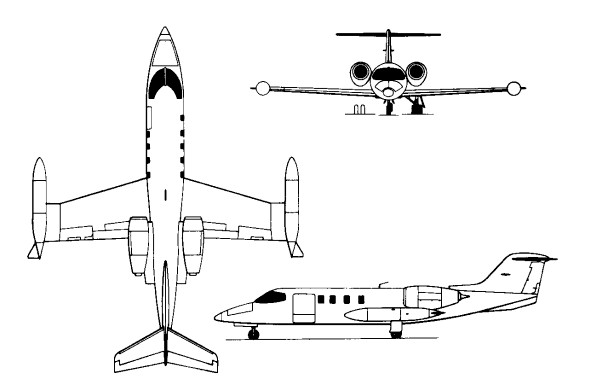
Compared with the Learjet 25s, the new Learjet 35 and Learjet 36 each had a 0.33m increase in length and, a 0.61m extension to each wingtip, outboard of the ailerons. They differed in fuel/seating capacity, the Learjet 36 seating up to six passengers but with the ability to trade two of them for the extra fuel to give non-stop capability across the North Atlantic.
The pilot on the first flight of the Learjet 26 (later designated the Learjet 36) with two TFE engines took place on 4 January 1973, piloted by Bob Fisher and Robert Berry.
Certification was gained and the first deliveries made in 1974. Two years later golf professional/ pilot Arnold Palmer used a Learjet 36 to establish a new round-the-world class record of 36990km completed in an elapsed time of 57 hours 25 minutes 42 seconds.
Gates Learjet expanded the slow speed boundaries of their entire bizjet line by certificating their Century III wing leading edge and flight control system modification. Aircraft with the modification bear the designation “A” following their model numbers. The Century III modifications on model 35s and 36s reduced the stalling speed and gave better low speed flying qualities.
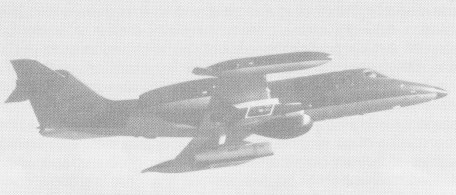
The JMSDF has procured a number of Learjet 36As, known as U-36As, for target-towing, sea-skimming-missile simulation, and ECM. These aircraft have an under-fuselage radome for a surveillance radar, a tip-tank-mounted missile seeker simulator, jammer pods, and chaff dispensers. Under-wing stores capability is improved, and maximum take-off weight is increased.

By 1991 around 750 Learjet Model 35/36 variants had been sold, including approximately 200 special mission versions to 20 customers around the world.

LR-36
Engines: 2 x Garrett AiResearch TFE 731-2 turbofan.
MTOW: 17,000 lb.

LR-36A Learjet Century III 36A
Engines: 2 x Garrett TFE 731-2-2B, 3500 lbs / 1588kg thrust.
Length: 14.83 m / 48 ft 8 in
Height: 3.73 m / 12 ft 3 in
Wingspan: 12.04 m / 39 ft 6 in
Wing area: 23.53 sq.m / 253.27 sq ft
Wing aspect ratio: 6.2.
Maximum ramp weight: 18,550 lbs.
Maximum takeoff weight: 18,300 lb / 8301 kg
Standard empty weight: 9970 lbs.
Maximum useful load: 5850 lbs.
Zero-fuel weight: 13,500 lbs.
Maximum landing weight: 15,300 lbs.
Wing loading: 71.1 lbs/sq.ft.
Power loading: 2.6 lbs/lb.
Maximum usable fuel: 7440 lbs.
Best rate of climb: 4339 fpm
Certificated ceiling: 45,000 ft / 13715 m
Max pressurisation differential: 9.4 psi.
8000 ft cabin alt @: 45,000 ft.
Maximum single-engine rate of climb: 1276 fpm @ 200 kts.
Single-engine climb gradient: 387 ft/nm.
Single-engine ceiling: 23,500 ft.
Maximum speed: 471 kts.
Normal cruise @ 41,000ft: 459 kts.
Fuel flow @ normal cruise: 889 pph.
Stalling speed gear/flaps down: 99 kts.
Balanced field length 4,784 ft
Seats: 8.

Gates Lear 35 / C-21

Lear 35A

Development by Garrett of the TFE731 turbofan engine, promising lower noise levels and greater fuel economy than the General Electric CJ610 turbojet which had been the standard Learjet engine, led to the Learjet 35 and Learjet 36 introduced in 1973. It had been intended originally to develop additional versions of the Learjet 25 as the Learjet 25B-GF (Garrett fan) and Learjet 25C-GF. A Learjet 25 served as, the engine test-bed, with a 1588kg thrust TFE731-2 engine in the starboard nacelle and the CJ610 retained on the port side. It was flown on 19 May 1971 followed by a second Learjet 25 with two TFE731-2s on 19 May 1971and, on 22 August 1973, the first Learjet 35 took to the air.

Gates Lear 35 Article

The 35 is a model 25B with a fuselage stretch (13 inches in the cabin), 0.61m increased wingspan outboard of the ailerons and the Garrett (Honeywell) TFE-731-2C engines (certified in 1974), with the 35A having a redesigned wing for better short field and low speed handling. The Model 35A incorporates wing-tip fuel tanks with an overall length of 48 ft 8 in (14,83 m). The engines are 3,500 lb st (15,6 kN) Garrett TFE731-2-211 turbofans.
The 35 and 36 differed in fuel/seating capacity, the Learjet 35 carrying a maximum of eight passengers and, with reduced payload, having transcontinental range; and the Learjet 36 seating up to six passengers but with the ability to trade two of them for the extra fuel to give non-stop capability across the North Atlantic. Certification was gained and the first deliveries made in 1974.
Gates Learjet expanded the slow speed boundaries of their entire bizjet line by certificating their Century III wing leading edge and flight control system modification. Aircraft with the modification bear the designation “A” following their model numbers. The Century III modifications on model 35s and 36s reduced the stalling speed and gave better low speed flying qualities. With the exception of the aerodynamic improvements to the Learjet wing, the new models introduced in 1976 did not represent profound applications of new technology. Rather, they were predictable examples of evolutionary changes.

The US Air Force leased 83 Model 35As as operational support aircraft between 1984-85 and bought them outright in 1986. These six-to eight-seat light jets are designated C-21A and were joined by four more in 1987, replacing T-39 Sabreliners.
Gates offers a wide range of special-mission aircraft for military applica¬tions, based on the Learjet 35A/36A corporate jet. The principal versions are the RC-35A for aerial survey, photography, and reconnaissance with Lorop cameras and Slar; the EC-35A for electronic warfare training, weapons simu-lation, and operational ECM/ESM duties; and the utility UC-35A.
In 1979 Gates unveiled a Sea Patrol model of the Lear 35A. Only two airframe mods were necessary to convert the 35A to the Special Missions role. A large belly radome has been fitted, housing the Litton 360 sea surveillance radar, while standard NATO underwing hardpoints have been attached, capable of carrying up to 500 lbs of external stores – sonobuoys, flares, smoke markers or rescue pods. These, plus the vast array of surveillance equipment fitted, has upped the aircraft’s empty weight some 1,300 lbs. APS weight is now 11,600 lb, maximum take-off weight 18,000 lbs. The maximum speed and altitude are down, from 0.83M to 0.79M, and about 5,000 feet from the stock 35A’s 41,000 ceiling, while fuel flow is up about 100 lb/hr.
With intercept dash speeds of 480 knots, and long-range patrol cruise of 0.74 Mach (say 430 knots at 31,000ft), the manufacturers claim the Sea Patrol Lear can cover nearly twice the amount of ocean as a slower turboprop. With 6,238 pounds fuel capacity and a typical 1,200 lb/hr consumption from the Garrett turbofans, 4½ hours safe endurance is available at altitude (effectively 2,000 nm), while patrol range at wavetop height is still 1,000 miles.
Gates Learjet Corporation reached a major milestone on 28 March 1980 when it delivered the 1,000th Learjet a Century III 35A.

In May 1981 the Fuerza Aerea Argentina took delivery of one Century III Learjet 35A configured for checkking air traffic radio and navigation aids. This was the fifth 35A delivered to the Fuerza Aerea, two being configured as high-altitude photographic aircraft. The Fuerza Aerea Uruguaya took delivery of a single Learjet 35A in March 1981.
In September 1986 the USAF announced that the 80 C-2lAs (Learjet 35As) leased from Gates in 1983 as the second element of the Operational Support Aircraft (OSA) programme, were to be purchased outright. The aircraft were delivered between March 1984 and October 1985 to replace CT-39 Sabreliners in the high-priority-transport and other support roles.
By 1991 around 750 Learjet Model . 35/36 variants had been sold, including approximately 200 special mission versions to 20 customers around the world.

LR-35 Learjet
Engines: 2 x Garrett TFE 731-2C.
MTOW: 17,000 lb.

LR-35A Learjet Century III 35A
First built: 1974.
Engines: 2 x Garrett TFE 731-2-2B, 3500 lbs thrust.
Seats: 10.
Length: 48.7 ft.
Height: 12.3 ft.
Wingspan: 39.5 ft.
Wing area: 253 sq.ft.
Wing aspect ratio: 6.2.
Maximum ramp weight: 17,250 lbs.
Maximum takeoff weight: 17,000 lbs.
Standard empty weight: 9971 lbs.
Maximum useful load: 7279 lbs.
Zero-fuel weight: 13,500 lbs.
Maximum landing weight: 15,300 lbs.
Wing loading: 67.2 lbs/sq.ft.
Power loading: 2.4 lbs/lb.
Maximum usable fuel: 6238 lbs.
Best rate of climb: 4760.
Certificated ceiling: 45,000 ft.
Max pressurisation differential: 9.4 psi.
6500 ft cabin alt @: 45,000 ft.
Maximum single-engine rate of climb: 1470 fpm @ 200 kts.
Single-engine climb gradient: 441 fpm.
Single-engine ceiling: 25,300 ft.
Maximum speed: 471 kts.
Normal cruise @ 41,000ft: 459 kts.
Fuel flow @ normal cruise: 889 pph.
Stalling speed gear/flaps down: 99 kts.
Balanced field length 4,224 ft

Gates Lear 31

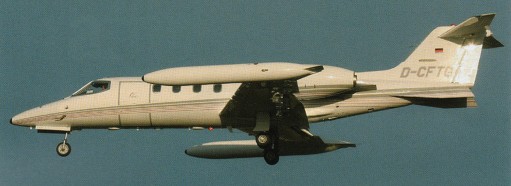
The Model 31 was announced by Learjet in September 1987 and combines the fuselage, eight-passenger cabin and 3,500 lb st (15,6 kN) Garrett TFE731-2-2B turbofans of the Model 35A/36A with a longer span wing with winglets plus the prominent ventral strakes known as Delta-Fins.
The Learjet 31 aerodynamic prototype first flew on 11 May 1987 and the type was certificated by the FAA in August 1988. Able to carry seven passengers and two crew over ranges up to 3076km, the LJ31 can cruise at 15545m.
Four EFIS-equipped versions were ordered by Singapore Airlines specially configured for crew training (S/Ns 31-033, 31-033A, 31-033C, 31-033D). They were basically LR31’s but with Honeywell EFIS and some of the vertical instruments out of the LR55, and had the ER fuselage tank.
By mid-1991, when the type was superseded by the Model 31A and 31A/ER, about 30 had been delivered. The Learjet 31A replaced the earlier aircraft on the Wichita production line in July 1991 and features an integrated digital avionics package, and can also be equipped with a braking parachute installed internally under the tail. The extended-range Learjet 31A/ER is a Model 31A with a higher maximum takeoff weight and able to carry extra fuel.

Learjet 31A
Engines: 2 x Garrett TFE731-2 turbofans, 1588kg
Max take-off weight: 7030 kg / 15499 lb
Empty weight: 4575 kg / 10086 lb
Wingspan: 13.3 m / 43 ft 8 in
Length: 14.8 m / 48 ft 7 in
Height: 3.7 m / 12 ft 2 in
Wing area: 24.5 sq.m / 263.72 sq ft
Cruise speed: 832 km/h / 517 mph
Ceiling: 15545 m / 51000 ft
Range: 3076 km / 1911 miles

Gates Lear 29

In January 1979 the company gained certification of the Learjet 28 and Learjet 29 Longhorn. Basically similar to the 10-seat Learjet 25D, these two models introduced a new wing of increased span. The introduction of winglets displaced the wingtip fuel tanks of earlier models, which meant that all fuel had to be carried internally.
This incorporated a cambered leading edge and supercritical winglets to provide improved performance and cruise efficiency, and 51,000-foot performance. The longer-range Learjet 29 traded two passengers for an additional 379 litres of fuel.
A line of five aircraft has been designated Longhorn series. They are the Learjet 28 and Learjet 29, both powered by General Electric turbojets, and the Learjet 54/55/56, and those three are powered by twin Garrett AiResearch fanjets.
The wing also has been responsible for significantly improved short-field performance. The balanced field length for the 28/29 series is only 2,520 feet and 3,520 feet for the 54/55/56 series. In addition, the 28/29 is able to climb from takeoff directly to 51,000 feet.
Wing manufacturing costs were considered prohibitive against the performance improvements gained and further development of both the Learjet 28 (five built) and 29 (two built) were terminated in August 1982. Around the same time, when sales of the Model 25 had reached 368, production was phased out in favour of the Learjet 35 and 36.

LR-29 Learjet Longhorn 29
First built: 1979.
Engines: 2 x General Electric CJ610-8A, 2950 lbs / 1338kg thrust.
Seats: 8.
Wingspan: 13.35 m / 43 ft 10 in
Length: 14.52 m / 47 ft 8 in
Height: 3.73 m / 12 ft 3 in
Wing area: 265 sq.ft. / 24.57 sq.m
Wing aspect ratio: 7.2.
Maximum ramp weight: 15,500 lbs.
Maximum takeoff weight: 15,000 lb / 6804 kg
Standard empty weight: 8924 lbs.
Maximum useful load: 6756 lbs.
Zero-fuel weight: 11,000 lbs.
Maximum landing weight: 14,300 lbs.
Wing loading: 56.7 lbs/sq.ft.
Power loading: 2.5 lbs/lb.
Maximum usable fuel: 5373 lbs.
Best rate of climb: 6925 fpm
Certificated ceiling: 51,000 ft.
Max pressurisation differential: 9.4 psi.
8000 ft cabin alt @: 51,000 ft.
Maximum single-engine rate of climb: 2125 fpm @ 220 kts.
Single-engine climb gradient: 580 ft/nm.
Single-engine ceiling: 29,000 ft.
Maximum speed: 477 kts.
Normal cruise @ 47,000ft: 448 kts.
Fuel flow @ normal cruise: 1047 pph.
Stalling speed gear/flaps down: 90 kts.
Balanced field length 2,700 ft

Gates Lear 28 Longhorn

In January 1979 the company gained certification of the Learjet 28 and Learjet 29 Longhorn. Basically similar to the 10-seat Learjet 25D, these two models introduced a new wing of increased span.
Learjet’s Longhorn series combines a revolutionary wing design, two of the most advanced engines introduced to the market, and 51,000-foot performance. The line of five aircraft has been designated the Learjet 28 and Learjet 29, both powered by General Electric turbojets, and the Learjet 54/55/56, and those three are powered by twin Garrett AiResearch fanjets. All the models are designed with a larger wing incorporating near-vertical winglets that have replaced the traditional Learjet tiptanks. The wing’s increased aspect ratio and super-critical winglets provide substantial aerodynamic improvements that in turn produce greater fuel efficiency and improved flight performance at high and low altitudes. The wing also has been responsible for significantly improved short-field performance. The balanced field length for the 28/29 series is only 2,520 feet and 3,520 feet for the 54/55/56 series. In addition, the 28/29 is able to climb from takeoff directly to 51,000 feet.
The Learjet 28 had 10-seat accommodation, but the longer-range Learjet 29 traded two passengers for an additional 379 litres of fuel. However, wing manufacturing costs were considered prohibitive against the performance improvements gained and further development of both the Learjet 28 (five built) and 29 (two built) were terminated in August 1982. Around the same time, when sales of the Model 25 had reached 368, production was phased out in favour of the Learjet 35 and 36.

LR-28 Learjet Longhorn 28
Engines: 2 x General Electric CJ610-8A, 2950 lbs thrust.
Seats: 10.
Length: 47.6 ft. / 14.52 m
Height: 12.3 ft. / 3.73 m
Wingspan: 43.8 ft. / 13.34 m
Wing area: 265 sq.ft. / 24.6 sq.m
Wing aspect ratio: 7.2.
Maximum ramp weight: 15,500 lbs.
Maximum takeoff weight: 15,000 lbs.
Standard empty weight: 8968 lbs.
Maximum useful load: 6532 lbs.
Zero-fuel weight: 11,000 lbs.
Maximum landing weight: 14,300 lbs.
Wing loading: 56.7 lbs/sq.ft. / 277.0 kg/sq.m
Power loading: 2.5 lbs/lb.
Maximum usable fuel: 4684 lbs.
Best rate of climb: 6925 fpm.
Certificated ceiling: 51,000 ft.
Max pressurisation differential: 9.4 psi.
8000 ft cabin alt @: 51,000 ft.
Maximum single-engine rate of climb: 2125 fpm @ 220 kts.
Single-engine climb gradient: 580 ft/nm.
Single-engine ceiling: 29,000 ft.
Maximum speed: 477 kts.
Normal cruise @ 47,000ft: 448 kts.
Fuel flow @ normal cruise: 1047 pph.
Stalling speed gear/flaps down: 90 kts.
Balanced field length 2,520ft