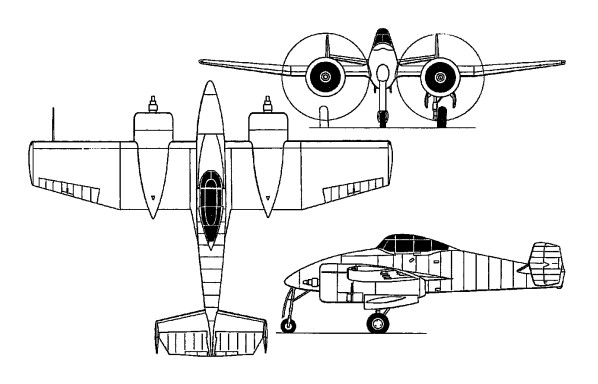
The G 34 had potential applications with the Air Force as well and as the Type G 45 ordered as a back up to the Lockheed XP 49 in November 1939. A land based version of the shipboard XF5F-1 was offered to the US Army Air Corps as the G 46 while the prototype naval fighter was still under construction, and this was ordered as the XP 50 on 25 November 1939. The XP 50 was essentially similar to its shipboard counterpart, apart from having a lengthened nose to accommodate the nosewheel member of a tricycle undercarriage, and, powered by two turbo¬ supercharged Wright R 1820 67/69 engines, was intended to carry an armament of two 20 mm cannon and two 0.5 in (12,7¬ mm) machine guns.
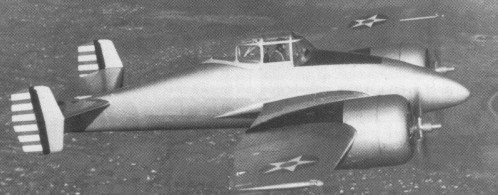
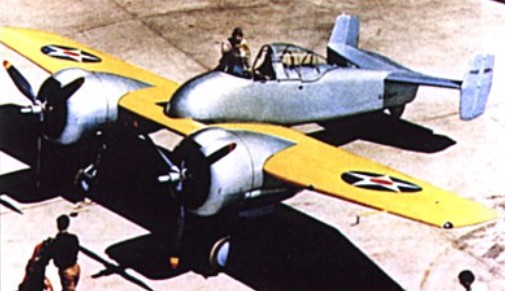
The prototype XF5F-1 had a number of modifications, the most noticeable being an extension of the fuselage nose so that it terminated forward of the wing. Although failing to win a production order, the XF5F-1 soldiered on until withdrawn from use in December 1944, having done some useful work as a development prototype for the more advanced Grumman F7F. A land-based version of Grumman’s design interested the US Army Air Force, which ordered a single XP-50 prototype.
First flown on February 18 1941 at Bethpage, the XP 50 (40 3057) was powered by a pair of 1,200hp (893kW) R 1820-67s and had a longer nose, tricycle landing gear and turbocharged engines. Its potential seemed tremendous, with good manoeuvrability, excellent pilot view even astern, two 20-mm and two 0.5-in guns, plus bombs, a range of 1,250 miles, ceiling of over 40,000 ft and speed of 424 mph. This came to nothing, the planned P-65 pro¬duction version being com¬promised by the need also to meet navy requirements with the equivalent F7F, and in any case Grumman’s resources were being stretched to the limit. An in flight explosion of the turbosupercharger on May 14 1941 forced test pilot Bob Hall to bail out and with the loss of the prototype, this pro¬gramme also being aban¬doned in favour of the more advanced XP 65 (G 51), which, in the event, was also to be discontinued.
XP-50 manufacturer’s estimates Engine: 2 x Wright R-1820-67/-69 Max speed, 424 mph (682 km/h) at 25,000 ft (7 620 m). Range, 585 mls (941 km) at 317 mph (510 km/h) at 10,000 ft (3 050 m). Time to 20,000 ft (6 095 m), 5.0 min. Empty weight, 8,307 lb (3768 kg). Max loaded Weight, 13,060 lb (5 924 kg). Span, 42 ft 0 in (12,80 m). Length, 31 ft 11 in (9,73 m). Height, 12 ft 0 in (3,66 m). Wing area, 304 sq ft (28,24 sq.m). Armament: two 20-mm and two 0.5-in guns, plus bombs. Crew: 1
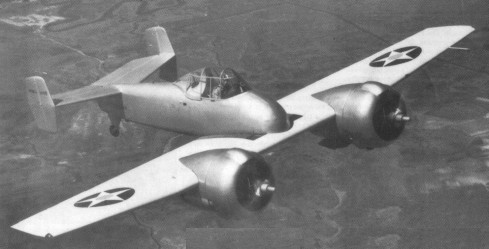
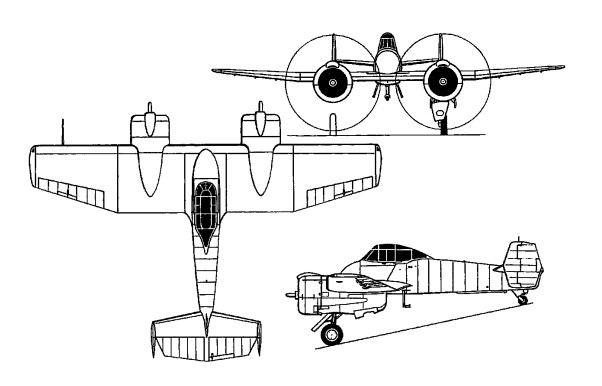
Ordered as a prototype on 30 June 1938 by the US Navy Bureau of Aeronautics, the XF5F-1 was of radical concept in that it was intended as a twin engined shipboard fighter, and this at a time when the first single engined shipboard fighter monoplanes were only just commencing flight test. Conceived as the G 34 Skyrocket, the XF5F-1 was flown on 1 April 1940, and, in its initial form, had a singular appearance resulting from an abbreviated forward fuselage, the wing leading edge extending ahead of the fighter’s nose. Powered by two 1,200 hp Wright XR 1820 40/42 radials and having provision for two 23 mm Madsen cannon, the XF5F 1 underwent some redesign as a result of testing, the engine nacelles being lengthened, the fuselage nose being extended, etc. Flight testing of the XF5F-1 provided information utilised in the development of the more advanced XF7F 1 (G 51). Despite the economic circumstances and America’s declining influence in world affairs, Congress loosened its purse strings wide enough to allow the Navy to modernise its naval air arm. As a result, the Navy became involved in three new fighter projects the Grumman XF5F 1 and similar USAAF XP 50, the Bell XF1 1 and the Vought XF4U 1. The long term intention was to bolster the Navy’s sagging carrier forces whose squadrons flew the Grumman F3F 2 biplane fighter harking back to the mid1930s
G-34 / XF5F-1 Skyrocket
The introduction of speedier and more heavily armed low wing fighters emerging from Europe such as Britain’s Supermarine Spitfire and Germany’s Messerschmitt Bf 109 capable of speeds well over 300mph (483km/h) made the Navy’s task ever more urgent. In addition, the changing military environment, along with the gathering storm clouds of impending war in Europe, spurred Navy officials to investigate new concepts in aircraft design the XF5F 1 Skyrocket. Ordered by the navy as the XF5F-1 [1442] on 30 June 1938, it was flown on 1 April 1940 piloted by R A “Bud” Gillies.
Not only was the G-34 an advanced concept, in its original form it was a most unusual-looking aircraft, with the leading edge of its low-set monoplane wing forward of the fuselage nose. The tail unit had twin endplate fins and rudders, and the landing gear was of the retractable tailwheel type, with the main units retracting aft into the wing-mounted engine nacelles. The engines were two Wright R-1820 Cyclones, each with a three-bladed propeller, these being geared to counter-rotate to offset the effects of propeller torque.
Flight test data early on in the Grumman G 34 (factory designation) revealed the Skyrocket was capable of outstripping in speed practically all other fighters then in both air services. At 16,000ft (4,877m), it achieved a top speed of 380mph and had an initial climb of 4,000ft (1,200m) per minute. Armament consisted of four 0.50 calibre Brownings.
In the summer of 1941, XF5F-1 was tested in competition against F2A, F4F, XF4U, XFL-1, P-39, P-40, and British Hurricane and Spitfire. After familiarization flights in each aircraft, pilots flew a specified series of maneuvers, then submitted pilot reports on each. LtCdr John Crommelin had this to say about F5F: “I remember testing against XF4U in a climb to 10,000’… I pulled away from the Corsair so fast I thought he was having engine trouble. F5F was a carrier pilot’s dream … opposite- rotating props eliminated all torque, and you had no engine in front to look around to see the LSO (Landing Signal Officer). Analysis of all data favored F5F, and Spitfire came in a distant second.” Availability of spare parts at the time and other particulars cancelled F5F, and the Navy chose F4F instead for production.
Despite the glowing performance figures the Skyrocket’s future was suddenly scrapped by the Navy, mainly for a combination of technical reasons and doubts over what some considered to be radical features. The Navy’s enthusiasm blunted by several problems in the Skyrocket testing programme such as engine cooling, instability in certain flight conditions and the wing’s odd position obstructing the view forward during carrier landings. Modified under a Dick Hutton design, the F5F received inward-rotating props, a new canopy and longer nose in 1941.
Grumman XF5F-1 long-nose
After completing 211 test flights, the XF5F 1 (BuNo 1442) was cancelled in early 1941. It did, however, lead to the XP-50 for the Army Air Corps.
Grumman XF5F-1 Third revision [1442]
XF5F-1 Engine: 2 x Wright XR-1840-40/42 Cyclone, 1,200-hp. Wingspan: 12.80 m / 42 ft 0 in Length: 8.75 m / 28 ft 8 in Height: 3.45 m / 11 ft 4 in Wing area: 28.19 sq.m / 303.43 sq ft Max take-off weight: 4599 kg / 10139 lb Empty weight: 3677 kg / 8106 lb Loaded weight, 10,138 lb (4599 kg). Max. speed: 616 km/h / 383 mph at sea level, 380 mph (611 km/h) at 16,500 ft (5030 m) Range: 1930 km / 1199 miles at 210 mph (338 km/h) Max climb, 4,00ceiling: 33,000′ ft Seats: 1
Designed in 1937 by Robert L. Hall, the company’s first carrier-based fighter of monoplane configuration was designed to meet a US Navy requirement which originated in 1935, but it was not until July 1936 that the Navy ordered this aircraft, under the designation XF4F-2 (G-18).
The model G-18 was powered by the Pratt & Whitney R-1830-66 Twin Wasp engine, a two-row, fourteen-cylinder radial. A Hamilton Standard two-position propeller was fitted. The armament installation was basically the same as that of the XF4F-1, with two 0.50 guns with 200 rounds each in the top of the engine cowling, and provision for two 100lb bombs under the wings. The gross weight of the aircraft was 5635lb, a substantial increase over the XF4F-1 biplane. The G-18 was ordered on 28 July 1936. Despite the substantial differences to the G-16, the designation XF4F-2 was applied. The prototype, BuNo 0383, was first flown on 2 September 1937. During trials it demonstrated a maximum level speed of 290mph, which was faster than the XF2A-1, but still below the USN requirement of 300mph.
The XF4F-2 was delivered to NAS Anacostia on 23 December 1937 for evaluation. During trials the prototype suffered from a series of snags and accidents. None of these was particularly serious, but their undermined the confidence of the USN. The XF4F-2 suffered repeated engine crankshaft failures. The arrestor hook proved too weak. On 24 February 1938 there was an on board fire when ballast bags in the aft fuselage began to burn. And on 11 April 1938 the XF4F-2 suffered a crash when the engine failed during a simulated deck landing. As a result, the US Navy selected the more reliable Brewster F2A-1 Buffalo for production, after NACA tests had suggested that minor aerodynamic improvements could boost the speed of the XF2A-1 by 30mph. The USN ordered 54 F2A-1s on 11 June 1938. Despite this setback, the USN continued to show interest in the F4F. This was probably partly due to its unwillingness to rely fully on the production of Brewster: The order for the F2A-1 was the first production contract for Brewster, and the manufacturer did not even possess a factory which was adequate for the production of aircraft. Grumman had already built the FF, F2F and F3F for the Navy, and the F4F showed some promise. A development contract was awarded in October 1938. To overcome the shortcomings of the XF4F-2, a new prototype was built with a more powerful two-stage supercharged engine, and airframe revisions which increased wing span and brought changes to wingtips and tail surfaces. In this form the XF4F-3 flew for the first time on 12 February 1939. In July 1936 the navy ordered the prototype XF4F-2, with one of the new 900-hp Pratt & Whitney R-1830 Twin Wasps at the front of a rather tubby fuselage which carried the monoplane wing an inch or two below the mid position. The R-1830S C5 G went into production in 1940 to power the Grumman F4F 3 Wildcat fighter. This was the first production aircraft with two stage supercharging. The hand¬cranked landing gear was re¬tained, and the pilot could look down through two windows in the floor of the comfortable cockpit. Bob Hall, designer of the faintly similar Gee Bee racers, took the XF4F-2 on its first flight on 2 Sep¬tember 1937. Armed with two 0.5-in guns and two 100-lb bombs, this showed promise but suffered from prolonged engine problems. First flown on 12 February 1939, the XF4F-3 had a com¬pletely revised airframe, with broad square-tipped wings and a much-improved tail. It also had a far better Twin Wasp, with a two-stage two-speed supercharger. Armament was increased to two 0.3-in in the fuselage and two 0.5-in in the outer wings. Though by far the heaviest Grumman fighter yet, the Dash-3 proved a fine aircraft, with excellent manoeuvrability, a speed of 333 mph and service ceiling of 33,500 ft. In August 1939 the navy ordered the first batch of 54 F4F-3s, with a longer fuselage, four 0.5-in guns in the wings and, later, armour and self-sealing fuel tanks. This order was soon in¬creased. Grumman offered an export version of the F4F 3 ordered by the US Navy as the G 36A, a contract for 81 aircraft being placed on behalf of France’s Marine Nationale, and France added 81 of a version called the G.36A with Cyclone engines. Seven were in various stages of assembly when France fell and the entire batch was transferred to Britain which also placed a contract for 100 G 36As on its own account. Britain’s Fleet Air Arm put in British non-metric instruments and a throttle lever that worked in the normal sense (the French pulled the lever back for take-off). The six 7.5-mm French guns in the wings were retained.
They proved far better than any other fighter in the Fleet Air Arm, and opened their score on Christmas Day 1940 when two from 804 Squadron shot down a Ju 88 in the north of Scotland.
G-36A Martlet I
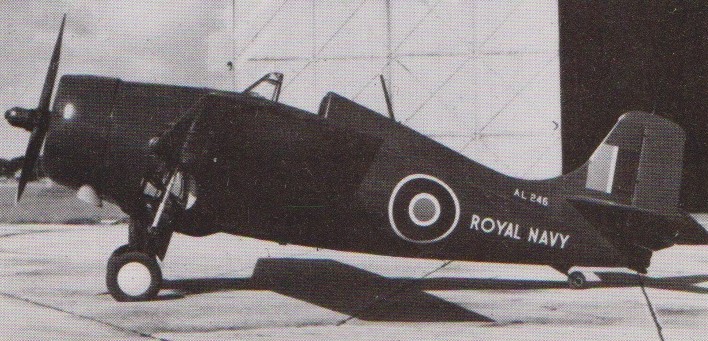
Whereas the French contract aircraft were powered by the 1,200 hp Wright R 1820 G205A Cyclone, Britain selected the Pratt & Whitney S3C4 G Twin Wasp of similar power. The first (French contract) G 36A flew on 11 May 1940 and entered British service as the Martlet I, a contractual change resulting in the British order being switched to the G 36B with folding wings, this entering service as the Martlet II (although the first 10 were accepted with fixed wings). The 30 F4F 3As that had been assigned to Greece were also taken into the Royal Navy inventory as Martlet IIIs, and with the passage of the Lend-Lease Act, 220 aircraft essentially similar to the F4F-4 but with the single stage R 1820 40B engine were assigned to the Royal Navy as Martlet IVs (F4F 4Bs), these becoming Wildcat IVs when British and US names were standardised in March 1944.
Churchill regarded the production of Fulmars vital and the greater need for land Spitfires, the diversion of resources to a new navalised variant would reduce Spitfire’s production numbers. To cover the gap until the Fulmar’s replacement (the Fairey Firefly) was able to enter service, Grumman Wildcats were ordered for the FAA. These entered service towards the end of 1940 as the Martlet, but these were unavailable in sufficient numbers, while Sea Hurricanes, without folding wings, were also not advanced enough as a solution.
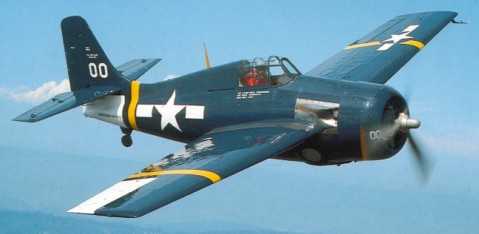
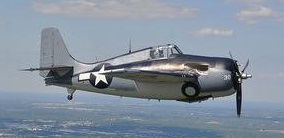
The appearance of the A6M2 N float fighter in the Aleutians prompted US Navy interest in a float equipped version of the F4F 3 shipboard fighter. One example was therefore fitted with Edo designed and manufactured single step metal floats, and with auxiliary rudders mounted near the tips of the tailplane flew on 28 February 1943. The need for additional keel area aft was revealed by initial trials and a large ventral fin was added to improve yaw stability. The floats and their bracing struts raised the fighter’s weight by only some 500 lb (227 kg), and from calm water at normal loaded weight the F4F 3S could take off within 34 seconds. However, the dramatic effect of float drag on speed performance led to an earlier contract to complete 100 F4F 3 Wildcats as float fighters being cancelled. Altogether Grumman built 369 F4F-3s for the US Navy, followed by 95 Dash-3As with the R-1830-90 engine. Some were converted to F4F-3P photo air¬craft and BuNo 4038 was fitted with twin floats. The navy allotted the name Wildcat, thereby estab¬lishing the famous series of Grum¬man ‘cat’ fighters, and the British changed to the same name in January 1944. The chief drawback of the otherwise outstanding F4F-3 was its size, which did not fit too well with the constricted decks of the new escort carriers. Leroy Grum-man took two paperclips and, after bending them in various direc¬tions, stuck them into a pencil eraser. He thus proceeded to demonstrate the principle of what at first was called the ‘sto-wing’. By attaching the outer wings by oblique skewed hinges they were made to fold back on each side of the fuselage, upper surface out¬wards. The company made abso¬lutely sure it worked before com¬mitting it to production at the 163rd aircraft, subsequent delive¬ries being designated F4F-4s, or Martlet IIs. These had the 1,200-hp R-1830-86 engine and the heavy armament of six 0.5-in guns in the outer wings. They were by far the most important Allied fighters in the Pacific from Pearl Harbor until the summer of 1943. Grumman completed the last of 1,971 F4F-4s on the last day of 1942, subsequently needing every inch of floor for the TBF and F6F. Small numbers were built of the experimental Dash-5 to -8. In January 1942 General Motors formed its Eastern Aircraft Divi¬sion to build aircraft in under-used car factories. In 1942 the manufacture of the Wildcat was transferred to the Eastern Aircraft Division of the General Motors Corporation. The first FM-1 Wildcat, assembled from parts supplied by Grumman, flew on 1 September 1942. The FM-1, fitted with a Pratt & Whitney R-1830-86 engine, was virtually the same as the F4F-4 (Wildcat IV). By 11 April 1944 the Eastern Aircraft Division had produced its 2,500th Wildcat. Manufacture of the F4F-4 continued in slightly modified form as the FM 1 Wildcat, the R 1830 86 Twin Wasp engine being retained but wing armament being reduced from six to four 0.5 in (12,7¬ mm) guns and ammunition capacity being raised (from 1,440 to 1,720 rounds). The first FM 1 was flown on 31 August 1942, at Linden, New Jer¬sey, a total of 1,151 subsequently being built of which 312 were assigned to Britain as Martlet (later Wildcat) Vs.
The version of the Wildcat built in largest numbers by General Motors, however, was the FM 2, the first version of the fighter produced for the US Navy to standardise on the 1,350-hp R-1820-56 Cyclone engine. The FM 2 was the production version of the XF4F 8, two prototypes of which were built by Grumman with the first flying on 8 November 1942. Distinguished by its short cowling and redesigned, taller tail. FM-2 Wild¬cats had the oil coolers removed from the under surface of the centre-section to the cowling, which was revised in shape. The removal of the oil coolers permitted the installation of universal racks under the inner wings for bombs or auxiliary fuel tanks, six 0.5-in guns, and (from No. 3,301) six 5-in rockets. This version was called the Wildcat V by the Fleet Air Arm.
FM-2 Wildcat
A total of 4,777 FM 2 Wildcats was built, the last delivery in August 1945, of which 370 were assigned to Britain as Wildcat VIs. Excluding prototypes a total of 7,898 F4Fs and FMs were built.
These were used operationally by the US Navy on a wide scale in the Pacific (FM-2 in particular serving as light escort carrier fighters), participating in the battles of the Coral Sea and Midway, and were used extensively in the attack on Guadalcanal. The type remained in first-line service until the end of the war. British Martlets initially replaced Sea Gladiators and, like their US Navy counterparts, remained operational until the end of the war.
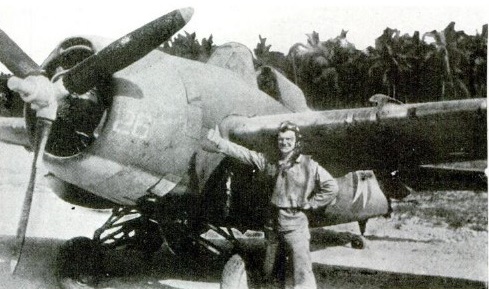
Lieut. Millard Thrash USNR 1944 at Guadalcanal after WASP sinking
XF4F-2 Engine: Pratt & Whitney R-1830-66 Twin Wasp, 900-hp. Wing span: 34 ft. Armament: two 0.5-in guns & two 100-lb bombs.
XF4F-2 Engine: Pratt & Whitney R-1830-66 Twin Wasp, 1050 hp Wingspan: 38 ft 0 in / 11.6 m Length: 28 ft 9 in Height: 11 ft 11 in / 3.6 m
XF4F-3 Engine: Pratt & Whitney R-1830 Twin Wasp. Armament: 4 x 0.5-in mg. Max speed: 333 mph. Service ceiling: 33,500 ft.
G.36A Martlet I / Wildcat Engine: Wright R-1820G 205A Cyclone, 1200 hp Wingspan: 38 ft 0 in / 11.6 m Length: 28 ft 9 in Height: 11 ft 11 in / 3.6 m Armament: six 7.5-mm mg.
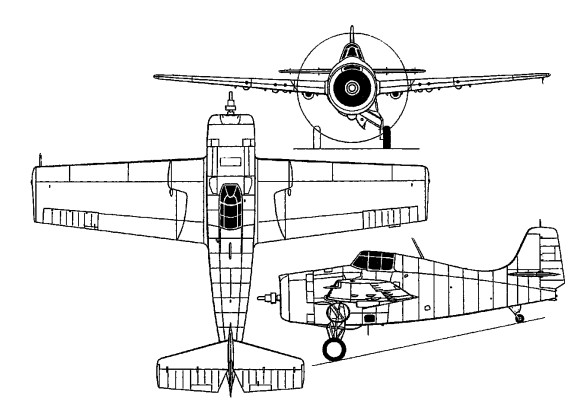
F4F-3 Engine: Pratt & Whitney R-1830-76 Twin Wasp, 1200 hp Wingspan: 38 ft 0 in / 11.6 m Length: 28 ft 9 in Height: 11 ft 11 in / 3.6 m Empty weight: 4425 lb Loaded weight: 5876 lb Max speed: 325 mph / 523 kph
F4F-3A Engine: R-1830-90.
F4F-3P Photo air¬craft.
G-36 / F4F 3S Max speed, 266 mph (428 kph) at 20,300 ft (6 185 m). Initial climb, 2,460 ft/min (12,5 m/sec). Max range, 600 mls (965 km). Empty weight, 5,804 lb (2 633kg). Loaded weight, 7,506 lb (3405 kg). Span, 38 ft 0 in (11,59 m). Length, 39 ft 1 in (11,91 m). Height, 18 ft 13 in (5,53 m). Wing area, 260 sq ft (24,15 sq.m).
F4F-4 / Martlet II / Wildcat Engine: Pratt & Whitney R-1830-36/40 Twin Wasp, 1,200-hp / 895kW Wing span: 38 ft / 11.58 m Length: 8.76 m / 28 ft 9 in Height: 2.81 m / 9 ft 3 in Wing area: 24.15 sq.m / 259.95 sq ft Max speed, 293mph (471 km/h) at 13,000 ft (3 965 m). Cruise speed: 249 km/h / 155 mph Initial climb, 3,050 ft/min (15,49 m/sec). Ceiling: 12010 m / 39400 ft Max range (clean), 890 mls (1432 km). Empty weight, 5,425 lb (2461 kg). Normal loaded weight, 7,580 lb (3 438 kg). Armament: six 0.5-in mg, 2 x 45kg bombs. Crew: 1
F4F-5
F4F-6
F4F-7
F4F-8
FM-1 Wildcat Engine: Pratt & Whitney R-1830-86 Twin Wasp, 1200 hp Wingspan: 38 ft 0 in / 11.6 m Length: 28 ft 9 in Height: 11 ft 11 in / 3.6 m Max speed: 318 mph / 509 kph Armament: 4 x 0.5-in mg.
FM-2 Wildcat V Engine: Wright R-1820-56 Cyclone, 1,350-hp. Armament: six 0.5-in guns, and (from No. 3,301) six 5-in rockets. Max speed, 289 mph (465 km/h) at sea level, 319 mph (513 km/h) at 19,600 ft (5 980 m). Time to 10,000 ft (3 050 m), 4.5 min. Max range (clean), 780 mls (1255 km). Empty weight, 5,542 lb (2 516 kg). Max loaded weight, 8,221 lb (3 732 kg). Span, 38 ft 0 in (11,59 m). Length, 28 ft 9 in (8,77 m). Height, 11 ft 5 in (3,48 m). Wing area, 260 sq ft (24,15 sq.m).
Wildcat VI Engine: Pratt & Whitney R-1830-56 Twin Wasp, 1350 hp Wingspan: 38 ft 0 in / 11.6 m Length: 28 ft 9 in Height: 11 ft 11 in / 3.6 m
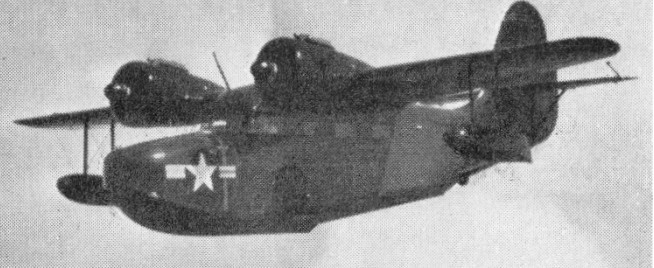
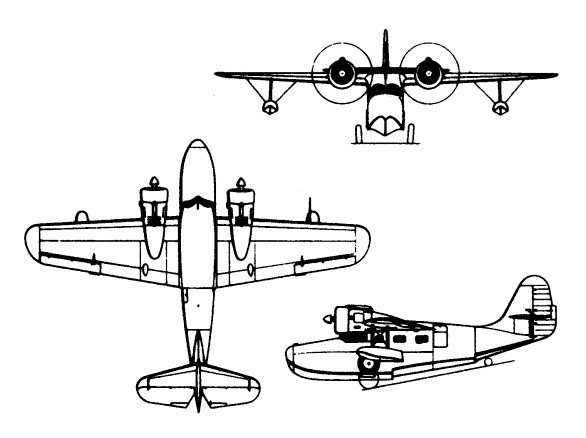
The G-21A eight-seat commercial amphibian first flew on 29 May 1937 and was Grumman’s first aircraft produced for the private and commercial market. Proving successful, 20 were delivered prior to 1 October 1938. The G-21 was adopted by the US Navy, under the designation JRF, first entering service in 1939, and by the US Navy as the JRF-5. However most of the 300 or so aircraft built went into military service, The US Navy initially received JRF-1s and the US Coast Guard JRF-2s in 1939-40. The series included JRF-1A aircraft, fitted for target towing and photography and JRF-3 fitted with anti-icing equipment and autopilot for use in northern waters by the US Coast Guard. The JRF-4 was a development of the JRF-1, and JRF-5 (OA-9) for the USAAF and fitted for photography. The JRF-6B was a navigational trainer. The JRF-5s also served with the RCAF and the JRF-5 and -6 with the RAF as the Goose.
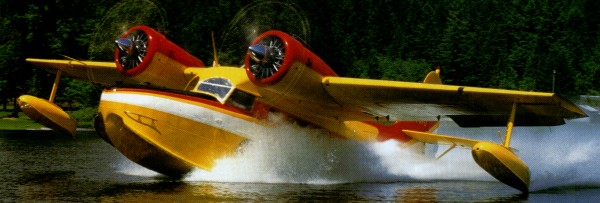
JRF-5 Goose
Production of the JRF ceased in September 1945, but the type continued to serve as a general/utility amphibian with the US Navy and Coast Guard. More than 300 of the G-21A Goose series with 450 hp Pratt & Whitney engines were built just before and during World War II. Large numbers of’ these amphibians were still used by the U S Navy and Coast Guard for an-sea rescue and transport duties in 1955. After the war McKinnon Enterprises began a conversion programme, replacing the original 335kW Pratt & Whitney R-985-AN-6 engines with four 253kW Lycoming GSO-480s and incorporating other refinements to produce executive transports. This programme was superseded by the turboprop-powered G-21C, D and G Turbo-Goose conversions, initiated in 1966. The turboprop version is powered by two 680 shp / 507kW Pratt & Whitney Aircraft of Canada PT6A turboprop engines. Other improvements include retractable wing floats and increased fuel capacity.
Grumman G 21 A / JRF Goose Engine: 2 x Pratt&Whitney R-985-AN6 Wasp Junior, 450 hp Length: 38 ft 4 in / 11.68 m Height: 15 ft / 4.57 m Wingspan: 49.016 ft / 14.94 m Wing area: 375.018 sq.ft / 34.84 sq.m Max take off weight: 7955.6 lb / 3608.0 kg Weight empty: 5426.5 lb / 2461.0 kg Max. speed: 174 kts / 323 km/h / 201 mph Cruising speed: 166 kts / 307 km/h Service ceiling: 21,000 ft / 6400 m Cruising altitude: 5003 ft / 1525 m Wing load: 21.32 lb/sq.ft / 104.0 kg/sq.m Range: 556 nm / 1030 km Fuel capacity 220. Crew: 2 Seats: 4-6
JRF-5 Goose Engines: two 450 h.p. Pratt and Whitney R-985-N-6 Span: 49 ft Weight: 8,500 lb Max Speed: 180 mph Maximum range: 800 miles approx Crew: 2-6
McKinnon Turbo Widgeon G-21E Engines: 2 x P&WAC PT6-27, 715 hp. Wing loading: 33.1 lb/sq.ft. Pwr loading: 7.3 lb/hp. Max TO wt: 10,500 lb. Empty wt: 6635 lb. Equipped useful load: 3507 lb. Payload max fuel: 0 lb. Range max fuel/ cruise: 1131 nm/5.8 hr. Service ceiling: 20,000 ft. Max cruise: 174 kt. Stall: 73 kt. 1.3 Vso: 95 kt. ROC: 2000 fpm. SE ceiling: 12,000 ft. Min field length – land: 1500 ft. Fuel cap: 3956 lb. Seats: 10.
McKinnon G-21G Turbo Goose Engines: 2 x Pratt -Whitney Canada PT6A-27, 507kW / 680 shp Wingspan: 15.49 m / 50 ft 10 in Length: 12.06 m / 39 ft 7 in Wing area: 35.08 sq.m / 377.60 sq ft Max take-off weight: 5670 kg / 12500 lb Empty wt: 6635 lb Equipped useful load: 5507 lb. Payload max fuel: 1551 lb. Fuel cap: 3956 lb Wing loading: 33.1 lb/sq.ft. Pwr loading: 9.19 lb/hp. Max. speed: 391 km/h / 243 mph Max cruise: 174 kt. Stall: 73 kt. 1.3 Vso: 95 kt. ROC: 2000 fpm. Service Ceiling: 6095 m / 20000 ft SE ceiling: 12,000 ft. Min field length – land: 1500 ft. Range max fuel/ cruise: 1131 nm/5.8 hr. Seats: 13
The first of three Hawkeye prototypes flew on October 21, 1960, the Hawkeye became the primary early warning component of the US Navy carrier air wings.
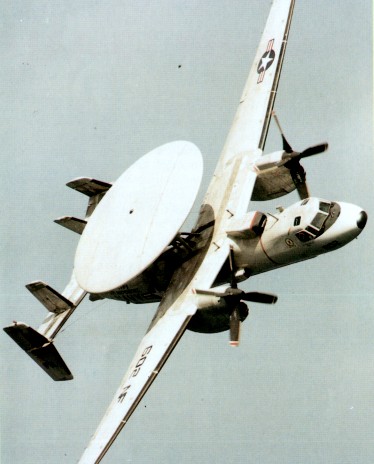
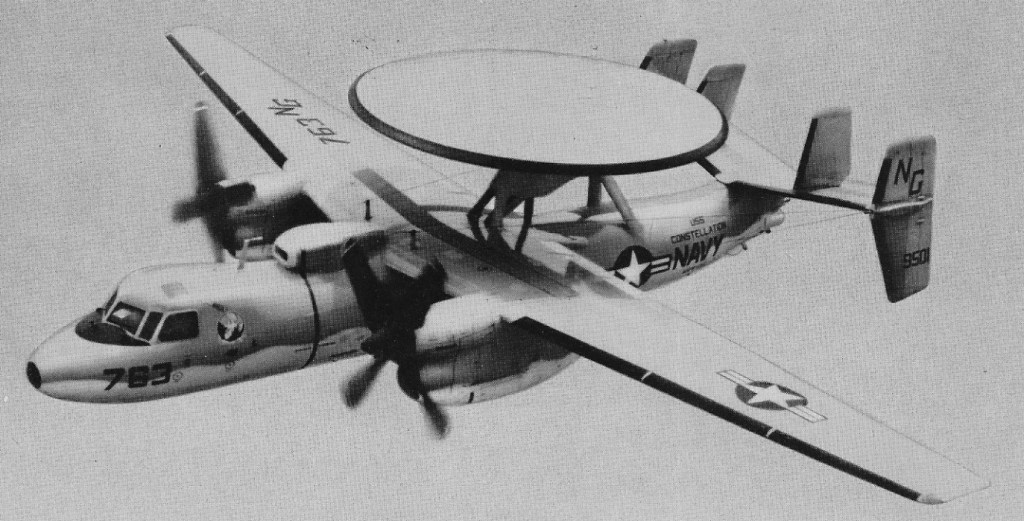
Delivery of the first member of the Hawkeye family, the E 2A (formerly known as the W2F-1) began on 19 January 1964 to the US Navy, entering service in 1965 as a replacement for the Grumman E 1B Tracer, an early warning derivative of the S 2 Tracker. The E 1B carried its radar aerial inside a fixed oval, aerofoil shaped radome, but the E 2 was the first AEW type to adopt the 7.32m diameter ‘rotodome’, with the antennae mounted rigidly inside a radome which itself rotates at 6 rpm in the case of the Hawkeye. Fifty nine E 2As were delivered to the US Navy, and the type quickly proved its worth off the coast of Vietnam. The Hawkeyes were sent out to patrol whenever there was a risk of the naval task force being attacked by enemy aircraft or ships; by extending the force’s detection range well beyond the normal horizon, even against low flying aircraft, the E 2As reduced the need for large numbers of intercepters to be kept on alert throughout the day and night. In addition to their defensive role, the Hawkeyes were able to relay target information from the aircraft carriers to their distant attack formations. With the E 2A the US Navy began to appreciate the many advantages of a modern AEW aircraft, but the 1950s technology computer had to be physically modified every time the ATDS (Airborne Tactical Data System) needed new software. To overcome this problem the Hawkeyes were fitted with Litton L 304 general purpose digital computers, and several minor modifications were also made; the E 2As thus became E 2Bs, which flew for the first time in February 1969, all having been converted by 1971. Grumman built 56 E-2As, later updated to E-2B, before introducing the E-2C. The first of the significantly more capable E-2C series flew in January 1971. By mid-1987 97 E-2Cs had been delivered to the US Navy, plus 21 to overseas customers.
Firm orders existed for a total of 47 aircraft, with procurement of 36 more by the end of 1985. Israel has four and in 1979 Japan released funds for the first four of an eventual total of about 15 for the JASDF. The Air Self-Defence Force accepted its first E-2C Hawkeye at Bethpage, Long Island, on 18 May 1982.
The E-2G has an advanced radar that is capable of detecting airborne targets anywhere in a three-million-cubic-mile surveillance envelope. It first entered service with the US Navy in November 1973 and went to sea on board USS Saratoga in late 1974. A training version is designated TE-2C.
By this time the first E 2Cs were flying, the prototype first flew in January 1971. Although virtually identical to its forebears externally, the E 2C is a very different under the skin. The improved APS 120 radar’ can detect and track aircraft over land as well as above the sea, and the APS 125 ARPS (Advanced Radar Processing System) is being incorporated in all E 2Cs to give long range detection of very small targets and automatic overland tracking. The APS 125 also incorporates a digital airborne moving target indicator (AMTI) in place of the E¬2B’s analogue unit. Communication equipment has been improved, and the E 2C has better hot day and single engine performance than its predecessors, and is four times as reliable.
E-2C
The E 2C entered service in 1974, its arrival more or less coinciding with the introduction of the US Navy’s new generation of carrier based aircraft: the F 14 Tomcat, S 3 Viking, EA 6B Prowler and A 6E Intruder. The latest APS-138 surveil¬lance radar was introduced on the E-2C airborne early warning aircraft built in 1983, and will be retrofitted to earlier E-2Cs in place of the original APS-125. APS-138 has a low-¬side-lobe active-element-array antenna, an enhanced passive detection system with trian¬gulation and exotic emitter recognition, together with expanded computer memory allowing the simultaneous and automatic track¬ing of up to 600 targets. At an operating height of 9,150m (30,000ft), a Hawkeye can detect and assess any approaching aircraft over a range of 480km (260 nm) in all weathers. From 1988 new E-2Cs will be fitted with uprated Allison T56-A-427 engines, and will receive the improved APS-139 radar system which can transmit on any one of ten UHF channels. General Electric is also developing an APS-145 radar for service in 1990 which will counteract the problem of overland clutter. The Hawkeyes work closely with the Tomcats, orbiting on station between 110 km (68 miles) and 185 km (115 miles) from the carrier at heights of 4600 m to 9150 m (15000-¬30000 ft); a typical orbit begins at 7000 m (23 000 ft) and rises to 8500 m (28000 ft) as fuel is burnt off. At a height of 7600 m (24 930 ft) the radar has a horizon range of 375 km (235 miles) and can detect high flying aircraft out to 460 km (285 miles). The radar can detect and track more than 200 targets simultaneously, supplying alti¬tude, range and velocity information. The crew of five includes three operators in the combat information centre, each of which has a main 25 cm (10 in) radar display and a 12.5 cm (5in) screen giving alphanumeric information. Targets detected by the AWG 9 long range fire control radar in the F 14 can be notified to an E 2C by data link; they are then correlated with the appropriate return on the Hawkeye’s own radar displays or are used to feed in new information, thus effec¬tively extending the range of the AEW cover-age. The intercepter may then be vectored automatically on to the rear of the target for a visual identification, or it can be manoeuvred into the optimum firing position. The US Navy claims that the use of an E 2C for airborne control can double the number of kills made by the intercepter force while substantially reducing losses of friendly air¬craft. Hawkeyes can also control a carrier’s attack force, supplying navigation and turn¬ing instructions by data link.
Northrop Grumman undertakes production of E-2C Hawkeye in the Hawkeye 2000 form (first flown April 1998).
E-2C Hawkeye Engine: 2 x Allison T56-A-425 turboprop, 4910 shp. Installed thrust: 6800 kW. Span: 24.6 m. Length: 17.5 m. Wing area: 699.66 sq.ft / 65 sq.m. Height: 18.34 ft / 5.59 m Empty wt: 17,265 kg. MTOW: 23,560 kg. Max speed: 600 kph. Cruising speed: 269 kts / 498 kph Service Ceiling: 30840 ft / 9400 m. Initial climb rate: 2519.69 ft/min / 12.80 m/s T/O run: 609 m. Ldg run: 439 m. Fuel internal: 7050 lt. Range: 320 km. Endurance: 4 hr on station. Air refuel: Yes. Crew: 5
Engines: 2 x turbo-prop Allison T-56 A-8, 2980kW Max take-off weight: 22450 kg / 49494 lb Empty weight: 16358 kg / 36063 lb Wingspan: 24.6 m / 80 ft 9 in Length: 17.2 m / 56 ft 5 in Height: 5.6 m / 18 ft 4 in Wing area: 65.0 sq.m / 699.65 sq ft Max. speed: 600 km/h / 373 mph Cruise speed: 500 km/h / 311 mph Ceiling: 9660 m / 31700 ft Range w/max.fuel: 3000 km / 1864 miles Crew: 5
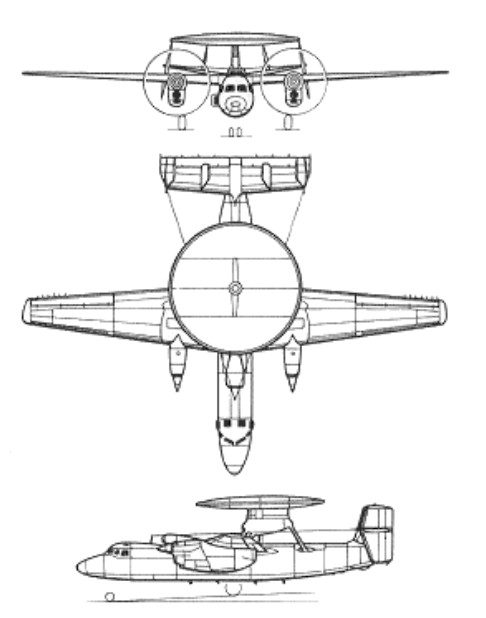
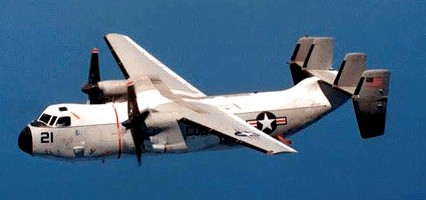
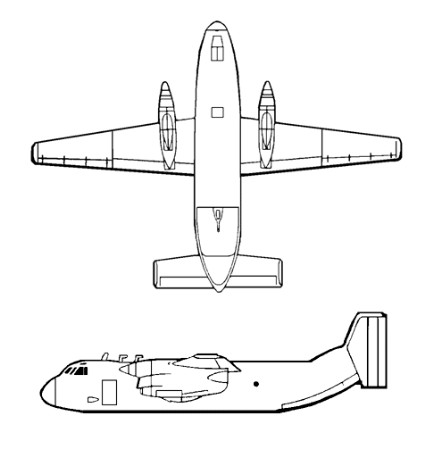
Derived from the E-2A Hawkeye, the first of two Greyhound prototypes flew on November 18, 1964. 19 were completed for the US Navy by the end of 1968, including the two prototypes converted from E-2A airframes. The C-2 shares wings and power plants with the E-2 Hawkeye, but has a widened fuselage with a rear loading ramp and replaced the piston-engined C-1 Trader in the COD role.
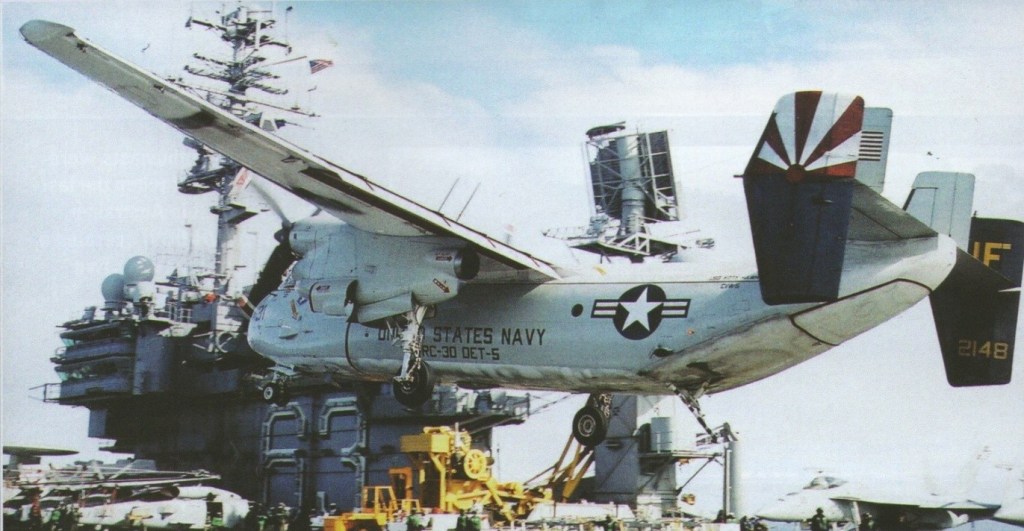
The original C-2A aircraft were overhauled to extend their operational life in 1973. The C-2A was produced 1965-1968, followed by the C-2A(R) 1985-1989 58 were built at a unit cost of US$38.96 million C-2As built after production was resumed in 1983 are based on the E-2C, and have the uprated engines and avionics of the latter. Production C-2As also have a new auxiliary power unit to reduce the need for ground support equipment at remote locations. Grumman received a $678 million multi-year production contract for 39 additional C-2A twin-turboprop carrier on-board delivery (COD) aircraft from the US Navy in 1983. The first of these was delivered in 1985, and production was to run until 1989. The C-2A was originally powered by two Allison T56-A-425 turboprop engines and four-bladed Hamilton-Sundstrand constant-speed propellers. An undercarriage with main gears is fitted to each engine nacelle and at the fuselage’s forward-most portion, a nose wheel is fitted. The wing systems are foldable and twist down, and then fold towards the empennage, just outboard of each engine nacelle, thus improving the carrier storage. Fitted into streamlined nacelles, the engines are mounted under each wing. Straight-in rear cargo loading and downloading are enabled by the inclusion of a large aft cargo ramp and door, and a powered winch in the design to allow for fast turnarounds. A cage system helps to tie down the cargo and restrain it from the arresting and loads during carrier operation.
Northrop Grumman has equipped the aircraft with modified fowler-type flaps, and hydraulically powered irreversible flight controls with an independent hydraulic backup system.
Ultra-high-frequency (UHF) radio navigation aids such as GPS, TACAN (tactical air navigation), dual VOR (VHF omni-directional range), UHF/DF (ultra-high-frequency / direction finder), LF/ADF (low-frequency / automatic direction finder) and weather radar; and communications equipment such as high frequency (HF) and very high frequency (VHF) were provided in the aircraft. The TCAS, TAWS and ARC-210 (airborne radio communication) radios were added later. The C-2A has open-ramp flight capability which enables airdrop of personnel and cargo or other supplies from a carrier-launched aircraft. Ground power self-sufficiency in remote areas and an auxiliary power unit onboard for starting the engine give the C-2A high operational versatility.
The C-2A is also an approved special warfare asset. It can airdrop the inflatable combat rubber raiding craft of a SEAL (sea air land) platoon out of its ramp. It deploys the platoon after the release has been made, thus enabling the SEALs to operate in close proximity to enemy camps. The airdrop capability also enables the aircraft’s utility as a search and rescue (SAR) platform to airdrop life rafts and provisions. In 1984, the Navy ordered 39 new C-2A aircraft to replace older airframes. Dubbed the Reprocured C-2A (C-2A(R)) due to the similarity to the original, the new aircraft has airframe improvements and better avionics. The older C-2As were phased out in 1987, and the last of the new models was delivered in 1990. Powered by two Allison T56 turboprop engines, the C-2A can deliver up to 10,000 pounds (4,500 kg) of cargo, passengers or both. It can also carry litter patients in medical evacuation missions. A cage system or transport stand restrains cargo during carrier launch and landing. The large aft cargo ramp and door and a powered winch allow straight-in rear cargo loading and unloading for fast turnaround.
Its ability to airdrop supplies and personnel, fold its wings, and generate power for engine starting and other uses provide an operational versatility found in no other cargo aircraft.
The fact that this aircraft has four vertical stabilizers is due to aircraft carrier hangar deck height restrictions. Only three of these stabilizers have working rudders. For adequate directional control of an aircraft of this size, a single rudder would have been too tall. It also places the outboard rudder surfaces directly in line with the propeller wash, providing effective yaw control even as the plane’s airspeed approaches zero, as during takeoff and landing.
Between November 1985 and February 1987, VR-24 (the former Navy Transport Squadron) and its seven reprocured C-2As demonstrated the aircraft’s exceptional operational readiness. The squadron delivered 2,000,000 pounds (910 t) of cargo, 2,000,000 pounds (910 t) of mail and 14,000 passengers in the European and Mediterranean theatres. The C-2A(R) also served the carrier battle groups during Operations Desert Shield and Desert Storm, as well as during Operation Enduring Freedom.
Production of the modernised version began in 1985. Delivered in 1990, the aircraft’s modernisation process included several improvements in the airframe and avionic systems over those in the C-2A.
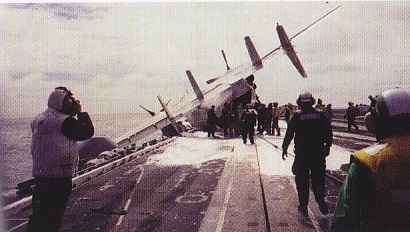
C-2A BuAer 162148 of VRC-30 gets a wave-off on USS Kitty Hawk off Perth, Australia, August 1988
Northrop Grumman is currently working on the resupply of the upgraded C-2A version. In November 2008, the company also obtained a $37m contract for the maintenance, logistics and aviation administration services over five years for the C-2A fleet assigned to air test and evaluation squadron 20 (VX-20) at Patuxent River. Greyhound service life extension programme (SLEP)
A service life extension programme (SLEP) is being carried out to improve the operating service life of the reprocured aircraft, achieving a viable and economically maintainable platform until it is replaced. The programme will increase its service life from 15,020 to 36,000 landings and from 10,000 to 15,000 flight hours. The SLEP involves structural enhancements to the centre wing, an aircraft rewire, a new propeller system and improvement of the avionics systems.
The eight-bladed NP2000 propeller is another part of this upgrade and was expected to be installed by 2010. Navigational upgrades such as the addition of a global positioning system (GPS), the dual CAINS II navigation system, crash-survivable flight incident recorders and a ground proximity warning system are also included in the programme.
Further, a mandate issued by Congress and the chief of naval operations provided for incorporation of two passenger-carrying safety requirements, namely the traffic alert and collision avoidance system (TCAS) and the terrain avoidance warning system (TAWS) in the extension programme. The landing limit of most of the airframes is quickly approaching and the SLEP, upon successful completion, will improve the operational life of the aircraft till 2027.
While all the existing fleet of 36 C-2As is being upgraded in the SLEP, the first upgraded C-2A(R) took off from the NAVAIR Depot North Island on 12 September 2005. Development and installation of the SLEP for this aircraft took three and a half years. As of 2009, a second airframe is close to completion, and the rest of the 34 aircraft are anticipated to take off in the following five years. As of September 2009, the USN was exploring a replacement aircraft for the C-2, including the V-22 Osprey.
The C-2 was operated by Carrier Airborne Early Warning Squadron One Two Zero (VAW-120), Fleet Logistics Support Squadron 30 (VRC-30) and Fleet Logistics Support Squadron 40 (VRC-40). ‘Providers’ at NAS North Island and Detachment Five (at NAF Atsugi, Japan) of VRC-30 are also flying the C-2As. VRC-40 is using the aircraft for its ‘Rawhides’ stationed at NAS Norfolk, while VAW-120 is using the aircraft for its ‘Greyhawks’ stationed at the same location.
VAW-120, the US Navy Fleet Replacement Squadron, was engaged in training aircrew men, naval flight officers and new pilots for the C-2A Greyhound as well as E-2C Hawkeye aircraft.
Variants: C-2A C-2A(R) “Reprocured” C-2A
C-2 Greyhound Primary Function: Transport Engines: Two Allison T-56-A-425 turboprop, 4,600hp (3,400 kW) Length: 56 feet, 10 in (17.30 m) Wingspan: 80 feet, 7 in (24.60 m) Folded span: 29 feet, 4 in Height: 15 feet, 10.5 in (4.85 m) Wing area: 700 sq.ft (65 sq.m) Empty weight: 33,746 lb (15,310 kg) Useful load: 20,608 lb (9,350 kg) Max takeoff weight: 60,000 lb (24,655 kg) Payload: 10,000 lb cargo or 26 passengers / 12 litter patients Wing loading: 77.6 lb/sq.ft (378.9 kg/sq.m Maximum speed: 343 knots (394 mph, 553 km/h) at 12,000 ft (3,660 m) Cruise speed: 251 knots (289 mph, 465 km/h) at 28,700 ft (8,750 m) Stall speed: 82 knots (94 mph, 152 km/h) at idle power Range: 1,300 nm (1,496 mi, 2,400 km) Service ceiling: 33,500 ft (10,210 m) Rate of climb: 2,610 ft/min (13.3 m/s) Crew: 2 pilots, 2 aircrew
C-2A / C-2(R) Engines: 2 × Allison T56-A-425 turboprop engines; 4,800shp (3,400kW) Propeller NP2000 eight-blade propeller Length 56ft 10in (17.3m) Height 17ft 2in (5.28m) Wingspan 80ft 7in (24.56m) Wingspan Folded 29ft 4in (8.94m) Wing area: 65 sq.m. Maximum Gross Take-Off Weight 57,500lb (26,082kg) Empty Weight 35,000lb (15,875kg) Internal Fuel 12,000lb (5,443kg) Payload 10,000lb (4,536kg) Carrier Landing Weight 49,000lb (22,226kg) Field Take-Off Weight.60,000lb (27,216kg) Field Landing Weight 52,000lb (23,587kg) Airspeed 260kt (true cruising airspeed) Maximum Speed 343kt Range 1,300nm Climb Rate 2,610ft a minute (13.3m/s) Ceiling 30,000ft (9,144m) T/O run: 665 m. Ldg run: 435 m. Fuel internal: 6905 lt. Range/payload: 1930 km with 4500 kg. Crew 4 (two pilots and two air-crew) Capacity 38 (26 passengers and 12 litter patients)
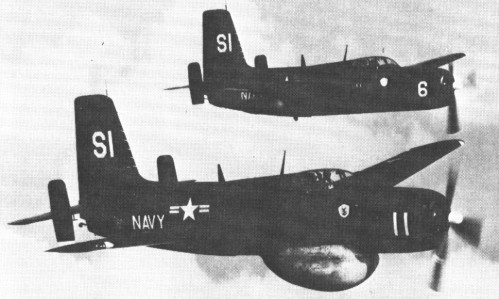
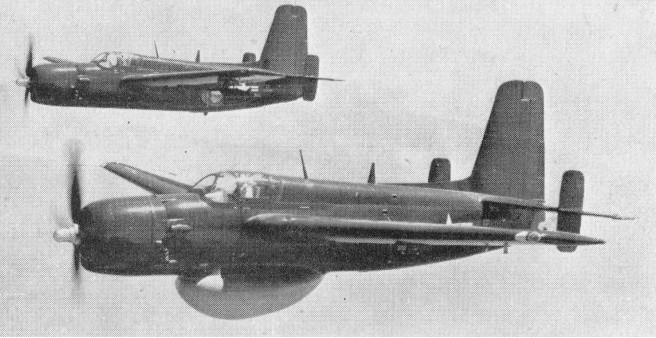
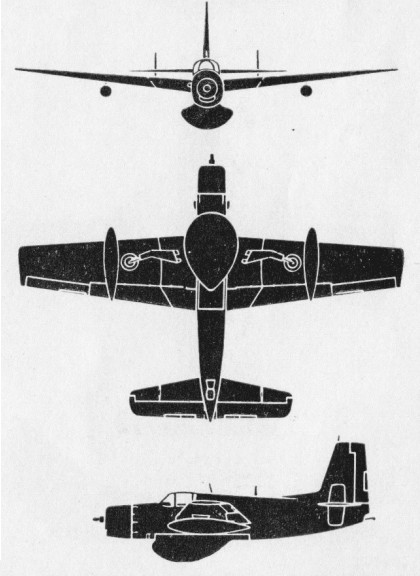
In 1944 Grumman set out to produce a successor to the war-winning TBF Avenger torpedo bomber with a composite power plant consisting of an R-2800-34W piston engine in the nose and a Westinghouse 19XB-2B turbojet engine in the rear fuselage, and the first result was the XTBF-1 (G-70), first flown on 19 December 1945. Looking like a slimmer and neater TBF, this machine had a Westinghouse J30 (later an Allis-Chalmers J36, otherwise de Havilland Goblin) turbojet in the tail for high-speed boost propulsion. This was later omitted. In 1949 two new prototypes incorporating all the changes were built (carrying the designations XTB3F-1S and XTB3F-2S) the former equipped as a submarine hunter and the latter as a killer. Both types were ordered by the US Navy under the respective designations AF-1S and AF-2S, but before completion of the first AF-1S its designation was changed to AF-2W. It was put into production in two versions, which operated from US Navy carriers in the ASW (anti-submarine warfare) role in pairs, known as hunter/killers. The hunter was the AF-2W, distinguished by its APS20A search radar, the displays and controls for which were in a two-seat rear compartment. The AF-2W carried a large search and early-warning radome beneath the forward fuselage. The killer was the AF-2S, which took over when its companion had obtained a sure ‘con¬tact’. First it used its smaller APS-30 radar under the right outer wing to pinpoint its target, using a searchlight in an identical pod under the left wing to illuminate it if necessary. Then it would attack using any of its assortment of weapons. The AF-2S Guardian (G-82) carried one 900kg torpedo, two 720kg depth charges or two 900kg bombs internally, while a similar load could be carried externally. In addition a searchlight was carried under the port wing and a radar scanner under the starboard.
In 1952-53 the AF-3S version was produced with additional submarine detection gear. The Guardians were among the largest single-engine military aircraft, heavier than a Douglas DC-3 and with a roomy side-by-side cockpit, the AF-2S having a third rear-compartment seat for the single radar operator. Grumman delivered 193 of the AF-2S attack version and 153 of its companion AF-2W model in 1950-3. The company then followed with 40 AF-3S machines, which were the first aircraft in service with MAD (magnetic-anomaly detection) gear in a re¬tractable tail-boom mounting. Production of the Guardian ended in March 1953.
AF-2S Guardian Powerplant: one 2,400-hp (1790-kW) Pratt & Whitney R-2800-48W 18-cylinder radial piston engine. Maximum speed: 510 km/h (317 mph) at medium/high altitude Service ceiling 9910 m (32,500 ft) Range 2415 km (1,500 miles) Empty weight 6632 kg (14,620 lb) Maximum take-off 11567 kg (25,500 lb) Wing span 18.49 m (60 ft 8 in) Length 13.21 m (43 ft 4 in) Height 4.93 m (16 ft 2 in) Wing area: 52.02 sq.m (560.0 sq ft) Armament: internal bay for 1814 kg (4,000 lb) Crew: 3
Tasked with finding and attacking targets under night or all weather conditions for the U.S. Navy/Marine Corps, A2F-1 Intruders were designed and developed by the Grumman Aerospace Corporation. The first trials aircraft flew on 19 April 1960 and eight YA2F-1 Intruder prototypes were delivered to the US Navy for evaluation, with original tilt able tailpipes and powered by two Pratt & Whitney J52-P-6 engines of 8500 lb.
The A2F-1 was designed to deliver nuclear or conventional weapons with great accuracy on targets that are completely obscured by bad weather or darkness. A digital integrated attack navigation system enables the pilot to set course for the target and then leave the aeroplane to fly itself. Two TV-type screens enable him to “see” the ground and target whatever the conditions. At the target the aircraft is capable of dropping its weapons and turn for home automatically.
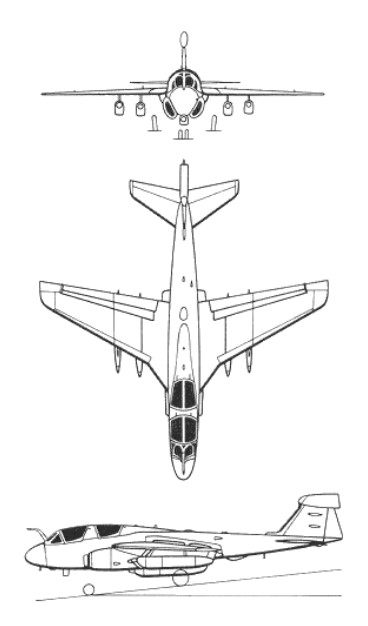
The slightly swept tail surfaces have a variable incidence tailplane. Lateral control is by inset spoilers forward of the trailing edge flaps which extend over almost the full wing span. Full span leading edge flaps are fitted. The outer wings fold upward and inward for ship-board stowage. Sideways opening air-brakes are on each side of the rear fuselage. The tricycle undercarriage has twin nose-wheels and a single wheel on each main unit. The nosewheel retracts rearward and main units forward.
The first prototype flew in November 1960.
A2F-1 Intruder
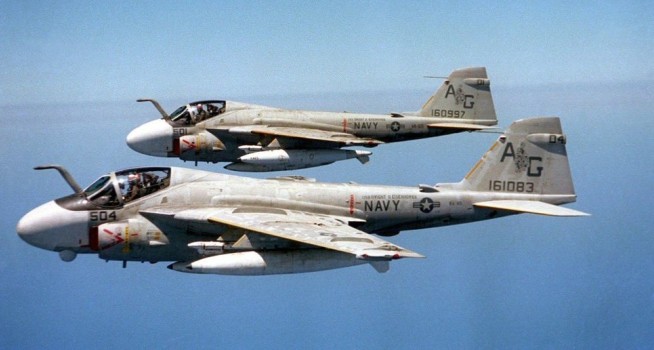
The first US Navy attack squadron to receive the Grumman A 6A Intruder, VA 42, re-equipped with the type at Oceana NAS, Virginia, in 1963.
In August 1964 it was reported that South Africa, rebuffed by the US State Department in bid to buy Grumman Intruders because of its race policies, was buying British Buccaneers instead.
From the A 6A was evolved the initial EA 6A ECM version for the Navy, its potential such that an advanced ECM version was developed in late 1966.
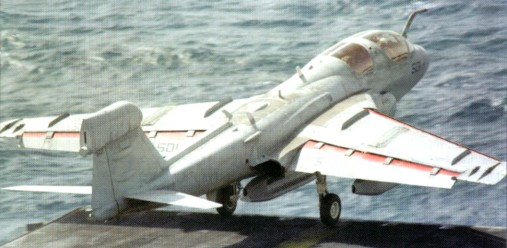
A development contract was issued in autumn 1966 and the EA-6B Prowler is externally similar to basic A-6 except longer nose enclosing four-seat cockpit and large pod on fin. First flown on 25 May 1968, delivery of first 12 production aircraft started January 1971. The first flew with an ALQ-99 jamming system which has evolved from being able to cope only with individual emitters (EXCAP), through several emitters (ICAP), to groups of weapons systems such as an air defence complex (ICAP¬ 2). The last of 170 was delivered on 29 July 1991.
The Grumman EA 6B was the Navy’s first aircraft to be purpose designed and built for tactical electronic warfare, two of the crew being ECM officers to operate the airborne equipment which can detect, identify, locate, and jam the emissions of hostile radars. Eight Prowlers were deliv¬ered to the US Navy in 1986, and plans call for production of the current ICAP-2 (Improved Capability) EA-6B shipborne electronic warfare aircraft to continue until at least 1991. Earlier EA-6Bs are being upgraded to ICAP-2 standard, which includes power management, improved emitter identification and correlation, and better reliability and maintainability. The first ICAP-2 flew in June 1980. EA-6Bs can now carry Harm anti-radiation missiles.
The A-6E began to enter service in 1972.
On 22 March 1974 Grumman flew the first A-6E TRAM version of the Intruder, this incorporating a turreted electro-optical sensor package for the delivery of laser-guided weapons; the TRAM target recognition attack multi-sensor) added infra-red and laser equipment to the full A-6 avionics systems.
An advanced version of the Intruder subsonic all-weather carrier-borne strike aircraft, the A-6F, was scheduled to fly during 1987. Production deliveries will begin in 1989, against US Navy/USMC requirements for 150 aircraft. A-6F improvements include a new Norden high-resolution synthetic-aperture radar, stand-off ASM, and AIM-120 Amraam/ AIM-9 Sidewinder AAM capability. The A-6F will be powered by two 40.07kN General Electric unreheated F404 turbofans, will have a new wing designed by the Boeing Military Airplane Company, and will be fitted with a new CRT¬ based cockpit and digital avionics. Much of the avionics being carried in five external pods.
The new Boeing wing, which is to be retro-fitted to all existing A-6E/KA-6Ds from 1987, will offer an 8,000hr service life. A-6E target recognition and attack multisensor (Tram) production continues, and 12 were delivered in 1986. The modification of earlier A-6Es to accept Tram turrets also progresses. The tram turret houses both a Flir system and a laser tracker/designator. The KA-6D is a flight-refuelling tanker converted from the original A-6A Intruders or from older A-6Es.
On 3 April 1989 an A-6E made its first test flight fitted with Boeing-built composite wings.
The US Navy continued to fund the A-6F in 1988 although production was no longer planned. Two A-6Fs were flying, the third, intended as a test-bed for the digital avionics suite, entered testing in late August 1988.
A2F-1 Engines: 2 x Pratt Pratt & Whitney J52-P-6, 8500 lb Wingspan: 53 ft Length: 53 ft 5 in Height: 15 ft 1.75 in Empty weight: 24,000 lb MTOW: 54,000 lb Max speed: 720 mph at SL Max cruise: 685 mph at SL Hardpoints: 4 wing, 1 fuselage
A-6 Engines: 2 x Pratt & Whitney J-52-P-8A, 41.3kN Weight empty : 26008.0 lb / 11795.0 kg Max take-off weight: 27500 kg / 60627 lb Wingspan: 16.2 m / 53 ft 2 in Length: 16.3 m / 53 ft 6 in Height: 15.584 ft / 4.750 m Wing area: 49.2 sq.m / 529.58 sq ft Wing loading: 114.39 lb/sq.ft / 558.00 kg/sq.m Max. speed: 1000 km/h / 621 mph Cruise speed: 770 km/h / 478 mph Ceiling: 12700 m / 41650 ft Range w/max.fuel; 5000 km / 3107 miles Crew: 2 Armament : 6804kg ext. (5 pt.)
EA-6A Prowler
KA-6D Intruder
A-6E Intruder Engine: 2 x P&W J52 P 8A, 9,300lb turbojet. Installed thrust (dry): 83 kN. Span: 16.2 m. Length: 16.7 m. Wing area: 49.1 sq.m. Empty wt: 12,000 kg. MTOW: 26,580 kg. Warload: 8165 kg. Max speed: 1040 kph. Initial ROC: 2300 m / min. Ceiling: 12,950 m. Fuel internal: 9030 lt. Max range: 4399 km. Air refuel: Yes. Combat radius hi-lo-hi: 1415 km.
A-6F Intruder
EA-6B Prowler Engine: 2 x P&W J52-P-408 turbojet, 11,200 lb thrust. Installed thrust: 99.6 kN. Span: 16.2 m / 53 ft 2 in Length: 18.2 m Wing area: 49.1 sq.m / 528.51 sq ft Height: 5.0 m / 16 ft 5 in Empty wt: 15686 kg / 34582 lb MTOW: 26535-28655 kg / 58500 – 63174 lb Max speed: 965 km/h / 600 mph Cruise speed: 850 km/h / 528 mph Initial ROC: 2540 m / min. Ceiling: 11,600 m / 38050 ft T/O run: 815 m. Ldg run: 655 m. Fuel internal: 8870 lt. Range: 535 km. Endurance: 1 hr loiter. Range w/max.fuel: 4000 km / 2486 miles Crew: 4
A2F-1 Engines: 2 x Pratt & Whitney J52-P-6, 8500 lb
Deutscher Aero-Lloyd, the air transport company, built a high-wing training monoplane designed by Dr Ing K. Grulich in 1925. Designated S.1, it could have either 75 hp or 100 hp Siemens engine.




 All Aero