Harlan Dove

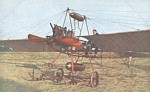
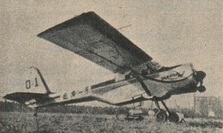
Harlan, who had rented a shed to Max Schüler, took over the semifinished student model in 1910. His chief architect Karl Grulich improved it, finished it – and Harlan came out with it. This Harlan-Eindecker became a successful aircraft. On 29 December 1910, Grulich thus flew his aircraft license number 46. By the end of the year 1911 several versions of this pattern were built and sold. At the end of 1913, the Harlan works had three aircraft sheds, but in the spring of 1914 Harlan was financially deadlocked. He sold his company.

At the beginning of 1914, the “Bussard-Flugzeug-Werke GmbH” emerged from the sale of the remains of the Harlan-Flugzeugwerke GmbH and had its small workshop and flying school in the shed.

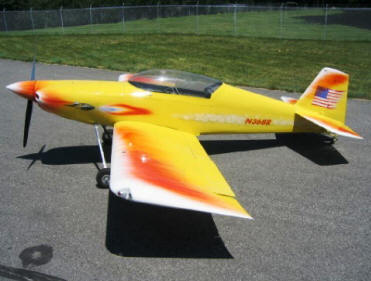
Harmon Rocket HR-2 Rocket II / Rocket III

The Rocket II is a modified Van’s two place RV-4.
The kit to build a Rocket II from John Harmon is an extension of RV-4 kit which is purchased from Van’s.
With the intended use of bigger engines the altered fuselage is wider and the length 18 inches longer.
The modified wing was tested by an independent engineering facility. A unique modification is titanium for the gear legs which provide a difference in feel when landing and also doesn’t shimmy during ground operations.
The HR2 is not a quickbuild kit as many builders of the Rocket prefer to be more involved in the aircraft building process and express a preference of some minor fitting and trimming. An economy cruise speed of 215 mph at 55 is average for a Rocket II with a LYC.10-540 -C4B5/250 hp. 2575 rpm. while there is one Rocket that has a 340+ horsepower and can cruise at 275 mph.

Harmon Rocket II
Engine: LYC. 10-540-C4B5/250 hp. 2575 rpm.
Propeller: Hartzel 80 in. dia.
Span: 21 ft. 10 in.
Length: 21 ft. 6 in.
Height: 5 ft. 7 in.
Wing Area: 109 sq. ft.
Wheel Track: 6 ft. 6 in.
Empty Weight: 1200 lbs.
Gross Weight: 2000 lbs.
Useful Load: 800 lbs
Power Loading: 5.9 lbs/hp.
Wing Loading: 16.4 lbs/sq. ft.
Fuel Capacity: 42 USgal.
Seats: 2
Cruise Speed 75%: 230 mph.
Econ. Cruise 55%: 215 mph.
Vne: 275 mph.
Rate of Climb (gross): 3100 fpm.
Stall: 55 mph.

Harmon Rocket III
Engine: LYC.10-540-400hp.
Propeller: Hartzel 78 in. 3 Blade
Span: 20 Ft.
Length: 21 Ft. 6 in.
Height: 5 Ft. 6 in.
Wing Area: 99 sq. ft.
Empty Weight: 1080 lbs
Gross Weight: 1800 lbs
Useful Load: 720 lbs.
Power Loading: 4.5 lbs/hp.
Wing Loading: 18 lbs/sq.ft.
Fuel Capacity: 47 USgal.
Seats: 1
Cruise Speed 75%: 260 mph
Econ. Cruise 55%: 230 mph
Vne: 310 mph
Rate of Climb (gross): 3600 fpm.
Stall: 58 mph.

Harmon Mr America

Harmon chose the long-established combination of a welded steel-tube fuselage and tail surfaces, with wood spar and rib wings. In addition, the wing may be easily removed for storage and towing. The entire aircraft can be built with hand tools except for the use of a welding rig. Mr. America’s powerplant is a nearly stock 1600-cc Volkswagen engine bored to 1650. The engine develops an honest 60 hp, to pro¬duce what is said to be rapid acceleration on takeoff to around 800 fpm at 90 mph during initial climb.

Gross Wt. 630 lb
Empty Wt. 430 lb
Fuel capacity 9 USG
Wingspan 19’8”
Length 15’2”
Engine 60 to 70-hp Volkswagen.
Top speed 125 mph
Cruise 110 mph.
Stall 48 mph.
Climb rate 800 ft
Ceiling 12,000 ft
Takeoff run 200 ft
Landing roll 300 ft
Range 400 miles

Harmon Der Donnerschlag

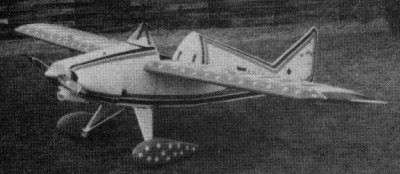
The translation of this open-cockpit sport plane’s name is “The Thunderclap” It was the airframe of this plane which was used as the foundation for “Mr. America.” Both share similar wings, fuselage, tail unit and landing gear. The wings are a wire-braced, shoulder type with two simple beam spars. As with the Mr. America, seating is for one, behind a modified Volkswagen engine turning a two-blade wooden prop.

Gross Wt. 600 lb
Empty Wt. 350 lb
Fuel capacity 10 USG
Wingspan 19’6”
Length 14’6”
Engine 73-hp Volkswagen
Top speed 120 mph
Cruise speed 110 mph.
Stall speed 55 mph
Climb rate 800 fpm
Ceiling 10,000 ft
Takeoff run 130 ft
Landing roll 250 ft
Range 500 mile

Harker Hawk

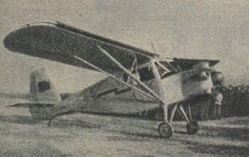
The Harker Hawk PFA 003-10004 is a single-engined aircraft registered G-BDNE. An original design by Don Hawker, the Harker Hawk was started in 1973. A two seat low wing monoplane with slightly swept-back wings, it had a tail wheel undercarriage. Powered by a Continental A65, construction of PFA.03010004 was underway during 1974.

Harbin Songhuajiang-1

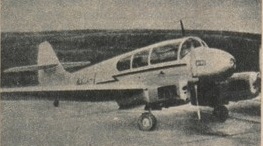
The Harbin Songhuajiang-1 (松花江一号) was a Chinese unlicensed copy of the Aero Ae 45S produced in 1959.

Built at the Weijian State-owned Machinery Factory, Harbin, it first flew on 29 September 1959.

Engines: 2 x Walter Minor 4-III, 104 hp
Propeller: two-blade
Wingspan: 40ft 4,25in
Length: 28ft 1,8in
Maximum Take-off Weight: 3527 lb
Crew: 1 + 5
Maximum Speed: 170.3 mph
Range: 500.2 mi

Harbin Y-12 / Hafei Aviation Industry Y12

In July 1982 it was reported that the Harbin Aircraft Works had developed a turbine-powered version of the Y-11, with PT6A-110 turboprops. A prototype was reputed to have flown. With a gross weight of 12,125 lb / 5500 kg, the maximum payload is 3748 lb / 1700 kg, and the Y-11T is estimated to have a max speed of 175 mph / 282 kph and a max range of 876 miles / 1410 km.

Developed from the earlier piston-engined Y-11, the twin-PT-6A-powered Y-12 has an enlarged cabin to accommodate up to 17 passengers. A first production batch of 18 aircraft was scheduled for completion by the end of 1986.

Harbin Y-12 Article

The Y-12 prototype first flew in 1982, and there have been three series production versions

Y12 (I)
Initial version with 500 shp PT6A-11 engines, 93” diameter propellers,
leading edge slats, seating for 17 passengers and a MTOW of 5000 kg.

Y12 (II)
Later production version with higher-rated 600 shp PT6A-27 engines, plain leading edge, 98” diameter propellers and MTOW increased to 5300 kg. The UK CAA issued Type Certificate FA49 for this variant in 1990 and examples are in operation in Malaysia and Fiji.

Y12 (IV)
Improved model with sweptback wingtips, redesigned seating for 18-19 passengers and max. weight increased to 5700 kg. The Canadian Aerospace Corporation markets a version of the aircraft under the Twin Panda name as a DHC-6 replacement.

The Sri Lankan Air Force ordered six Y-12 turboprop utility transports from China in 1986, and at least two have been delivered to the Chinese Air Force for aerial survey work.

The Y12 was originally produced by Harbin Aircraft Manufacturing Corporation (HAMC), and under Chinese commercial arrangements is marketed by the China Aviation Technology Import and Export Company (CATIC). HAMC has subsequently been reorganised in 1999 as Hafei Aviation Industry Co. Ltd (HAI), responsible for the Y12 and other sub-contract work.

Federal Aviation Administration Type Certificate: A00006WI applies to the Hafei Aviation Industry Company Limited Y12 IV.

Harbin Y 12 II Turbo Panda
Engines: 2 x PT 6 A 27, 500 shp
Length: 48.885 ft / 14.9 m
Height: 18.373 ft / 5.6 m
Wingspan: 56.43 ft / 17.2 m
Wing area: 369.205 sq.ft / 34.3 sq.m
Max take off weight: 11686.5 lb / 5300.0 kg
Weight empty: 6262.2 lb / 2840.0 kg
Max weight carried: 5424.3 lb / 2460.0 kg
Max speed: 158 kt / 292 km/h
Cruising speed: 135 kt / 250 km/h
Initial climb rate: 1653.54 ft/min / 8.4 m/s
Service ceiling: 22966 ft / 7000 m
Wing loading: 31.78 lb/sq.ft / 155.0 kg/sq.m
Range: 724 nm / 1340 km
Crew: 2
Payload: 17pax

Y-12-II
Engine: 2 x P&WAC PT6A.
Installed pwr: 925 kW.
Span: 17.2 m.
Length: 14.9 m.
Wing area: 34.3 sq.m.
Empty wt: 2840 kg.
MTOW: 5000 kg.
Payload: 1700 kg.
Cruise speed: 330 kph.
Initial ROC: 528 m / min.
Ceiling: 7000 m.
T/O run: 180 m.
Ldg run: 208 m.
Fuel internal: 1600 lt.
Range/payload: 1440 km with 800 kg.
Capacity: 17 pax.

Y12 IV
Engines: 2x Pratt & Whitney Canada PT6A-27
Propellers: 2x Hartzell HC-B3TN-3B/T10173(N)B-3
MCTOW 12,500 lb (5670 kg)